The Annual Load

It's becoming a once-a-year tradition to borrow Dad's truck and make a trip to Sienna Ranch for aged horse manure. They have more than they know what to do with; therefore, the property manager is more than willing to fire up the front loader and fill up the truck with this ultimate soil amendment. The hardest part of the trip is shoveling the manure out of the truck and on to our driveway. After that, it's just a matter of adding a wheelbarrow at a time to the garden, and hardly a month goes by around here that we're not adding a wheelbarrow of something to the garden, so that's no big deal. Anyway, it's beautiful stuff, if you like that sort of thing. Clearly I do. And the garden does, for sure. Every time I amend with manure, everything sort of gets a new surge of growth.


It's important to pile the manure right next to your front gate, because really, nothing says 'welcome' like a large pile of horseshit.

We took a trip up to Petaluma yesterday; we obtain all our grass-fed and pastured meats from Tara Firma Farms, and as members we were able to join them for some roasted pork on Father's Day. We enjoyed walking through the hills and fishing in their pond on a beautiful sunny day. We made some side trips to the Marin Cheese Company (stinky French cheeses for Dad, check) and Cottage Gardens (plants for Mom, check) as well as an extreme side trip to Oakland to Pollinate Farm and Garden (canning rack for me and Tom, check). 


Ok, out to the garden for me - that pile o' poo won't move itself.

Preserving Green Chilies

This morning I went out to the garden and there were several ripe green chilies ready for picking. We don't have any tomatoes yet, so I can't make salsa; I'll start researching other recipes for using green chilies. Meanwhile I started looking for ways to preserve them in the freezer, in case someone wants a scoop on a cheeseburger or taco.

I turned, as I often do, to The Kitchn for guidance, followed their instructions, and now have a jar of jalepeno peppers and a jar of ancho poblano peppers in the freezer, ready for use.

A big ancho poblano and several jalepenos ready for roasting

put your broiler on high, broil one side for 3-5 minutes

Then broil the other side 3-5 minutes

cover with plastic wrap and let steam/cool for 20 minutes

Peel, remove seeds and ribs, and chop - then into jars or bags for freezing!
I love that I now know this technique; any time I want a pepper for a recipe, I can scoop out a tablespoon. I've researched how to can sweet peppers, but this is a great way to preserve hot or mild green chilies for later use.

I am a little surprised that we have chilies already, but June has been hot!

By the way, as I was researching this topic, I came across a lot of articles about using epsom salts when growing peppers (and tomatoes, incidentally). I had never heard of it, but I read enough raves that I immediately went and bought some and added a tablespoon to the dirt around each pepper and tomato. I also plan to dissolve some in water and use as a foliar spray, especially on the droopy paste tomatoes.

Had a nice walk with Joe in Joaquin Miller Park as Adam had his drum lessons nearby. Came across some interesting things to share.

clubhair mariposa lily, very rare here

a random teepee - about 25 feet high

I've never seen this before

the actual monument

I passed this man twice. He was deep in prayer and never opened his eyes.
I found this profoundly moving. 

a cathedral of bay laurel trees
Happy Saturday!

Daylight Owl Sighting!


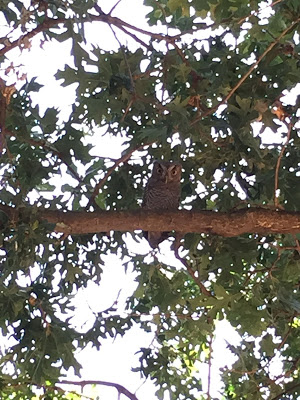
I saw this little guy high up in an oak tree, above a playground in a city park. It's hot today, about 95 degrees, and still. No one was in the park. I was walking the dog, and heard some little birds twittering like mad in the tree above me. I stopped and watched them for a while, never identifying them - too high up, and too small, but some sort of bird I don't usually hear. Then I saw a great, big, terrifying eye and that really caught my attention! He was only about a foot high, imagine how intimidating he'll be when grown!

Best I can figure, this is a juvenile Great Horned Owl. They're common in this area, they often hunt in  large public parks, and the young ones don't get their tufted ears till later (thanks, Barbara!). The fact that he was out in the daytime is worrisome in that they usually don't hunt in the middle of the day unless food is scarce. I can only assume this bird is out hunting in daylight because the drought has made food harder to find.

I looked at him for a long time, and he just stared down at me, not moving a muscle. What a magnificent creature. Did you know Great Horned Owls are monogamous? And, at the moment, not endangered. I'm thrilled I got to see this bird today.


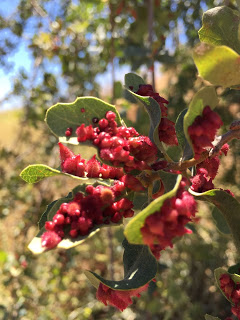
Galls on California Oaks

I was taking a walk with Joe the dog today in Lime Ridge Open Space, in a specific area where dogs are allowed (most of Lime Ridge is off limits to dogs), when I came across a young oak tree whose every leaf was completely covered in galls.


It was amazing to me that the tree could support this amount of gall growth, and still be healthy and vibrant, and it made me realize that I haven't written much about galls. We have a valley oak (Quercus lobata) next to our driveway, and it has a lot of galls, and only one person on the Urban Farm Tour asked me about it, which is a shame, because I love to tell people about galls. Especially kids, who think they are really cool.

Galls are home to cynipids, or gall wasps, a microscopic non-stinging wasp that can be quite beneficial. (Gall wasps were the particular branch of study of one Alfred Kinsey, before he became a famous sex researcher.) There are a few other insects who make galls, but the vast majority we see in California are made by cynipids. The wasp burrows in to the tree or leaf, or lays an egg; the tree responds by growing these galls, which in turn become a sort of nursery for the baby wasps.

Galls can be quite beautiful, as evidenced by the photo above and by professional photographers, but most are rather mundane, like these:


Some look like mini Hershey kisses!

The area we were walking in today was quite dry and barren, and mostly boring to look at, which is why my eye was immediately drawn to the red leaves on the young oak tree. However, the fennel was blooming, which provided the honeybees some forage, and me some nice anise-scented breaths.


Hiking this time of year really brings home one of the reasons why California is called the Golden State; the hills are truly golden and from far away are quite pretty; but up close all you see is DRY.

Variations of Blue

We've gotten used to getting about three eggs a day; two light brown ones from the Barred Rocks, and one dark brown one from one of the Rhode Island Reds. There's usually one in early morning, one in the afternoon, and one in the evening! (I just check every time I walk by.) So far they've all been laid in the same nesting box.

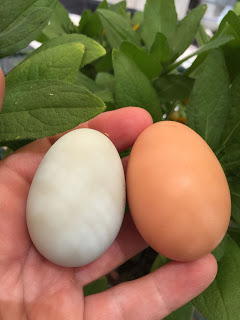
But just now when I went out to collect, there was a dark brown one in the usual nesting box, and a blue one in the other nesting box! So one of our Easter Eggers has started laying!


I realize that in this picture the egg looks sort of a dirty white. But trust me, it's a bluish greenish. Entirely different from the other eggs we've been getting. This is exciting!

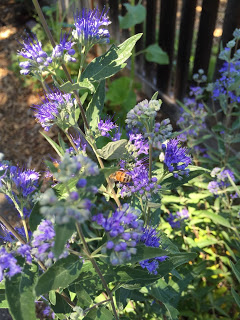
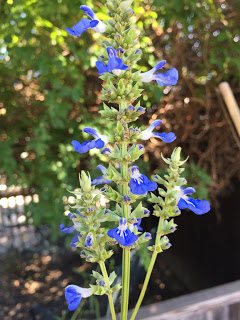
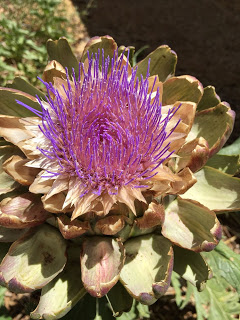
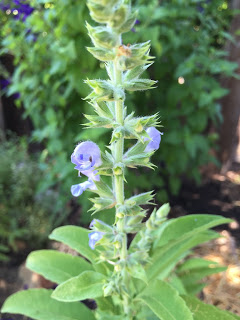
There are lots of bluish flowers in the garden, complimenting the newest egg.

spirea

'Jean's Purple Passion' salvia

some sort of salvia I can't remember the name of

artichoke

salvia ulignosa Bog Sage
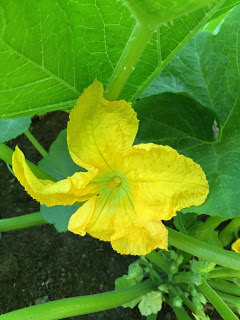
There's plenty of other interesting, non-blue things to share with you, as well. The delicata squash is blooming and forming fruit.


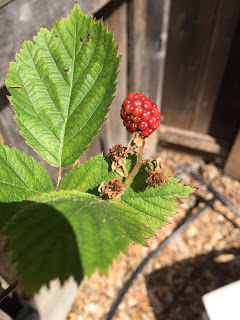
Blackberries are starting to ripen!


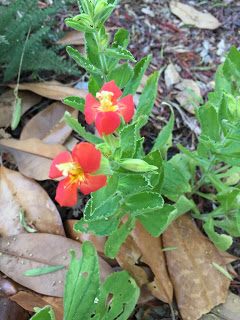
One of the plants in the woodland garden out front has bloomed, and I can't remember what it is. Some sort of unusual variety of monkey flower?


It's fun to see what happens each day - it seems like there's always something new to examine.

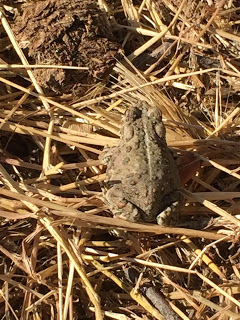
There's always something to see on my hikes, too. I went out in the hills and collected more steer manure to add to the compost. While I was shoveling, I came across this little guy, and we were nowhere near water.

Smaller than my thumb!
I wonder how he survives the heat?

Speaking of compost, I made a decision about the straw situation. I've been using straw in the hen house and changing it once a week. As the chickens get older, the poo is becoming quite prolific. That means I change the straw more often, and the straw in my compost bins is not breaking down very quickly, so I started to realize that we were going to run out of room in the compost bins. I decided to change the hen house over from straw to sand. I've done that, and it's quite easy to maintain - it's play sand (which you can get for about $5 a bag at any hardware store), and I just go in every morning with a kitty litter scoop and scoop the poop into a bucket, which I then dump into the compost. Most of the poop is located right underneath the branch where the chickens roost. So far it's working great. I still use straw in the nesting boxes (because, comfort!) and I still use the deep litter system in the run, which is working great.

I wonder what I'll find tomorrow in the garden to show you?

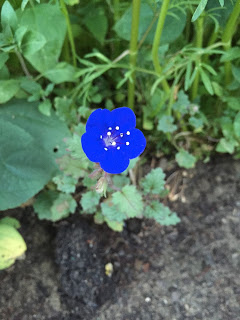
Update at 8:30 pm! Just found a native California Bluebell blooming in the new pollinator garden, to add to our collection of blue.