Not much got done here in the garden this past weekend, for two reasons. One, it was raining! Glorious buckets of rain, much needed after a completely dry January. And two, my daughter and I were away at a theater competition in Fullerton (that's in Orange County, down in Southern CA). When I got home late Monday night, the skies had cleared and the seed packets had arrived!
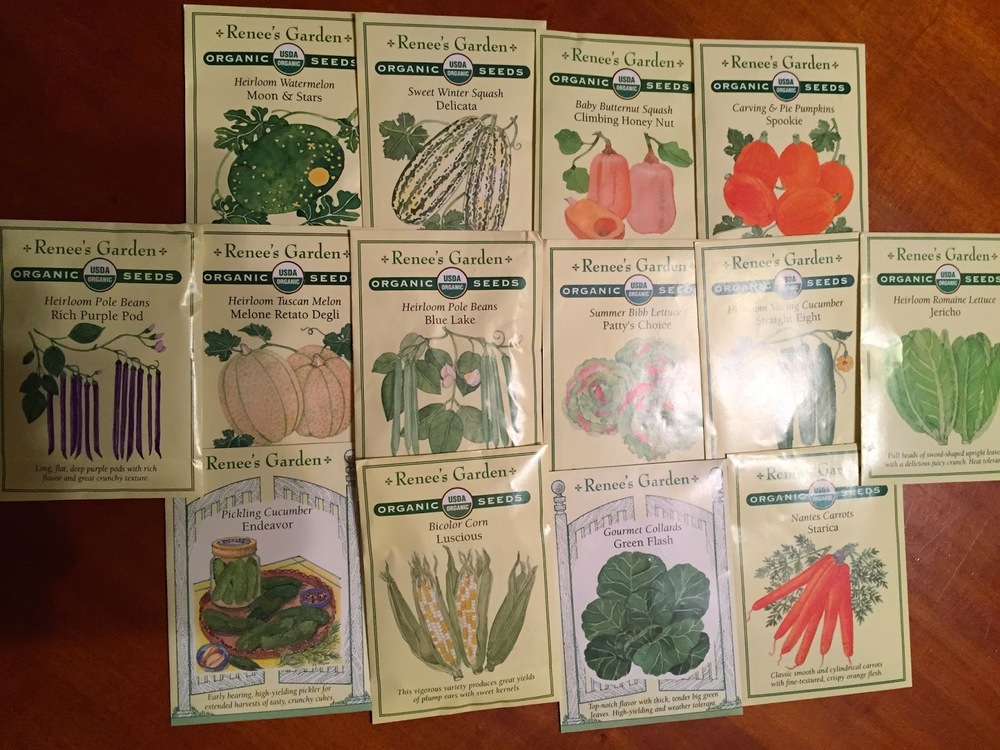
I ordered all my vegetable seeds from Renee's, as usual. Her seeds always do well in my garden, and when I've ordered from other companies, the results are just not as successful. I believe that's because her small company is located quite near where I live, and she grows all these varieties in her test garden. The seeds that she collects from the plants on her property also do well in my climate. That's my theory, anyway.
I also got some flower seeds from the same company. These are all varieties that did well in my garden last year, plus the bees really liked them - and I did too!

I also ordered some more native wildflower seeds from Larner's as I do every year. Judith has a wonderful demonstration garden and her seeds are terrific. When we visited, we saw how they collect and separate them. I do some of that here with my own flowers, but it never hurts to have more.

I'm planning a trip to a new-to-me nursery in San Francisco, Bay Natives. I would like to purchase some larger bushes of manzanita as well as some other native plants in larger form. I see they also have artichokes, so that will fulfill Kate's wish to have an artichoke garden.
I ordered six raspberry canes, six more blueberry bushes, and 100 bare root strawberry plants from Stark Brothers, a business I learned about on Growing a Greener World. It's not a local nursery, but I've never ordered bare root plants before, and I haven't been thrilled with the blueberry bushes and strawberry plants I've gotten from local nurseries. I expect that order to be delivered some time this week.
And of course, I'll get tomatoes and peppers from the Contra Costa Master Gardeners, as I did last year. Here's the info on their sale:
3 Great Tomato Plant Sales In April!
Mark your calendars!
 Next week, our Master Gardeners will startthousands of tomato, pepper, eggplant and tomatillo seeds in anticipation of our 4th Annual Great Tomato Plant Sale. It's sure to be amazing once again!
More details on the varieties available next month.
I really missed working in the garden this weekend. And I was about as far away from nature as you can get, being on a college campus for two days, and then in Disneyland the other two. Although Disney did have quite a few flowers in bloom, and we saw many butterflies and bees working the blossoms. Still, it was more of a 'people' weekend then a 'garden' weekend. Kate's group did very well in the competition, and it was a very interesting time for me, as the children were taught by professionals both at the college and behind the scenes at Disney. Theater was my life for many years, and I would have loved something like this when I was in high school. For Kate, it wasn't so fun. Lots of crowds, much asked of her, intense competition, and so on. Disneyland is overstimulating for the most grounded person, let alone an autistic one! We managed to have a good time for the most part, despite all the challenges.
We got very little sleep, and work was tough today. When I got home, I found a little present on my porch from a neighbor, which brightened my day considerably!

Sweet little eggs from her newly-laying hens! Aren't they beautiful? Soon, we'll have something like this every day at Poppy Corners: We intend to finish the coop this long President's Day weekend.
I ordered all my vegetable seeds from Renee's, as usual. Her seeds always do well in my garden, and when I've ordered from other companies, the results are just not as successful. I believe that's because her small company is located quite near where I live, and she grows all these varieties in her test garden. The seeds that she collects from the plants on her property also do well in my climate. That's my theory, anyway.
I also got some flower seeds from the same company. These are all varieties that did well in my garden last year, plus the bees really liked them - and I did too!
I also ordered some more native wildflower seeds from Larner's as I do every year. Judith has a wonderful demonstration garden and her seeds are terrific. When we visited, we saw how they collect and separate them. I do some of that here with my own flowers, but it never hurts to have more.
I'm planning a trip to a new-to-me nursery in San Francisco, Bay Natives. I would like to purchase some larger bushes of manzanita as well as some other native plants in larger form. I see they also have artichokes, so that will fulfill Kate's wish to have an artichoke garden.
I ordered six raspberry canes, six more blueberry bushes, and 100 bare root strawberry plants from Stark Brothers, a business I learned about on Growing a Greener World. It's not a local nursery, but I've never ordered bare root plants before, and I haven't been thrilled with the blueberry bushes and strawberry plants I've gotten from local nurseries. I expect that order to be delivered some time this week.
And of course, I'll get tomatoes and peppers from the Contra Costa Master Gardeners, as I did last year. Here's the info on their sale:
3 Great Tomato Plant Sales In April!
Mark your calendars!
Next week, our Master Gardeners will startthousands of tomato, pepper, eggplant and tomatillo seeds in anticipation of our 4th Annual Great Tomato Plant Sale. It's sure to be amazing once again!More details on the varieties available next month.
Don't miss out -- mark your calendar for these dates!
Our Garden - Walnut Creek
Saturday, April 4, 10 A.M. - 3 P.M. and
Saturday, April 11, 10 A.M - 2 P.M
West County Sale - Adams Crest Farm, Richmond
Saturday, April 11, 10 A.M. - tbd
I really missed working in the garden this weekend. And I was about as far away from nature as you can get, being on a college campus for two days, and then in Disneyland the other two. Although Disney did have quite a few flowers in bloom, and we saw many butterflies and bees working the blossoms. Still, it was more of a 'people' weekend then a 'garden' weekend. Kate's group did very well in the competition, and it was a very interesting time for me, as the children were taught by professionals both at the college and behind the scenes at Disney. Theater was my life for many years, and I would have loved something like this when I was in high school. For Kate, it wasn't so fun. Lots of crowds, much asked of her, intense competition, and so on. Disneyland is overstimulating for the most grounded person, let alone an autistic one! We managed to have a good time for the most part, despite all the challenges.
We got very little sleep, and work was tough today. When I got home, I found a little present on my porch from a neighbor, which brightened my day considerably!
Sweet little eggs from her newly-laying hens! Aren't they beautiful? Soon, we'll have something like this every day at Poppy Corners: We intend to finish the coop this long President's Day weekend.