Tom and I spent most of the weekend framing the chicken run. This is the outside structure that will house the flock, the coop, the food and water.
As you may remember, we bought our plans from The Garden Coop, and last weekend we dug the trench, since we thought that would be the most tedious part. Dad obtained our redwood from the mill (what a gift, thanks Dad!) and Tom bought some supplies at the hardware store that he'd never really needed before, like sawhorses. Cutting the wood to size was no big deal, that took Tom one morning of math and measuring.

While he was doing the hardware runs and cutting, I was doing a big garden clean up around the rest of the yard. I figure we're done with frost for this winter, at least the heavy stuff, and so I cut out a bunch of dead branches and pulled up old dead flowers. Then I felt free to spread native annual wildflower seeds, so I did that. The vegetable garden is going gangbusters; I just have to remember to water regularly since we've had absolutely no rain in January.
Then we were both done with our respective jobs and it was time to frame. We got a little stuck on the 'nail' issue. Should we use a nail gun, or hammer by hand? I went to Ace Hardware and talked with an awesome old guy named Tony who really knew his stuff. He showed me the correct kind of hammer for framing, a much larger and heavier hammer with a bumpy head. Both Tom and I were worried about driving a nail perfectly, as funny as that sounds. Tony also told me it would take twice as long with a hammer.
Then we talked nail guns. I didn't know that most nail guns are powered by an air compressor. You can get battery-powered ones too, but it sounded like Tony thought the air guns were better. To buy something like that would run about $300. So he suggested renting, which we had thought of, but our local Cresco wasn't open on weekends. Tony suggested Home Depot. The closest HD that rents equipment is in Oakland, nearly to Alameda, so I called and talked to them first and they had what we needed.
But meanwhile I started thinking about everyone we knew that built something or was handy. My dad, woodworker extraordinaire, would never dream of using a nail gun. He'd probably dovetail the coop together. :) My friend Bob built his coop with a hammer, because he's excellent, so no gun there. We have a neighbor who built an extension on to his house, but he borrowed a gun from yet another neighbor that we don't know, and I didn't think I should just show up at his door, introduce myself, and ask to borrow expensive equipment. Then I called a neighbor who built a coop last year and yahoo! he had a nail gun and compressor we could borrow. Plus, we got to take a good look at his coop and chicken system. I gave him a jar of honey to thank him for the equipment loan, and we started setting stuff up.
But there was a wrinkle: Matt's nail gun is a 'finish' nail gun, which means we can use it for the siding on the coop, but not for the framing. So we ended up renting a framing nail gun from Home Depot after all, which cost $29 for the day without the compressor. Not bad. Throw in a box of framing nails, and it was a cheap day at the hardware store. Just two long trips to the far side of Oakland.
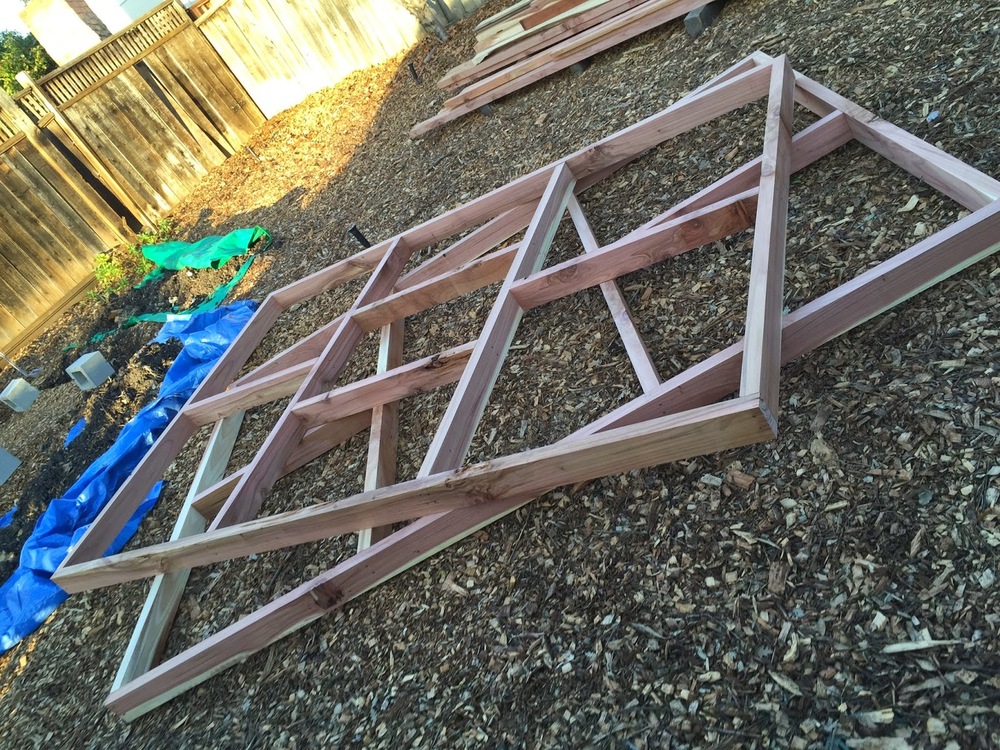
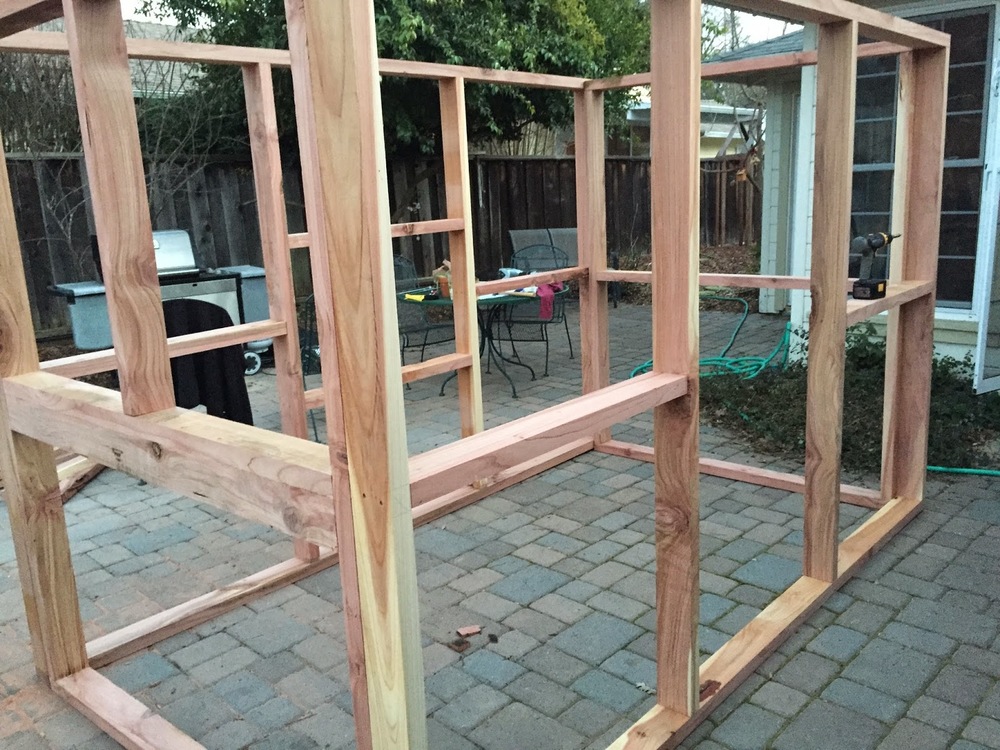
The frames were not hard, but we still made plenty of mistakes. There was a distinct learning curve. Here's a question for you: How on earth do you remove a nail that has been placed with a nail gun? Let's just say our hack saw got a lot of use during this stage of construction. But an afternoon later, we had our four wall frames, and then we set them all up and bolted them together with deck screws.

Next, we needed to dig holes for the cinder block 'piers,' on which the frame rests. This required leveling, then filling, then leveling, then digging some more, all of which was fun, believe it or not. It took three days for Tom and I to get into a good working rhythm, and by today, we were finally enjoying ourselves. It always takes us a while to give up our own power struggles. We both very much like to be right, and unfortunately we can't BOTH be right all the time.

Once the piers were in and leveled, we could move the framed structure over, which we did with the help of two teenage boys. I thought this would be the easiest part of the weekend, but in fact it was quite difficult. This structure is heavy, and at the moment, we have an obstacle course of sprinkler heads, dirt piles, and tarps to maneuver around.

Tom and I are so proud of ourselves. We've never done anything like this, and are not likely to again, but it's a skill that we both wish we could practice more now. Well, we have plenty more to do, the roof will go on next weekend, hopefully with the help of my dad, as there is some precise sawing that needs to be done.
I've been recommended a place to purchase the chickens. The farm is called Dare 2 Dream Farms, and they sell chicks, coop-ready older chicks, and pullets. They have many breeds. I've written to them asking about birds that would be good for both our summer heat and winter frosts, who are friendly and good layers. I like Buff Orpingtons, Wyandottes, Rhode Island Reds, Barred Rocks, and maybe Australorps or Easter Eggers. I'm hoping the farm will suggest what would be best for me. I think we'll get six coop-ready birds, and hopefully they'll be laying by summer.
As you may remember, we bought our plans from The Garden Coop, and last weekend we dug the trench, since we thought that would be the most tedious part. Dad obtained our redwood from the mill (what a gift, thanks Dad!) and Tom bought some supplies at the hardware store that he'd never really needed before, like sawhorses. Cutting the wood to size was no big deal, that took Tom one morning of math and measuring.
While he was doing the hardware runs and cutting, I was doing a big garden clean up around the rest of the yard. I figure we're done with frost for this winter, at least the heavy stuff, and so I cut out a bunch of dead branches and pulled up old dead flowers. Then I felt free to spread native annual wildflower seeds, so I did that. The vegetable garden is going gangbusters; I just have to remember to water regularly since we've had absolutely no rain in January.
Then we were both done with our respective jobs and it was time to frame. We got a little stuck on the 'nail' issue. Should we use a nail gun, or hammer by hand? I went to Ace Hardware and talked with an awesome old guy named Tony who really knew his stuff. He showed me the correct kind of hammer for framing, a much larger and heavier hammer with a bumpy head. Both Tom and I were worried about driving a nail perfectly, as funny as that sounds. Tony also told me it would take twice as long with a hammer.
Then we talked nail guns. I didn't know that most nail guns are powered by an air compressor. You can get battery-powered ones too, but it sounded like Tony thought the air guns were better. To buy something like that would run about $300. So he suggested renting, which we had thought of, but our local Cresco wasn't open on weekends. Tony suggested Home Depot. The closest HD that rents equipment is in Oakland, nearly to Alameda, so I called and talked to them first and they had what we needed.
But meanwhile I started thinking about everyone we knew that built something or was handy. My dad, woodworker extraordinaire, would never dream of using a nail gun. He'd probably dovetail the coop together. :) My friend Bob built his coop with a hammer, because he's excellent, so no gun there. We have a neighbor who built an extension on to his house, but he borrowed a gun from yet another neighbor that we don't know, and I didn't think I should just show up at his door, introduce myself, and ask to borrow expensive equipment. Then I called a neighbor who built a coop last year and yahoo! he had a nail gun and compressor we could borrow. Plus, we got to take a good look at his coop and chicken system. I gave him a jar of honey to thank him for the equipment loan, and we started setting stuff up.
But there was a wrinkle: Matt's nail gun is a 'finish' nail gun, which means we can use it for the siding on the coop, but not for the framing. So we ended up renting a framing nail gun from Home Depot after all, which cost $29 for the day without the compressor. Not bad. Throw in a box of framing nails, and it was a cheap day at the hardware store. Just two long trips to the far side of Oakland.
 |
| This thing scared us, at first. |
Next, we needed to dig holes for the cinder block 'piers,' on which the frame rests. This required leveling, then filling, then leveling, then digging some more, all of which was fun, believe it or not. It took three days for Tom and I to get into a good working rhythm, and by today, we were finally enjoying ourselves. It always takes us a while to give up our own power struggles. We both very much like to be right, and unfortunately we can't BOTH be right all the time.
Once the piers were in and leveled, we could move the framed structure over, which we did with the help of two teenage boys. I thought this would be the easiest part of the weekend, but in fact it was quite difficult. This structure is heavy, and at the moment, we have an obstacle course of sprinkler heads, dirt piles, and tarps to maneuver around.
Tom and I are so proud of ourselves. We've never done anything like this, and are not likely to again, but it's a skill that we both wish we could practice more now. Well, we have plenty more to do, the roof will go on next weekend, hopefully with the help of my dad, as there is some precise sawing that needs to be done.
I've been recommended a place to purchase the chickens. The farm is called Dare 2 Dream Farms, and they sell chicks, coop-ready older chicks, and pullets. They have many breeds. I've written to them asking about birds that would be good for both our summer heat and winter frosts, who are friendly and good layers. I like Buff Orpingtons, Wyandottes, Rhode Island Reds, Barred Rocks, and maybe Australorps or Easter Eggers. I'm hoping the farm will suggest what would be best for me. I think we'll get six coop-ready birds, and hopefully they'll be laying by summer.