• About
  • Blog
  • Contact
  • Favorites
  • Archive
Menu

Poppy Corners Farm

Street Address
Walnut Creek, California
Phone Number
Walnut Creek, California

Your Custom Text Here

Poppy Corners Farm

  • About
  • Blog
  • Contact
  • Favorites
  • Archive

Community Seed Library

September 8, 2018 Elizabeth Boegel
IMG_0442.jpg

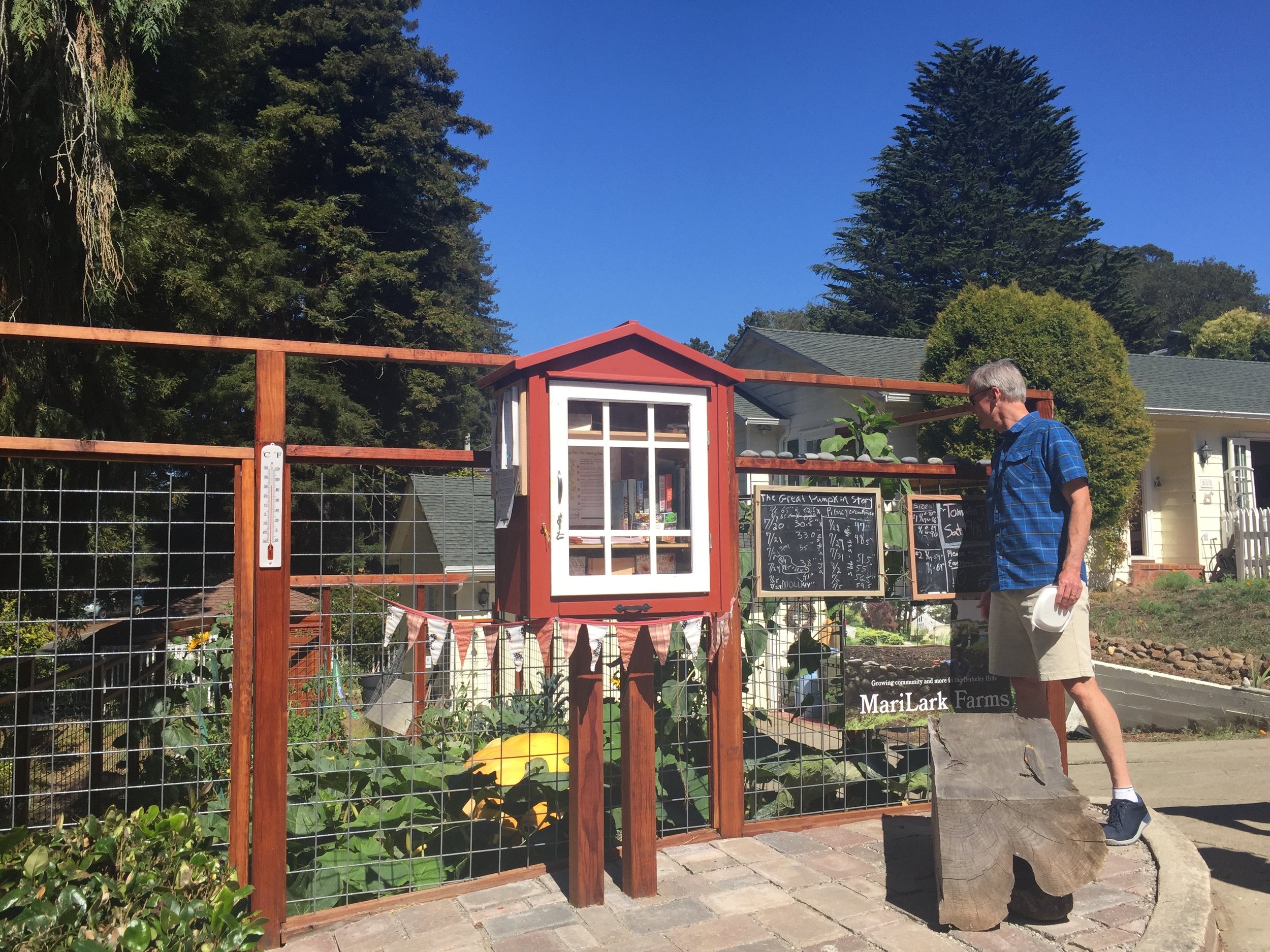
The other day I picked up a copy of Edible East Bay magazine. There were lots of great articles, as usual, but one really stood out to me - a story about a man in Berkeley who had recently opened a Community Seed Library in front of his house. His drive to make this project a reality, and the possibilities about making this a true seed-sharing movement, really struck me. So I emailed the owner, Charlie, to see if I could come and visit his seed library and have a conversation about it.

IMG_0443.jpg

Charlie responded with enthusiasm and invited me to come to his yearly tomato tasting. Charlie lives in an historic property (which is named MariLark) on the edge of Tilden Regional Park; what a location! My friend Nils, also a suburban farmer and beekeeper, came along with me. I brought four of my tomatoes to add to the tasting, and Nils and I enjoyed trying all the fruits on display. Lots of them had been grown by Charlie, but many had been grown by friends, family, and neighbors, and it was fun to see all the different varieties represented. There were no doubles - somehow everyone had brought different kinds!

IMG_0439.jpg

It was a beautiful sunny day, but Charlie has growing challenges with the often-present cloud cover due to our local celebrity, Karl the Fog.  He still manages to have a really wonderful garden, filled with greens, tomatoes, flowers, and herbs, over a large terraced property. He also is growing an enormous pumpkin!

IMG_0445.jpg

I enjoyed chatting with Charlie about the design of the seed library and his mission to grow the movement and have a seed library in every neighborhood. I've wanted to have a seed library for quite some time now, but I have logistical concerns, especially in the very hot summers and direct sun experienced in my garden. Optimally, seeds are stored in dry, chilly temperatures. Our chilly weather is often wet, and our dry weather is often bloody hot. So I'm not sure how viable the seeds would be after six months in the sun, or four months of rainfall. Charlie and I discussed how to get around that issue - maybe make mine seasonal, or do some sort of finagling to make full-time shade in a certain spot in my garden. Ideally I'd like it to be right next to our Little Free Library, but that might not be the best place for it. Charlie would like to have a 'sister seed library' and is hoping I am game to provide it. It's going to take some thinking, first.

There's a lot to like about the library in Charlie's yard. My favorite thing is the pull-out writing table, so you have a place to sort and label your seeds. Charlie provides the envelopes and pens. He has gardening books inside, too. Other folks have left notes such as "free native plants to a good home" and an email address. The seeds themselves are on the bottom shelf, placed in boxes, far back in the shade, in an insulated area. We discussed how to make some sort of shade cover for them in there - special film? A removable cardboard cover? Nils suggested that we put these library boxes on pivots, so that you can pivot it toward the shade, with instructions how to pivot it around to get inside. All good ideas. Hey, you engineers out there, weigh in on this please.

IMG_0447.jpg

After all this, I realized I had forgotten to bring seeds to share, so I'll have to go back. This is a really neat idea, and I want to visit often. 

Do you have a seed library that you visit? If so, please tell us all about it in the comments.

Tags learning, seed saving, seeds, tomatoes
Comment

September wreath

September 6, 2018 Elizabeth Boegel
IMG_0425.jpg

This month, I decided to use some branches of my Teucrium fruticans bush, a beautiful California native (also called Germander) that has leaves that are silvery grey on top and silvery white underneath. The flowers are tiny but are a lovely purple and attract native bees every spring. Those branches form the base layer of leaves, and then I layered some seed pods from Monarda fistulosa  (Bee Balm or Wild Bergamont) over the top.

This Wild Bergamont is beautiful in bloom. It lasts a couple of months, then the seed pods take over and are lovely in their own right. 

IMG_1136.jpg

Last weekend, I sowed a bunch of crops in flats for planting October first. I realized that there were some things I was missing - like cabbage. So I ordered some interesting varieties from Seeds from Italy, and I'm hoping to have some different things to show you come Fall. 

Tags seasonal wreath
Comment

Bluma Organic Flower Farm

September 4, 2018 Elizabeth Boegel
Cosmos

Cosmos

I'm only taking two classes this semester; one is yet another course in California native plants, and the other is a course in Nursery Management. (I had also signed up for a course on Plant Diseases, but it was cancelled because the person who teaches it retired, so they are searching for another disease expert.) My Nursery Mgmt professor requires us to get out in the community and research some sort of nursery operation, ideally volunteering some time there, and interviewing the owner or staff. Recently I read an article in our local paper about an organic flower farmer about 20 miles south in Sunol. I decided that was the perfect place to visit, so I contacted the owner, and spent about three hours there on Labor Day, weeding a row of flowering oregano and chatting with whoever came near. I also got to spend the lunch break with the team and ask more questions. It was a very interesting morning!

rows of Lisianthus and Zinnia

rows of Lisianthus and Zinnia

Joanna Letz is the owner of this two-acre, organic flower farm called Bluma. The farm is located in an area called the Sunol Ag Park, which is owned by the San Francisco Public Utilities Commission and managed by the Alameda County Resource Conservation District. There are six farms located within this land, which is in a sort of bowl-shaped valley surrounded by hills. Two creeks meet here, and it's easy to see the watershed influence on this land. The soil is very beautiful and Joanna adds 36 cubic yards of compost every year at the start of the growing season. That is the only additional fertility this land needs. 4th-6th grade students come here to learn about organic farms and local watersheds. There is a 59-foot high 'water temple' built on this land, which speaks to the history of water here. This temple was built in 1906 and originally collected water in a cistern which was then funneled to San Francisco though the Niles aqueduct. There are paintings on the roof of the temple. It's closed to the public now (though that might be temporary), but I visited there many years ago in my letterboxing days. 

You can see the water temple at the far left of this photo.

You can see the water temple at the far left of this photo.

My 50-foot row of oregano was surrounded by a vast variety of weeds, many taller than me. It took me 2-1/2 hours to weed my row, and by the end of it I was pretty pooped. And my hands hurt badly this morning, evidence of the repetitiveness of the activity of grasping and pulling. Farming seems increasingly to me to be a young-person's game. At least this kind of small-scale farming. Joanna works the field from early April to late October, and then rests it by planting a five-seed cover crop, including things like hairy vetch, to return nutrients to the soil. Sometimes she uses weed cloth, but mostly the weeding is done by hand. The weeding is not about elimination; rather, the focus is on knocking back a lot of the large growth so that the flowers can get the sun and space to dominate. So nearly every row of flowers is in some stage of weed overgrowth, and the weeding is just as frequent a task as harvesting. Meaning, basically, it's an everyday task. 

You can't even see the oregano through these weeds. 

You can't even see the oregano through these weeds. 

My row when I was finished. I was instructed to pile the weeds up in the path on either side of the row; they will break down and feed the soil. However I did pull a lot of weeds that had a LOT of seeds on them, so those will likely germinate at som…

My row when I was finished. I was instructed to pile the weeds up in the path on either side of the row; they will break down and feed the soil. However I did pull a lot of weeds that had a LOT of seeds on them, so those will likely germinate at some point and continue the cycle. So this practice is both good and not-so-good.

While I weeded, the rest of the staff was harvesting bunches of flowers for delivery. Joanna makes deliveries three days a week to local grocery stores and restaurants. She doesn't do the arranging, unless she is providing flowers for a wedding or other big event, which is a couple of times a month. She used to sell at Farmers' Markets, but doesn't any longer.

The flower bundles go in to a truck which follows the crew, and then into a cooler at the end of the field, that is shared by many farmers. 

IMG_0419.jpg

Joanna shares a greenhouse with another farmer in this area and that is her main propagation space. It was fun to walk by that other farmer's fields, too - and see how he does large-scale (well, larger than mine anyhow) tomato and pepper farming. I was pleased to see that he also has cut down superfluous growth on his tomatoes (all of which were small cherry and saladette types) and interested to note that he has done the same on his peppers. Guess I need to take a hint and do that too.

The crew and I sat in an outdoor learning classroom (just basically a few picnic tables covered by a tarp) to eat our lunches, brought from home. Three of the staff are part-time workers - one works once a week, one three days a week, another is on-call. Only one is full-time (other than Joanna) and she works six days a week. There could be others that I didn't meet, and in fact, there must be. They all work from 6:30 am to 5:00 pm, a very long day. This is out in hot sun without any shade, of course. All of them are young, in their 20's, and all of them care about food justice and good organic produce. When asked what they wanted people to know, they said "buy your food and flowers at the Farmers Markets." 

A newly-planted field

A newly-planted field

Large-scale flower farming is overwhelmingly conventional, using pesticides and herbicides at will. Many also use specific hormones to enhance the crop in some way. Organic flowers cost more, and should, as I learned just from my one scant weeding session. Joanna uses the tractor only to create rows at the beginning of each planting, so this land is also largely no-till. While the weeds are a hassle for the workers, they are good for the soil, keeping a living root growing at all times and feeding the microbial life that lives there. This type of farmer recognizes that keeping the soil healthy will keep the crops healthy, and the downside is the weeds. But it's worth it to see the amount of insect life on an organic farm. Joanna's fields were full of a huge diversity of pollinators, and I saw very little evidence of pests, and trust me, I would have seen them if they had been there. Goodness me, it was my own private little jungle. 

I looked up from my task to take this photo of Joanna, the owner, harvesting flowers. 

I looked up from my task to take this photo of Joanna, the owner, harvesting flowers. 

I learned an awful lot just by spending the morning with these young, energetic, committed farmers. I encourage you to do the same in your neighborhood, if only to recognize the hard work farmers do to make our lives beautiful and delicious. Especially in our desk-and-computer-oriented tech society. We have it so easy in so many ways! And yet, even though the work was hard yesterday (and I was super relieved to go home after lunch instead of finishing out the day), there were tremendous benefits: Being outdoors in the sunshine, smelling sweet oregano as I brushed past it to pull a weed; using my body the way it's meant to be used, stretching and reaching and squatting and crawling; having my knees in the good dark earth and smiling at the earthworms as they revealed themselves to me; hearing the distant chatter from the other workers but not having to engage unless I really felt like it; the satisfaction of being set a task and completing it before leaving for the day; and the sweet knowledge that I didn't have to organize anyone or figure out the next step or spend time at home figuring out the logistics of the thing. I did not hear one mobile phone ringing. Instead I listened to the hawks and crows and jays. I saw a kestrel fly over the fields. Someone came by to visit the farmers and discussed powdery mildew. It was all very present and NOW. And I imagine that this sort of work could be quite addictive. 

Hard to choose a favorite flower from this farm, but this one might be it, some variety of zinnia that I haven't grown, but definitely need to!

Tags learning, flower garden, organic
Comment

Crop Fail? Garlic and Shallots

August 31, 2018 Elizabeth Boegel
IMG_9427.jpg

I didn't share the whole story about my garlic and shallot harvest this year; maybe it was too depressing, or maybe because I didn't have answers, I thought it wasn't worth talking about. I know I wrote about the fact that the garlic harvest was meager; and I said that, while the shallot harvest was large, about half were strangely soft instead of firm, and I wasn't pleased with the quality. But I kept what I could and hung them up in the house as usual after curing them, hoping to get a little further in the year before having to buy shallots and garlic at the store. We use a LOT of these two vegetables, and it kills me to have to buy them. I really rely on our yearly crop.

IMG_9277.jpg

The garlic harvest was even worse than the shallots. Most of the bulbs had not grown properly - some were just one inflated clove - some were small and ill-formed. Only a few were of the proper size and shape. The leafy parts were limp and small. I couldn't figure out what I had done wrong. All I could do was blame it on the weather - we had mild weather with no rain until March, and then suddenly  a deluge of rain all at once. It was a very strange winter. In May, I seeded those beds - the ones that had held both garlic and shallots - to summer cucurbits; cucumbers (which have done excellently) and melons (which were extremely slow to get started, and are just now putting on fruit). Of course I amended both beds with compost before planting. 

Anyway, about a month or so after I hung up all the garlic and shallots in the house, I went to cut a bulb off of a shallot and was surprised by the fact that all the foliage on the tops was black. And I mean, so black. I looked more closely and found that the leafy parts of all the shallots were covered with black aphids. Not just a few - a solid mass of critters. I had seen these on the growing garlic and shallots, but thought that they moved on to greener pastures during the drying process on top of the chicken coop. Guess they were just hiding. I was completely skeeved out by the whole thing and threw out all the shallots. (Compost, not trash.) Then I went to inspect the garlic. You guessed it - also covered in black aphids. 

I was MAD. I've never had problems with my harvests before. Always big, beautiful bulbs of shallots and garlic. Enough to last us for most of the year. Enough to give away some. I have people that BEG me for a braid of garlic. (No one ever begs for pickles.) I had to resign myself that I had a crop failure and I might never know why. Aphids were not the problem. Something else was the problem; the plants were weak, and the aphids saw an opening and took it. But what that problem was, I couldn't figure out.

WELL. Earlier this week I got an email from Pleasant Valley Farm Supply, the place from which I ordered my seed garlic and shallots this year, and also where I got them last year. Pleasant Valley doesn't actually grow these themselves, they get them from local growers. And this year (the email said), there was a catastrophic crop fail of shallots. Not all of them, just the organic shallots. Would I accept conventional seed instead? I didn't think much about it, and wrote back to the company that yes, I would accept that. (Not much choice, most other seed houses are already sold out of this year's garlic and shallots.) We had noticed that organic shallots were hard to find lately in Whole Foods. I was having to buy conventional at the local supermarket. But I did not connect the dots on that until I got another email today from Peaceful Valley. Guess what this one said? 

"We are very sorry to say that we will not be getting most of our organic garlic varieties in stock this season. Our grower just informed us that they all either tested positive for bad nematodes or come from the same place as a variety that tested positive for bad nematodes.

We know this is a huge issue, but we cannot prepare for this type of crop failure in the future, as we can not know how they will test for nematodes until the varieties are grown and sent to the lab for testing."

A HA! Organic garlic crop failure as well! Holy cow. This brought me to the UCANR website (University of CA Agricultural and Natural Resources, my source for all things farming in CA) where I found an article about nematodes on onion and garlic crops. And this sentence especially made me sit up straighter: "They (allium nematodes) are capable of surviving drought for many years in or on dry plant material, only to become active again with rehydration." !!!!! It kinda WAS the weather! Dry conditions until March, and then the rains began in earnest. It's like those nematodes just sat there waiting and then BAM. There are three kinds of nematodes that feed on allium crops, and I'm not sure which one I had. Maybe all three. I very likely got the nematodes from the seed garlic and shallots, which I can't really bring myself to be mad about, because those poor farmers. They had it too and didn't know it until they had catastrophic failure this year and lost all their income from that crop. My little problem was measly in comparison. Or maybe they were already in the soil, just waiting to pounce? Who knows???

So now I'm in a little quandary. I can't order seed from elsewhere, because it's likely to be sold out by now, or they get their starts from the same places as Peaceful Valley. I will be using conventional seed garlic and shallots, because that's all that's available, so maybe it will have some natural resistance. I certainly am not going to plant it in the same place as last year; I'd already set aside another spot for it. And I was going to plant double the amount in case of another failure. The only thing UC recommends is crop rotation, which I already do. I won't be able to plant any alliums in those beds for three years, which isn't a problem. So I guess I'll go ahead and try again. 

Oh well. Live and learn. Try and try again. Choose your pithy saying. Compost, compost, compost.  That's one I'll take to heart. I'll be adding lots of organic matter to the beds before planting any winter crop seeds. That usually helps to correct any problem. Maybe I'll send a soil sample in to Earthfort in Oregon, to see what kind of nematodes I've got in there.

Meanwhile, I do feel better knowing that it wasn't something I did wrong in the growing season; just a freak thing that could happen to anyone (and actually did happen to others, lots of others). It'll be interesting to see what happens this coming growing season.


Tags learning, vegetable garden, IPM
Comment

Vietnamese Sandwiches (from the garden!)

August 28, 2018 Elizabeth Boegel

We love street food, and we especially love street food from other countries. Banh Mi is one of our favorite summertime meals, and it's also a great way to use the fresh veg from your garden. 

This recipe is adapted from Eating Well, but you can find many versions online. Banh mi is often served with grilled pork and pate, but we like to have it with grilled chicken (pate isn't exactly in our budget, ahem). You can make it as spicy as you like, with the addition of fresh chilis (or, like me, have it without). You can make extra of everything and have it again for lunch the next day. Add some chips on the side, or a cucumber/rice vinegar salad, and you're all set for a stupendous summer dinner.

“Vietnamese Sandwiches

Serves 4

Fresh Baguette, cut into four pieces, and sliced lengthwise
Mayo
1 T lime juice
1 T fish sauce
thinly sliced cucumber
basil leaves
cilantro leaves
thinly sliced scallions
thinly sliced chilis, whatever kind you’ve got
about 2 cups of sliced grilled chicken
1 cup peeled, grated carrot
1 cup peeled, grated daikon radish
1 T salt
2 T sugar
1/4 C white wine vinegar

Early in the day, make pickled carrot and radish slaw. Toss the carrot, radish, and salt together in a bowl. Let sit 10 minutes. Then put in sieve and rinse. Press out as much water as possible. Then put the carrot/daikon into a small bowl and add the sugar and vinegar. Toss. Cover and refrigerate until ready to use. (Smells a little funky, but tastes incredible. Trust me.)

When time to eat, mix lime juice and fish sauce in a small bowl. Put all ingredients out on the table. For assembly: I suggest you spread some mayo on one side of bread, then dribble the lime juice/fish sauce on the other. Layer chicken, cucumber, cilantro, basil, and chilis. Then top with carrot/radish slaw. It’s simply amazing - crunchy, sweet, spicy, herby - everything in every bite.

Note: a thinner baguette works well here, nothing too bread-y or doughy”
— - adapted from Eating Well

Enjoy!

Tags cooking, vegetable garden
Comment
← Newer Posts Older Posts →

Subscribe

Sign up to get email when new blog entries are made.

We respect your privacy. We're only going to use this for blog updates.

Thank you! Please check your email for a confirmation notice to complete the subscription process.

Powered by Squarespace