• About
  • Blog
  • Contact
  • Favorites
  • Archive
Menu

Poppy Corners Farm

Street Address
Walnut Creek, California
Phone Number
Walnut Creek, California

Your Custom Text Here

Poppy Corners Farm

  • About
  • Blog
  • Contact
  • Favorites
  • Archive

Summer Winners

August 26, 2018 Elizabeth Boegel
IMG_0291.jpg

Even though we still have more than a month yet to go with full summer production, I'm rounding up the winners of this year's garden and making lists of things I want to plant again next year.

Let's start with tomatoes. I had some real troubles in one particular section of the garden. Several plants underneath and near our peach tree did very badly, and I'm not sure if it's due to all the years of copper spray we put on the peach tree (which does kill soil life even though it's an 'organic' treatment), or the fact that those tomatoes got more shade. However several varieties did not produce even one fruit. These were Kolb, Black Beauty, Carbon, Cour di Bue, Pineapple, Vorlon, Black from Tula, and Sheboygan. Black Beauty did produce fruits but all were immature and never grew to size nor ripened. The Sungold cherry was near this section and also did not do well, only producing a couple of fruiting clusters, not the usual riot of fruit that we get from this variety. Other varieties produced just one or two tomatoes (Kellogg's Breakfast, which we've had great luck with before, Ukrainian Purple, another that has done well for us before). Since I only planted 32 plants in total, not getting any fruit from eight varieties, plus slight fruit from another three was a real problem. I have only canned 12 jars of tomatoes, three cans of salsa, and frozen six jars of garlic/basil/tomato sauce. I did manage to dehydrate another quart. But this is nothing compared to what I put up last year, so quite a disappointment. 

Winners/Will be planting next year along with some new varieties: 

Paste: Gezahnte, Italian Heirloom, Hungarian Heart, Opalka, and Amish Paste. 

Slicers: Dester, Cherokee Purple, Black Krim, Crnkovic Yugoslavian, Dr. Wyche's yellow, Kellogg's Breakfast, and Martha Washington.

Cherry: Beam's Yellow Pear, Austin's Red Pear, Black Vernissage (extremely prolific and large fruits), Black Cherry (we missed having this one this year), and Sungold.

I'm hoping to plant 40 tomato plants next year and will add some new varieties to trial.

Next up is peppers, our second most important summer crop. For sweet peppers, we've had a good year. I use sweet peppers for fresh eating, for roasting and freezing for winter, and in things like romesco sauce that go in the freezer. Bell peppers are just now starting to ripen and will be ready to go in September, while the corno di toro style are good in July and August. Next year, I hope to plant twice as many sweet peppers.

Hot peppers are also important, both the mild ones and the super spicy ones. We use fresh jalapenos in salsa which is canned for the winter. It's also nice to have some for fresh eating or roasting; Adam likes them on grilled cheese sandwiches, in chowder, in guacamole, and alongside Mexican dishes. Many peppers get dehydrated for spices or spice mixtures: paprika, smoked paprika, red chili flakes, cayenne powder, chili powder, chipotle powder (just smoked jalapenos). Many get made into fermented hot sauce or sriracha. Hot peppers were great for us this year and next year I want to plant double the amount. 

I will plant some of the same varieties and trial some new ones. The ones I won't plant again: Tolli's Italian, Gilboa Yardenne, CA Wonder, Jupiter, Etuida, Escamillo.

Winners/Will plant again next year: 

Sweet: Lipstick, Carmen, Corno di Toro, Glow, Bull Nose Bell, Chocolate Bell, maybe Italian Sunset.

Hot: Calabrese Piccante, True Thai, Jalapeno, Magyer Paprika, Alma Paprika, Leutschauer Paprika, Maule's Red Hot.

I've tried lots of different beans, and the winner (over several seasons now) is clear: Pole beans, not bush; the variety is Rattlesnake, an heirloom. Picked when young and tender, they taste wonderful. And they're pretty, too! We eat them fresh and also blanch and freeze them for winter.

We've tried lots of different cucumbers, and the one that always performs best for us is Boston Pickling. Next year I might try another long thin cucumber, but none have ever performed like this pickling cucumber. Tom has made countless jars of pickles and relish, and we've eaten them in every fresh form we can think of. A real winner. The bees love it too. The only downside is that they are prickly and we have found that wearing gloves to harvest is less painful.

IMG_0297.jpg

Butternut squash always does well here. I usually plant Waltham, but this year I tried a different variety and did not write it down. (I know, I know.) Whatever it is, it's beautiful and prolific, and we'll have plenty to eat fresh and some to eat over the winter if I can manage to store it properly. This photo is of an unripe squash, but we are eating our first fully ripe one tonight.

IMG_0307.jpg

I have basil growing in six different places in the garden right now, all at different stages - it's that important to our summer cooking. I use it nearly every day. I also dehydrate a substantial amount to use over the winter in pasta. It's an essential ingredient in our chunky frozen tomato sauce. Most of it goes to make pesto, which I then freeze, at least 12 jars of the stuff. This coming week is the one I've set aside to start this process. I use CA organic walnuts instead of pine nuts, plenty of garlic, and raw-milk parmesan. 

I tend to grow Genovese basil almost exclusively, though I do grow Thai basil for the bees.

IMG_0298.jpg

I've tried all different kinds of pumpkins, and this year I've had the best luck of all. And that's funny, because I did not buy the seeds. Instead I just saved seeds from the pumpkins we bought to carve. I felt they were the perfect size and shape (round and on the smaller side, about a foot in diameter), so I thought I'd give them a try. We have about 8 beautiful pumpkins ready to go, and another 8 or so that are huge and green. The plant has been extraordinarily prolific and I've had to cut it back in several places because it was taking over the pollinator garden and was growing into the next-door neighbor's driveway. I wish I knew what variety it was, it's done such a great job.
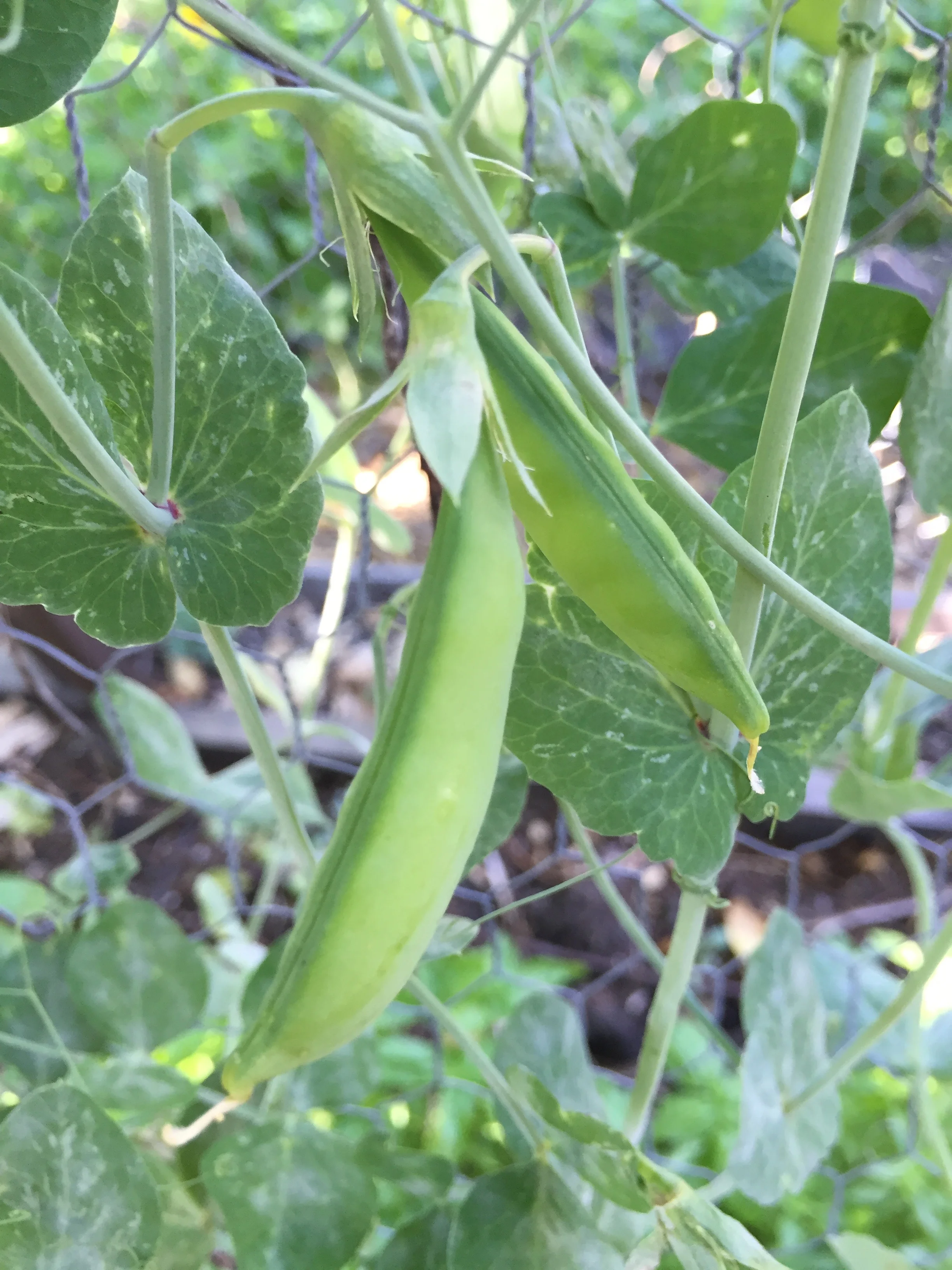
I planted both sugar snap and shelling peas in late July, in a shadier spot, to see what would happen. Well, we're harvesting sugar snap peas now (Magnolia Blossom variety, they are beautiful and tasty) and the shelling peas (Sabre)  are also starting to fruit. So that was a good experiment! Tomorrow I will seed some more so that we continue to have them through the fall.

The last of the collards was just given to the chickens; I just re-seeded cilantro; we didn't have good luck with dill this year; our watermelons and cantaloupes are about five inches big right now and will likely not reach maturity by the time I do my October planting. Oh, and our rhubarb is going crazy, we didn't know we'd be able to harvest that all through the summer! And apples - oh my, our tree is loaded with crisp tart-sweet fruit. Delicious. The squirrels like it, too.

I'm getting ready to start the winter garden and will sow seeds in the greenhouse next weekend, more on those varieties then.

I'd love to know which summer vegetables/fruit did well for you this year, and what you would recommend. Please share your successes!


Tags vegetable garden, herb garden, cooking, preserving, tomatoes, peppers
Comment

Purple Hyacinth Bean

August 23, 2018 Elizabeth Boegel
IMG_0271.jpg

I grow a 'Montana' variety of clematis against the south side of our house. It blooms profusely every spring, as long as I am diligent about cutting it back right after it blooms (some clematis bloom on the previous years' growth, like this one).  The problem with that is the plant looks quite denuded and yucky in early summer, and it also leaves this side of the house showing, which badly needs a paint job. I've long wanted some other climbing vine to grow in tandem with the clematis, blooming in late summer so that the whole area looks nice all year. I've tried several things to no avail, but this year I've had a success story.

Most of the green growth above is the clematis vine, in the form of pointed arrow-shaped leaves. This June I seeded some purple hyacinth beans below it, and that's what you see growing up and through, and blooming now. I expect this plant to keep growing, and bloom until our first frost, which isn't usually until mid-December. I'll let the seeds mature on the plant, with the hopes that it will re-seed itself (it's an annual vine) and do the same thing next year, although with earlier timing, filling in just as I cut back the clematis in June.

IMG_0276.jpg

I bought these seeds from Renee's, though you can also find them at Baker Creek. The purple seedpods are lovely, as are the deep red stems. The young leaves on this plant are apparently edible (so it might make a nice summer alternative to spinach), but only cooked, and so are the pods, though only when immature and again, only when cooked. They contain a cyanide compound that is poisonous and can be quite dangerous when eaten raw. So, eat the leaves and pods quite young and quite cooked. There is some debate about the older seeds/pods, so I would stay away from those altogether. 

IMG_0274.jpg

Apparently Thomas Jefferson planted this vine at Monticello, so it has a long history, but I don't think I've seen it being grown before. Perhaps it's more common on the East Coast.

The leaves are gorgeous too, heart-shaped with red veins.

So, if you need a fast-growing summer vine with beautiful flowers and seeds, and one that is also edible, this would be a good choice. I'm quite happy to find a companion plant for the clematis, and this plant has the added benefit of having the ability (like all peas and beans) to fix nitrogen in the soil.

Tags flower garden
2 Comments

Garden Ninja

August 18, 2018 Elizabeth Boegel
Likely a juvenile female Stegmomantis californica

Likely a juvenile female Stegmomantis californica

As much as I'd like to think I'm a 50-year old with the reflexes of a ninja, it's not me I'm talking about. It's this praying mantis. I've noticed a real explosion of mantids in my garden this August, and I've been enjoying watching them work. They are such a highly specialized insect. Many folks consider them beneficial, and I do too; they eat things like grasshoppers and crickets that can destroy your garden. However, they do not discriminate. They will eat any insect that comes near them, and this morning I watched one catch a honeybee in a very clever manner.

IMG_0223.jpg

It waited patiently in the plum tree, hanging just above a sunflower, looking for all the world like a leaf. It noticed that bees were coming to the sunflower. So it waited. And waited. And waited.

Every so often she would do a little sideways rock. But mostly she stayed very still.

IMG_0228.jpg

And then bam! Leap! Pounce! Forelegs sinking into the bee and holding it in such a way that it could not sting her.

First she ate a leg, and then she munched on a wing. Or maybe she just removed them and then moved to the meat of the bee. Mantids eat their prey alive. They do not sting it or poison it, just hold it skewered in their barbed forelegs and start to eat. 

Mantids have two compound eyes and three simple eyes between those. In the compound eyes, there is a concentrated area called a 'fovea' that allows them to focus and track. Apparently they can jump with extreme precision and even change direction or twist their bodies mid-air. They seem to attack anything that flies, and there are some mantids that eat hummingbirds or other small birds!

I came in to start this blog; fifteen minutes later I went out to see how the lunch was going, and the mantis was done! Licking her chops!

IMG_0243.jpg

You can't even tell from her body that she ate a bee. She is still in the same place, so I'm assuming she's going to do some more hunting, although I don't think they need to eat all that often. This plum tree is in the middle of a pollinator garden and is full of flowers - mostly cosmos, at the moment, some verbascum, some tithonia that haven't yet bloomed, and the fading sunflowers. It's a good place to hunt, if you're a mantis.

In a month or so, I will check this area for egg sacs, which the mantis encases with a sort of brown hard material. I imagine they will be hard to see and perfectly adapted to the surroundings. 

Are you seeing a lot of mantids in your garden this August?


Tags insects, IPM, wildlife, flower garden, bees
2 Comments

Romesco Sauce

August 15, 2018 Elizabeth Boegel
IMG_0212.jpg

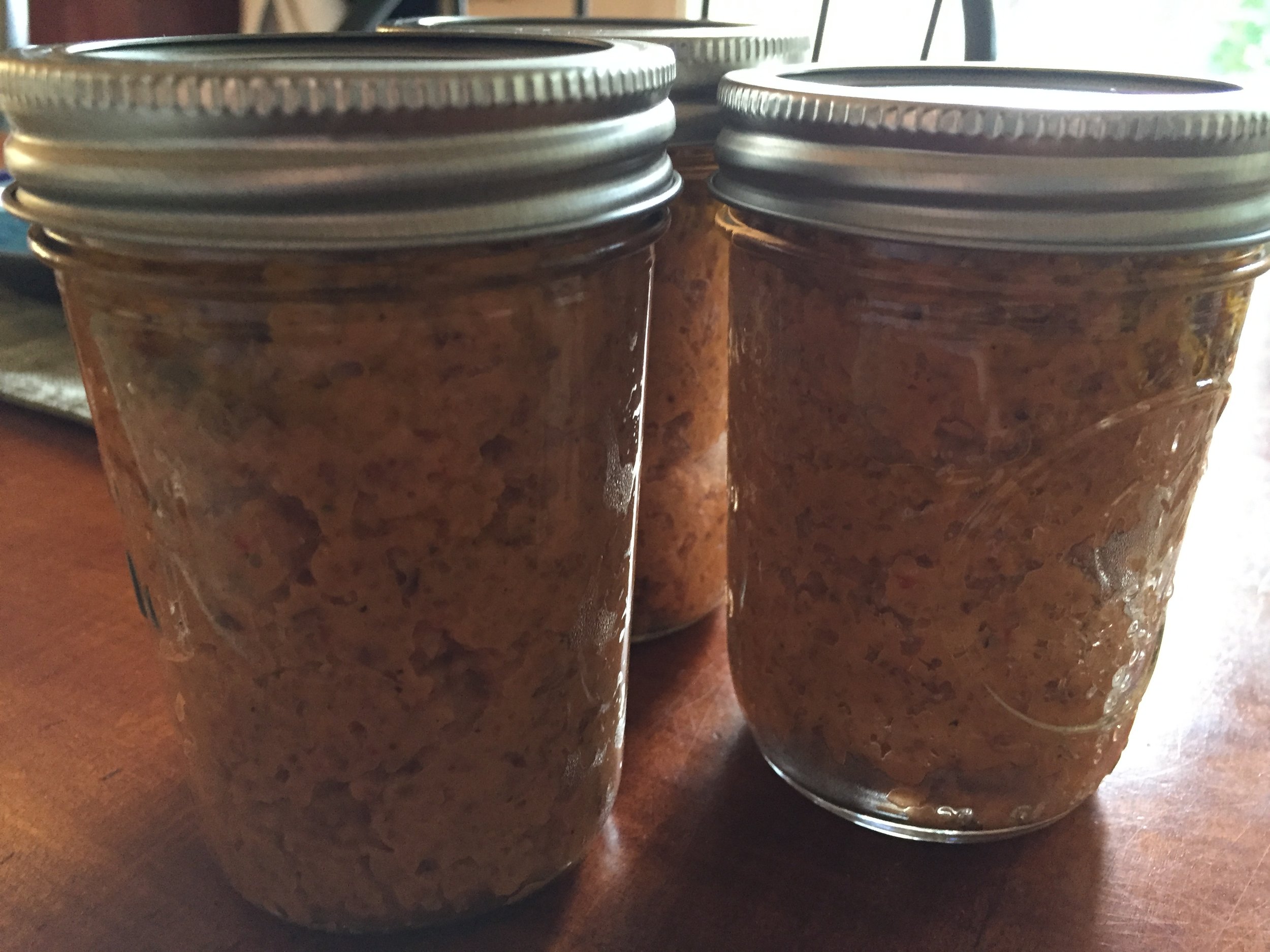
We love making romesco sauce every summer and freezing some for winter. It uses up some of the harvest, and really tastes good with grilled steak. It's also good on fish, chicken, or pork. Or you could use it as a spread on a sandwich. Or with cheese and crackers. It's slightly spicy and full of flavor. 

I make a double batch; we have some with dinner and for lunch the next day, and the rest I put into mason jars. I cover the surface of the sauce with a film of olive oil (just like I would with pesto) to preserve the color, then I stash the labeled jars in the freezer. Taking this sauce out in dark, dreary January is a real treat. 

Here's the recipe:

“Romesco Sauce

This is the recipe for a single batch. If you want extra to freeze, it easily doubles. Every recipe I read calls for hazelnuts; I have trouble finding those, so I just double up the almonds and skip the hazelnuts.
Instead of thyme sprigs, sometimes I’ll use my own dried thyme and in that case, I never remove it from the tomato, just add it to the food processor.

1 tomato (about 6 oz), quartered
olive oil
fresh thyme sprigs
salt and pepper
1 slice (4x4 ish) of crusty white bread, cut into cubes (I use a good French loaf)
1 red bell pepper (or whatever kind of sweet pepper you have in the garden, just large)
1/2 cup almonds, toasted
1/2 cup hazelnuts, toasted and skins rubbed off
4 cloves garlic
2 Tbsp red wine vinegar

Preheat oven to 400. Place tomato in small glass baking dish, drizzle with olive oil and scatter thyme over. Season with salt and pepper. Roast until tomato is soft, about 20-30 minutes. Scatter the bread cubes over the tomato and roast another 10 minutes. Let cool and discard thyme.

Meanwhile, char peppers directly over a gas flame or under broiler, until blackened all over. Transfer to a large bowl, cover with plastic wrap, and let stand for 15 minutes. Then peel, stem, core, and chop.

Add almonds, garlic, vinegar, nuts (don’t forget to toast them!), pepper, and tomato mixture to the food processor. Blend until combined. Add olive oil in a drizzle as machine continues running. You may need as much as a cup, you may need far less (I usually use 1/2-2/3 cup). ”
— adapted from Bon Appetit
IMG_0213.jpg

Enjoy!

Tags cooking, peppers, tomatoes, preserving
Comment

Bat Talk and Walk

August 13, 2018 Elizabeth Boegel
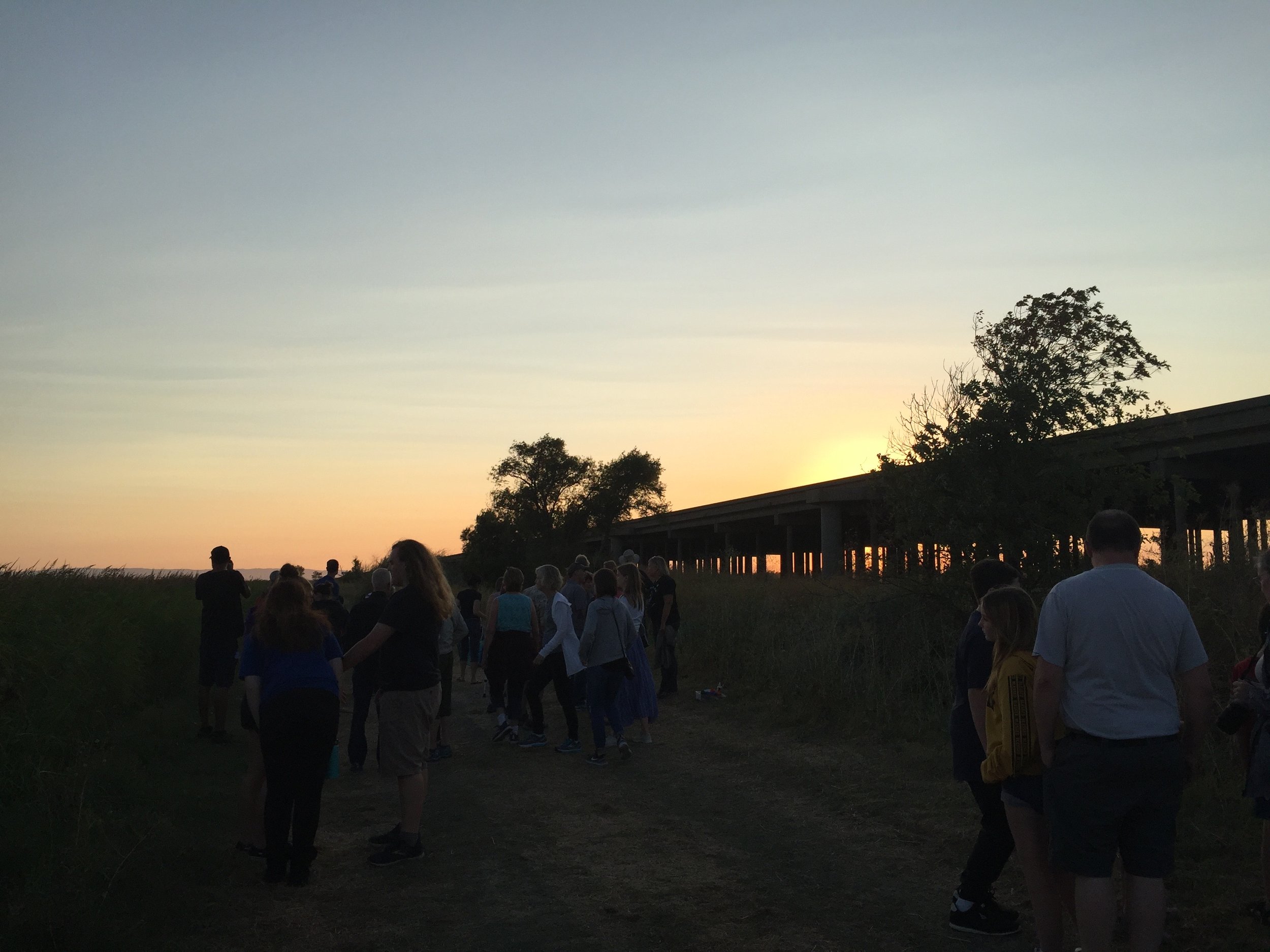
The view as we were leaving the wetlands at about 8:15; the gorgeous sunset is mainly due to layers of smoke in the air from the nearby wildfires.

The view as we were leaving the wetlands at about 8:15; the gorgeous sunset is mainly due to layers of smoke in the air from the nearby wildfires.

Last night, we had the most incredible experience: We traveled to a local wetland area to learn about bats and see their nightly exit from their 'cave.' The area where we went is part of the Yolo Basin Foundation, an organization based in the Yolo Bypass Area, which is very interesting in its own right. In between Davis and Sacramento, there is a long overpass built over a 17,000 acre wetland area. This area is designed to flood in the winter months when we get all of our rain. In the summer, it dries up, but there are pockets of wetness and bogs, and there are many farmers who grow rice in those places. There are also natural wetlands that attract many species of migrating and native birds. Any time you drive highway 80 from San Francisco to Sacramento, you go over this area. There are always interesting things to look at, from sunflower fields to rice fields, to herons and egrets. 

We've driven over this area hundreds of times but never driven off of it to explore the wilderness area, which is open dawn to dusk each day. We finally saw it last night when we went to the Foundation to learn about and view bats.

The bats we saw were mainly Mexican Free-tailed bats, though we also learned about Pallid bats and Big Brown bats, which also live under the overpass. Mexican Free-tailed bats are tiny, like 3-4 inches long in body, and eat lots of agricultural pests, which makes them quite a boon to the Central Valley. The farmer who grows rice in these fields, who allowed us to venture on to his property, reports that he uses zero insecticides on his crops, even though rice is a crop notoriously predated upon. The bats do all the work for him.

terrible picture, but she just wouldn't cooperate. 

terrible picture, but she just wouldn't cooperate. 

The speaker, a naturalist who works with bats, had examples of each of these bats with her and showed them to us under a camera that projected the image onto a large screen. These bats were brought in for rehabilitation (for instance, the one above had her wing damaged by a cat) and are not able to be released into the wild. They don't permanently live in these display cases, this was just for our benefit. It was so interesting to see these bats up close and discover the beauty and delicacy of their wings, their downright adorable faces, and the large ears. Our naturalist had a special machine that could 'hear' the echolocation the bats were making, which is beyond the range of our own hearing. It was so cool to hear those clicks! We were all riveted. The naturalist explained what the bats eat, how they live, and why they live under this overpass, which is basically because it so perfectly mimics cave environments. Which, by the way, are in short supply - habitat is disappearing for many bats, because of human interference and loss of insect life. Pesticides affect the creatures that eat insects, of course, and that includes both birds and bats.

After our talk, we drove out to a super-secret place under the overpass, through the farmer's rice fields. He was growing domestic rice, which is short and chartreuse-y green, and also wild rice, which is tall and has a huge inflorescence tinged with red from the pollen. It's a gorgeous crop.

IMG_0184.jpg

After driving about a half hour on the twisty-est roads imaginable around bogs and ponds and groupings of reeds and rice, we came to our spot.

IMG_0185.jpg

There were about 30 of us in our group, and we went to this spot because for some reason, the bats have chosen that tree in the distance as their exit point. About 250, 000 bats live under this overpass, and there are three exits, but this one seems to be the one most of them choose and we were told to expect three 'ribbons' or waves of bats. The naturalist said they exit at a similar time each night but that it wasn't exact and so we would just wait until something happened, and it didn't take long before we noticed, all along the underside of the overpass, a great rushing of wings. The bats fly for awhile under the overpass until exiting at this tree. So suddenly you notice an enormous shadow of wings rushing down the channels of the overpass, like some great hoard of locusts, and then they burst out into the air.

IMG_0196.jpg

And then they start to fly in this curve, going out over the fields, and eventually they rise up into the sky and disperse in groups.

IMG_0192.jpg

The line of bats went on and on, and then there was a break, and a second ribbon appeared, and then a third. We saw hawks sitting in trees nearby, waiting to snatch a bird from the ground if it fell. We watched the clouds of bats grow higher and further away (they can hunt up to 50 miles away from their cave). Meanwhile huge dragonflies were hovering around our heads and formations of geese skimmed the overpass. Suddenly we noticed more 'rushing' and out came a fourth ribbon, very rare, and then later another ribbon, the 5th, which caused our naturalist to text her husband in disbelief.

We just stood and stared. It was like a miracle. I've seen bats on the wing at night in various places (and I hope desperately that we have them at home), but I've never seen something like this. It was incredible.

The way the bats flew made me think of sine curves, and it reminded me that sine curves happen all around in nature, in the ocean waves, in sounds that we hear, the sunrise/sunset pattern, our heartbeat. It made me think about the great Creator of our universe who makes even daily things look like poetry. Sometimes you just have to stop for minute and experience the Divine, which is so easily found in nature.

These talks and walks go on all summer, before migration in the autumn takes the bats to who-knows-where (none are tagged, so no one knows). They are sold out for the season except for Sept 21, and you can get your tickets HERE. If you can't go this year, put in on your calendar for next year; you don't want to miss this experience.

Tags learning, wildlife, nature, local
2 Comments
← Newer Posts Older Posts →

Subscribe

Sign up to get email when new blog entries are made.

We respect your privacy. We're only going to use this for blog updates.

Thank you! Please check your email for a confirmation notice to complete the subscription process.

Powered by Squarespace