Pickled Carrots

We have an abundance of carrots right now, so I decided to pickle a few of them. I'm 47 years old, and I just tasted my first pickled carrots ever, on Mother's Day at Full Belly Farm. They were a revelation - crisp and with that real pickle taste, but beautifully orange and with a sweetness that only comes from carrot.

I did a lot of searching for recipes; it seems that pickled carrots are something people are passionate about, and there are many personal tastes. I need to go on a hunt for dill seed (something we had trouble finding last year), but meanwhile I have coriander seed that Ruby from the Institute of Urban Homesteading gave me from her garden, so I decided to use that. I have garlic that we've grown ourselves, and of course I have peppercorns, sea salt (which stands in for pickling salt in a pinch), and cider vinegar on hand. (You need to use a vinegar that has 5% acidity; white vinegar is often called for in these recipes, but I prefer the flavor of cider vinegar and always have some here for broth and making Thieves Vinegar.)

First up, picking a big bunch of carrots. I finally got wise to planting carrots far enough apart. I'm not a huge fan of thinning, so instead I just planted the seeds about 1-2 inches apart. It worked. We have decent-sized carrots this year, since they weren't crowded, and I didn't have to thin, which I find tedious and wasteful.


The chickens get the carrot-tops and any carrots that are too small for this project. They LOVE carrot tops.


The carrots get washed and sliced to the size of the jar, then blanched for 90 seconds in boiling water.
Meanwhile I boiled the jars and warmed the lids, and then put a clove of garlic at the bottom of each jar, plus peppercorns and coriander seeds. After the carrots are blanched, they are added to the jars.


The jars are then filled with a boiling mixture of vinegar, water, and salt. I boiled the full jars for 10 minutes in a water bath. At the moment I'm using our pasta pot with the pasta draining insert, so the jars don't wobble around on the bottom of the pot and break. Mom bought us a canning rack, and I thought it would fit in our La Crueset pot and that could be used for smaller jars, but it doesn't fit. So we do need to buy a whole new canning rig.

Anyhow, I made do, and the carrots turned out great. They'll keep for a year, but they'll be ready to eat in a couple of days.


And last night, we had our first pesto of the season! The basil is very young, but there was enough of it, and I added some spinach for backbone. I used garlic from our garden, and walnuts instead of pine nuts. It was delicious. Nothing says 'summer' like pesto!


The Annual Load

It's becoming a once-a-year tradition to borrow Dad's truck and make a trip to Sienna Ranch for aged horse manure. They have more than they know what to do with; therefore, the property manager is more than willing to fire up the front loader and fill up the truck with this ultimate soil amendment. The hardest part of the trip is shoveling the manure out of the truck and on to our driveway. After that, it's just a matter of adding a wheelbarrow at a time to the garden, and hardly a month goes by around here that we're not adding a wheelbarrow of something to the garden, so that's no big deal. Anyway, it's beautiful stuff, if you like that sort of thing. Clearly I do. And the garden does, for sure. Every time I amend with manure, everything sort of gets a new surge of growth.


It's important to pile the manure right next to your front gate, because really, nothing says 'welcome' like a large pile of horseshit.

We took a trip up to Petaluma yesterday; we obtain all our grass-fed and pastured meats from Tara Firma Farms, and as members we were able to join them for some roasted pork on Father's Day. We enjoyed walking through the hills and fishing in their pond on a beautiful sunny day. We made some side trips to the Marin Cheese Company (stinky French cheeses for Dad, check) and Cottage Gardens (plants for Mom, check) as well as an extreme side trip to Oakland to Pollinate Farm and Garden (canning rack for me and Tom, check). 


Ok, out to the garden for me - that pile o' poo won't move itself.

Preserving Green Chilies

This morning I went out to the garden and there were several ripe green chilies ready for picking. We don't have any tomatoes yet, so I can't make salsa; I'll start researching other recipes for using green chilies. Meanwhile I started looking for ways to preserve them in the freezer, in case someone wants a scoop on a cheeseburger or taco.

I turned, as I often do, to The Kitchn for guidance, followed their instructions, and now have a jar of jalepeno peppers and a jar of ancho poblano peppers in the freezer, ready for use.

A big ancho poblano and several jalepenos ready for roasting

put your broiler on high, broil one side for 3-5 minutes

Then broil the other side 3-5 minutes

cover with plastic wrap and let steam/cool for 20 minutes

Peel, remove seeds and ribs, and chop - then into jars or bags for freezing!
I love that I now know this technique; any time I want a pepper for a recipe, I can scoop out a tablespoon. I've researched how to can sweet peppers, but this is a great way to preserve hot or mild green chilies for later use.

I am a little surprised that we have chilies already, but June has been hot!

By the way, as I was researching this topic, I came across a lot of articles about using epsom salts when growing peppers (and tomatoes, incidentally). I had never heard of it, but I read enough raves that I immediately went and bought some and added a tablespoon to the dirt around each pepper and tomato. I also plan to dissolve some in water and use as a foliar spray, especially on the droopy paste tomatoes.

Had a nice walk with Joe in Joaquin Miller Park as Adam had his drum lessons nearby. Came across some interesting things to share.

clubhair mariposa lily, very rare here

a random teepee - about 25 feet high

I've never seen this before

the actual monument

I passed this man twice. He was deep in prayer and never opened his eyes.
I found this profoundly moving. 

a cathedral of bay laurel trees
Happy Saturday!

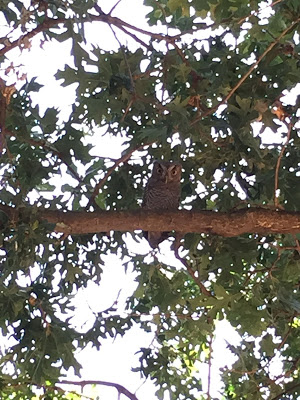
Daylight Owl Sighting!


I saw this little guy high up in an oak tree, above a playground in a city park. It's hot today, about 95 degrees, and still. No one was in the park. I was walking the dog, and heard some little birds twittering like mad in the tree above me. I stopped and watched them for a while, never identifying them - too high up, and too small, but some sort of bird I don't usually hear. Then I saw a great, big, terrifying eye and that really caught my attention! He was only about a foot high, imagine how intimidating he'll be when grown!

Best I can figure, this is a juvenile Great Horned Owl. They're common in this area, they often hunt in  large public parks, and the young ones don't get their tufted ears till later (thanks, Barbara!). The fact that he was out in the daytime is worrisome in that they usually don't hunt in the middle of the day unless food is scarce. I can only assume this bird is out hunting in daylight because the drought has made food harder to find.

I looked at him for a long time, and he just stared down at me, not moving a muscle. What a magnificent creature. Did you know Great Horned Owls are monogamous? And, at the moment, not endangered. I'm thrilled I got to see this bird today.


Galls on California Oaks

I was taking a walk with Joe the dog today in Lime Ridge Open Space, in a specific area where dogs are allowed (most of Lime Ridge is off limits to dogs), when I came across a young oak tree whose every leaf was completely covered in galls.


It was amazing to me that the tree could support this amount of gall growth, and still be healthy and vibrant, and it made me realize that I haven't written much about galls. We have a valley oak (Quercus lobata) next to our driveway, and it has a lot of galls, and only one person on the Urban Farm Tour asked me about it, which is a shame, because I love to tell people about galls. Especially kids, who think they are really cool.

Galls are home to cynipids, or gall wasps, a microscopic non-stinging wasp that can be quite beneficial. (Gall wasps were the particular branch of study of one Alfred Kinsey, before he became a famous sex researcher.) There are a few other insects who make galls, but the vast majority we see in California are made by cynipids. The wasp burrows in to the tree or leaf, or lays an egg; the tree responds by growing these galls, which in turn become a sort of nursery for the baby wasps.

Galls can be quite beautiful, as evidenced by the photo above and by professional photographers, but most are rather mundane, like these:


Some look like mini Hershey kisses!

The area we were walking in today was quite dry and barren, and mostly boring to look at, which is why my eye was immediately drawn to the red leaves on the young oak tree. However, the fennel was blooming, which provided the honeybees some forage, and me some nice anise-scented breaths.


Hiking this time of year really brings home one of the reasons why California is called the Golden State; the hills are truly golden and from far away are quite pretty; but up close all you see is DRY.