Sad News

A friend was over today and was interested in the bee hive. So we went over to look at it, and I noticed two dead bees on the landing board. No other activity. I got a bad feeling. Immediately I thought about working in the garden the last couple of days, and I'd seen a marked decrease in bee action in the flowers. And those dead white things we kept finding, what I thought were larvae. I quickly got my hive tool and the smoker and we opened the hive.

Right away I knew something was wrong. There were no bees. In a top bar hive, you start inspections at the back of the hive, away from the entrance. Usually it's the less busy end of the hive, but there are still always lots of bees there. Not today. I started moving bars out and looking at them, and still no bees. Then we started to see dead bees and dead larvae littering the bottom of the hive. Bees are fastidious creatures, there should be no mess. Then, the worst part: We got to the brood comb (or where the brood comb should be), and all we saw were tiny wax cubicles with dead larvae in them. No eggs. No sign of the queen (though I didn't look very hard). There were even some bees who had started to hatch, and died halfway through the process, half their little bodies sticking out of the comb.

There were bees on two bars. There should be 30, 000.

Naturally, I was, and am, devastated. I have no idea what has caused this. There is no sign of webs, insects, mice, robbing. There is bar after bar of honey. Some of the bees have disappeared, and many are dead in the hive.

Two weeks ago, this was a thriving, busy hive. What happened?

My working hypothesis right now is that it is some sort of toxicity problem. I have emails out to all my beekeeper groups and friends. I am scouring the web. Since there is no sign of disease or mites, it really all points to pesticide poisoning.

I will post more about it as I know more. I am just sick about this, and don't really know what to do next. I'm frustrated, and mad, and most of all, very sad.

Hoop Houses

Guest post by Tom today, talking about the latest construction project at Poppy Corners Farm – hoop houses!

*******

Elizabeth had planted some winter crops, and while we're able to grow things in winter, we wanted to protect them from the frost we often get, and maybe cut down on our deer losses somewhat. Enter hoop houses – lengths of floating row cover fabric stretched over a frame over the raised beds.

Construction of the frame was rather straightforward and pretty inexpensive to boot. I picked up 10' lengths of 3/8" rebar and 1/2" Schedule 40 PVC pipe. The frames needed two lengths of rebar and five length of PVC for each of our 4x8' raised beds.


Next, I used a hacksaw to cut the rebar into 2' lengths. You only need to cut the rebar about half-way through, then you can just bend at the cut and it'll break off nicely.


Use gloves – it'll leave sharp ends. You can buy the rebar in 2' lengths to begin with, but you can get one 10' length for about the price of two of the 2' lengths. I didn't mind using the hacksaw.

Starting at one corner of the raised bed and proceeding about every two feet, I hammered the lengths of rebar about two inches out from the raised beds, and about even with the top. Next, I slotted one end of the PVC pipe over one piece of rebar, then bent it over and slotted it over the rebar on the other side of the bed.


As you can see, the tops of the hoops are around 4' tall. I could have tried trimming off some of the length of the PVC pipe to get a shorter hoop, but I was a little concerned about how much stress that would put on the pipe and the rebar.

A little more sawing, pounding, and bending, and the frames were complete!

This is really starting to look like a farm.
Elizabeth then stretched the row cover fabric over the frames, securing them with binder clips.


The hoop houses should let enough sun through for things to keep growing, as well as raise the temperature underneath several degrees. It should let rain through as well.

******

Elizabeth here. I'm very pleased with this project, and had several neighbors stop and talk about it and how it might help with frost and deer. I am so happy that folks are interested in what we do here. There's a group of older ladies who walk by every so often, and one of them found me in the yard yesterday and offered me her 1916 copy of "The ABC and XYZ of Beekeeping," a still relevant and necessary book for beekeepers today. I was so touched. She said she wanted me to have it because she admires me! I was extremely proud and grateful.

I spent some quality time yesterday moving cardboard and mulch to a spot in the front yard that used to be grass, but now is mostly used as a path to get to the side yard, and so is quite muddy. I sheet mulched it as usual, without the layer of compost; I figure I don't really need to improve the soil here, since it will just mainly see foot traffic (although even cardboard and mulch will add a significant amount of organic matter). I put a fairly thick layer (6") of wood chips on top of the cardboard, because we've seen now from experience that it all compacts rather a lot as it decomposes.


Today I started on the back yard. I didn't get very far; we need a whole lot more cardboard. I'm always amazed how much this process requires, and also pleased at the amount of material we can take out of the waste stream and decompose here, naturally. So, I will have to go dumpster diving to find more. I did this before at a local recycling place, which has since closed! argh! But I got a lead on a dumpster behind a Rite Aid... I just realized how crazy that last sentence sounds. I'm getting nuttier by the minute!

Happy Thanksgiving, all, and Happy Gardening!

Prepping the Thanksgiving Bird

Today, Kate and I drove up to Petaluma to pick up our pastured turkey. Petaluma is a small farming community about as far north of San Francisco as we are east. It's a pretty drive to get there, along Highway 37 between the Napa Valley and the San Francisco Bay. We saw a flock of American White Pelicans flying in 'v' formation above the marshes, which was glorious.

I ordered our turkey from Tara Firma Farms last week. It's a really neat place. They pasture all their meat animals on a gorgeous hilly vista. I first heard about them when I was searching for a local source of grass-fed beef. This farm actually has a CSA for meat - you can get a monthly delivery. We visited them last Mother's Day and spent a wonderful day walking around the farm, getting to know how the place works. It takes a tremendous amount of dedication, commitment, and LAND to run a farm like this. We were struck by the fact that this beautiful farm had very little odor. The animals all live in their natural element, roaming around, and even the pigs don't have much of a smell.

By California law, they are able to kill their chickens and turkeys on site, in an outdoor abattoir, open to the elements. The pigs and cows go to a local abattoir close by, which reduces the amount they need to travel, therefore stressing the animal less. This local abattoir reserves one day a week for pastured meat. It's a great system.


We so enjoyed watching the piglets. But there was one tiny guy, you can see him on the bottom right of this photo, was clearly the runt. It made me think of Wilbur in 'Charlotte's Web.' I left hoping that there was some little girl named Fern to take care of it.

Our turkey, all 18 pounds of it, was killed yesterday on the farm. I talked to the lady at the counter, and she said she had watched this process for the first time. She said it was very, very quiet; the birds don't fuss at all once they are head-down in the funnel. I think I should probably watch this in person at some point. If I'm going to be a responsible meat-eater, it seems like an important thing to do.

Anyway! We brought home the bird, and then I had to follow through with my plan of spatchcocking and dry brining it. Oh my, that thing looked awfully big on my cutting board. I confess to feeling very dubious.


First I pulled out the innards and put 'em in a pot with water, salt and pepper, and a bay leaf. I'll let that simmer all day, and that will be the broth we use for making the gravy. Then, I had to spend some time removing a few stray feathers. They were really stuck in there! This is about as close to a freshly killed animal as I've ever been, and it was a learning experience. I just kept thinking about Ma Ingalls and how many chickens she had to pluck in her lifetime. Usually, when I'm afraid of doing something homestead-y, I think of the pioneer women, who were totally badass in every way. They give me courage!

God Bless The Kitchn, my favorite go-to site for stuff like this: They had step-by-step instructions for a South American spatchcock, which separates the white meat from the dark meat. (Regular spatchcocking is just butterflying the bird. I wanted to cook the meats separately.) I sharpened my knife, got out my brand-new poultry shears, and got to work.


It turned out to be pretty simple, actually!

Then I mixed up my dry brine. Sea salt, pepper, and fresh herbs from the garden, chopped up.


I rubbed this under the loosened skin of the whole bird, and of course all along the outside, after patting it dry. I piled the two parts up on a platter and stuck it in the fridge. It'll stay in there, uncovered (air circulation!), until Thursday. The turkey looks like some sort of cut up alligator head or parts of a prehistoric beast. It's a pretty impressive pile of meat, that's for sure.


Let the sheet mulching begin.... again!

Here we are with a glorious week ahead of us. No school, no work, only a few rehearsals and performances, one important birthday (my mom's), one important holiday that involves a lot of cooking, but mostly.... blissfully empty. For us, this means only one thing: playing the new Kingdom Rush game! Well, okay, that.... and yard improvements!

This past week, a tree company delivered me a load (maybe eight cubic yards) of pine mulch, free. Then I ordered three cubic yards of organic compost from Sloat's Garden in Danville, which is the most expensive part of the process - that runs about $160 including delivery. I've been collecting cardboard boxes for several weeks now (thank you friends and family!), and we are ready for some sheet mulching!

Here's the section of yard we plan to SM (sheet mulch). A play structure used to live here, and the trampoline is very happy here now, and still gets a lot of use - but one of the legs is broken. It has very little time left on this earth. (This tramp has a nice story, actually. It belonged to the kids across the street, who then sold it to the kids around the corner, who then sold it to us. It's had quite a life and a ton of use, so it has really served its purpose quite well. Oh, and our old play structure? Given to us as a gift by Tom's family when Adam was diagnosed with leukemia and had compromised immunity, it lived happily in this space for many years and was a magnet for the neighborhood kids. A nice young man with a two year old came and dismantled it and transported it to his yard, for his son to play on. This is the best kind of recycling!)


We stopped watering the grass in this area when drought hit, so it's looking pretty grim, though with our recent rains, it's greening up. There's little actual grass, lots of a very tenacious crabby sort of thing, another kind of weed that spreads by sending out tendrils and putting down new roots (vicious stuff), bindweed (or jimson weed) which is just terrible; in other words a smorgasbord of awful weeds. But the SM, if we do it right, should smother all of it. That is the beautiful thing about this process. Several times this past summer, if I saw an area of weeds I wanted to control, in any part of my garden, I'd put down a piece of cardboard or burlap, and cover it with organic matter. I have a pile of horse manure six inches deep over old burlap bags under the peach tree, because the weeds had gotten so bad there. So far, so good - no regrowth.

The only place I have trouble removing weeds is when they are in concrete - such as in the cracks of our patio, or the cracks in our driveway. You can't SM there! Most of the weeds die in the heat and dry of our summer, but in winter they are prolific, and I don't want them to set seed. I constantly weed by hand, but if that doesn't work, I will boil water and pour it on. Other times I will go out in the dark of night and spot treat with herbicide. In that case I use as little as possible, and only after dark when the bees are in the hive for the night. But I haven't had to do that in a long time. Boiling water really helps, especially if you add liquid soap to the mix.

Back to SM! This back area is also where our fruit trees are. I had the quince removed, but we still have an apple tree, as well as the peach.


We also have a tiny fig tree, which is hidden by the trampoline in the photos. I'd like to put in a sweet cherry where the quince was. The trampoline will stay here on the SM until spring, or until it gives up the ghost, whichever comes first, and then we'll build more raised beds. Probably six of them. I think this will be where the tomatoes, peppers, and melons will be planted, as this area gets more sun than any other part of the yard.

Truck dumping compost, next to the mulch mound

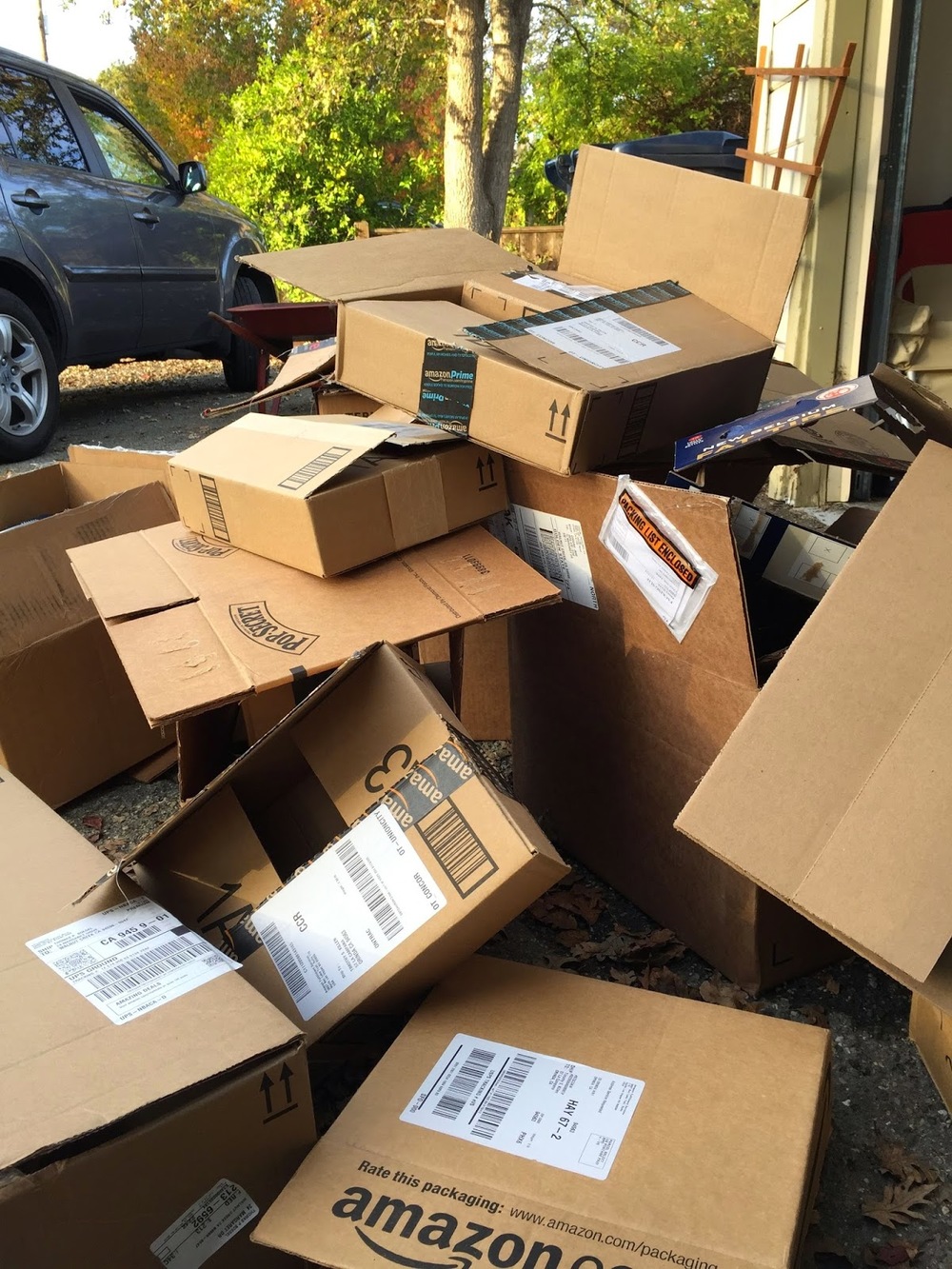
The most finicky part of the SM process is removing all tape and labels from the boxes, as those won't decompose like the cardboard will. I spent several hours today removing tape. The stuff Amazon uses is the devil itself - it has threads in it, so it comes apart when you try to remove it. ARGH! The plastic stuff at least comes off in one long strip! Amazon, if you're reading this, you need to change your tape for the .0001% of your customer base who sheet mulches!!!!


The boxes also need to be cut so that they lay flat. Once that's done, it's just a matter of moving materials. That's a job, and a blog, for later this week.

Tomorrow, I head out to the farm for our pastured turkey. I'll report on that experience, as well as my turkey prep, as I'm trying something new.

I'm enjoying the leaves on my walks.


 Mushrooms are enjoying our recently wet earth, and popping up all over the place. These tiny yellow beauties are in our yard:


I spread red clover seeds all over the one remaining area of grass in our yard, and they are going gangbusters.


I'm hoping they bloom over our mild winter, and provide forage for the bees.

Speaking of the bees, both Tom and I have noticed a strange thing on the landing board of the hive. Every so often, maybe 5 times in the last month, there's a white dead thing there. Here's a picture of it.


I think it's dead larvae. But why is there dead larvae on the landing board? I did some searching around, and there are several explanations. One, there's mites or disease in the hive. The last time we opened it, though, everything looked great, no sign of anything amiss. Another reason could be the sudden change in temperature. It might be that this particular patch of brood got chilled and therefore isn't viable, or for some reason just stopped developing. The bees might also be culling larvae for some reason. Whatever it is, I'll need to keep an eye on the hive for the next few weeks. The bees are flying in and out as normal, whenever it gets over 50 degrees outside. They seem to be bringing in pollen and nectar. I'm anxious about this new development, but not overly so.

Yum, Tom's making a Jamie Oliver recipe of Thai spiced rice noodles with chicken, butternut squash, and broccoli, and it smells amazing. I'm off to dinner!

True Autumn

Well, it really is true autumn around here now, even with mild, sunny days. The nights are chilly and we've had some rain, here's hoping for more! The leaves are falling in earnest and Thanksgiving plans are in the works. I think I've finally found our pastured, heritage turkey, which will be killed on the farm the weekend before we need it. Pastured turkey is not cheap - $7/lb., but worth it in so many ways. I am anxious to try a dry brine on the bird.

Let's see, what's been happening at Poppy Corners? Last weekend we had some family friends over. The kids and I went around the neighborhood and collected fall leaves and seedpods, anything interesting we could find. Then we sat outside in the sunshine and each painted a watercolor of what we found. One of these is mine, two are from my kids, and two are from the other kids, all 6th and 7th graders. This was a fun experiment! We all look at the same things differently.


Adam has been in Opera mode all week, which will continue until December 7. Last night was opening night. It's been really fun for me to hang out backstage and geek out on the action. Here's a synopsis of Act II, which is when Adam is involved.

A great crowd, including children, has gathered with street sellers announcing their wares (chorus: Aranci, datteri! Caldi i marroni! – "Oranges, dates! Hot chestnuts!"). The friends arrive; Rodolfo buys Mimì a bonnet from a vendor, while Colline buys a coat and Schaunard a horn. Parisians gossip with friends and bargain with the vendors; the children of the streets clamor to see the wares of Parpignol, the toy seller.

After the kids follow Parpignol off stage, a marching band assembles backstage (!) and starts playing, then they march on stage and the kids follow them, party party party, and that's the end of Act II. The kids rush to shed costumes and makeup during the interval, becoming 21st century boys once again.

Yesterday, in between performances, Adam, chorister and friend Alex, and I went to a local artisan chocolate shop in the Mission called Dandelion. We've been there before for a private tour, and they are just incredible, sourcing chocolate from all different parts of the world and making it into 70% bars the old fashioned way, roasting and mixing and adding only sugar. We bought several bars with beans sourced from Liberia, where they are teaching former child soldiers how to farm cacao. Delicious, and for a good cause. I thought you'd get a kick out of the bathroom trash cans. This is San Francisco in a nutshell.


If you get a chance to look at Dandelion's website (just click on the link I provided above), there's an interesting blog post on the history of chocolate. Check it out!

We also spent a little time at Ocean Beach, right at sunset. There were plenty of kite boarders and people building bonfires on the beach. This is also San Francisco in a nutshell, foggy and beautiful.


After some games of tag, it was time to head back to the theater for another performance.

I've loved the whole experience: Listening to the leads warm up in their dressing rooms, chatting with the dressers as they work with the kids, sharing winks with the adult chorus backstage, learning the lingo of the Opera (the singers say 'toi toi toi' to each other, for luck), watching the leads come and go off stage, and of course listening to the great score by Puccini.

War Memorial Opera House, home of the San Francisco Opera

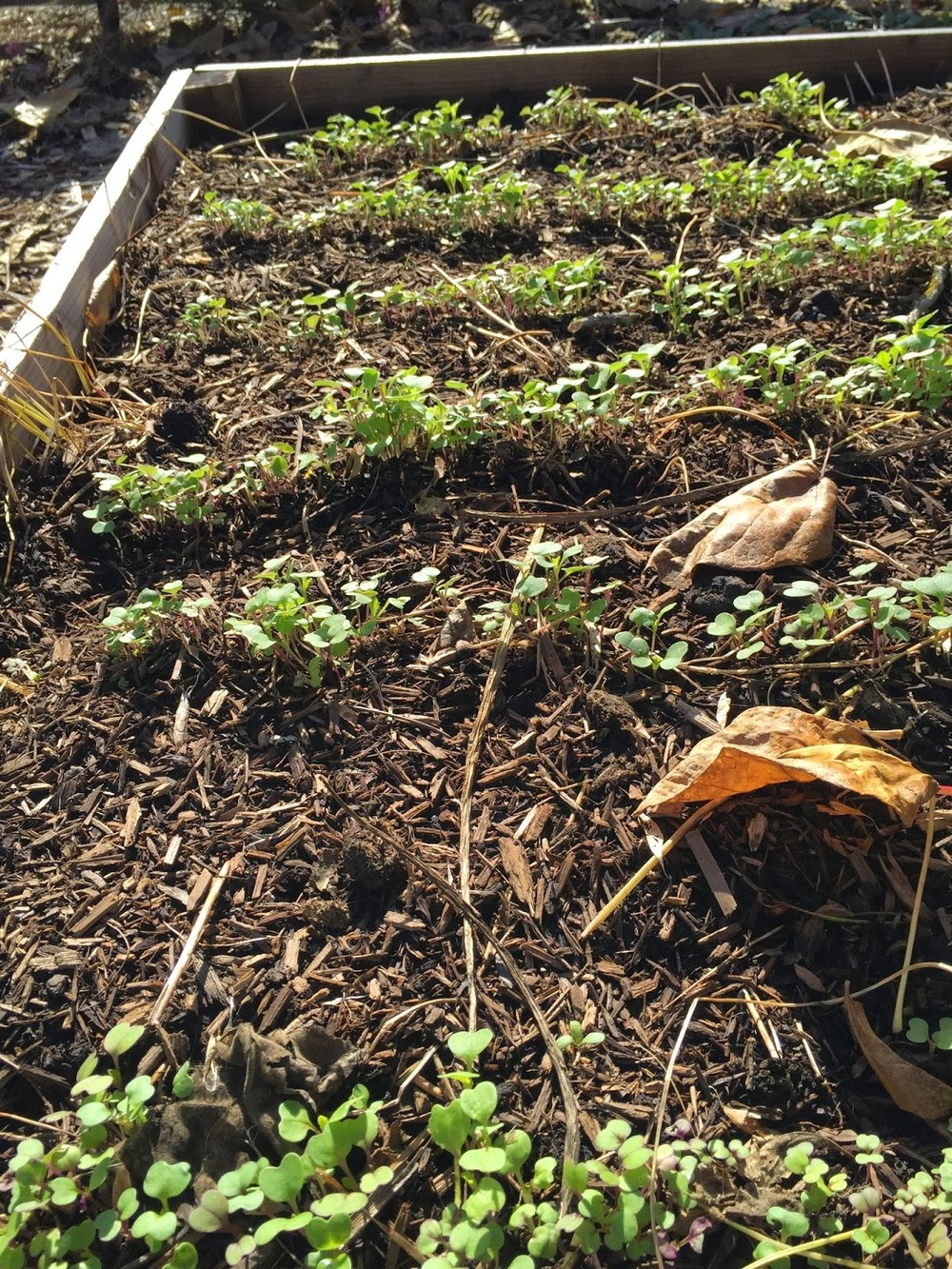
It's also a lot of time and energy, though, and that means that I'm too tired to do much work in the garden.  While I was looking the other way, the vegetable seeds germinated. Every time I plant a seed, I think to myself, "There's no way this is going to grow." But then they always do! It's like magic, isn't it? It's amazing that something so small has all that potential. Nature is always miraculous.


I refreshed the herb spiral/hugelkultur with new herb starts. I use fresh herbs in everything, so it's very worth it to keep the spiral producing. I added more chives, oregano, thyme, tarragon, parsley, marjoram, and sage, along with some chicken manure and compost. The mint, lavender, and sorrel are all going gangbusters (no surprise there) so they did not need refreshing. My rosemary is in a separate pot and is doing fine. Most herbs are perennial, so if I can protect them from frost, they'll last. The thing that I find a bit confounding about this arrangement is that it is decomposing in place - the hill keeps getting smaller - and I have to keep adding dirt. Meanwhile, a quick check on the wood that is forming the base of this hugelkultur shows that it hasn't decomposed at all, neither has the sawdust I put under there. Maybe I layered everything the wrong way. Anyhow, the herbs do fine here, as long as I give them extra dirt when needed.


Our list of projects for Thanksgiving week is growing. We're planning to build hoops over each bed, then place a row cover over those, to deter deer. We are also going to sheet mulch the other side of our property, where we've had various kid things for years - play structure, then trampoline. We'll mulch it to get rid of the 'grass' (mostly dead, as we didn't water over the summer), and then build more raised beds. I'd like to plant several manzanitas and a cherry tree in various parts of the yard. I also have a lot of trimming to do.

Hiking with the dog has been fun, sometimes muddy. November brings dramatic skies, with contrasts in bleak and glorious. The hills are not yet green, but there is potential for that, and soon.

A valley oak, perfectly situated in its surroundings