• About
  • Blog
  • Contact
  • Favorites
  • Archive
Menu

Poppy Corners Farm

Street Address
Walnut Creek, California
Phone Number
Walnut Creek, California

Your Custom Text Here

Poppy Corners Farm

  • About
  • Blog
  • Contact
  • Favorites
  • Archive

Trying Something New

January 11, 2020 Elizabeth Boegel
IMG_3803.jpg

Despite the fact that I have numerous seed packets in cold storage (leftover from last year, and even the year before that), I still ordered a few more because I like to try new stuff every year, along with my tried-and-trues. The new seeds arrived yesterday. I’m excited to try these new varieties, including a tomato that is good for hanging baskets (‘Silvery Fir Tree’)! I don’t start tomato seedlings until March 1, and usually I start my peppers then, too.

But I recently read a book by Monty Don of Gardener’s World fame (a show on the BBC that we absolutely adore), in which he strongly suggests starting peppers in January, to give them plenty of time to germinate and grow, before they go in the ground in May. This requires a little extra fuss because they’ll probably need potting up twice before then, but because peppers are tricky to get started, this allows you earlier harvests when they do eventually get in the ground. To me this seemed sound advice. My peppers always set fruit later than I would like. Why not try it?

IMG_3805.jpg

So, I got out my trusty seed table, single light set-up, heating mat, and seed blocker, and got to work planting up peppers. I seeded 50; I expect not all will germinate, but it would be lovely if they do. We always grow plenty of both hot and sweet peppers, as well as paprika peppers, in order to have lots for fresh eating and for preserving and making into spice mixes.

A bright sunny day (though chilly) encouraged us to get outside and get a lot done. The highlight was digging up a Douglas Iris clump that was about four feet in diameter (no small feat with our heavy clay!) and chopping it into about six pieces which then got distributed about the garden. You know it’s time to do this when the greenery forms a ring, with nothing in the center, telling you that the bulbs have increased so much that they have crowded out the middle. Winter is a great time to split native Douglas iris, as the roots are growing like mad and will not even notice that you’ve changed their position.

Tags starting seeds, peppers, vegetable garden, flower garden, bulbs
Comment

Starved for Green

January 8, 2020 Elizabeth Boegel
Acalanes Ridge

Acalanes Ridge

We Californians have an interesting climate. Like west coasts on many countries (the west coasts of South Africa, Australia, and Chile; the Mediterranean basin), we have what is called a ‘Mediterranean hot-summer climate’, which features dry summers and mild, wet winters. The influence of the ocean tempers things a lot with regard to temperatures, and we have very low humidity most of the year, which keeps things pleasant for humans. The plants that have evolved to live here are summer-dormant; they shut down in the warm months and burst into bloom in the colder months. For native plants, January is spring, and July is basically winter, to put it in terms anyone else would understand. If you do what I do, which is grow things year-round, you can see that I have to manipulate my environment, which isn’t all that great a thing to do. It requires work and water. The rage ten years ago (and frankly maybe it should still be the rage; it’s certainly the responsible thing to do) is to plant with only shrubs and flowers that would follow this pattern, i.e. native. I do have a lot of native plants in my yard, because I think it’s important from an ecological and historical perspective (I want to support the creatures that evolved with these plants), but I also include things from other places, since I’m watering for the vegetables anyway. This is probably not sustainable in the long run, and it’s something I’m thinking deeply about, and need to find a solution to, with regards to growing food.

However, I didn’t come here today to talk about anything as serious and pressing as climate change. I just wanted to note that the eyes of Californians are simply starved for green by the time January rolls around.

Shell Ridge

Shell Ridge

Over the holiday break, Tom was great about taking walks every day, and I joined him on several occasions, and have vowed to get in the hills as often as possible before my classes start up again. What we have noticed is how our moods change instantly when we get up to a place where we can fill our eyes with green. Local farmers are grazing their cows there, and I spent an entranced fifteen minutes watching them find the new grass with their lips, tear it out, and chew slowly as they made their way to the next verdant patch. I swear I wished that I could eat the grass, too, somehow get that beautiful green goodness into my body. We Californians have been looking at brown hills (golden, my ass) since May. Some of them were charred black from fires. It’s a cliche, but the green is a rebirth and a promise. I imagine this is how folks in other climates feel when the first crocus pokes its head over the snow. Our promise just happens to come in winter rather than spring. Where others might have eyes hungry for pink or purple or yellow, ours are starved for green.

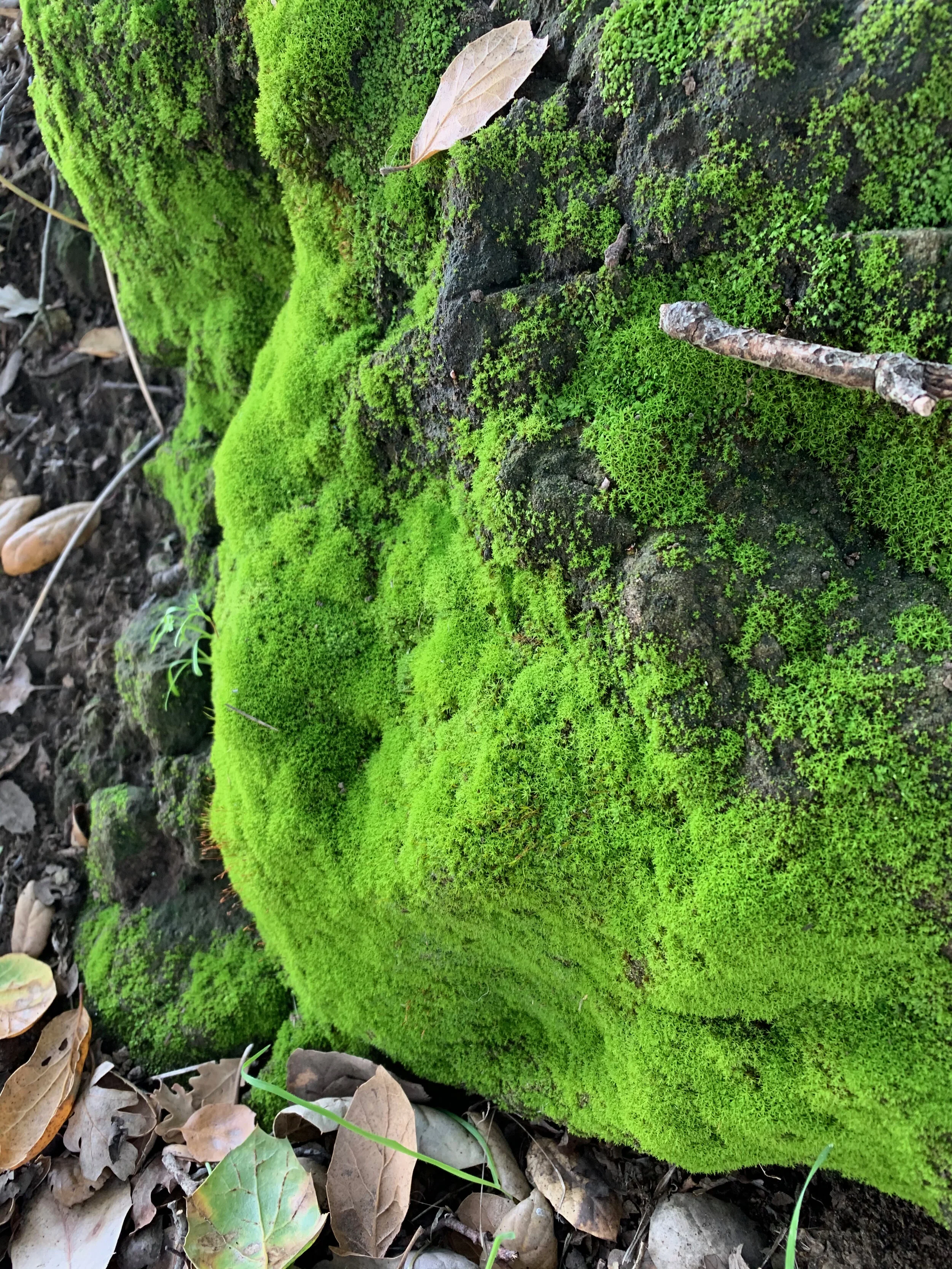
moss on a shady rock on Acalanes Ridge

moss on a shady rock on Acalanes Ridge

We’ve had very little rain this winter, and I’m running the drip system right now as I write. Who knows if we will get a deluge in the next few months? I’m hoping so, but if not, I’m trying to fill my eyes and my soul with green right now, to store up for the dry months.

Tags hiking, climate
Comment

Misconceptions

January 3, 2020 Elizabeth Boegel
Winter harvest

Winter harvest

Did you ever manage to see The Biggest Little Farm? It’s a lovely movie, filled with beautiful photography and the picturesque processes of building an organic farm in the Southern California foothills. It covers seven years in the life of this particular farm and documents its failures and successes. I loved the film, and have recommended it to many people.

But just the other day, I received the monthly newsletter from Ruby Blume of the Institute for Urban Homesteading; it gave me a different view of the movie. A little history - Ruby was instrumental in starting the urban farm movement in Oakland, and helping others to learn how to grow food, preserve it, keep small livestock and bees, and craft items for the home. In the last few years, urban farming in Oakland and Berkeley has become almost de rigueur, and Ruby herself moved to Oregon a couple of years ago to farm a larger property and raise sheep. The Institute still offers classes, but it’s not nearly the clearinghouse it was before, for many reasons (you can learn on YouTube, there are lots of places that teach this stuff now, Ruby is no longer in the area and rather out of touch with what the ‘scene’ has become), but during its heyday it was a great source of knowledge and information. I still get Ruby’s newsletter because I like to read about what she’s accomplishing on a larger scale in Oregon (and allow myself to dream of something similar), and her most recent newsletter had a paragraph that I felt I should share here, with Ruby’s permission (which she kindly granted). Since I’ve been doing a lot of lecturing at Merritt, and giving a lot of farm tours here on the property, I have a lot of new readers who may have a fairly idealistic view of the whole process. The Biggest Little Farm was a very romantic view of farming, and I certainly don’t want to give anyone a false impression of what farming is truly like. Hence, I’ve copied Ruby’s paragraph here, so that you can get a more realistic picture. (Full disclosure - we’ve been part of the Institute’s Urban Farm Tour in the past, and have taken many classes with Ruby.)

“When I was working on the farm tour, I gathered with the featured farmers and several told me about the recent movie The Biggest Little Farm. “You will LOVE it,” they said. I had my doubts, but one rainy night in December I watched it with my farm partner. We could barely make it through the film. I understand that most people will find this movie inspiring and uplifting, but for me it was infuriatingly idealistic, leaving so many gaps in the story of what farming actually requires. “We had some generous funders.” No doubt. The property alone cost $11M. You read right. Eleven Million Dollars. This is more than 20 times what I had to invest. And how much additional capital did it require to construct barns, sheds, corrals and coops, buy a stable of shiny new farm machines (30-50K each), install miles of fences and irrigation lines, reconstruct a pond, rip out 55 acres of mature orchard, completely terrace and keyline those same acres and plant thousands of fruit trees? How did they pay for the farm, the labor, the commercial scale worm composting and compost tea systems, the livestock and guardian dogs? How long did it take to get marketable crops and what did they live on and pay their farm workers until then? Could they have made it happen without their Hollywood investors? They did not show the backbreaking daily work required or demonstrate that permaculture/biodynamic farming is economically sustainable. We did some math and came up with a conservative estimate of $20 million dollars for their project. What couldn’t any of us do with that much cash in hand? While I agree with the core message of the movie (SOIL is LIFE! ), there is a reason most farmers work on an industrial level: the farmer has to make a living. Farm reality is that we cannot just do whatever we want and farm decisions are almost always dictated by the limitations of budget. Most small-scale farmers also work off the farm in order to pay for the farm. So while it is great that they are now selling 55,000 pounds of fruit a year and employing 60 workers, we greatly doubt they could have done this without that big start-up nut, or that they could pay back that money of they had to. Here on Ferry Road, we struggle to pay our basic bills and to afford the materials to improve our infrastructure. We do not have the luxury of purchasing a single tractor or hiring a single farm hand, let alone a stable of each. We are lucky to be able to defray some of the cost of our farming with what we produce. I am not angry or jealous of the gap. I love the agrarian life, the critters, the manure, the clean air, the quiet nights and the gorgeous food we produce for ourselves with some extra to share. But what I would LOVE to see is a film that promotes organic/holistic farming with a realistic budget and practical solutions for mid-to-low income folks who would like to return to the land. Now THAT would be inspiring.”
— Ruby Blume
IMG_3784.jpg

We have two new additions at Poppy Corners. One is this bird feeder, attached underneath the chicken coop roof. One of the things I dislike about bird feeders is that the fallen seeds sprout and become a mess to dig up. Attaching it in the chicken run means that the chickens clean up any fallen seed, which solves that problem.

But the bird feeder is solving a bigger problem. Here’s what’s been happening: In the past few months, I’ve noticed that anywhere I’ve put seeds in the North Garden, nothing grows. Well that’s not exactly true. In beds where there is row cover (agribon), the seeds germinate fine and grow fine, except along the edges of the beds where the agribon blows in the wind. Likewise, anywhere uncovered, no germination. Then I started noticing flocks of birds in my beds and borders, eating the seeds. This is something they’ve never done before. Any pea seed I planted, dug up and eaten by birds. Any flower seed, likewise eaten. No plants on the ends of the covered beds where the agribon doesn’t quite cover - seeds eaten. The birds are eating all the seeds. Only in the North Garden where the chicken coop is. So I thought and I thought and I thought - why are birds eating everything, only this year? Why not other years?

Then it hit me. In September, our next-door neighbors (who’ve lived here since the neighborhood was built in the late 40’s) suddenly moved into a retirement home in the Sierra foothills. These neighbors had seven or eight birdfeeders in their yard, just on the other side of the fence, in the big Japanese pine. She also used to put out peanuts for the squirrels and jays. But since she’s been gone, the feeders have been empty. No one has moved in yet, and the caretakers of the house haven’t noticed (or don’t care about) the feeders. All these birds, who for generations had eaten well in Wes and Lavelle’s yard, now had no food. In winter. And I just finally cut down the last of the seed pods on my property. So of course they are eating anything they can find! They are simply desperate for food! I reasoned that if we provide them with that food, they’ll maybe stop eating all my seeds that I want to grow up into big plants. It’s worth a shot anyway!

image credit: Stark Bros

image credit: Stark Bros

The second new thing is a mulberry tree. In November, I chopped down our old, diseased peach tree with my trusty hatchet and saw. We moved the greenhouse into that space, and then Tom put in a tall post on which to hang our sun sail and some outdoor lights, and then I planted a Pakistan mulberry tree near there. Peaches require a lot of inputs to grow and thrive; mulberries do not. Peaches also require a lot of water; mulberries do not. A Pakistan mulberry specifically is well-suited to heat and drought. Here is the blurb about it on Stark Bros: “An exotic variety with outstanding durability. This vigorous and productive tree yields large and firm, oblong fruit. These ruby red-purple mulberries have sweet, raspberry-like flavor with low acidity that is good for fresh eating or making cobblers. As a bonus, the fruit juice does not stain! Developed in Islamabad, Pakistan, it is very tolerant of heat, humidity, sun, droughts and poor soil. Disease-resistant. Matures to be 30-40' tall. Ripens April through mid-summer. Self-pollinating. Morus alba x M. rubra” I will not let it grow THAT tall, I will keep it under 8 feet, so that picking the fruit is easy. Also, there will be so much of it that I will not miss any of the birds take their share. We’re excited to have another kind of fruit on the homestead, though we will miss our peach tree.

Tags wildlife, birds, fruit garden, learning, rant
3 Comments

January Arrangement

January 1, 2020 Elizabeth Boegel
IMG_3776.jpg

I’ve decided to start a new monthly series, making an arrangement with whatever interesting things I can find in the garden. I don’t know much about flower arranging, as I usually just make a bouquet as I pick, and then stuff the lot into some sort of vase. I follow a landscape designer and writer in the UK named Dan Pearson (he’s had history with such famed gardeners as Beth Chatto), who is married to a photographer called Huw Morgan. Together they’ve created the most amazing website called Dig Delve, an online magazine of sorts for all things plants. They make great arrangements from what they find on their property, but they also had a guest florist named Flora Starkey over several times this past year, and I was fascinated by the way she looked at the garden, chose plants, and composed art. It made me want to cultivate a better eye where these things are concerned. My feeling is that I can read about it all I want, but I won’t learn unless I actually DO the thing, hence this series.

IMG_3762.jpg

It’s a lovely thing to go out on a somewhat sunny, breezy winter afternoon and search for materials with which to create. I noticed a new-to-me bird at the fountain, which turned out to be a yellow-rumped warbler, which apparently are rather common here in the winter but whom I’ve never noticed. The bees are busy in the blooming manzanita and narcissus, and the chickens are sunning themselves in dusty corners of the run, looking content. Most of the gardening I’ve been doing lately involves winter cleanup, which isn’t sexy and involves a lot of crawling and bending and huffing and sweating, which is another kind of good; it was doubly nice to just take the trug and the secateurs and stroll around in my flip flops (a perk of living in CA during the winter, at least in the afternoons).

IMG_3764.jpg

It’s fun how much you can find to make an interesting arrangement (as long as you’re not under five feet of snow!). I’ve often said that I try to have flowers every day of the year (for the pollinators), but November and December are the hardest months to do that. January starts the native plants blooming; this is spring (though still quite chilly, it’s when we have rain) for us, and the manzanitas and ceanothus will respond readily, and also the spring bulbs are beginning to come up.

Have any of you taken a flower arranging class, or read a book about it that you think I’d enjoy? If so, please share information in the comments. Meanwhile, I’ll be trying my hand at this each month and teaching myself what looks right. We’ll see how much I improve over the coming year.

Happy New Year!

PS: Heavens, I forgot to write down which plants I used for this arrangement. That’s kind of the point of this post, isn’t it???? The red berries are Chinese Pistache (tree). The purple spikes are Salvia leucantha. The white flowers are, of course, narcissus. The red flower is Abutilon. There is one fennel stalk with umbel, and the leafy spike at the back is native California huckleberry, Vaccinium ovatum. There is also some manzanita on the far right.

Tags flower garden, seasonal flower arrangement
Comment

December Cooking: Lemon Curd (and scones)

December 29, 2019 Elizabeth Boegel
IMG_3753 (1).jpg

I’m very fortunate to have a Meyer lemon tree within arm’s length in my next-door neighbor’s garden. I’m also lucky that she lets me have as many lemons as I want. Winter is citrus time here in California, and the tree is loaded at the moment with delicious-smelling fruit. Each winter I try to juice as many as I can (for use in cooking all through the year), preserve some whole lemons with salt, and often I also dry slices for tea or for cooking. And, of course, it’s not winter vacation without some scones, cream, and lemon curd.

IMG_3757.jpg

Curd is very easy to make, it takes about 15 minutes, and then you have a delicious puckery sweet treat to have for the week with scones, muffins, toast, or to stir into yogurt.

“Lemon Curd, adapted from Food 52
makes about two cups

3 large whole eggs
zest of one lemon
1/2 cup fresh lemon juice (3-4 lemons depending on the size)
1/2 cup sugar
6 Tbsp unsalted butter, cut into chunks

Whisk eggs into a small saucepan (nonreactive). Whisk in juice, sugar, and zest. Add the butter. Heat over medium heat, whisking almost constantly, getting into all the corners. The butter will melt, and soon after the mixture will thicken and begin to simmer around the edges. When it thickens to your liking, whisk about ten seconds longer, then decant into jars or ramekins and chill in fridge before using. It’ll keep for about a week in the fridge. (We never strain our curd because we like the zest; if you don’t, you can strain after cooking. The egg will not scramble as it heats, because the sugar and juice will stabilize it, so there is no need to strain unless you don’t like the zest.)”
IMG_3759.jpg

We believe lemon curd tastes best on plain, not-too-sweet scones. We also like clotted cream, but that takes days to make, so often we’ll just whip cream (with a little powdered sugar) until it surpasses the soft peaks of whipped cream and moves into a more solid consistency - not quite butter, but ‘harder’ than whipped cream typically is. This gives us the moist creamy thing we like with the sharpness of the custard.

“Authentic British Scones, adapted from Curious Cuisiniere

2 cups AP flour
2 Tbsp sugar
4 tsp baking powder
1/2 tsp salt
3 Tbsp unsalted butter, cut into chunks, cold
2/3 cup milk
1 egg yolk beaten with one Tbsp milk (to glaze)

Preheat oven to 425. In a food processor,* place flour, sugar, baking powder, salt, and chunks of butter. Pulse until the butter resembles small peas or coarse cornmeal. Add in the milk, while pulsing, a little at a time. You may need a bit less or a bit more. The mixture should just come together and be sticky.

Turn out onto a floured board and pat into a circle, about 1” thick. Cut out rounds - I used a 2” circle cutter, but whatever you have will work. It should make about 9-10 scones depending on the size of your circles. Place on a cookie sheet lined with parchment paper and brush with milk/egg glaze. Bake for 12-15 minutes (12 minutes is good for my oven) - scones should be golden brown on top. Let rest for 30 minutes on the sheet, on a cooling rack. For softer scones, place a tea towel over them as they cool.

Serve with butter, or curd, or cream, or jam, or all of the above. Great with afternoon tea!

*If you don’t have a food processor, just use your fingers or a pastry cutter. ”

This concludes my series of monthly seasonal recipes. I’ve enjoyed trying to distill each month into one or two items found in our garden at that time of year, whatever we are craving and most enjoy eating during that season. Part of eating seasonally (and from the garden) is that you eat a lot of what’s available at that time, until you absolutely can’t eat any more of it. Then you miss it until it’s available again. I’m already craving the fresh tomatoes and cucumbers of summer! When you eat this way, you get a varied set of nutrients over the course of a year. Naturally, I couldn’t incorporate every vegetable or fruit that we grow - that would take an entire cookbook. I also left out things like salads and sautéed greens, figuring you can manage those without a recipe. These recipes have just been highlights - there’s plenty more to explore where seasonal cooking is concerned! See my recommendations for a list of cookbooks that I like very much and use often, though I also use several online sites such as Smitten Kitchen and Alexandra Cooks, frequently. Also, I would encourage you to experiment. And then let me know the results, so I can make it and enjoy it too!

Here’s a recap:

January - using up a stored supply of goods

February - the chickens begin to lay again

March - roots and buds

April - baby artichokes

May - summer cake

June - cherry tomatoes and blueberries (and foccacia)

July - fruit desserts, canning, pickling

August - part one - preserved peppers and pimento cheese

August - part two - Tomato Galette

September - delicata sausage casserole

October - more winter squash recipes

November - apple galette and baked spinach

December - lemon curd and scones, above

Happy New Year, all. Thank you for reading my little essays, and I look forward to sharing 2020 with you!

Tags seasonal recipes, cooking, fruit garden
2 Comments
← Newer Posts Older Posts →

Subscribe

Sign up to get email when new blog entries are made.

We respect your privacy. We're only going to use this for blog updates.

Thank you! Please check your email for a confirmation notice to complete the subscription process.

Powered by Squarespace