• About
  • Blog
  • Contact
  • Favorites
  • Archive
Menu

Poppy Corners Farm

Street Address
Walnut Creek, California
Phone Number
Walnut Creek, California

Your Custom Text Here

Poppy Corners Farm

  • About
  • Blog
  • Contact
  • Favorites
  • Archive

Let's Go

March 3, 2019 Elizabeth Boegel
IMG_1711.jpg

This has been a big weekend for the garden. Well, honestly the garden itself hasn’t changed much, but a lot of work went in to preparing it for spring and summer. Since it looks like we will no longer be dipping into the 30’s at night, I took off all the row cover and the PVC hoops. It feels great to get all of that gear put away, and leave the beds open to the elements.

IMG_1706.jpg

Everything I planted last October is being eaten now (except garlic and shallots, those won’t be ready for another 2-3 months). Some things, like the Asian and mustard greens, and the Lacinato kale, are starting to form flower heads. I’ll let them bloom for the bees, and also maybe collect some seed. The broccoli and cauliflower just keep producing, there’s leeks and carrots and parsnips, peas and favas and chard. It’s fabulous.
IMG_1712.jpg

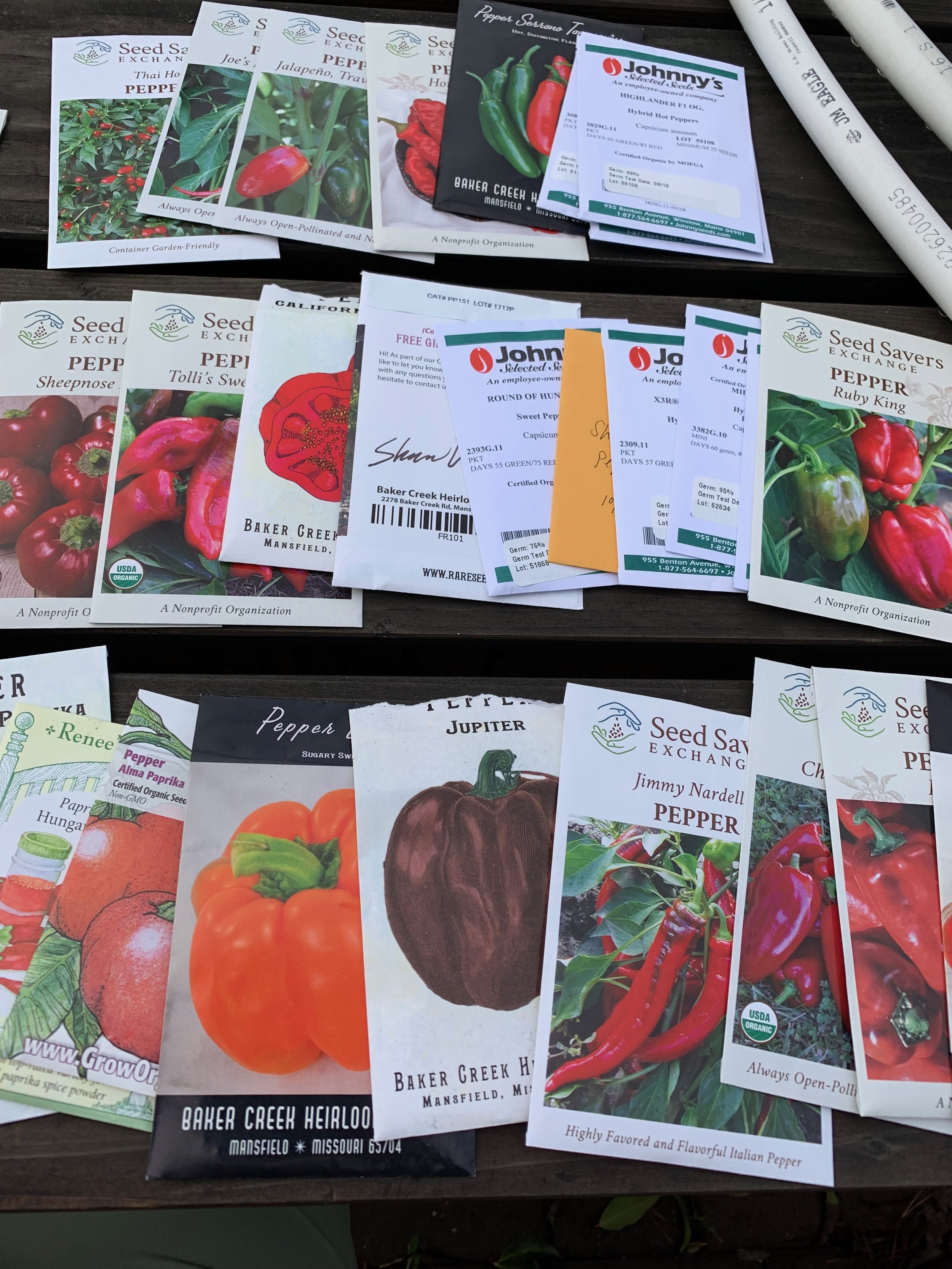
But now it’s time to start thinking about the summer garden! And in that vein, I sowed all my tomatoes and peppers today. I’m planning for about 40 plants of each, but planted twice as much (insurance against something failing) and if I have extras, I’ll give them to friends. One of Adam’s friends has decided to start a small backyard garden and she’s already asked me for a few! That makes me happy, that a young person is getting into growing food.

Tom made me a bunch of tiny seed blocks, so I was able to fit several hundred seeds within one seed tray and that limits the amount of heating pads/grow lights/space we need indoors, which is terrific. In about 2-3 weeks, I’ll pot those plugs up into larger seed blocks, and I can avoid using compostable cups (which have their limitations) and I can put them straight into gallons after that. My goal is to get them in the ground in very late April or the first weekend of May.
IMG_1714.jpg

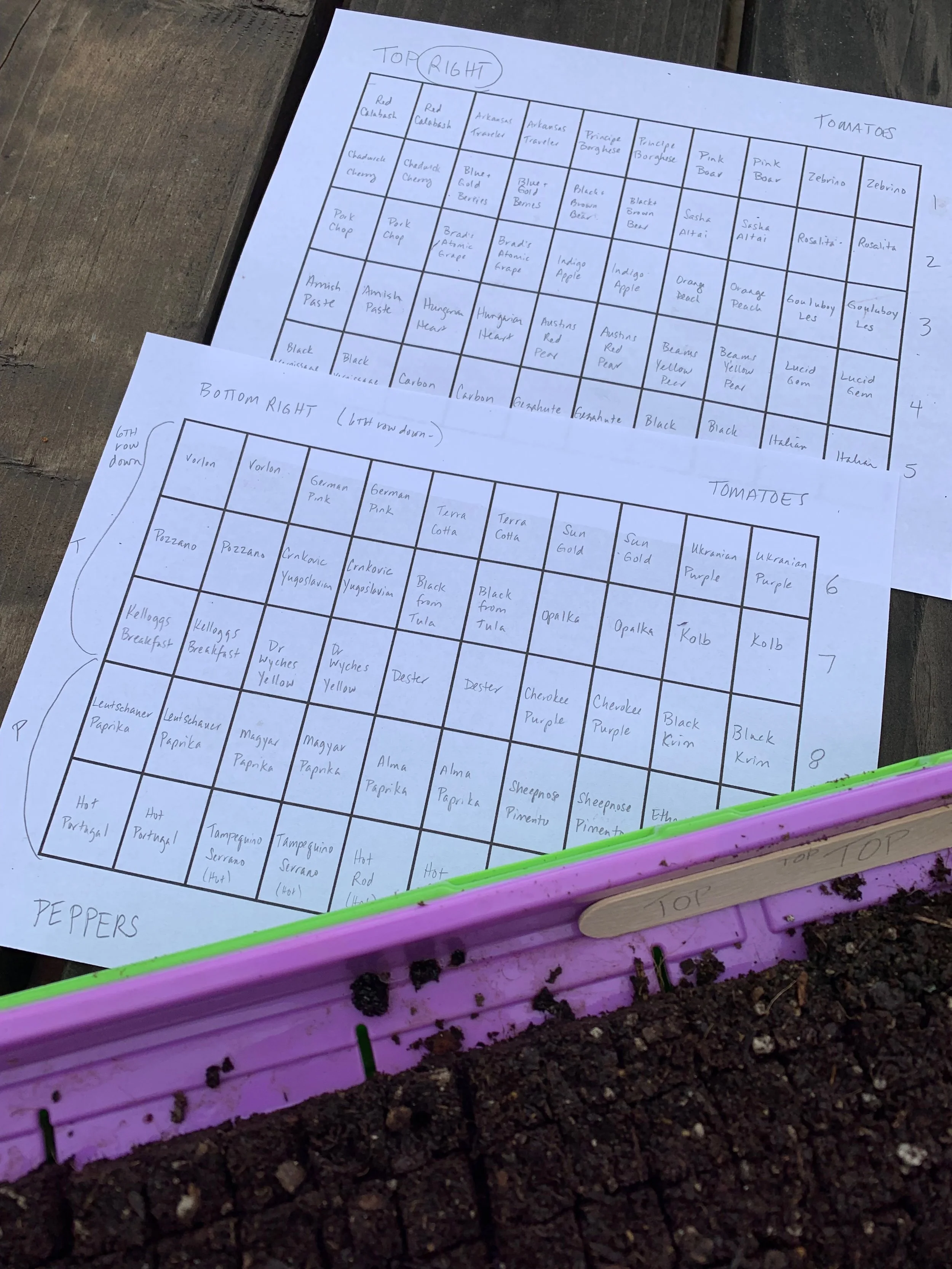
I have mostly seeded old favorites, but I have quite a few new varieties to try as well, many that were given to me by friends. Here’s what I planted. Click on the name to link you to where to purchase (or just to drool at the pictures).

Cherry/Grape/Saladette tomatoes: Sun Gold (Johnny’s, hybrid), Red Calabash (Baker Creek, heirloom), Principe Borghese (Seed Savers, heirloom), Pink Boar (Wild Boar Seeds, hybrid), Zebrino (Paramount Seeds, hybrid), Chadwick Cherry (Seeds of Change, heirloom), Blue Gold Berries (Wild Boar Farms, hybrid), Sasha Altai (Tomato Fest, heirloom), Rosalita (Tomato Fest, heirloom), Black and Brown Boar (Wild Boar Farms, hybrid), Brad’s Atomic Grape (Wild Boar Farms, hybrid), Indigo Apple (Wild Boar Farms, hybrid), Orange Peach (Southern Exposure, heirloom), Goluboy Les (Delectation of Tomatoes, heirloom), Austin’s Red Pear (Seed Savers Exchange, heirloom), Beam’s Yellow Pear (Seed Savers Exchange, heirloom), Black Vernissage (Totally Tomatoes, heirloom), Black Cherry (Baker Creek, heirloom)

Beefsteak/Slicer tomatoes: Vorlon (Renaissance Farms, heirloom), German Pink (Seed Savers, heirloom), Terra Cotta (Baker Creek, heirloom), Crnkovic Yugoslavian (Seed Savers, heirloom), Black from Tula (Seed Savers, heirloom), Kolb (Seed Savers, heirloom), Kellogg’s Breakfast (Baker Creek, heirloom), Dr. Wyche’s Yellow (Baker Creek, heirloom), Dester (Seed Savers, heirloom), Cherokee Purple (Baker Creek, heirloom), Black Krim (Baker Creek, heirloom), Carbon (Baker Creek, heirloom), Lucid Gem (Wild Boar Farms, hybrid), Arkansas Traveler (Totally Tomatoes, heirloom), Pork Chop (Wild Boar Farms, hybrid)

Paste/Plum tomatoes: Italian Heirloom (Seed Savers, heirloom) , Gezahnte (Baker Creek, heirloom), Hungarian Heart (Baker Creek, heirloom) , Amish Paste (Seed Savers, heirloom), Ukrainian Purple (Seed Savers, heirloom), Pozzano (Johnny’s, hybrid), Opalka (Seed Savers, heirloom)

And here’s the pepper list:

Hot peppers: Jalapeno Traveler’s Strain (Seed Savers, heirloom) , Joe’s Long Cayenne (Seed Savers, heirloom), Thai (Seed Savers, heirloom), Highlander (Johnny’s, hybrid), Red Ember (Johnny’s, hybrid), Hot Rod (Johnny’s, hybrid), Tampequino Serrano (Baker Creek, heirloom), Hot Portugal (Seed Savers, heirloom), Ethiopian Brown (Baker Creek, heirloom)

Sweet peppers: Tolli’s Sweet Italian (Seed Savers, heirloom), CA Wonder (Baker Creek, heirloom), Lipstick (Baker Creek, heirloom), Yankee Bell (Johnny’s, heirloom), Milena (Johnny’s, hybrid), Red Knight (Johnny’s, hybrid), Shishito (Baker Creek, heirloom), Ruby King (Seed Savers, heirloom), Etiuda (Baker Creek, heirloom), Jupiter (Baker Creek, heirloom), Jimmy Nardello (Seed Savers, heirloom), Chervena Chushka (Seed Savers, heirloom), Buran (Seed Savers, heirloom), Ajvarski (Baker Creek, heirloom), Sheepnose Pimento (Baker Creek, heirloom)

Paprika peppers: Round of Hungary (Johnny’s, heirloom), Leutschauer (Baker Creek, heirloom), Magyar (Renee’s Garden, heirloom), Alma (Seed Savers, heirloom)
More spring news:

I get a newsletter from a farm in upstate New York, called Essex Farm. They provide everything a family needs at their farm - you pay a fee for the year, and you get all your meat, veg, grains, fruit, and value-added products from them. I admire them, and their systems, greatly. If I lived anywhere within an hour of them, I’d be a member. But alas, I have to satisfy myself with reading their weekly member newsletter. (The owner, Kristin Kimball, also wrote a great book called ‘The Dirty Life,’ about meeting her husband Mark and buying the farm. A new book is coming soon, I can’t wait.)

This week’s newsletter (also written by Kristin) had two interesting things I wanted to share. Here’s the first, a very ‘spring’ thing: “A truck just pulled in and dumped twenty yards of potting soil from Vermont Compost onto a tarp north of the greenhouses. Zohar is out there now, making flats with the soil blocker. By the end of the day we’ll have 80 flats of onion seeds in the germination chamber. And so now (as Anne likes to say at this time of year, and despite the low of zero this morning) let the wild rumpus start! The sun is out and soon the greenhouse will be full and we will be listening for the spring peepers, looking for the day the soil in the field is warm and dry enough to work.” Isn’t that great?! And here’s the other one that made me smile: “It’s love season in the pig herd. We bought a boar named Ham Solo just before Valentine’s Day, and turned him in with nine nubile gilts. He seemed overwhelmed at first, but he’s in the zone now. May the force be with you, Ham.”

The spring feeling of ‘something’s coming’ makes me smile. Now, I just have to get through midterms, and I’ll be a much happier person. :)




Tags vegetable garden, seed starting, tomatoes, peppers, hoop houses
Comment

The Cedar Waxwing Invasion

February 25, 2019 Elizabeth Boegel
image credit: Evan Lipton/Macaulay library

image credit: Evan Lipton/Macaulay library

Oh my goodness, what a day. Upon finishing my homework, I went back to my room to grab my iPad. A flurry of activity out the south-facing window where the Catalpa tree is located caught my attention. Birds. Tons of birds. Larger birds. All of them in the Catalpa, flying in and around and resting on the branches. I spotted half a dozen Robins and smiled, because they haven’t been around lately. But there were other birds I didn’t recognize. Then one of them rested on a branch nearer to the window, and I could see a stripe of yellow at the base of its tail. Could they be Cedar Waxwings? I’ve never see them in our yard before and couldn’t believe it. I grabbed my camera and headed outside.

The activity and noise were just tremendous. Big groups of waxwings and robins flying all around the tree and also perching. I couldn’t get any good pictures but you can just see the crested head of a waxwing in the photo above. It was hard to make sense of all the activity - what was going on? Robins eat invertebrates, and it just started raining again, so that would explain why they were perched and ready for action. But the waxwings - I couldn’t understand what was happening. I looked down for a moment and that’s when I saw huge splotches of black bird poo everywhere, dotting the ground and the plants.

IMG_1690.jpg

Things started to get clearer. Waxwings eat berries, but there aren’t any berries in my yard right now except for some yellow Toyon berries and they weren’t in the toyon. A pattern started to emerge - the waxwings would rest in my tree, then fly across the street to a huge group of trees across the street. Upon closer inspection, I realized those trees were Privet. The waxwings came to eat the huge supply of privet berries. And now they were pooping them out all over my yard.

Here’s what I read in Audubon:

“With thin, lisping cries, flocks of Cedar Waxwings descend on berry-laden trees and hedges, to flutter among the branches as they feast. These birds are sociable at all seasons, and it is rare to see just one waxwing. Occasionally a line of waxwings perched on a branch will pass a berry back and forth, from bill to bill, until one of them swallows it. “

Get this - a group of Cedar Waxwings is called a ‘museum’ or ‘ear-full’ of waxwings. They are loud.

More of what I read:

“Except when nesting, almost always forages in flocks. May hover briefly while plucking berries or taking insects from foliage. Often flies out to catch insects in mid-air.”

They could all be catching newly emerged mosquitoes, which would be wonderful - we have warmed up about 10 degrees at night and mosquitoes could definitely be hatching from standing puddles of water from last week’s deluge. I looked up robins, and it appears that they don’t just eat insects - they also glean fruit. So it looks like all of the birds are enjoying those horrible privet trees. Guess they’re good for something.

Waxwings are apparently common here in winter, but migrate north to breed, all the way to Canada. Hopefully they’ll hang around for a while so I can admire them!

Tags birds, wildlife, ecosystem
Comment

Hazard Zones

February 20, 2019 Elizabeth Boegel
IMG_1669.jpg

In my Geology class, we are studying hazards. Actually, let me back up. What’s kind of fun is that I have the same teacher for both Geography and Geology, and she gives each student an amount of “money” between 350 k and 2 million, and with that “money” you have to “buy” a house in the Bay Area. Then, you study Geography and Geology by looking at “your” house and its location. Most of the students are around 18 years old, so for them this is a fantasy experience and helps them prepare for the adult world. For me, I’m enjoying taking all of these things we’re learning (i.e. what color should you paint your house based on insolation, albedo, absorption, to keep it cool in summer? what happens if you live west of the freeway on the east side of the bay, pollution-wise with the sea breeze? etc) and applying them not only to my pretend house, but to our real house in Walnut Creek. (Just for the record, my pretend house for Geography is in Richmond, and my pretend house for Geology is in Vallejo, I got $350 k for each of them, so that’s why they are in those locations. For those of you who don’t live in the Bay Area, those are two of the least desirable locations. To live, say, even in Oakland, you need to have a good $750 k, and if you want to live in Berkeley, a cool million or more, depending on views. Yes, this reminds me to say that we are studying the housing crisis here in my Political Science class, and it is enlightening.)

Hence my post a while back about the rocks underneath your property and how to figure out the age and formation of those rocks. But, at the moment, we are looking at hazard zones. The information I’m going to give here is Bay Area specific; if you live elsewhere, I’m sure you can find a local government website that can give you this, but you might need to do some digging. For those who live in the area, hopefully this will help you prepare. The website I’m going to share is new to me, I don’t know if it was around when we bought this house 15 years ago, but if it was, I never heard of it. Of course we had the hazards given to us in our mortgage agreement, and we knew that we were in a flood zone and had to pay for flood insurance as a condition of our mortgage, but that’s about all I remember. It was in the middle of our first leukemia year with Adam, he was 2 and Kate was 1 and there were other things on our mind. Sometimes I wonder how we ever managed a move at all. Anyway….

If you live here, there is a website dedicated to the local governments. It is called, fittingly enough, Bay Area Association of Governments. From here I got to their ‘Resilience’ program, which you can find HERE. My address is what’s inputted for this exercise, but you’ll want to put in your address to find out your hazards. Meanwhile let’s look at my house and the hazards I found here.

Let’s look at Earthquakes first, since that’s the first thing everyone thinks about when they think about California.

So if you go to the left of the picture, and click on ‘Shaking Scenarios,’ you can choose your fault and see what’s up. After the colors come up, go to the left again and click on ‘Legend.’ That will tell you what the colors mean. I’m going to click on ‘Mt. Diablo’ for the fault, since that’s closest to us, and let’s see what the shaking scenario is.

Image 2-20-19 at 5.24 PM.jpg

Yikes! All that red can’t be good. And indeed it’s not. This, according to the legend, is a very strong shaking event. Well, what does that mean? Let’s look at this chart from the USGS (United States Geologic Survey):

vhp_img5113.jpg

“Some thrown forcibly to the ground.” “Damage considerable in some buildings designed to be resistant” (!) “Buildings shift off foundations if not bolted to them.” Guess what I’m going to check about our house, ASAP???

However, if I take off Mt Diablo fault and add Hayward Fault (the second closest fault to us), I get this:

Phew. Strong, but better. Damage could be bad in old buildings that aren’t prepared. All of this makes me think we should be buying earthquake insurance, though some folks think it’s not any better than just your homeowner’s. I’ll let you do your own research on that.

Ok, let’s move on to flooding. I said that we have flood insurance already because we were told our home was in a flood zone. It’s hard to see, because we get so very little water here, but in moments like last week when I watched our back yard become a lake, it gets a little easier to imagine. Flood insurance is expensive, and many of our neighbors have had engineers come out and determine that they didn’t need to pay it anymore; they fill out a form and send it in to FEMA and that’s that. We have not done that, and are still paying the insurance, and after seeing this map, I’m glad. One thing that’s not so evident in real life is the system of creeks that carry water from Mt Diablo down to our neighborhood. On this map, that’s what’s happening when there is a big flood. Here’s how I got there - unclick any fault information in shaking, and go to ‘Flooding.’ Then click FEMA map. Here’s what I get:

Image 2-20-19 at 5.35 PM.jpg

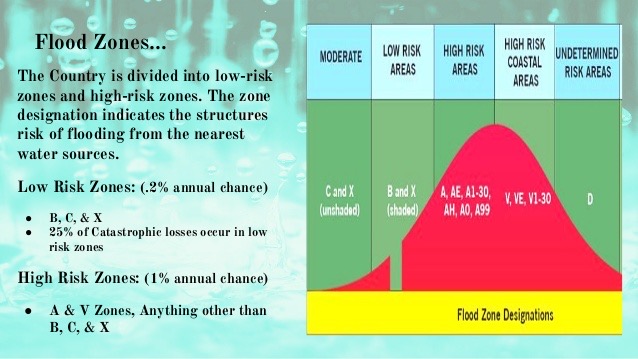
So now I go to the legend, and I see we’re in dark blue which is “AO” or “AH,” I can’t tell, but what do those mean anyway? Let’s take a look:

flood-101-8-638.jpg

This is directly from FEMA. Whether it’s AO or AH it doesn’t really matter, it means we have an annual chance, albeit a low one, of flooding. Glad we have that insurance.

This makes me think of liquefaction. Liquefaction is what happens when you live in a watery place and an earthquake causes the ground to become like a big, shaking waterbed. Think landfill, like the edges of San Francisco, a good portion of Alameda, Emeryville, etc. If we have so much water in our area, if the water table is so high, does that mean we’re at risk for that, even though we’re not on landfill? Well, let’s check. Unclick the FEMA thing, and go to ‘Other Earthquake.’ Then click on ‘Liquefaction Susceptibility.’

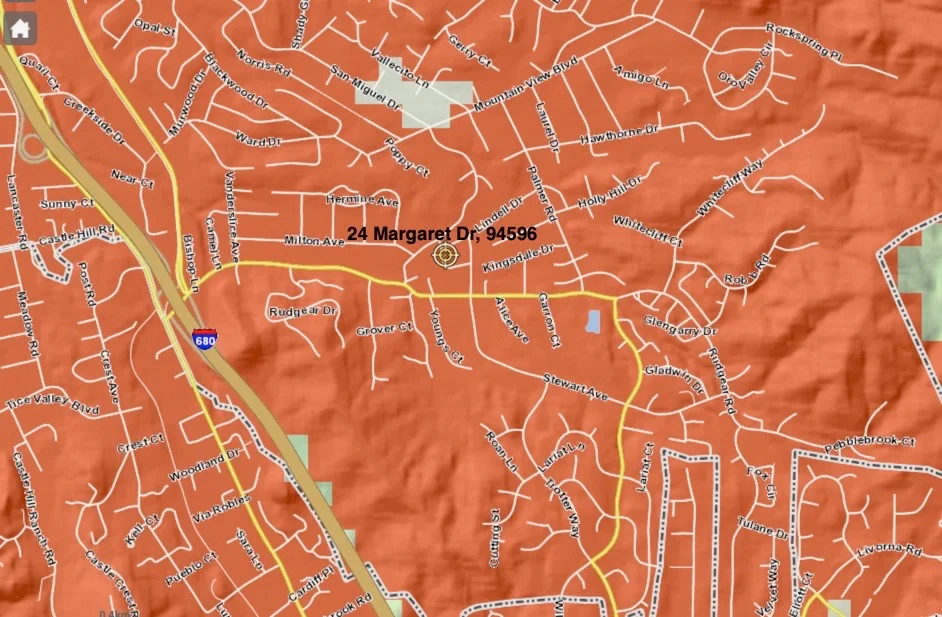
Image 2-20-19 at 5.41 PM.jpg

Oh dear. At this point, I don’t like to see any color at all. Well, what’s the legend say? “Moderate Susceptibility.” Hm. I guess I feel moderately about that. Not exactly reassured.

Ok, let’s look at the thing that scares me the most, Wildfire. Unclick all the Liquefaction stuff and go to “Wildfire.” Then click on “Urban-Wildlife Interface.” (This is the area I think I want to study in grad school or work in eventually.)

Image 2-20-19 at 5.44 PM.jpg

Legend: “Wildland Urban Interface Fire Threat.” Well, crap.

Ok ok, let’s just go all in, let’s look at landslides. We’re under Mt. Diablo, and have foothills surrounding us on three sides, so it’s possible I guess. Unclick all the fire stuff and click on “Landslide.” Let’s look at “Rainfall induced landslide” first.

Image 2-20-19 at 5.47 PM.jpg

Hooray, we’re in the clear!

Let’s look at “Earthquake induced landslide” next. Will it also be good news???

Image 2-20-19 at 5.49 PM.jpg

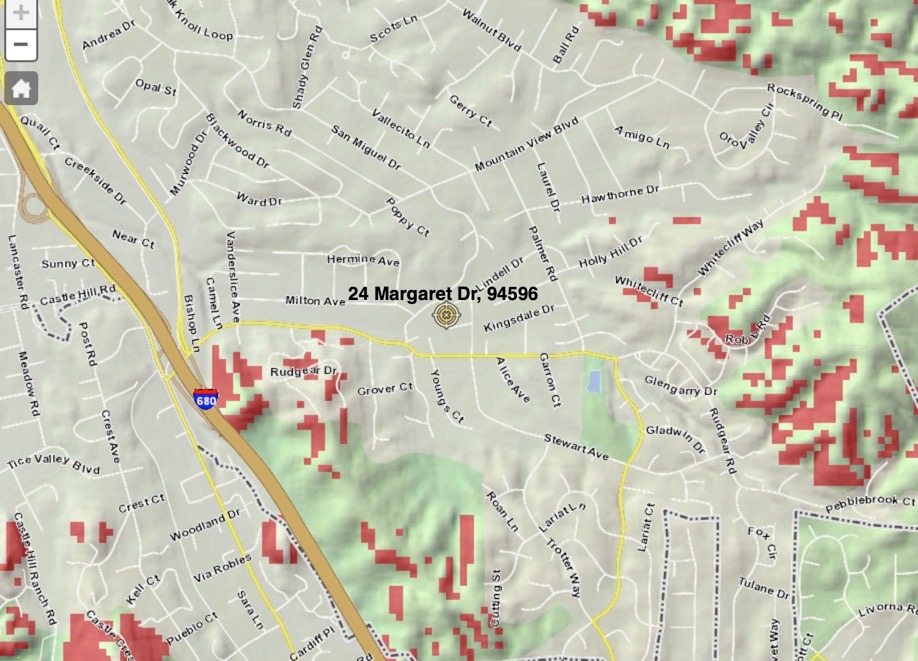
Hm… legend? “Area Not Yet Evaluated.” Well ok, let’s see the existing landslide distribution, then - maybe that will help.

Image 2-20-19 at 5.50 PM.jpg

OOOO, close, but it just misses us. Hallelujah. That’s one thing I don’t have to worry about!

So you see how this could be a valuable tool for preparing your home for a local hazard event. There are several things we can do, right away, to make this home more safe.

I hope this helps you plan for hazards in your areas, too. If nothing else, it’s fun to go and click around on the map. Go ahead, take a look at San Francisco, and see what it’ll be like for folks living in the Millennium Tower.

Tags learning
Comment

Restless

February 17, 2019 Elizabeth Boegel
IMG_1645.jpg

It’s that time of year. I’m itching to start summer vegetable seeds, to rip off the row cover, to spend whole days out in the sunshine, to see masses of spring flowers appear in the pollinator gardens. It’s a desperate feeling, and one that cannot be soothed with nice family dinners in the still-early-dark, or browsing seed catalogs, or even walking around the garden. I imagine all creatures in the Northern Hemisphere feel a similar restlessness, whether still dealing with snow and ice, or dreary wet, or just grey skies.

IMG_1629.jpg

Our property has been inundated with water. The west coast hosted an atmospheric river that flowed through our sky and simply dumped rain at the lower elevations, snow at the higher. This is good. This is necessary. This is exactly what California needs. All of that is true, but it does make for dampened spirits. I am thanking our December selves for obtaining and spreading all those wood chips, as they do a really good job of soaking up a lot of moisture and keeping us mud-free. But our hard landscape surfaces were standing lakes for a good week, and the chickens were miserable inside their coop, looking forlornly out at the rain.

February 15 is our last average frost date, but ‘average’ is the key word there, because we’ll have frosty nights this coming week. So I can’t take the row covers off just yet, even though I’m dying to. I bought a cheaper brand that is barely hanging on, having been ripped to shreds by our high winds and rain. Agribon holds together much better, but it comes in inconvenient sizes and is so much more expensive. Still, once we’ve used up our roll of the cheap stuff, I’ll go back to Agribon. Even though it’s low-quality stuff, the row covers have done their job, protecting all the winter veg from the elements, while still letting in light and moisture. Everything is looking good and tasting good, and that’s really the most important thing about having a winter garden - providing lots of food in the colder months.

However the canning shelf is looking light in everything but pickles, and I yearning for a fresh strawberry. It’ll be a while yet.

IMG_1637.jpg

I’ll start my veg seeds the first weekend of March, as I always do, in hopes that I can plant them out the first weekend of May. I already know where everything is going to go, planning the summer garden is long since a completed task, and now I just wait. The internet is full of gardeners starting seeds, so it’s hard to resist that urge. From experience I know that it’s best to put it off a while yet.

IMG_1646.jpg

Meanwhile in the open spaces the wild almond trees have begun to flower, and I’ve seen the first of the poppies, and wild mustard is starting to make its robust presence known. I notice an increase in bird activity, and the bees are loving the cold sunshine. Soon we will need to add some room to their hive, and swarm season will be upon us. Vector control says it’s time to start putting out yellow jacket traps in hopes of catching the early queens, but I don’t usually start to see them until March. Once in a while I see a native bumblebee, but mostly they are still hibernating. I’m hoping that things will really start to wake up in March, and thats the time this restless feeling will go away.

Tags vegetable garden, winter garden, wildlife
Comment

February Cooking: The Chickens Begin to Lay Again

February 6, 2019 Elizabeth Boegel
IMG_1599.jpg

Look at those bright orange yolks. That’s a direct influence of the daily greens I give our chickens to eat. All that good nutrition ends up in the eggs and makes them even more desirable. I love when the days begin to lengthen and we can eat eggs again!

Having too many eggs is rarely a problem. Lately I’ve been having a couple for breakfast scrambled with fresh grapefruit on the side. Adam likes ‘em with crispy whites and runny yolks over some sautéed greens and some of my sourdough toast. Poached eggs in a roasted tomato/garlic/basil sauce (which I freeze in jars every summer) is a quick shakshuka, dried chilies added for those who like it spicy. Sopped up with stale bread or a pita, or simply eaten with a soup spoon, it’s hard to beat.

Dinner frittatas are a good way to use up excess eggs, because you’ll need 8-12 eggs depending on how hungry everyone is. You can throw in any vegetable you have on hand, fresh or already cooked; bacon or pancetta or crumbled sausage; leftover beans or rice or cheese. We especially love them with greens from the garden, but soon we’ll switch to asparagus or spring peas (that’s not until March, usually). We always finish the frittata with some freshly grated parmesan or a bit of crumbled goat cheese, to give it a spicy salty kick.

If I have a lot of eggs and we’re craving a dessert, I like to make chocolate pudding. This recipe from The Kitchn is perfect, because it’s low sugar and high protein and uses plenty of dark chocolate. I make it at least once a month when we have extra eggs. Later this week I’m going to try this recipe from Food + Wine for avgolemono, because not only do we have a lot of eggs, we also have a lot of lemons.

Cauliflower starting to head up in our garden - this is the Romenesco kind.

Cauliflower starting to head up in our garden - this is the Romenesco kind.

February is when all the brassicas start showing up at the Farmers’ markets - broccoli, cabbage, and cauliflower are abundant here because they grow well over the winter and taste even better if touched by a little frost. My go-to way to cook any vegetable is to toss it with oil and salt and roast it in a 425 degree oven for 20-30 minutes, but once in a while it’s nice to have it some other way. Lately we’ve been sautéing them in butter and garlic, which is divine. Recently, the Washington Post posted this recipe for a green curry cauliflower, which is on my short list for weekend cooking. It looks delicious. Cabbage will soon be available and we’ll eat it fresh, as crunchy salad, and make some into sauerkraut. I’ve yet to find a cooked cabbage recipe I like; if you have one, please share it!

IMG_1602.jpg
IMG_1603.jpg


Overwintered carrots, parsnips, and beets are a frequent sight in February. Carrots and parsnips roasted together are a classic, and even better roasted underneath a salty, buttermilk-brined chicken. You could add some beets to that too, or roast them separately - wash, wrap in foil, then after roasting, slip off the skins. Don’t forget to wash and saute the beet greens, as they are delicious. Swiss Chard is in the same family as beets (Chenopodiacea, actually now Amaranthaceae, these things are moving targets), and is a beautiful sturdy green to add to your salads or sautes.

‘rainbow lights’ chard

‘rainbow lights’ chard

Actually, you can make a chard gratin just as you can with any spinach or kale. Or mixed! Delicious, for those who like their vegetables a little richer and cheesier.

I grow fava beans (or broad beans) every year as a cover crop in many areas of the garden. Beans and peas form an association with a bacteria that allows nitrogen to be collected from the air in the soil and fixed on the plant roots. If you cut down those plants before they set fruit, the roots (and the nodules of nitrogen) will decompose in the soil and become available to the next set of plants. So I do that a lot in the winter because fava beans are reliable winter growers in California. However this year I’m keen to try some of the fruit, so I’m letting a few plants produce pods.

IMG_1605.jpg

When you talk to folks about eating fava beans, they say two things: They’re delicious, and they’re hard to prepare. That’s because the beans take some extra steps in cooking. Actually, if you eat the pods young, like the one in the photo above, you can eat it whole like you would a string bean. And the leaves are edible too, just like pea shoots! But if you wait until the pod is big and knobbly, you shell the beans out of the pod. Then you have to blanch them in boiling water for a minute, and then slip the inner bean out of its outer coating. It’s like the beans have two coats. Once blanched and shelled that second time, you can saute the beans with butter or oil and they are delicious.

I’d love to hear what you’re eating out of your respective gardens! March will bring a plethora of delicious spring foods, and I can hardly wait.


Believe it or not, some Geum plants are blooming!

Believe it or not, some Geum plants are blooming!


IMG_1600.jpg
Tags seasonal recipes, cooking, vegetable garden, eggs, chickens
Comment
← Newer Posts Older Posts →

Subscribe

Sign up to get email when new blog entries are made.

We respect your privacy. We're only going to use this for blog updates.

Thank you! Please check your email for a confirmation notice to complete the subscription process.

Powered by Squarespace