• About
  • Blog
  • Contact
  • Favorites
  • Archive
Menu

Poppy Corners Farm

Street Address
Walnut Creek, California
Phone Number
Walnut Creek, California

Your Custom Text Here

Poppy Corners Farm

  • About
  • Blog
  • Contact
  • Favorites
  • Archive

Surprise Harvest

January 30, 2019 Elizabeth Boegel
IMG_1590.jpg

I bought some organic Yukon Gold potatoes from the store to make sorrel soup today. As is usual, there were a couple of sprouting potatoes in the bag, so after I made my soup, I took those rejects out to the garden. I figured I’d plant them in the round fire ring where I had planted potatoes (both Yukon and Red) back in August and again in October. December and January frosts had killed those plants, so I figured there would be no crop. But when I dug down to plant these sprouting potatoes, look what I found! I was so surprised. I then went over to the Romaine and Cabbage bed, where I had noticed potatoes growing (volunteers) in October. The frost had killed them too, even under cover - or so I thought. There I found a bunch of fingerling potatoes! What a wonderful unexpected harvest! I didn’t need to buy potatoes for my sorrel soup but I didn’t know that. I will cut and roast them all tonight to have with our Boeuf Bourguignon.

This is the sorrel soup I made, one of my favorites. I’ve already written about it here, with a recipe, if you’re interested. I think it’s entirely worth growing sorrel just for this recipe.

A couple of interesting things to share:

One is my garlic crop.

I planted hardneck garlic for this year (you can read all about my weird garlic 2018 here), two different kinds. The one on the left is Spanish Roja. The one on the right is German Red. See how differently they grow? The Spanish one is tall and thin and light green, and the German one is short and sprawly and dark green. I can hardly wait until May to pull these guys up and see how they look underneath. I have sort of an idea, because I had extra seed garlic after planting, and since seed garlic is just a head of garlic like you buy at the store (except organic in my case and from a farm), I’ve been using the extra for cooking. The problem is I don’t know which is which. Both are extremely easy to peel which is fabulous, and apparently a feature of hardneck types. Both have reddish outer skins. Both taste great. But one has giant cloves and one has smaller cloves. Whichever one has giant cloves wins. That’s the one I will plant again.

The hardneck thing is going ot be hard for storage though, since I guess you can’t braid hardnecks. We’ll cross that bridge when we come to it.

Second interesting thing:

I’m taking Geology this term, and my professor showed us how to figure out what kind of rock is underneath our houses.

First, go to the USGS website.

Then, click on the national geologic map database.

Then, when you’re on the US, look at the right side and scroll down to ‘location’ and type in your address. You’ll need to have Adobe Flash on your computer to use this. Click the magnifying glass to zoom in or out.

The map will pinpoint your location at the bottom of a red diamond. You will see lots of codes, like at my house, it says the soil beneath us is ‘Qa.’ You’ll need a key to determine what the codes mean. Scroll down the left side of your screen and you’ll see a hand with the letter ‘i’ in a circle. Double click on that, then click on the area around your house. A little black box will appear with some choices. Choose ‘browse.’ A separate window will open up with a key to your little part of earth!

My property is made up of alluvial soil, that is, soil that was under water. This explains our hardpan clay.

If you look at my map, you’ll see lots of little broken black lines to the right (east) of our house all along the hills. Those are all faults. In California, hills pretty much mean faults. Can you see the orange section to the right of our house? That’s called Shell Ridge, and it’s called that because there are all kinds of fossils of seashells on those hills. It used to be an ocean. Then somehow the earth was lifted up (earthquake?) and it emerged from the water. However, if you look at the type of rock in that area, you’ll find it’s basalt - which comes from cooling lava. So at one point there was a volcanic eruption under that ocean. It also tells you the age of the rock - this particular rock comes from the Orinda Formation, which is from the Pliocene age. That’s somewhere between 2-5 million years ago!

I’m not sure if this is your kind of thing or not, but I find it fascinating.

I’d love to know how you’re all faring, winter-wise. I imagine some of you are in the deep freeze of the midwest about now. I’m sorry to tease you with shots of garlic and potatoes when you’re probably breaking ice in your livestock waterers every hour. Please let us know how things are going on the other side of the country!


Tags vegetable garden, cooking, garlic, learning
Comment

Promise

January 25, 2019 Elizabeth Boegel
loving the trimmings from the cereal rye cover crop

loving the trimmings from the cereal rye cover crop

It’s a typical January, in Walnut Creek - chilly at night, but around 60 and sunny during the day, which allows for some hope that spring will soon be here. Actually, it may as well be spring, despite the frosty nights: All the California native plants have had lovely soaking rains, which is their trigger to start growing. If we’re lucky, the hills will soon be full of color, with blooming poppies, tidy tips, clarkia, lupine, mule’s ear, and Chinese houses, making a sort of natural mosaic painting out of our landscapes.

And in my own garden, promise is definitely lurking.

It lurks in the chicken egg (or two!) that we are now getting every afternoon, signaling longer days.

It lurks in the pollinator gardens, in which thousands of seeds have germinated and are starting the push to grow and flower.

It lurks in the buds on the perennials.

IMG_1547.jpg

It lurks in the native bulbs, like this elegant brodiaea, about to bloom.

It lurks in the vegetable beds, where whorls are tightening to make flower heads, which we will eat, soon.

an Italian variety of cabbage

an Italian variety of cabbage

IMG_1488.jpg

It lurks in the greenhouse, where early summer flower seeds are germinating.

IMG_1553.jpg

It lurks in the beehive, where pollen is steadily being collected, to feed the babies.

IMG_1554.jpg

And promise also lurks in the fruit bushes, with budding flowers and fruit.

Huckleberry

Huckleberry

Strawberry

Strawberry

It’s heartwarming to walk around the garden and see these promises of spring. Have you seen any signs of it in your garden, yet?


Tags flower garden, vegetable garden, fruit garden, chickens, bees
Comment

"Announcing your place in the family of things"

January 19, 2019 Elizabeth Boegel
Manzanita blossoms falling to the wood chips below

Manzanita blossoms falling to the wood chips below

I’m sure you’ve all heard that Mary Oliver, the acclaimed poet, died this past week. Upon her passing, I was surprised to see such passionate and vehement opinions (all favorable) about her work, expressed by various nature writers whom I admire. I came across her poems once or twice and enjoyed them, but had never dug deep. So, encouraged by all these wonderful comments, I attempted to do so now.

Shelling pea blossoms

Shelling pea blossoms

And, WOW. Her work is really inspiring. I wish I had discovered her earlier. All of it is deeply spiritual, deeply nature-loving, and wonderfully understandable (not the case with many poets). I have ordered her latest book, ‘Devotions,’ which is a sort of best-of. It’s a book I think we should have around, and should be read by anyone who appreciates nature.

A honeybee foraging in the fava bean blossoms

A honeybee foraging in the fava bean blossoms

I read an essay about her in the Washington Post, by Maggie Smith, that really hit home for me; here’s the paragraph that made me truly tune in: “I learned from Mary Oliver how attention is a kind of love, how shining your mind’s light on a thing - a grasshopper, a bird, a tree - is a way of showing gratitude. I learned that poems do not need to be ‘difficult’ to be intelligent, that poems can be both inspirational and investigative, that poems can be tender without being soft. I learned from her to own my wonder and to stay open to uncertainty.”

Late-season narcissus

Late-season narcissus

Does that sound familiar? Isn’t it sort of a theme of ours, those of us who appreciate nature, and who want to mark its processes in some way? Haven’t we talked about, over and over, the need to pay attention, to tell the story? Mary Oliver was one of us.

the first starflower

the first starflower

Her most famous poems are famous for a reason - they resonate. Here is one I love:

“You do not have to be good.
You do not have to walk on your knees
for a hundred miles through the desert repenting.
You only have to let the soft animal of your body
love what it loves.
Tell me about despair, yours, and I will tell you mine.
Meanwhile the world goes on.
Meanwhile the sun and the clear pebbles of the rain
are moving across the landscapes,
over the prairies and the deep trees,
the mountains and the rivers.
Meanwhile the wild geese, high in the clean blue air,
are heading home again.
Whoever you are, no matter how lonely,
the world offers itself to your imagination,
calls to you like the wild geese, harsh and exciting -
over and over announcing your place
in the family of things.”
— Wild Geese, by Mary Oliver
growing in fresh wood chips

growing in fresh wood chips

I think there is probably no greater epitaph - no greater appreciation of this poet and her life - than to go outside this weekend, no matter the weather, and pay attention.


Tags learning, art, flower garden
Comment

Always a Trade-off

January 15, 2019 Elizabeth Boegel

I have a confession to make. For the past many years, we’ve been using paper napkins. I don’t know why we had this disconnect…. perhaps it has something to do with the transition from having kids to young adults, and we’re behind in making that transition. Neither Tom nor I grew up with paper napkins, but when kids are little, it sure is handy. And I would comfort myself that many of those used napkins would go in our compost, to be reborn in our garden. But many went in the trash. What a waste of resources.

Likewise with paper towels. I tend to reach for them more than for the cloth towel that is hanging on the oven door.

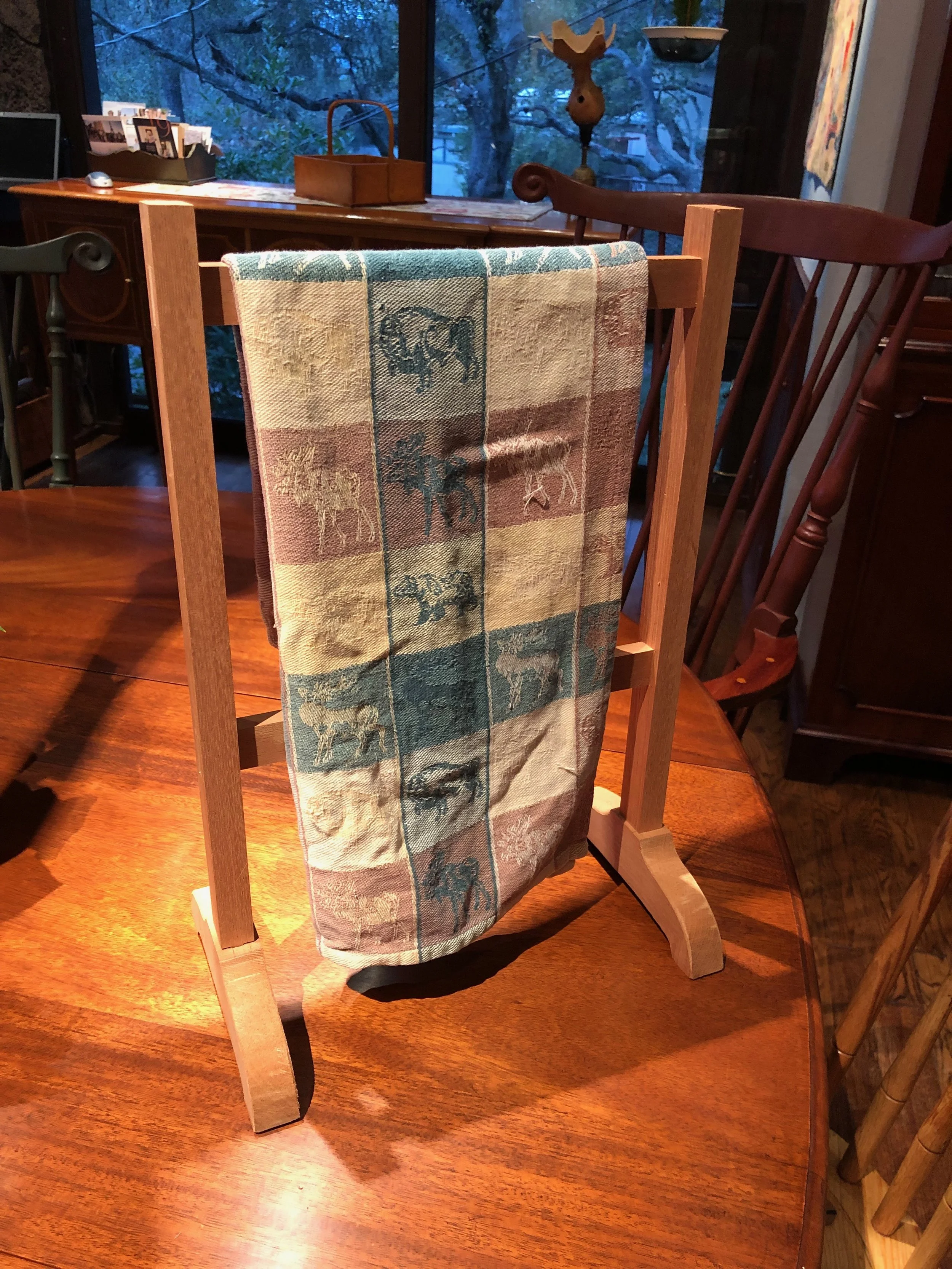
Recently I somehow woke up to the fact that this was happening, and set about making a change. My mother has bins upon bins of unused cloth napkins and was happy to gift me a pile. I found cute napkin rings on Etsy which makes it more fun. I started putting cloth napkins in the kid’s lunch bags. And I asked my dad to figure out some kind of cloth towel rack that would sit next to our sink, in place of the paper towel rack. He immediately adapted an old Shaker design for a quilt rack and made me this beautiful thing.

IMG_2172.jpg

I have a million cloth towels, so changing it out every couple of days is not an issue. And we won’t forgo paper towels entirely, I imagine. But just putting this in arm’s length, right next to the sink, will eliminate most of our paper towel use.

I recently, also, cleaned out our linen closet, and we had so many old towels and rags. There’s only so many that need to be saved for cleaning or painting; and so, when I packed up the Thanksgiving and Christmas items, I used these to cushion breakable things, instead of replacing the old ratty packing paper with fresh packing paper. It felt good to find a purpose for those cloths.

Tom also goes through undershirts; you know, those white t-shirts, and has to buy new ones a couple times a year. I had a pile of them that I wasn’t sure what to do with, and finally realized that I could spend 15 minutes cutting them into strips and storing them for summer, to use as tomato or pepper ties. And at the end of the season, they can be composted, since they are 100% cotton.

So all of this was making me feel pretty good! Maybe a little self-righteous… walking around like I had my stuff together, man. Then I went to do laundry. And I realized: All this stuff has to be washed. Which is fine, I don’t mind washing and folding (by the way, I love the Marie Kondo way of folding, I’ve become a convert), but WHAT ABOUT WATER? Isn’t that just as precious a resource as trees (which make paper)?

And so, chastened, I was newly cognizant of the fact that there is always a trade-off. Sure, you can argue that I’m doing laundry anyway, so adding these little towels and napkins isn’t that big a deal, and you’d be right about that. But it IS still using resources. No method is perfect. I mean, you can find this everywhere - like my seed starting mix from the other day. I’m not using peat, because it’s not renewable, but I AM using coconut coir, which comes from palm trees, which are a by-product of the coconut water and milk industry, which has it’s own BIG issues, not the least of which is shipping those coconuts to the United States. Or how about our electric car? It doesn’t use any oil, true, but it does use electricity, which in CA is partly wind-powered, partly water-powered, but also coal-powered.

I think, therefore, that we can’t be perfect. All we can do is make a better choice. And honestly, that takes some pressure off. We weigh our paths, our goods, our consumerism. And we make a knowledgable, conscious choice. That’s all we can do, really.

IMG_1408.jpg

In other news:

I think we may have a skunk living under the train shed with the opossum.

My dad has a new website for his woodworking. You can access that site HERE. There are dozens of furniture plans available, along with step-by-step YouTube videos instructing you how to make them. Tom redesigned this website to make it more user-friendly, and I hope you’ll stop by and check it out, if for nothing else than to view the gorgeous period furniture.

Today is the 15-year anniversary of our son, Adam, being diagnosed with leukemia. He’s the healthiest person we know, now.

Tags learning, environment
Comment

Soil Blockers

January 12, 2019 Elizabeth Boegel
Our friend the opossum, making her way along the fence about 8 a.m., back to Adam’s train shed, under which she has lived for many years

Our friend the opossum, making her way along the fence about 8 a.m., back to Adam’s train shed, under which she has lived for many years

I do a lot of seed starting, beginning now with spring flowers, and then in March all our summer veg, and then again in August for winter veg. I go through a lot of seed mix and I have used and re-used those flimsy plastic seed trays for years. There’s a lot of problems with those seed trays; they tear and break easily, you have to dig out the seedlings to pot them up which often hurts the roots, and they don’t sit well in the flats that are made to go with them. They’re standard: Everyone uses them, but everyone rather dislikes them. Me especially.

I’ve experimented with other ways of starting seeds. You can put them in half an eggshell, you can make little paper pots for them, you can buy ‘cow pots’ made out of manure. You can start them in peat pellets, but peat is a very unsustainable medium. I just wanted a better way. And then I started hearing about soil blockers.

image credit: Lee Valley Tools

image credit: Lee Valley Tools

People seem to have great luck with these little machines. I figured it was worth a try and asked for them for my birthday. Tom ordered two sizes for me - one is a block of 3/4” squares - there are 20 of those squares in the block. The other is a block of 4 2x2” squares. I experimented with them today to start Iceland Poppies, along with some other seeds. The tiny blocks were good for the poppies because I just scattered the seed over the whole block, those seeds are so tiny. The larger blocks are good for bigger seeds, like sunflowers or beets.

IMG_1466.jpg

The trick is to really saturate your soil mix. I used an organic seed starting mix made of shredded coconut coir and perlite, with organic worm castings mixed in. You really add a lot of water and let it sit awhile to hydrate. This makes it easier to form the blocks. I have to say that the larger blocks were MUCH easier to make than the small ones.

My examples are not terribly good because I need to put the soil blocks closer together. Otherwise when you water them, they spread all over the place. I’ll just use a spray bottle on these, but in the future, the soil blocks will cover the trays with no gaps between blocks.

IMG_1463.jpg

One really nice thing about these soil blocks is that you don’t disturb the roots when you transplant them, as you lift the block of roots out whole. No digging, no pricking out, no separating roots.

A lot of folks make wooden trays in which to hold these blocks; three sided trays so the water can run out the other side, and you can slide out the blocks to plant them in your beds. I knew we did not have a lot of time to be building wooden trays; hopefully we’ll make some in the future. Meanwhile I bought some trays I had seen at the Heirloom Seed Festival in Santa Rosa in September. They are made by Bootstrap Farmer. They are super sturdy and will last for years. Plus, they come in fun colors.

The ones on the left are called ‘microgreen trays’ - see how they have a slight bit of drainage in the bottom? These are good to put the soil blocks in. Then I set that tray on top of a regular tray, like the ones on the right, to catch any water, which I reuse. I’m really happy with these trays. Not cheap, but certainly will last longer than those cheap ones.

I seeded a bunch of different flowers today, and those trays are in the greenhouse. It’s really to early to do much of anything, but I wanted to see if I could get those (notoriously difficult) Iceland Poppies to germinate in the next month, so I can plant them out as soon as it starts warming up in February. I also sowed-in-place a million California poppy, Clarkia, Phacelia, and California bluebell seeds all over the pollinator gardens. Hopefully we’ll have a good show in a month or so.

Tags flower garden, seed starting, recommendations
4 Comments
← Newer Posts Older Posts →

Subscribe

Sign up to get email when new blog entries are made.

We respect your privacy. We're only going to use this for blog updates.

Thank you! Please check your email for a confirmation notice to complete the subscription process.

Powered by Squarespace