• About
  • Blog
  • Contact
  • Favorites
  • Archive
Menu

Poppy Corners Farm

Street Address
Walnut Creek, California
Phone Number
Walnut Creek, California

Your Custom Text Here

Poppy Corners Farm

  • About
  • Blog
  • Contact
  • Favorites
  • Archive

Honey Tasting

August 11, 2018 Elizabeth Boegel
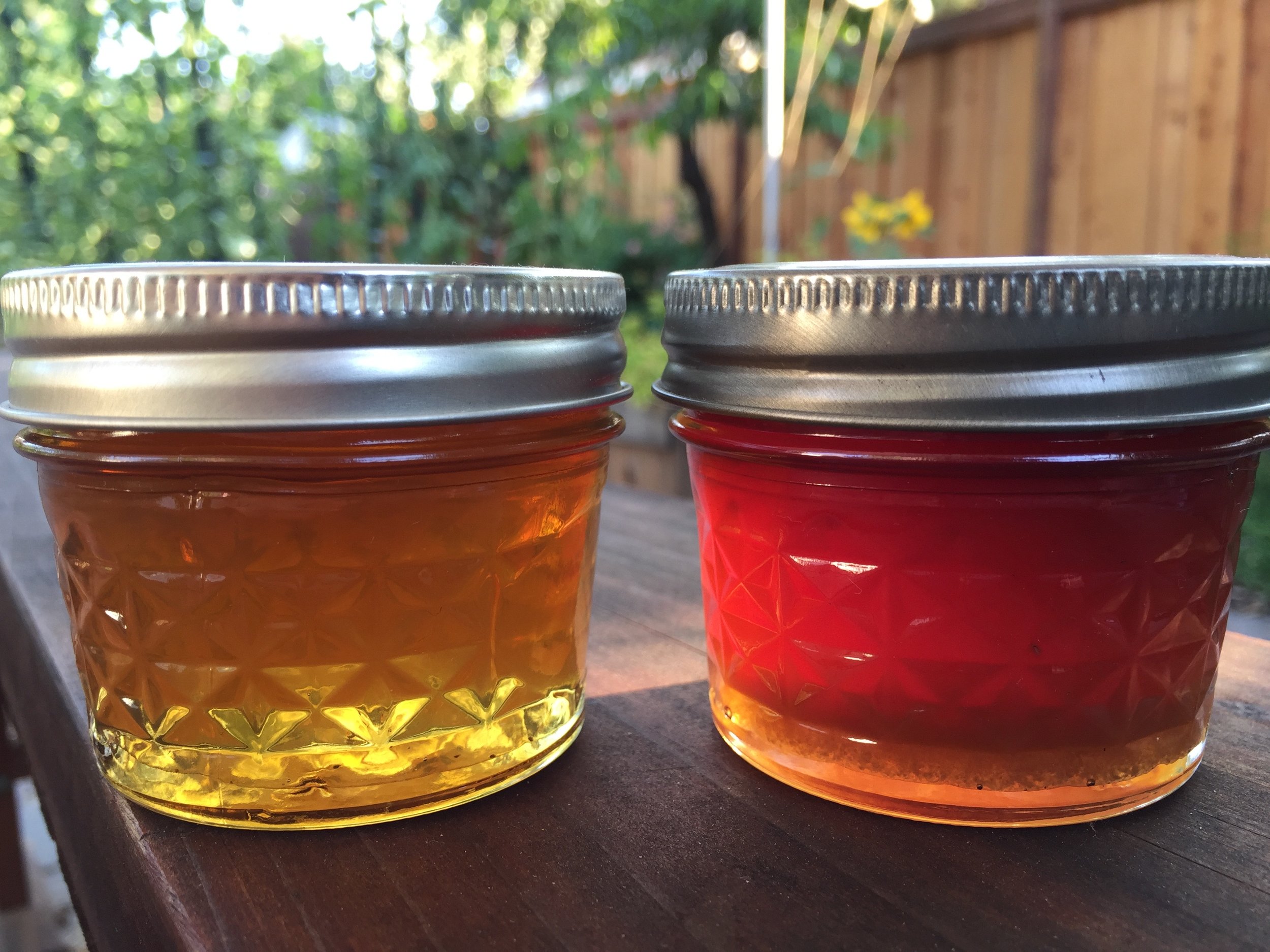
On the left, late spring honey. On the right, winter honey.

On the left, late spring honey. On the right, winter honey.

Each month, my beekeeping association has a general meeting with a guest speaker. Lately, the folks at UC Davis (our local land-grant university) have been coming to give the talks. We had a great one in July about the latest research in varroa mites (given by Dr. Elina Nino, Program Director for Apiculture), and last week, Amina Harris was our speaker. She is the director for the Honey and Pollination Center. UC Davis is really leading the way in a lot of interesting agricultural studies (have you seen the latest on nitrogen-fixing corn? very exciting) and their participation in apiculture is ground-breaking. Ms. Harris' program is the only one I know of for honey tasting, which is similar to wine, coffee, or beer tasting. But the reason for it is very different. UC Davis wants to help determine if the honey coming into the US is adulterated.

IMG_0168.jpg

You may remember my post about this very issue. Imported, adulterated honey is a huge problem for our country, and the people manufacturing it keep getting around the chemical tests that have been developed to detect the fake stuff. So, Ms. Harris reasons, if we get humans on the case, with developed palates, we can begin to add another dimension to the testing of imported honey. 

So, she gave us a quick lesson in tasting, and it was fascinating. You can take an official course at UC Davis in this art, but it ain't cheap. So it was fun to have her explain some basics.

IMG_0174.jpg

First off, she divided all honey into four categories: Fruity, Floral, Buttery, and Brown Sugar. Within those categories there are other sub-categories with about a million flavors for each. She gave us each three samples of honey to demonstrate the first three categories: Blackberry, Orange Blossom (citrus), and Eucalyptus. Let me just state right here that in order to know what the origin of your honey is, you have to have an awful lot of property with dedicated plants. Like three square miles of predominantly eucalyptus trees, because that's the foraging range of bees. I can never state what kind of honey mine is, because my bees forage on such different stuff in my neighborhood. I can guess what they are eating in different seasons, but it's just a guess. So I could never market my honey as one certain kind.

We were instructed on how to smell the honey, and what to think about and look for as we tasted it. I have to say, I'm not so good at this. I never have been. I think I have a good palate and a good sense of smell, but when it comes to describing the way things taste, I'm terrible. I'd be simply rubbish at taste-tests. All honey smells like honey and all honey tastes like honey. However I will say that when you taste test three different honeys side-by-side, you can easily tell the differences in them. But would I be able to say which flower made which honey? Doubtful.

Anyway, surprisingly, I enjoyed the eucalyptus honey the most, because it had the lightest flavor (and Ms. Harris would say 'light' is not a flavor). And yet it had the darkest color, so you would assume it would have a more robust flavor. This honey tasting stuff is pretty eye-opening. Also, you can taste the pollen in the honey (if it's real and not heated) - although less pollen gets into the honey than you would think. Also, that idea that local honey helps with allergies? I've said it before, but it bears repeating: Most allergens come from wind-pollinated trees, and that means that pollen won't be in honey. So really it won't help with your allergies. However honey has a LOT of other health benefits (if it's real, and if it's untreated or heated); it's anti-viral, anti-fungal, anti-bacterial, and it never goes bad. Did you hear about that honey they recently found in an Egyptian burial site? Still good.

And this is the perfect place to insert my mantra about buying honey: We should always buy local honey from a local beekeeper. It will not be cheap, in fact it will be much pricier than the stuff in the bear at your local Safeway. But this way you are sure to get the real stuff, unheated and untreated, simply filtered (to remove any wax or bee-parts) and bottled. Go to your farmers market or local health food store to purchase your honey. 

IMG_0176.jpg

Today is beer-making day, pickle-relish-making day, and sriracha-making day. We ran out of sriracha a long time ago and miss it terribly. Homemade is so good! If you haven't made it, I highly suggest you do. I'm not a hot-sauce person, but I love a slug of sriracha in my Asian noodle dishes (and Adam will eat it on everything). You can find the recipe here. 

Tags honey, beekeeping, preserving, peppers
2 Comments

August Wreath

August 9, 2018 Elizabeth Boegel

I finally got around to making the August wreath. I snipped some suckers off our California Pepper tree (Schinus molle) and also some of the seed pods from the Salvia Clevlandii. The pepper is blooming with tiny white flowers, and the sage is extremely fragrant. So altogether the two make a lovely looking and smelling wreath.

IMG_0165.jpg

Salvia clevelandii is one of the stars of our garden. It takes very little water, the native bees love the purple blooms which are arranged on a sort of wheel, there are 2-3 wheels per stem, hummingbirds love them too, and then the birds love the seeds. The shape of the plant is very architectural and gets quite tall and makes a big statement. 

This photo is from Las Pilitas nursery in southern California and there is a nice description of the plant here. 

This photo is from Las Pilitas nursery in southern California and there is a nice description of the plant here. 

It's not a dense plant though, especially with dry soil, so it has an airy look to it which I like (movement in the breeze too which is my favorite) and it needs cutting back each autumn. The scent is very strong, and you'll either love it or hate it. I love it. It smells wild. It smells of chaparral. It smells of Mt. Diablo in summer.

Speaking of summer, we are overrun with cucumbers. Tom has made 16 jars of pickles, all kinds, and I have another large jar in the fridge with half-sours, my own personal favorite. We've eaten cucumbers in all ways and are still awash. Perhaps you would be surprised to find out (I certainly have been) how many people do not like cucumbers. I'm having trouble giving them away! Tomatoes and peppers are steady, so is basil, and green beans are an everyday event as well. Today I shall make salsa. 

I've ordered garlic, shallots, asparagus and seed potatoes for fall planting, as well as all brassicas, greens, and root veg seeds. I won't start winter seeds in the greenhouse until September first, with a plan for all the winter veg to go in the ground October first (though asparagus will go in in January). Which reminds me, I need to order fresh row cover, Agribond 19, which I get from Peaceful Valley. So here's your reminder - order those overwintering items now - garlic and shallots sell out quickly.

Tags seasonal wreath, flower garden, vegetable garden, preserving
2 Comments

Red Sky

August 7, 2018 Elizabeth Boegel
IMG_0143.jpg

This is what sunrise looks like these days, seen peeking through my neighbor's Japanese Black Pine. During the day, the sky stays red, with the sunlight filtering through the thick layer of smoke in the air. 

IMG_0158.jpg

It's depressing as hell, actually. It feels post-apocalyptic. Then I think about the folks who live near, or in, the fires. For them, it really is post-apocalyptic.

IMG_0155.jpg

This isn't a political blog, but I must say it doesn't help when the president tweets out falsehoods about why California is burning. I've come to believe that there is a large part of the population that believes every word he says, and he knows this. And that's why he says things that are deliberately false, to spread this dissension and hatred. So the fires, or the air quality, or the true reasons behind them, aren't the only thing depressing me (although God knows, that's enough to depress anyone). It's this horrendous idea that California has brought this on itself. The truth is bigger than that. It's that it's happening to all of us, everywhere. Our events look different, but they all stem from the same thing. And at the moment I just can't see a way out for any us. And it weighs heavily.

IMG_0149.jpg

It's hard to focus on the harvest, or what we're cooking, or starting seed for a winter garden, when this larger issue is (literally) hanging above our heads. I try to remember that all I can control is my immediate sphere. I try not to read the news more than once a day. I try to find the real science behind the 'why' and try to imagine a future where we are all okay. But friends, I must be honest, I'm struggling. And I wonder if you are struggling too? Am I alone in this feeling?

Tags learning, environment
6 Comments

Paprika, and some other random things

August 5, 2018 Elizabeth Boegel
Orange pepper is 'Alma', skinny red one is 'Magyar', and fat red one is 'Leutschauer'. Got these seeds from Renee's, Baker Creek, and Seed Savers.

Orange pepper is 'Alma', skinny red one is 'Magyar', and fat red one is 'Leutschauer'. Got these seeds from Renee's, Baker Creek, and Seed Savers.

I am growing three kinds of paprika peppers this year, in the hopes of making my own spice powder for the year. So far this has been a tremendous success. All three of these peppers are producing like crazy. When fresh, they are all mild enough to eat on sandwiches or salads (at least mild enough for my pepper-loving son, I haven't tried them that way) and when ripe, have been excellent for making paprika. 

IMG_0140.jpg

For regular paprika, I just slice up the peppers and dry in them in the dehydrator, then grind them in our spice mill (a dedicated Krups coffee grinder). 

For smoked paprika, we smoke them for about six hours over hickory wood smoke, then slice and dry in the dehydrator. This has yielded a particularly yummy result.

IMG_0132.jpg

It's lovely and fresh in jars, and will make nice additions to our meals over the next year. It can also be used in other homemade spice mixes such as chili powder, which is next on my list. I also want to smoke some jalepenos to make dried chipotle peppers.

In other news, I've read a couple of articles that I thought you might be interested in, regarding the current fires in California and climate change. The first is from one of our favorite local farms, Full Belly. This article starts off reporting the condition of the farm after a fire passed within its boundaries, but then goes on to explain all about soil health and water conditions. You can read this article HERE.  The second is from the LA Times, and it explains how the current fire conditions (and weather conditions, and water conditions, it's all related) are a direct result of climate change. Here in California, there's been a distinct shift (in the last year) from speculation to confirmation, regarding climate change. (And as you know, our current administration is still denying it.) You can read that article HERE. 

Rudbeckia hirta

Rudbeckia hirta

I still haven't gotten around to making the August wreath yet. It's been too hot and smoky to get out on a hike and see what's available. I'll post it when I get to it, but meanwhile last month's wreath has dried beautifully and still looks nice, so there's no rush.

Now, off to make tomato/basil sauce for the freezer!

Tags learning, preserving, peppers
Comment

Gezahnte tomato

August 3, 2018 Elizabeth Boegel
IMG_0125.jpg

I have a new favorite canning tomato. These beauties are a variety called Gezahnte, from Baker Creek Seeds, who reports they are from Switzerland. As you know, I pick tomatoes just after they begin to break color, so the squirrels don't eat them. I bring them inside to ripen, and these ripen beautifully inside over just a couple of days and become a bright pink-red.

They are hollow-ish inside. So when you pick them, they feel very light. But what it means is that there is very little juice/seeds/pulp, which makes them perfect for canning.

But they also look really gorgeous when sliced (like flowers!), and taste great, so they're good for fresh eating, too. And not terribly messy because they are not terribly juicy.

The plant itself is super-prolific. I have two of these vines growing, and each has at least 15 fruits on them at the moment, with just as many already picked and processed.

IMG_0134.jpg

They form in these adorable clusters. I just love their pleated shape.

The plants have done wonderfully despite our hot days (mid-90's for months) and cool nights (around 60 still every night) and dry conditions. They did have blossom end rot early on, and I lost about 10% to that, which seems about typical for my garden. However 10% is nothing on a plant this prolific, so it doesn't bother me so much.

The fruits are between 6-8 ounces; not terribly large. When canning, they slip their skins extremely easily and pull apart effortlessly for crushed tomatoes. Another plus is that they keep their color after canning.

IMG_0133.jpg

The cans on the right are the Gezahnte; the ones on the left, other kinds of tomatoes mixed. You can see how much prettier the Gezahnte cans are.

So this tomato is a new winner for me, and I plan to grow it every year. I think my four favorite paste tomatoes are Opalka, Amish Paste, Ukranian purple, and this one. I won't mess around with any others from now on - just these four.

Tags tomatoes, vegetable garden
2 Comments
← Newer Posts Older Posts →

Subscribe

Sign up to get email when new blog entries are made.

We respect your privacy. We're only going to use this for blog updates.

Thank you! Please check your email for a confirmation notice to complete the subscription process.

Powered by Squarespace