• About
  • Blog
  • Contact
  • Favorites
  • Archive
Menu

Poppy Corners Farm

Street Address
Walnut Creek, California
Phone Number
Walnut Creek, California

Your Custom Text Here

Poppy Corners Farm

  • About
  • Blog
  • Contact
  • Favorites
  • Archive

New Strawberry Wall

January 27, 2018 Elizabeth Boegel
IMG_7106.jpg

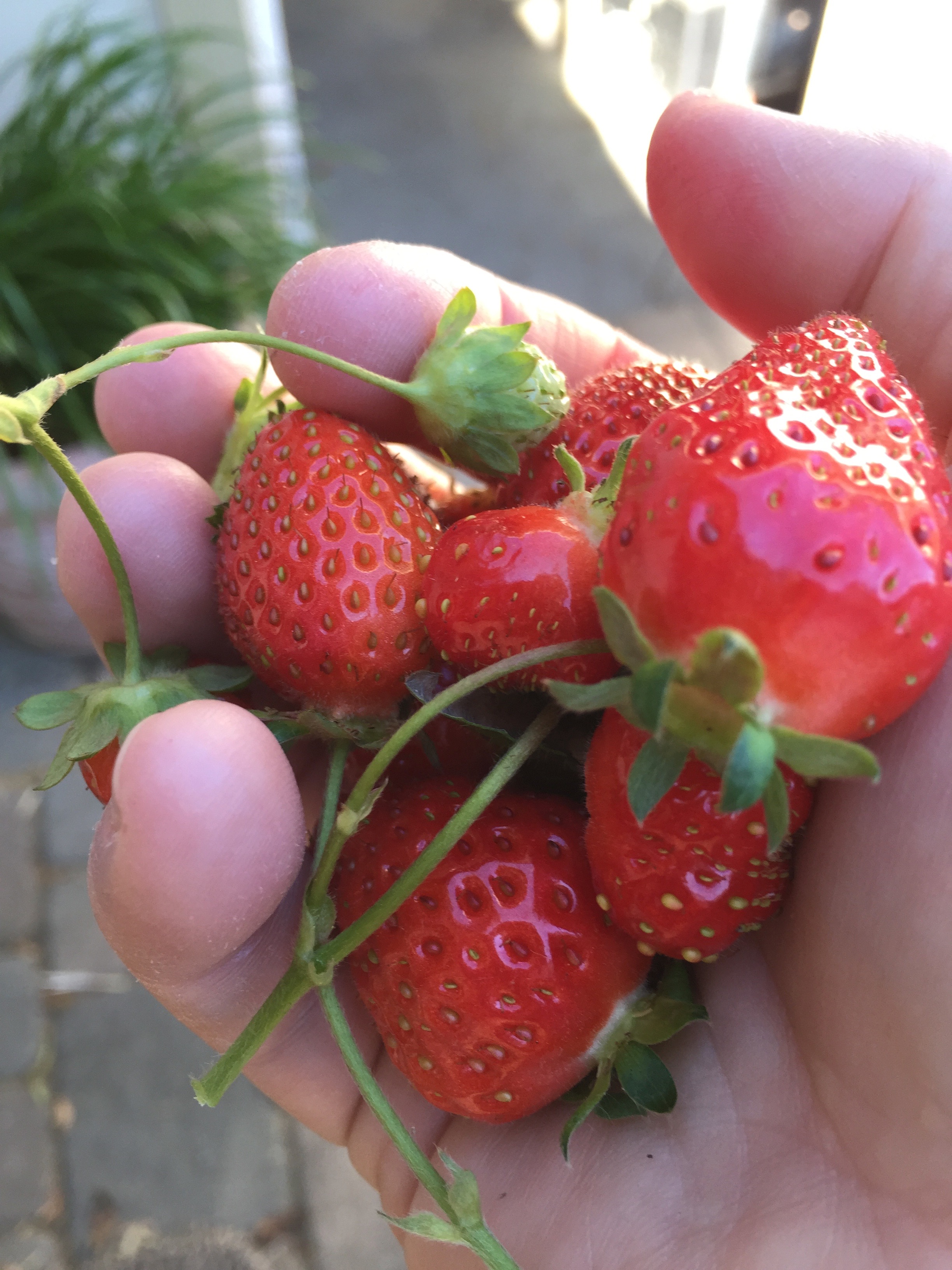
Come June, all we want to eat are strawberries. We buy them at the Farmers Market by the flat; to eat fresh, to add to baked goods, and to make jam. We buy them because I can never grow enough here to satisfy our cravings. Tom and I joke that our entire yard could be planted to strawberries and it still wouldn't be enough. Well, we won't do that, because then where would the tomatoes go (our second most favorite thing)??? It doesn't stop us from growing a few strawberries though. 

Through the years, we've experimented with different ways of cropping berries. Growing them in the ground is, of course, the classic way to do it, but there is a cost to doing it this way - SLUGS. The berries that we have in the ground always get eaten up right away by slugs. I could plant them in a raised bed, which would offer some protection, but strawberries are a perennial, which means that bed would be dedicated to them for years. So we've tried various pots and planters. We have had the most success with a planter made out of a recycled pallet and hung on a wall. The berries are up off the ground, and they hang down over the slats, which keeps them clean. 

However there were problems with the pallet. Over time, I've come to understand where strawberries grow in the wild - and that is the forest. They are an understory plant that likes dappled shade. That means cooler temperatures and wetter soil. Our pallet is hung up in full, hot, dry, all day sun. We just couldn't keep up with the water, and the berries were always drying out. 

I've also learned, over the course of my studies, that most growers use their strawberry plants for three years, and then replace them. You can do this by buying new crowns, or taking off the runners and planting those. Or you can try removing the runners to keep the energy going to the main plant, which is what I did. So we got a few good years of berries out of our pallet planter. But the plants were starting to look very dried out and tired, so I felt it was time for a fresh start. At $7 for 25 crowns, berry plants are not expensive. 

So I ordered four different kinds of plants from Peaceful Valley, and they arrived this week. I got half June-bearing and half Ever-bearing. As the names imply, June-bearers fruit all at once at one time in the summer, while Ever-bearers fruit every season except winter. I knew I wanted to plant the berries up off the ground again, at least the bulk of them, so we had to figure out how we wanted to do that.

IMG_7107.jpg

It's amazing the things you can find on Nextdoor, for free. Someone was giving away this old wooden trellis; it's extremely heavy and sturdy and I knew I could use it for something. I brought it home and painted it, and it's been a trellis for peas for a season now. But I wondered if we could attach gutters on to it, to make a new sort of wall. And that's exactly what we did.

We purchased galvanized steel gutters from Home Depot - they come in 10 ft sections for $6. Add in some brackets to fasten the gutters to the trellis and some end caps, and voila - not an expensive project at all. We chose steel over plastic because 1) we don't like plastic, and 2) the steel won't rust when it's galvanized (dipped in zinc). I would have loved to use wood but the weight of the thing concerned me. 

The gutters were cut to size using tin snips, and then we used a drill to put in drainage holes. 

IMG_7101.jpg

I bought the best potting soil I could find, loaded with humus and organic matter, and mixed that with a little granulated organic fertilizer for a slow release of nutrients. The one thing about planting in pots is that you must continue to feed them, because the plants aren't getting nutrition from the surrounding soil. Something like fish emulsion is perfect for this, because it has both water-soluble nutrients for use right away, and other nutrients that the soil bacteria will break down over time. 

The strawberry crowns come like this:

IMG_7103.jpg

25 crowns banded together. You separate them and plant them proud, that is, with the crowns above the soil line. Strawberry crowns have a tendency to rot if planted too deeply. 

This 'wall' has three gutters, and I bought four kinds of berries, so one row went in the ground at the bottom of the trellis. It will be interesting to see how those fare compared to the ones off the ground. Because this strip of earth is between the patio and the garage, it doesn't have as much pest pressure as other parts of the garden.

A light covering of coffee chaff (high in nitrogen) and the project was done. I'll have to keep these moist, but the nice part of this particular location is that it gets only morning sun, so the plants will be much cooler than they were over in the pallet planter. (Which, by the way, I replanted with succulents.)  Hopefully, come June, we'll be able to skip a few trips to the Farmers Market and eat a lot of our own berries, instead.

Tags fruit garden, projects
Comment

Mood Follows Action

January 25, 2018 Elizabeth Boegel
IMG_7061.jpg

Do you struggle with the motivation to accomplish your stated goals? Do you feel like you need to pump yourself up in order to take the steps to reach those goals? 

Recently, I read a great article in Outside magazine called "Motivation is Overrated," by Brad Stulberg. It's basically a response to the fact that many people fail to keep their New Year's resolutions, but I think the information is applicable anytime. I don't know about you, but I tend to make goals for myself throughout the year, whether it's health-related, work/school-related, or relationship-related. I don't put much stock in goals that are made once a year and then forgotten. I think self-introspection should be done regularly, and if something isn't working in life, then it needs to be corrected. This can happen in July as well as it can in January.

The premise of the article is this: Usually when we make a new goal, we are excited to get started. Our mood is elevated, we are raring to go. Inevitably, our mood changes. And we let that dictate our actions.

For instance, suppose you decide you really want to focus on healthy family dinners. You promise yourself you're going to cook six nights out of seven. You are chomping at the bit to get started; you have visions in your head of your family sitting around the dining room table, eating a delicious, balanced meal that you prepared. Everyone is laughing and talking. Everyone is feeling good because they are together and they are being nourished by what you provided. This feels great. Your heart swells and you decide to make it happen. The first week, you're pumped; you plan the week's meals, you shop for everything you need, you clear an hour out of your schedule to prepare the meal each night. That week goes great, the novelty is wonderful, your family is happy, oh, maybe your one picky kid isn't so thrilled, but it all goes swimmingly nonetheless. The next week you plan the same, but something comes up at work and you're not able to do one of the nights. Then one of your kids suddenly has a soccer practice scheduled and you can't do another night. You still forge ahead with the plan, but then you just don't feel like cooking one night, and one night turns into two, and before you know it, it all falls apart because your motivation failed. Your brain started telling you it wasn't worth all this trouble, and your FEELINGS started telling you it was too much work and trying to schedule it around real life just wasn't feasible. You let your MOOD DICTATE YOUR ACTIONS.

IMG_7060.jpg

Well, I'm like this with daily exercise. I love to hike in the hills. I love to take walks. I especially love the way I feel afterwards - cleansed, whole, fresh. Alive. Energetic. Despite all these things, I have trouble getting motivated to just get out there. And so I was encouraged to read, in this Outside article, that I had it all backwards. I shouldn't wait until I FEEL like walking. Instead, MOOD FOLLOWS ACTION. I need to DO the thing first, and then the good feelings will follow. 

This has become my new motto. When I don't feel like doing my homework? MOOD FOLLOWS ACTION. I get it done and I feel good. Smart. On top of things. When I don't want to clean the house? MOOD FOLLOWS ACTION. I get it done and then I feel organized and happy with my surroundings. When I don't want to go walking in the rain? MOOD FOLLOWS ACTION. I get it done and then I feel better, more focused. 

It works in reverse too. When I want to reach for some ice cream after dinner? I say, 'that's just a feeling. I don't let my feelings dictate my actions.' And that helps. 

So, give it a try - make it your motto, too. And see if it helps you get closer to your goals. I'm finding it surprisingly affective.

By the way, I subscribed to Outside magazine for years, but I was always rather put off by their male-centric focus, especially male-athlete-centric focus. The gear they reviewed was always for guys, the articles were always about male athletes, and the sections on health and physical fitness were always skewed male. So I let my subscription lapse. But in the last year, I've been following them on twitter, and things are changing at the magazine. They made a commitment that half their stories would be by women writers, and they are focusing on people of color and people of different body types. One of the greatest adventure stories I read this year was the story of a queer black woman hiking the Appalachian Trail alone. Recently I also read a story about a female athlete with a larger, curvier size. Her size wasn't just glossed over, it was the focus of the article - that she was appreciating her body and what it could do.

Another thing they are doing well is commentary on the state of outdoor conservation in the current political climate. They also took a stance on the #metoo movement and started surveying women to find out about harassment in the outdoors. 

Plus, as their executive editor Alexandra Navas said, "We're trying to have our stories be more respresentative of our readers... As I see it, we're a magazine for people who love the outdoors, and that's not just core athletes, that can be anyone."  

If you, like me, have been turned off by this magazine in the past, I'd say give it another try. Here is their website - check it out.


Tags learning, nature
Comment

Home-cooked Dinners

January 22, 2018 Elizabeth Boegel
IMG_4146.jpg

As you know, I am a big fan of home-cooked dinners. Our garden harvests often dictate what we eat, but I'm also always looking for inspiration. I don't really enjoy having the same thing all the time (for some reason, I'm ok with it at breakfast time, but not at dinner). That means I am constantly looking at websites, magazines, and books to get new recipes. I thought I'd share a few winners here with you, in case you need some new ideas, too.

IMG_6441.jpg

One website that I follow pretty avidly is Smitten Kitchen. Deb takes recipes from all kinds of different sources and reworks them to make them more streamlined, simpler, and easier for busy households. In the process, none of the interest, flavor, or health is lost. We've enjoyed many of her recipes and some are in heavy rotation. She recently posted a new one that was an enormous hit around here. "Sheet pan meatballs with crispy turmeric chickpeas" is definitely a recipe we will be making again. Spicy, but in the warm way, not the painful way, with lots of flavor (especially with a generous lashing of the yogurt sauce), we ate these as sandwiches, sort of like falafel. Delicious. And even better the next day for lunch. 

I use so many of Deb's recipes that I decided it was only fair I should buy her newest book, so I did - and tomorrow night we are going to enjoy her Artichoke and Parmesan Galette. Yum!

IMG_5768.jpg

I also recently purchased a Dorie Greenspan cookbook. I've respected her work for years, and decided it was time to actually own something that she'd written. So I bought "Around My French Table" and we've been enjoying recipes from there for a few months now. One of the best we've had is this one:

“Almond Flounder Meuniere (serves 4)

(although we used local Petrale sole instead of flounder)

2/3 C ground almonds
2 T flour
grated zest of one lemon
24 ounces sole
2 egg yolks, lightly beaten
cold salted butter, about 4-6 T

Whisk the ground almonds, flour, and zest together, then season with salt and pepper. Pat the fish filets dry. Using a pastry brush, lightly coat one side of each filet with beaten yolk. Then either press that side into the ground almond mixture, or spoon it on top and press into filet.

Heat a large nonstick skillet to medium. Add 2 T of butter and cook it till it turns light brown, about 3 minutes. Slip the filets into the butter (you’ll have to work in batches) nut-side down. Do not crowd. Cook for 3 minutes or so, until golden on bottom, then turn over. Add another T of butter to pan. Cook until the fish is opaque throughout, about another two minutes.

Keep previously cooked filets warm while you cook the rest.

Serve with lemon wedges, toasted sliced almonds, and chopped parsley, if desired.”
— Dorie Greenspan

This was an incredibly simple way to cook this delicate fish, and really, really delicious. By the way, I keep my almond flour (basically just ground almonds) in the freezer until I need it. I do this with all my flours and cornmeals, so they stay fresh.

IMG_8627.jpg

I'm also loving my new Lodge cast iron skillet (a birthday present from my parents). I've had a cast iron dutch oven for years, which I mainly use for baking bread, but I've always wanted a skillet too. We've made all kinds of things in it, from dinners to breakfasts. I made a wonderful savory Dutch Baby as a side dish for one dinner. So easy - just make a Dutch Baby like you normally would for breakfast, but omit the sugar and instead add herbs and parmesan. I made Toll House cookies for a bunch of teenaged boys who came over, and cooked them like a pie in the skillet - they were even more yummy that way. (I've made many, many chocolate chip cookie recipes over the years, trying to find the perfect one; I haven't been able to out-do the basic Toll House recipe.)

IMG_8152.jpg

For a great winter soup, you really can't beat Pioneer Woman's Chicken and Dumplings. This is a soup that we never get tired of no matter how often we have it; it's certainly even more delicious the next day for lunch, if there is any left over. I usually simplify it a bit; because I often have broth already made, I just bake some chicken breasts in the oven and then shred those, instead of cooking a whole chicken, while using some of the stock I have on hand.

IMG_9989.jpg

Ok, your turn: What have been your favorite meals this winter? Please share in the comments, so I can make them too!


Tags cooking
Comment

Mushroom ID: Will it ever be Straightforward???

January 16, 2018 Elizabeth Boegel
IMG_7047.jpg

I am continually fascinated by, and equally frustrated by, the process of mushroom ID. Wintertime is our mushroom time, as that's when we get the rain - it's dry 8-9 months of the year here in inland Northern CA. So when we get a good rain, boy, that's when the fruiting bodies of these fungi finally pop up, creating such a beautiful display all over the garden. Some are in leaves, some are in soil, but the overwhelming amount I  find are growing in the wood chips we have all covering all the pathways and perennial beds. 

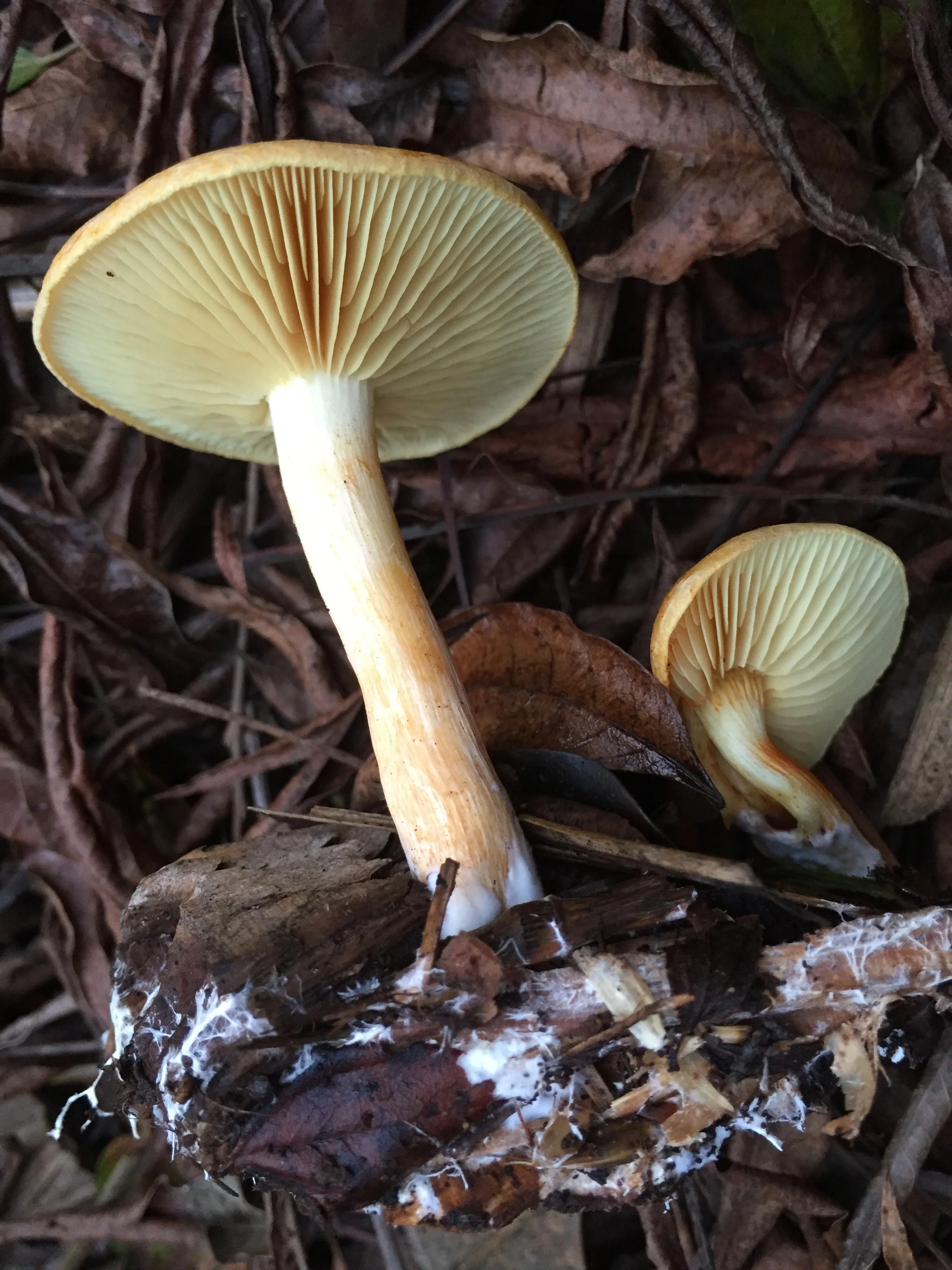
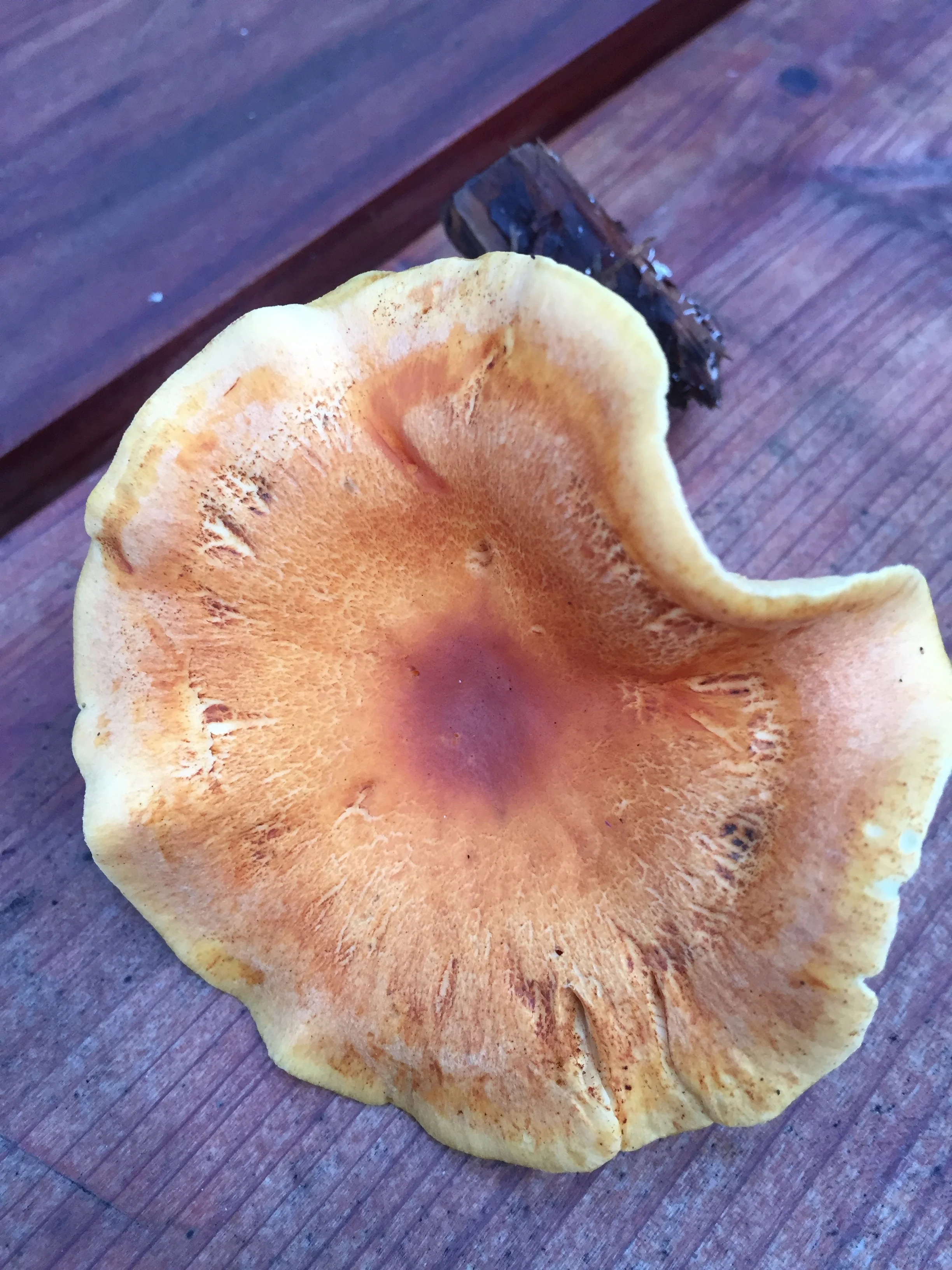
The pictures here today are all from one cluster, found in a shadier part of the garden, under Chinese pistache trees and Ceanothus. The mushrooms are not growing out of the leaves, however - they are growing out of the woodchips.

IMG_7039.jpg

You'd think identification of these would be easy - they're NOT 'little brown mushrooms' (or LBM's, as they're known in the mycology world). These are a glorious orange. But when I plucked a few out and went to my trusty mushroom book (California Mushrooms: The Comprehensive Identification Guide), just knowing the color alone did not help. Nor did the fact that they were growing on wood chips. It was really getting the spore print that helped me to identify this mushroom.

IMG_7057.jpg

It's easy to do a spore print - just take the stem (or stipe) off the mushroom and place it gills-down on a piece of paper. Cover it with a container to keep it from drying out too quickly, and leave it overnight. In the morning you will have a good idea of the color of the spore. In this case, the spore was a very similar color to the mushroom, but that isn't always the case. For instance, chanterelles are deep yellow mushrooms with light-colored spore. 

IMG_7049.jpg

Once I had this spore color, I could begin to key out my species. Do you know about Botanical Keys? They are kind of like a flow chart to determine what it is you are looking at. They are also called Dichotomous Keys. On paper, they can be many many pages long. One of the questions on my lab practical for Terminology was to key out to plant family. The instructor had a plant sitting there that was in bloom. We had to take a flower and dissect it to determine all its parts, and then key it out. It was not as easy as you would think and a lot of folks had trouble with it. Some books, like my mushroom book, include a key at the very beginning to get you to the genus of mushroom that you are looking for. Then there are keys in each spore color group, so if you know the spore color, you can go right to that key. It's an interesting process. 

IMG_7040.jpg

Of course there are terms that I had to look up, like the aforementioned 'stipe,' plus things like adnexed or adnate, decurrent or subdecurrent, etc. Yikes. 

I found a nice online keying system for mushrooms that got me to the right genus, too - but it is very east-coast centered, so I had to find the correct west-coast version in my book. This system is called MycoKeys. I thought this was a nice way to figure this mushroom out if there isn't a field guide handy. (For an interesting example of an online botanical key, check out this one from the UK.)

Anyway, after fiddling around with these dang mushrooms for two days, I think I have my ID. I believe these orange mushrooms are Pholiota malicola var. macropoda. Unfortunately, the edibility of this particular mushroom is 'unknown.' So I guess we won't be eating them anytime soon. Still, this was a useful exercise in recognizing and identifying mushrooms. The problem is, I probably won't remember this. And then I'll have to do it all again next year.

How are you at ID'ing fungus? Do you enjoy doing it? Do you ever get GOOD at it? Are you one of those knowledgable people who can forage for edible fungi? And if so, are you willing to take me under your wing? :)

Tags mushrooms, mulch
6 Comments

"Greenwashing" at Farmers Markets

January 12, 2018 Elizabeth Boegel
Public Market, Seattle - pretty sure these guys are legit and highly regulated

Public Market, Seattle - pretty sure these guys are legit and highly regulated

Piggybacking on my post about buying real honey a couple of days ago, here's another scam of which we need to be aware. Yesterday I received my monthly copy of Mother Earth News magazine. In the 'news' section, there was a brief article titled "How to Ask the Right Questions at a Farmers Market." This is in response to the problem of greenwashing, which is unfortunately becoming more and more prevalent. I first heard about this only about six months ago, but it seems that it's now a common problem. And since I frequently encourage you to buy locally from Farmers Markets, I think it's important that you know there is a dark side.

Greenwashing: "Disinformation disseminated by an organization so as to present an environmentally responsible public image."

We are becoming smarter and more selective consumers, and this means that producers have to come up with new ways to get us to buy their products. It's now quite common at the local Farmers Market to 1) have vendors who are not farmers at all and have no affiliation with the farm, 2) have produce that is grown by large commercial and conventional farms re-sold under the guise of small and local, and 3) have produce with misleading labels. 

It really stinks that we have to navigate the markets, once a safe space, with a more discriminating mind, but guess what? That's how much power your food dollar has. Never think that your everyday buying habits are not making change, because they are, so much so that the big companies have to figure out ever sneakier ways to trick you. 

My own personal Farmers Market, right outside the back door

My own personal Farmers Market, right outside the back door

We'll talk about other options besides the Market too, but first, the Cornucopia Institute, a non-profit out of Wisconsin ("promoting economic justice for family scale farming"), has created a handy printable guide for you to take to the Market with you. It has a list of questions for you to ask the vendor, which will help you determine whether the food is really local, if it's in season, if it's organic. As I've often said here, if you talk to the farmer, you'll learn all you need to know, and this guide will help you to do that. Real farmers are so happy to answer your questions, so happy to talk about the work they are doing, because they are proud of it and proud of their product.

By the way, local small farmers often can't afford the official organic certification. Don't let that stop you from buying from them. Many of them limit the use of chemicals because it's simply a best practice; if you talk with them, they'll be happy to tell you about it. 

Remember the seasons, too. If it's December and your local market has tomatoes, you should be suspicious. However if it's May and your local market has tomatoes, that farmer just might have a heated greenhouse and a very clever touch. You'll know if you talk to them. If you don't know what's in season right now (and how could you help but be confused when you can buy most produce any time of year in any big store?), there are lots of good guides for figuring that out. For instance, you could go to The Seasonable Food Guide and type in your state to find out what's in season during each month. It says that right now, in California, in early January, there are nearly 70 items I can buy that are in season. (Granted, when I type in Minnesota, there are only 14 choices. But still! 14! Pretty amazing in that climate. Some are stored items like sweet potatoes.)

Now I have a confession to make. I actually don't love shopping at Farmers Markets. Most of it has to do with a sort of impulse I feel about wanting to buy something from everyone. I get all weirded out by the vendors watching me look at their produce and then not buying something.I've been to countless markets and I nearly always feel it, especially in the dead of January when the offerings are small (as they should be!) and farmers are probably hurting. Going in there and asking questions of them makes me even more uncomfortable. It feels like asking them to prove themselves. But here's something I know is absolutely true: If I were selling my produce at the market and someone came up and started asking me questions, I'D BE DELIGHTED. I'd be so thrilled to talk about my farm and how I do things. Goodness why do you think I write this blog? Basically to brag about what we grow here! So if a vendor is reluctant to talk to you, well then, you're right to be suspicious.

However! If all of this just makes your skin crawl and you just can't do it, there is another option; you could connect directly with the farms in your area. CSA boxes are a great way to get the produce directly from the farm, delivered right to your door (sometimes there is a pick-up location). You simply sign up with the farm to receive a box of whatever they have growing every week, every two weeks, or every month. Sometimes they ask you to purchase a few months right up front - this is good for them because it gives them the resources they need to buy seed and supplies. It gives them a guaranteed income. And you get a box of great stuff on the regular. 

I'll tell you what, it'll force you to cook what's in season, with new produce that you may never have cooked before. Many of the farms include recipes in their boxes so that you have some ideas to start with. It's a fun adventure! And since these CSA farms offer visits and tours, you'll be able to see firsthand the operation and have the confidence in knowing you're buying the good stuff. You can often even volunteer work time to lower the price of your subscription, which gives you the added benefit of learning what it takes to put food on your plate. 

The amount of different things you can buy from subscription is huge - eggs, wine, dairy - I even bought my parents a fish subscription one year from a local Sacramento River Fish Farm. I think they'd tell you how fun it was to get different kinds of fish every month!  As I've written about here before, we even had a meat subscription for a time from a local grassfed operation. It was great. 

IMG_7919.jpg

I just ordered more wheat from a local place near us in the Capay Valley, Full Belly Farm. They aren't really set up for that kind of thing, but I've developed a relationship with them over time and they are happy to send me wheat every six months or so. It just took one phone call that first time to set that up, and they've been so accommodating. We've also been there several times, to eat a fabulous Mother's Day dinner, to pick up organic straw, and just to visit the farm. They have an open door policy. That's the kind of transparency you want! Many, many family farms are doing CSA boxes now, and one great place to figure out who is in your area is Local Harvest. Just put in your zip code and find out what farms are near you!

I'm sorry that we all have to be so discriminating when it comes to our food, and not just at big supermarkets, but also at the small Farmers Market. But it's just one more step in making sure we are eating the very best produce available, and sending a message with our purchases, too.

Tags learning, local, farm to table, organic
Comment
← Newer Posts Older Posts →

Subscribe

Sign up to get email when new blog entries are made.

We respect your privacy. We're only going to use this for blog updates.

Thank you! Please check your email for a confirmation notice to complete the subscription process.

Powered by Squarespace