
This is one of my favorite crops. It grows without any input from me for half a year, then supplies us with food for nearly an entire year after that. This particular variety has done well for us for several years now; it grows easily over the winter, forms nice-sized bulbs and cloves, dries quickly, and keeps well. Links to where to buy this seed garlic in video description. Enjoy!
Sitting At The Feet

Looking East to Mt. Diablo from the Berkeley Hills, through a scrim of CA poppies
I took the last final exam yesterday, turned in the last written project, gave the last presentation; my semester has now come to a close. What an amazing five months I have had. I've said it before and I'll say it again: I'm one lucky girl. To get to go back to school, at my age, with two children still at home, with the kind of expenses we have in the Bay Area - well, I'm just so fortunate to have the most understanding husband and family ever. I'll take the summer off to drive the kids around to their various activities, and start at Merritt again in the Fall. I'm already signed up for three classes: Arboriculture, Soil Nutrition, and Plant Terminology, and by Christmas, I should have my first certificate. I can hardly wait to get started again, that's how much I'm enjoying myself.

A native Elderberry tree in blossom
I have the comfortable feeling of knowing I'm exactly where I need to be at exactly this moment. All paths have led here. I am sitting at the feet of the masters, these wonderful teachers, who are all not just teachers but employers and managers and business owners. The brilliant part of this horticulture program is most of the teachers are also working in the business. This gives all of us students such a well-rounded education; we learn all the biology, the ecology, the taxonomy for heaven's sake, and at the same time we learn the trends of landscaping, the ways in which the state of California is monitoring the water usage of certain plants, the nuts and bolts of dealing with clients, and how to make a living. It's just the perfect mix of academics and business.

a swath of Rumex, or sorrel, on the trail
At the moment it's the academic stuff that interests me most. It's been more fun than I can say to be re-learning plant biology at the same time my 9th-grader is learning it for the first time. It's been great to find out technical names for parts of plants and to learn how fertilizers actually work. But the best part, by far, is being around these professors and soaking up their knowledge. And gosh, they know so much. So much more than I think my head can ever hold.
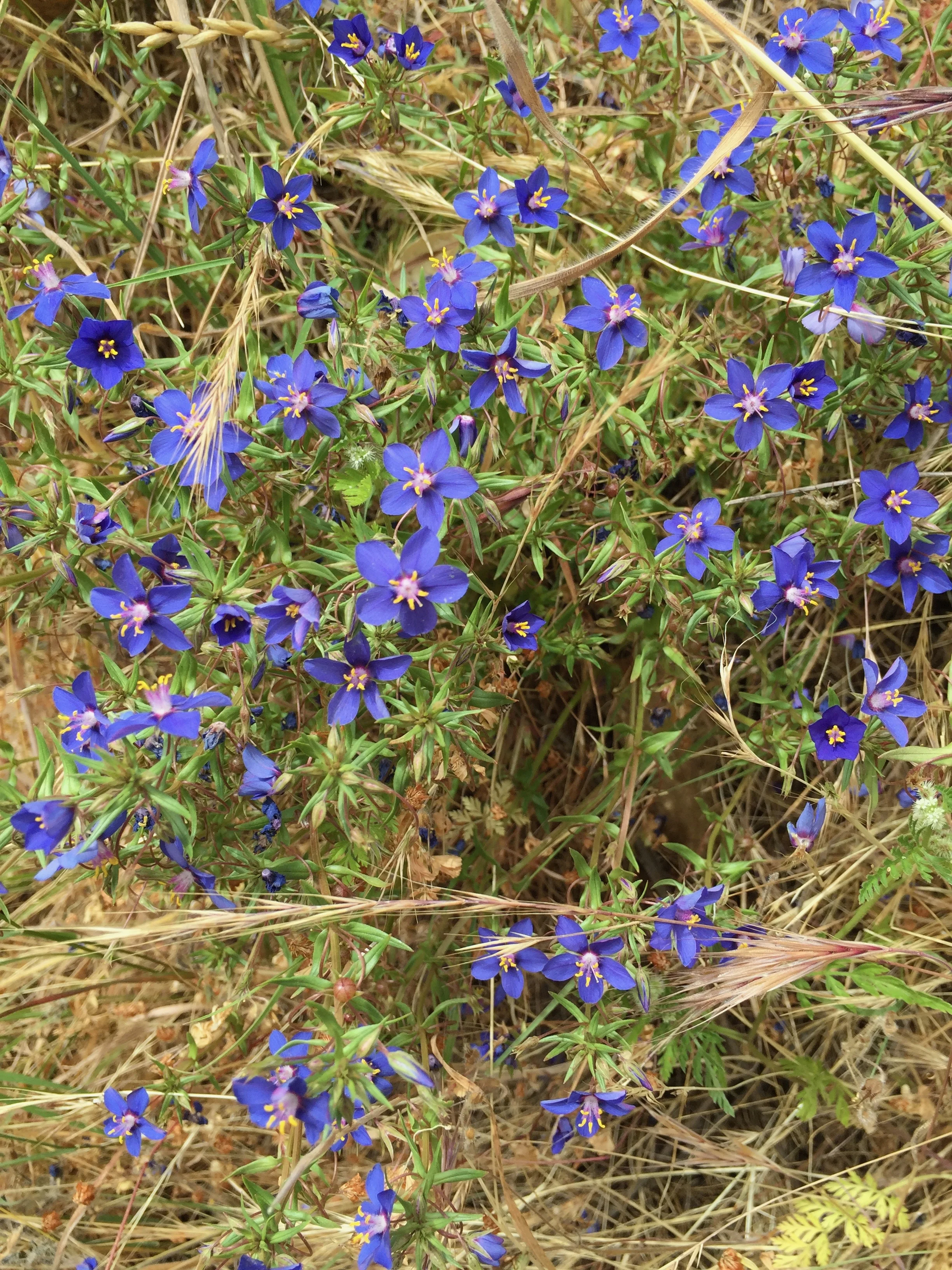
Anagallis monellii 'Blue Pimpernel,' an exotic that has naturalized
My weeds class, in particular, has been a great source of learning, and that's due mostly to my teacher, Stew Winchester, who has spent all of his life roaming the hills and valleys of California, and knows simply everything there is to know about how the state was formed geologically and about every single plant and tree. It's also due to the fact that we go to a different location each week and take a hike, looking at all the natives and exotics all around us. There are no words to describe how fun it is to take a walk in the hills with 20 other plant geeks, being led by a sensei who can answer every single question you have about what you're seeing. It's immediately satisfying and I'm not sure I really know why. I know I've always liked to be able to give names to things, and slowly, slowly, I'm absorbing this knowledge.

Physocarpus capitatus (Pacific Ninebark)
I've always talked about how much I like craftsmen - folks who are the best at what they do, whether it be making jam or weaving cloth or building barns - and I'm finding I also really appreciate craftsmen of the mind - people who know a lot about a certain subject. This class was kind of like a wheel, with Stew at the center of the hub, and all the students the spokes - each one having a little bit of expertise in all kinds of different subjects - one a birder keeping us aware of all the birds we were seeing, one an expert in the medicinal value of certain weeds, several professional landscapers hoping to build even greater knowledge, and people like me, with a little bit of information about a lot of different subjects (I was often called 'the bee lady' and was called over every time we saw an interesting bee or a wasps' nest).

Phacelia
It made me wish everyone had this kind of a forum for whatever interests them. It made me appreciate all the classes for lay-people that we have attended, in everything from sausage-making to propagating plants from cuttings. It has made me appreciate the student-teacher dynamic, and how teachers are all around us, in many different forms. It made me appreciate that everyone is an expert at something. And what is clearer than ever is that there is ALWAYS more to learn, no matter how old or experienced we get.

The work of woodpeckers
As I go about my summer, this Spring semester will never be far out of my head. It's like an awakening, really, of what is possible. There are so many futures to choose from. It's like being 18 again. What am I going to focus on? How shall I use my skills? These are questions I cannot answer yet, but I know that the answers WILL come, as long as I keep an open mind and continue to learn. Meanwhile, I'll be putting some new skills into practice, in our own garden. Summer is nearly here, with its mountains of produce to be processed, and fall planning is not far behind.

a little bouquet I foraged on our last hike, in the Berkeley hills: Exotic sweet pea and vetch, along with some rattlesnake grass and a Ceanothus branch covered with lichens and mosses
Maybe there's something you've been wanting to learn or to explore, but maybe you've been nervous to get out there and give it a try. Consider this a rousing endorsement and encouragement to go for it. I'm guessing that you will feel just like I am feeling - enormous with knowledge and possibility!
Summer Evening Blues

Triteleia laxa, or Ithuriel's Spear

Savlia clevelandii 'Bee's Bliss'

Tomorrow's breakfast

Phacelia bolanderi, or Woodland Phacelia

Heirloom cornflowers 'Blue Boy' with a flower I cannot figure out, either a verbena or a wallflower

Scabiosa 'Butterfly Blue'
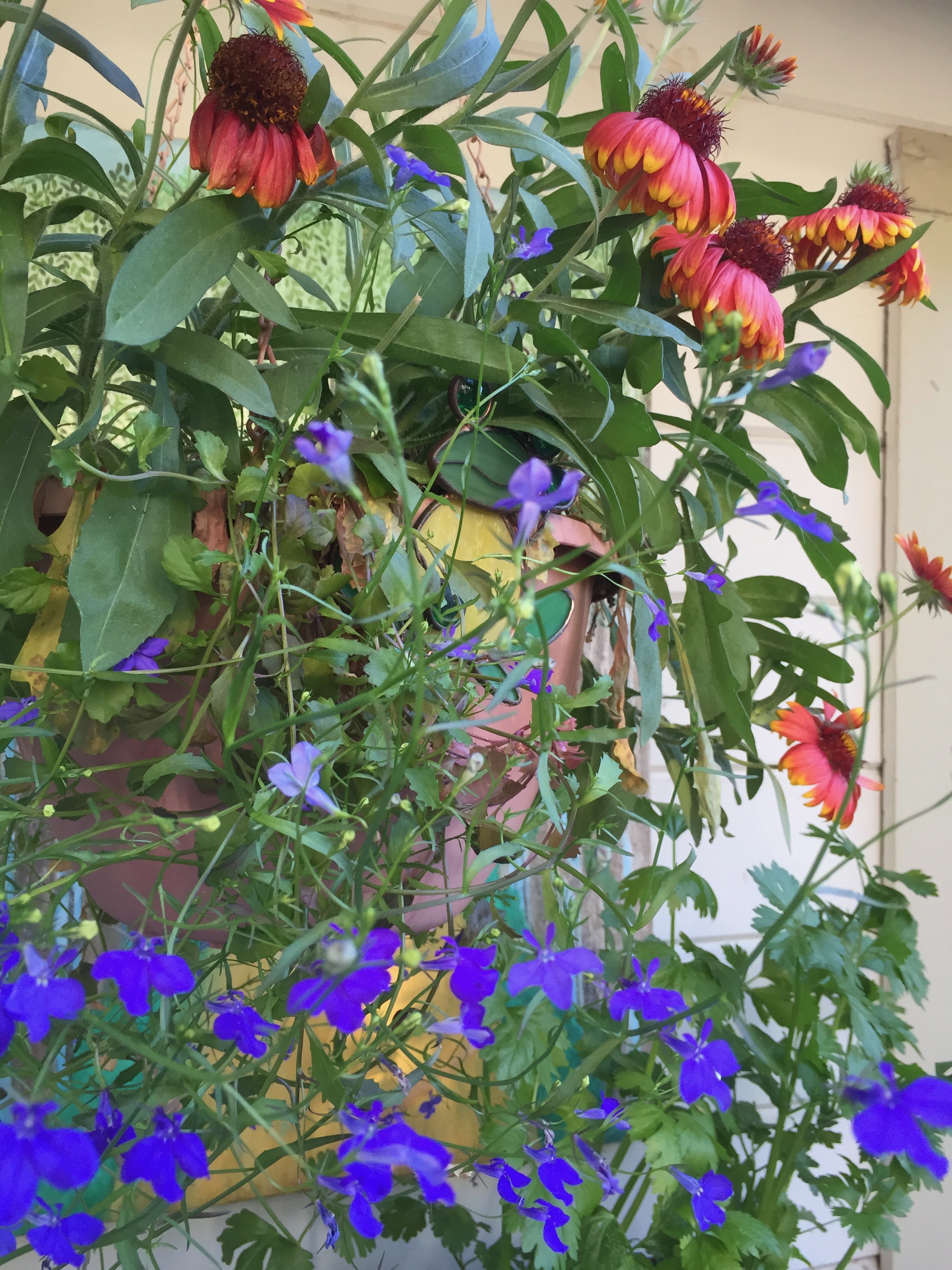
Windowbox Lobelia, Blue Heaven (with Gaillardia in the background)
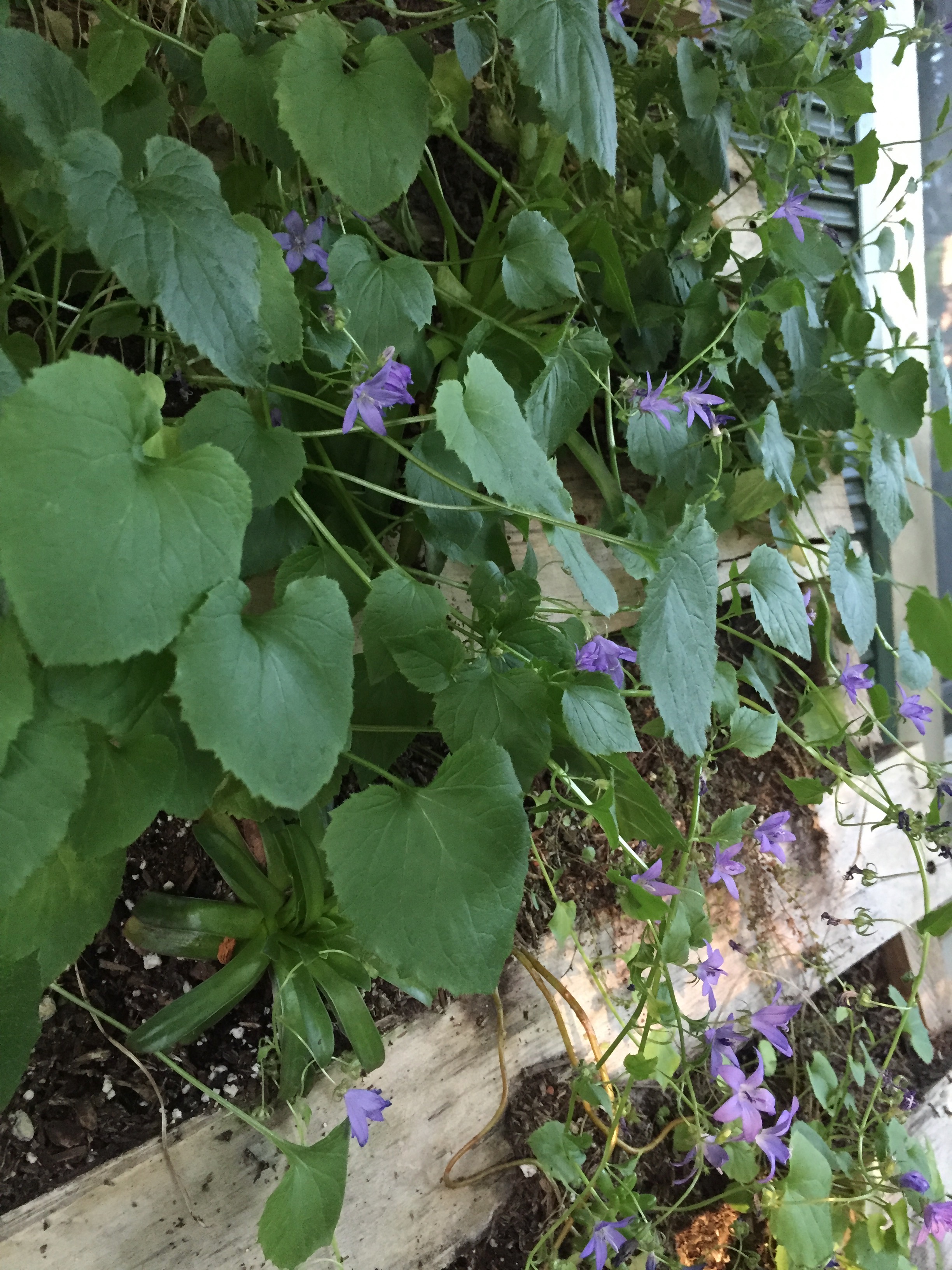
Campanula or Bellflower

Aster chilensis, or California Aster

Culinary Sage

Solanum umbelliferum, or Blue Witch

Penstemon heterophyllus, or Foothill Penstemon

Gilia capitata, with Rudbeckia in the background

Verbena lilicina 'de la Mina'
Oh, okay, it's not summer yet. 98 degrees in Walnut Creek today, so it sure felt like it - given us a little taste of the summer evening blues.
A Frustrating Development
We had a great morning, getting so much done in the garden, and we were videotaping every moment for you. It felt so good to get things accomplished. The garden and this blog have taken a back seat lately; May is just a really busy month for us, and especially so this year. It's unfortunate that the garden needs to most attention during May, because it's the last priority. So today it felt wonderful to get caught up.
Then, we opened up the hive to add some bars - we have noticed that there is a large crowd of bees outside on the landing board, which is due somewhat to the hot weather, but also due to overcrowding. I had noticed during the day that every time I went by the hive, the bees were somewhat aggressive, buzzing my face until I left the vicinity. They don't do that unless something is wrong. I figured it was due to lack of space, and I was glad I had three bars ready to add, to give them more room. We figured we could do a quick in-and-out, just adding the new bars to the back. But when we opened the hive, we found a bit of chaos - all the bars were full of comb, and the bees were somehow spilling out to the back through a crack in the follow board. That's a board we have at the back of the hive - it's solid, not just a bar - and it's there to keep the bees from going out into the empty spaces in the hive. This way we can keep the hive smaller in winter, when it's cold and there are less bees, and they can stay closer together for warmth. This time of year, we gradually add more bars and therefore more space. Somehow the follow board was tweaked enough so that there was a crack, and the bees were spilling out. Many had died in a spider web that is in the very back corner of the hive.
At the same time we were seeing this mess, the bees were aggressively coming out and buzzing us. We had just decided to leave it open and go start the smoker, and properly get things in order, when a bee landed on my right index finger and stung me. No big deal, we each usually get stung once a year. I walked away from the hive (because another bee was buzzing my face) and scraped off the bee and the stinger. I went over to get the smoker lit and we did that very quickly indeed and went back to the hive to start creating order. As we were doing that, I started to feel very hot, my face was beet-red and my head was pounding. I thought I might pass out. We kept on going, but finally I told Tom I had to go inside and figure out what was going on.
A little history. Last August was the most recent time I was stung. It was on my left ring finger knuckle. My hand swelled up out of all proportion to the sting. I couldn't move my hand properly for four days. My family was out of town in Maine, and I was alone at home. I was ok, but besides the extreme swelling, I was having another reaction: Intense pain in the opposite armpit.
After two weeks, the swelling was better, but still recurring every few days, like a new swelling. And the armpit pain was persistent. I figured it was a lymph node reaction. My uncle, a doctor, was in town during this time. He suggested that I was slowly becoming allergic to bee stings over time, and that I should be very careful in the future if I was ever stung again. I did a lot of research but found very little information regarding lymph node reactions or about folks becoming more sensitive to bee stings over time. So I sort of forgot about it all, though my knuckle on that finger has never been the same and there are some rings I cannot wear.
All of that was in the back of my head today. I started to feel my feet swelling in my shoes, so I quickly took those off. I was completely overheated, so I decided to take a cold shower to try to cool off. In the shower, I started to itch intensely - my feet and my hands were simply terrible, so itchy, and also my head and pelvis. Then my lips started to tingle and swell up. My heart was beating so fast and then I felt my throat start to ache and swell. At that point, I got out of the shower, pulled on some clothes (clumsily, as my right hand was now a ballon), and Tom drove me to the emergency room. Right before we left I took two Benadryl.
When we got to the hospital I thought I was going to jump out of my skin. I couldn't be still and everything was insanely itchy. My throat and lips felt much worse, and my heart rate and blood pressure were very high. They took me in immediately.
Not long after that, I started to feel the Benadryl kick in. That helped calm me down, and then they gave me a high dose of Prednisone, which helped with the itching. My breathing was always fine, I never had trouble there, and after some time the throat thing went away. My heart rate and blood pressure came down a bit and after a couple of hours I was able to leave. However, I have to take Prednisone for the next three days, and Benadryl as needed. Also, they issued me two epi-pens. I trained on how to use them during my work with medically and mentally challenged kids, but no one in our family has ever needed one. Here's where Kaiser is great: The pens cost us a $10 copay. That is amazing and we are so grateful to have good health insurance.
We have now been home for two hours, and something that started happening before we left the ER was excruciating pain in my left armpit. The 'ouch' in my right hand, due to the actual sting and the fact that I am very swollen (the swelling is now moving up to my wrist, so typing has been pretty hard!), is uncomfortable, but it's nothing compared to the intense pain in the armpit. It's so strange. It's the opposite arm, which is exactly what happened last time. I'm still trying to find any information I can about this kind of reaction, but coming up pretty empty-handed. It must be a rare thing.
As for the fact that my reaction has gotten more sensitive over time, it seems to be sort of half and half with beekeepers; some get less sensitive over time, and some more. I'm obviously in the latter category.
I am seriously frustrated, because from now on I have to be very careful around the bees. Next time I get stung, it's epi-pen time, no question - if I'm worse every time, next time it could be my breathing that takes a dive. I'm going to have to wear a hood and long sleeves and gloves, which I loathe. I'm going to have to let Tom do most of the hive checks with me looking on manning the smoker. I've just gotten to a place where I feel like I know what I'm doing, after three or so years, and now I have to back off. Ugh.
But, I'm very lucky, and I know that. And there is no question of us keeping the bees, neither one of us is willing to get rid of them. Maybe in the future, if it's necessary. We found one thing very funny today: The ER doctor just really didn't know how to react to the fact that beekeeping is (for us) a hobby. He assumed it was my profession, otherwise why do it? It was clear he thought we were nuts. He spoke to us a little slowly and a little carefully, like we were just a bit mental. Tom and I had a good giggle about that.
If anyone has any information about this sort of thing, I'd love to hear it - please share in the comments.
Now, I'm going to go take some more Benadryl and go to bed. :)
Rust
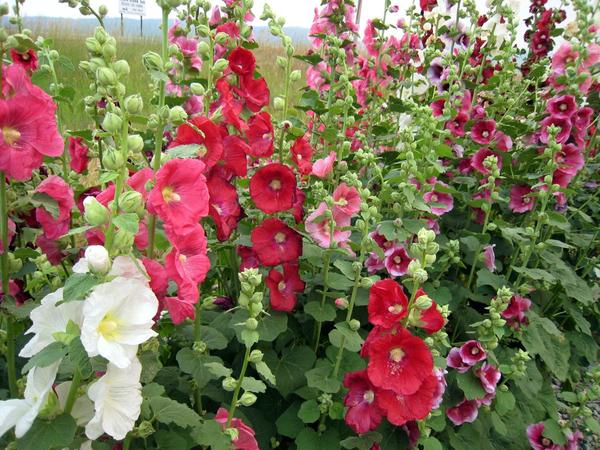
Not my Hollyhocks. Just a picture I found on the web. I only dream of flowers like these.
When you think of California, I'm guessing that hollyhocks are not the first thing you picture. Poppies, yes. Redwoods, check. Sequoias, sure. But not hollyhocks, which are really not often grown here. Alcea, or hollyhocks, hail from Asia and Europe. They like full sun, lots of regular water, and they are considered high-maintenance. I would never think to grow them, because we can't afford to use that much water, but I got a couple of free packets from the free seed guy in my neighborhood in 2015. Never one to turn down free seeds, I scattered these in my pollinator garden and forgot all about them.
In 2016, some of the seeds germinated and we got a few small flowers, but mostly just leaves. Apparently this is normal for hollyhocks - they bloom the second year. Ok, I thought, I'll wait. And this year, they finally started lookin' GOOD.

But in the last week or so, I noticed something wasn't right. I was having one of those weeks where I wasn't home except to sleep, and so I couldn't get in there and see what was happening. Today, I finally took a better look. And this is what I found.

Underside of leaf
Rust. A very bad case of it, all over the older leaves, the stems, some of the newer leaves, even some of the buds. Things had gotten very advanced and I was very late to the party.
I cut off a couple of leaves and took them to the only nursery within 30 miles that I thought might confirm my diagnosis, privately-owned Orchard Nursery in Lafayette (no affiliation with the hardware stores). I like this nursery very much, I just can't usually afford to shop there. However the people working there are knowledgable. Sure enough, my diagnosis was right, and I was advised to use copper fungicide to remedy the problem. I already have that at home since I use it as a spray for my dormant peach tree in the winter (to prevent peach leaf curl), so I headed home to take care of it. "One last thing," the nursery worker told me, "Hollyhocks are NOTORIOUS for rust." Fabulous.
So I came home, clipped off all the leaves that were affected, and drenched all the plants in Liqui-cop, including some nearby roses which had a slight case (but nothing like the hollyhocks). The affected foliage went into the green can, NOT the compost, so I don't reinfect everything. However rust spores travel through the air, so they likely drifted in from another garden, and found a nice place to settle here, and they're all over I imagine. We had a wet early spring, which probably didn't help, but I also tended to aim a spray or two of water from the hose at them, knowing they needed more than just what they were getting from our drip hose. This was a big mistake, as wet foliage can really increase the chances of rust.

You can see the spores, sort of

Top of leaves look like this
I did some reading, and hollyhocks indeed are notorious for rust; it's usually a given that you will have rust if you have this plant. So! If you have some, go ahead and treat proactively, it can't hurt. And don't let water get on the foliage, if at all possible (I know, that's a ridiculous thing to think about unless you live here or in the desert).
My poor hollyhocks are all denuded and naked-looking, but the buds look ok; so maybe I'll get some flowers after all. I'll keep you posted!