• About
  • Blog
  • Contact
  • Favorites
  • Archive
Menu

Poppy Corners Farm

Street Address
Walnut Creek, California
Phone Number
Walnut Creek, California

Your Custom Text Here

Poppy Corners Farm

  • About
  • Blog
  • Contact
  • Favorites
  • Archive

A Class Excursion to Alcatraz Island

April 6, 2017 Elizabeth Boegel
Alcatraz as seen from our boat, looking west, with the Golden Gate bridge peeking out to the left, the Marin headlands to the right.

Alcatraz as seen from our boat, looking west, with the Golden Gate bridge peeking out to the left, the Marin headlands to the right.

My 'Weeds in the Urban Landscape' class meets every Wednesday morning, and each week, we travel to a new place in the Bay Area to study the weeds that grow there; some are coastal, some are inland, some have northern exposures, some southern, some are in sandy soil, some in clay, some in landfill. On Alcatraz, we had an opportunity to see weeds in pretty much every exposure, in pretty much every kind of soil. Alcatraz is just a bare rock rising out of the San Francisco Bay; when it was used as a military outpost during the Civil War, dirt was brought in to mobilize cannons, and to absorb the shock waves when they were fired. This dirt came from nearby Angel Island. Gardens were first planted by the military families who lived here, then by the inmates when Alcatraz was used as a prison, as well as by the families of the guards who also lived on the island. The prison was closed in 1963, and for years there was no official gardening program; however, in the last 15 years, a large volunteer corps has arisen to plant and tend the flowers on Alcatraz.

One of the 'official' gardens on Alcatraz, on the site of the old hospital. There are some historic roses planted here. as well as many native and exotic perennials and bulbs. Angel Island is in the background, on the right.

One of the 'official' gardens on Alcatraz, on the site of the old hospital. There are some historic roses planted here. as well as many native and exotic perennials and bulbs. Angel Island is in the background, on the right.

The weeds arrived here in the soil that was brought in, and by birds colonizing the island. There are many seagulls (California and Western) and cormorants (Brandt's and Pelagic) that nest here each year; I met an ornithologist whose job it is to study these birds, and we had a fascinating conversation about the mating and nesting habits of the gulls and cormorants, as well as the Black-Crowned Night Heron, Snowy Egrets, and Pigeon Guillemots that were all over the island. 

Seagulls nesting in an abandoned yard, and in the ruins of the guard's cottages; looking south to the San Francisco skyline, and part of the Bay Bridge

Seagulls nesting in an abandoned yard, and in the ruins of the guard's cottages; looking south to the San Francisco skyline, and part of the Bay Bridge

Snowy Egrets nesting in trees and bushes, with a view west to the Golden Gate in the distance. The egrets made the funniest noises; sort of a cross between an angry cat and a kid grumbling. At one point we were able to get within three feet of nesti…

Snowy Egrets nesting in trees and bushes, with a view west to the Golden Gate in the distance. The egrets made the funniest noises; sort of a cross between an angry cat and a kid grumbling. At one point we were able to get within three feet of nesting colonies.

Not the best picture; I was on top of a cliff looking down at the edge of the island. These cormorants are making nests, can you see the brown piles? Cormorants find a new mate every year and nest in a new place; seagulls mate for life, spend most o…

Not the best picture; I was on top of a cliff looking down at the edge of the island. These cormorants are making nests, can you see the brown piles? Cormorants find a new mate every year and nest in a new place; seagulls mate for life, spend most of their lives away from each other, and come together every year in the same place to build a nest and raise chicks.

There were a lot of distractions on the island, but we came to study weeds and make a revised weed list for the naturalists in charge, so that's what we did. We took the first boat out to the island, with the rangers and workers and volunteers, at the crack of dawn. This was lovely because we were able to have some time alone there before the hoards of tourists descended. The last time I visited Alcatraz, I was in my early twenties, and I was more interested in the prison and the stories there, rather than the external natural communities. On this visit, we did not go inside any buildings, as our time was focused outdoors.

Since I've been taking this weeds class, I've developed new eyes. I've always noticed things that other folks haven't, when I'm on hikes or out in the wild, but now I am even more aware of the little things. There's so much to see in the micro world. However there was one thing that was very obvious right away, in a macro way - the pro-Native-American graffiti all over the island. Either I hadn't seen it in my previous trips, or it has been done in the last twenty years.

We spent the lion's share of our time on the island making a current list of all the weed species, both native and exotic. We were able to find and categorize over 100! We wandered around the island for hours, talking about plants; we had a lot of tourists stop to listen and ask what we were studying. Then they'd move away, disappointed. Why study weeds? I can totally understand this opinion. But I have grown to have a new respect for weeds, and how and why they behave the ways they do. Scrappy. That's what they are. 

However I'd have to say that the planned and tended gardens really were more fun to look at, and we spent a lot of time talking about those as well. What was so terrific about all these gardens was the setting. All these old, crumbling facades, with brilliant flowers set against them. The juxtaposition of old and new was what really made this place beautiful. And then, of course, the location and the background of the bay and the surrounding hills and communities. Man-made vs. nature. 

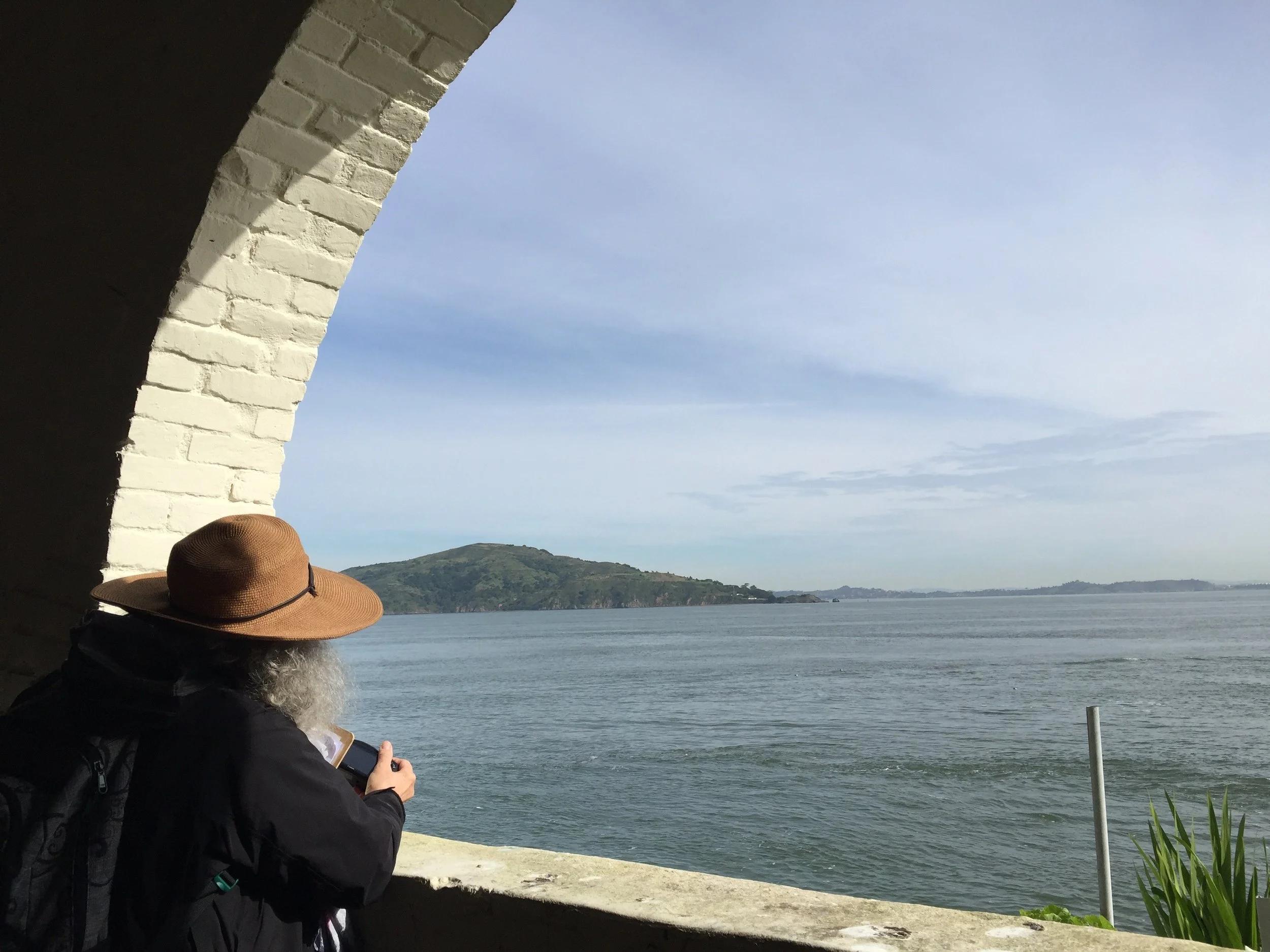
a classmate looking north towards Angel Island

a classmate looking north towards Angel Island

It was also very gratifying to see native bees all over the flowers. That means that they are nesting there. I only saw one honeybee - who knows from how far away that bee came? I didn't see any feral honeybee hives on the island, but I suppose there could be one in a tree or in an old building. I doubt the folks in charge would leave a feral bee nest in a place that gets millions of tourists visiting, though. Doesn't matter, the native bees do an excellent job here pollinating the flowers.

It was a fabulous trip. Not so fun on the boat ride back, with about a thousand other people; where we had been able to roam all over the ship on the way over, even in front of the captain's deck with our face to the wind and the Bay, now we were jammed check-by-jowl with a many-languaged humanity. I suppose that has its own rewards, but I was pooped and glad to get off that boat at Pier 33, only to then face traffic all the way home. One of the things about spending so much time in nature, outdoors, is how awful you feel when you're trapped in a vehicle, on a bridge, in crawling traffic. I kept thinking about a seagull I had seen on the island, perched in an agave blossom, high above the human activity milling about below.

My midterms are over, and I'm officially on spring break. Time to turn my thoughts to the home turf. It's still not time to plant the summer garden; temperatures remain in the 40's in our yard at night. However I can start to do more planning, and get the truckload of compost delivered and added to the beds. I'd like to get all my term papers done over the next week too, as well as hike in the nearby hills and see which native wildflowers are blooming. I've definitely felt that I haven't been very home-and-hearth focused, though, so I need to get some stuff done around the house and spend some time with my children, whether they want to or not. :) 

Tags learning, hiking, birds, wildflowers, flower garden
4 Comments

April Planting List

April 1, 2017 Elizabeth Boegel
Cilantro blooming in the garden - insects love the blossoms. The pollen is pink!

Cilantro blooming in the garden - insects love the blossoms. The pollen is pink!

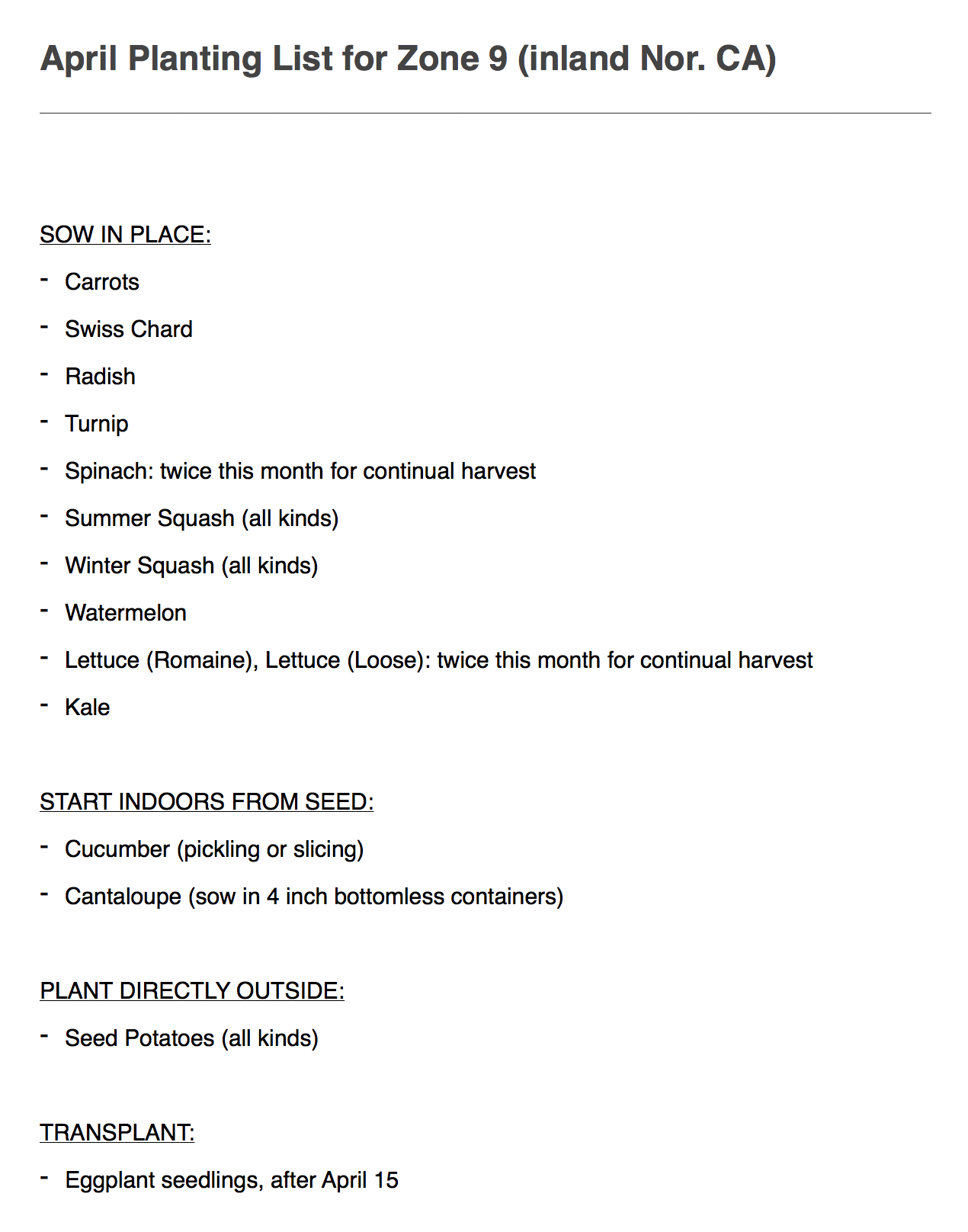
Here is your planting list for April, if you live in zone 9. The Master Gardeners recommend that you start your cucumber seeds indoors; I have never done this myself, rather seeding directly into the garden soil. However they always take a long while to germinate and get started, and I'm not ready to directly plant into the raised beds anyway, so I'm going to try to start them indoors this year. I've planted six pickling cucumber seeds and six slicers. I'll let you know how they come along.

Screen Shot 2017-04-01 at 12.25.46 PM.png

Hope you're in the garden, enjoying a beautiful April day! Happy planting!

Checkerbloom (Sidalcea malvaeflora) with lavender blossoms

Checkerbloom (Sidalcea malvaeflora) with lavender blossoms

Tags monthly list, vegetable garden
2 Comments

Combating Depression Naturally

March 31, 2017 Elizabeth Boegel
Looking up a ridge in Briones Regional Park, to a beautiful California Buckeye tree, and Mt. Diablo in the distance

Looking up a ridge in Briones Regional Park, to a beautiful California Buckeye tree, and Mt. Diablo in the distance

The summer after Adam started treatment for leukemia, when he was two years old, and Kate barely one, I started having terrible dreams. Every single night, I'd wake up terrified after dreaming of the kids dying in horrible ways. One night we'd all be walking through an ice cave, having to make our way across a slick wooden bridge, and one of them would slip and fall into a crevasse. The next night we'd be boating on a lake, one of them would lean over to look at something, fall into the water, and get trapped and drown under the boat. This happened every night. My days were already filled with real-life terror; I didn't need my nights to be filled with it too, though I understood my brain was processing our new reality of hospitals and chemotherapy. Eventually I saw a doctor, and she sent me to a psychiatrist, who diagnosed me with depression. This started me on drug therapy which was part of my life for many years. It's easy to say, "Of course you were depressed! look at what was going on in your life!" but it was really more than that. Looking back, it was easy to see that I had been suffering with depression since I was in my late teens; it just hadn't come to light until the whole leukemia mess began.

Clematis in our garden

Clematis in our garden

The medicine helped a lot, and I spent many years trying different therapies along with a few different medications. I figured I would be taking medicine every day for the rest of my life.

Then about five years ago, I was at a dinner with a group of moms that I had known for a while - our children had gone to preschool together. (We still get together every few months.) Somehow the topic of medication came up, and it turned out that every single one of us was on one anti-depressant or another. This struck me as strange. I started discreetly asking around, and it became clear that most of the women I knew were in treatment for depression or anxiety, which was astounding to me.

Dichelostemma capitatum (common name, Blue Dicks), in Briones

Dichelostemma capitatum (common name, Blue Dicks), in Briones

Now, before I go further into this subject, I want to make it clear that I think medication can be a very good thing. I have two kids whose lives have been either quite literally saved, or have become much better, with medication. Kate takes an anti-depressant for her anxiety and depression and it has improved her life immensely. I would never say that medication has no place in the treatment of mental disorders. I'm not a doctor, after all. However, for me, something about those informal statistics that I had collected made me very suspicious of the overuse of depression diagnoses and treatments. And I decided to do a little experiment.

a California poppy in our garden

a California poppy in our garden

I decided to go off my medication. 

I did this without telling my doctor, which was idiotic. The side effects of withdrawal were not pleasant; I was dizzy every day for nearly a year, despite having tapered down the medicine very gradually before stopping it altogether. However I was clever about three things that I decided to take action on at the same time: Eat a diet high in whole, nutrient-dense foods, without worrying about calorie counting (something I have done all my life, with varying success); exercise as often as possible, in the great outdoors rather than in a gym; and try to get a decent amount of sunshine every day. I had read that these three things are natural anti-depressants, and I figured that adding them might just work.

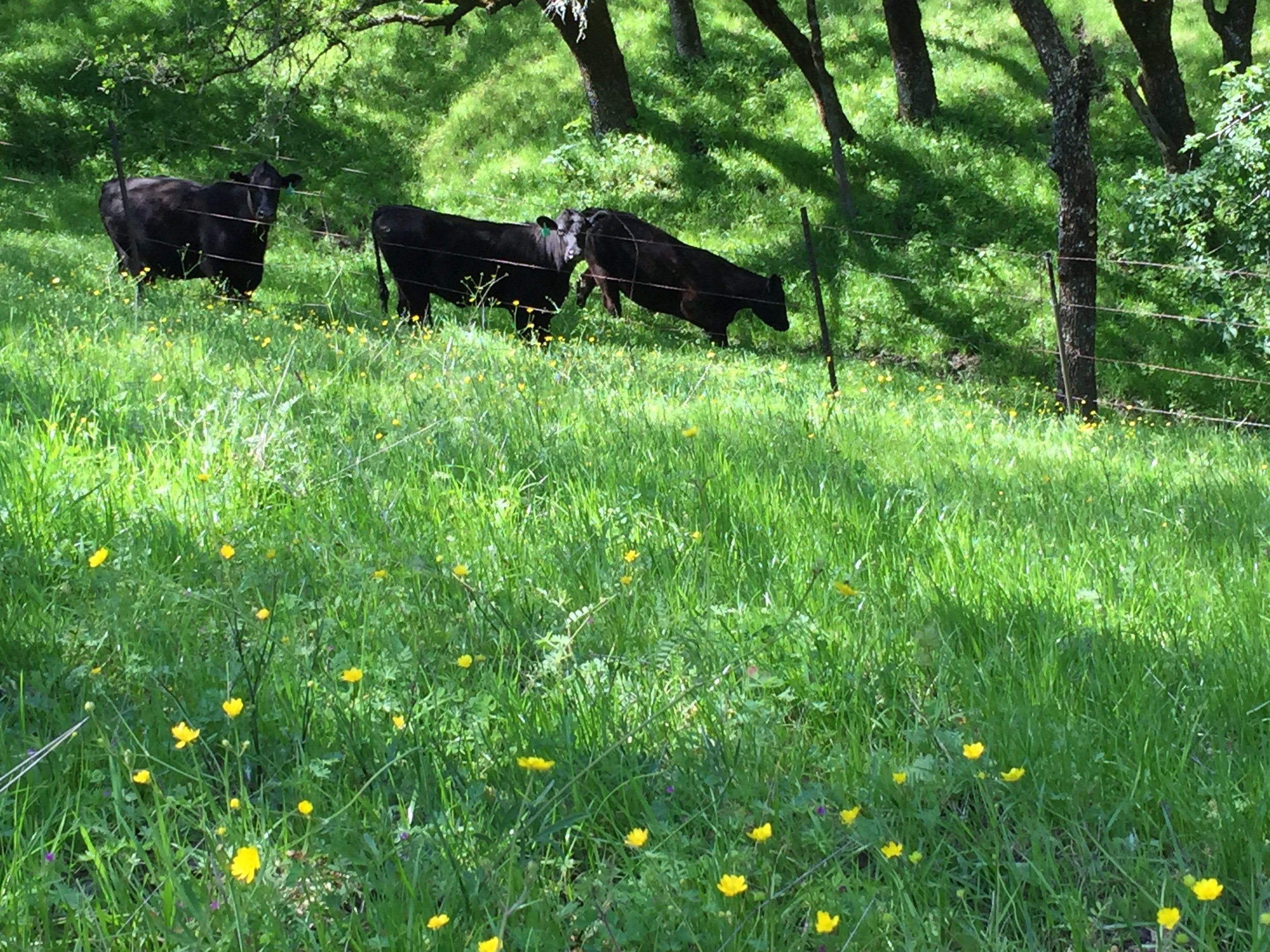
Cattle grazing in Briones amongst native and exotic grasses, and native buttercups

Cattle grazing in Briones amongst native and exotic grasses, and native buttercups

Again, let me stress that I am not a doctor and I am not suggesting that anyone else just go off medication. BUT: For me, it totally worked. I haven't taken any anti-depressants for five years. 

It's not always perfect. It can be tricky in winter; if it's very rainy, or very dark and cold, I do struggle a bit. Spring has become my new favorite season because I know the sun will be abundant and that automatically helps me feel good. And when I do count calories, as I am doing now, I have to be very careful to get as much nutrient-dense food in my diet as possible; if I eat too much junk, I start to feel very bad indeed. And if I slack off, and don't get outside in some way every day, I really notice my mood slipping. So I have to treat these three things just like I treated my medication, as a daily dose. I have to be somewhat religious about them.

About a third of our big, beautiful tomato starts

About a third of our big, beautiful tomato starts

But as long as I keep up with those things, it really does work. I realized yesterday that I am in a very good place at the moment. I'm in school, studying subjects that interest me, rather than working in a job that is emotionally draining; I'm getting outdoors every day, either in the garden or in the open spaces, and getting plenty of physical exercise; my diet is very dialed in, and Tom and I have both shed quite a few pounds recently; and all of this combines to make me a much happier person. I'm busy, yes, and managing everything can be difficult, but I'm enjoying myself too. And that is such a good thing.

An artichoke has appeared in one of our plants, hooray!

An artichoke has appeared in one of our plants, hooray!

I say all this just to encourage anyone who has a history of anxiety or depression, or struggles with health problems of any kind, that this might be a 'prescription' to help you, too. There are times in our lives when we must take medication in order to keep on going. I have friends that will always be on anti-depressants. That's ok, that's good, thank heavens for modern medicine. However, anything can be improved by the addition of nutritious food, daily walking, and some sunshine. It certainly can't hurt, and might really help. It's such a beautiful time to get outdoors here in California, too. The wildflowers are out in full force and the sun doesn't yet have the power to completely sap our energy, as it will in the 100 degree days of high summer. And have you seen the studies about the benefits of digging in the dirt, cultivating a garden? See here, and here, and here for more about that. And here for information on how having your hands in the soil helps your immune system. Google 'the health benefits of gardening' and see how much information you find.

Not to mention that the addition of a market garden right outside your back door can make it a lot easier to eat healthful foods. 

Beautiful California Oaks

Beautiful California Oaks

So why not get up and go outside right this very minute? :)

Tags health, rant
2 Comments

The Chicken Dilemma

March 28, 2017 Elizabeth Boegel

You may recall that Ginny the chicken has had something wrong with her for a month now. She is walking very funny, limping and hopping, but other than that she is fine. Eating, drinking, laying an occasional egg. After all this time, we had about resigned ourselves to the fact that she would never be quite 'right,' but at least she was managing. 

Then the other chickens, somehow clueless all this time, suddenly got hip to the fact that Ginny was injured, and the torture began. One chicken in particular, Tonks, is very aggressive with Ginny, climbing on top of her and holding her down, then pecking away at her comb, Ginny squawking in terror the whole time. After many days of breaking up the fights, we found ourselves sequestering Ginny more and more often in the hen house with a bowl of food and another of water. She was able to climb down to the run if she wanted, but she didn't often go down, and so she was mostly looking at four walls all day. That's not good for any creature. And then when she'd go down, Tonks would be ever more aggressive, until one day we found Ginny stuck beneath the shelf on which we keep the large food and water feeders. She apparently had dug herself a hole under there to get away from Tonks, and then got wedged in there and couldn't get out. I managed it, but she lost a few feathers in the process. I started to think that we'd have to cull Ginny, because her life was miserable. 

Parts of Ginny's comb have been repeatedly pecked and are shortened and bloody.

Parts of Ginny's comb have been repeatedly pecked and are shortened and bloody.

Then yesterday I had an idea. What if I let Ginny, and only Ginny, free-range? She would be free from the bullying, and be able to get more exercise, and one chicken can't do a whole lot of damage to our garden. So, with a deep breath, I let her out. She was ecstatic; scratching around in the bark all day finding sow bugs and earwigs and worms. She pecked a little at the kale, but not a lot. And she also found the compost pile and went to work over there. When I picked her up and put her in the hen house for the night, she settled down in a nesting box with what I could swear were contended coos. For some reason, at night, no one picks on her. Some unwritten chicken rule about bedtimes I guess.

This morning we let her out again, but today she acted differently. She stayed very near to the coop all day, clearly wanting to be with her mates. When I let her back in with the others for a moment, Tonks came charging out directly to harass her. I pulled Ginny out into the yard again, and made her a nice nesting box in the shade. She has her own food and water, and she's happy pecking about in the mulch. It might take her some time to get used to being outside, but in the long run, everyone will be happier. It just requires me putting her in the hen house each night and taking her out again each morning. 

Tom's home this week on his spring break, and we had a good time watching Ginny scratching and pecking for bugs. It just looks right; like a chicken is supposed to look. And I said out loud, "this is a slippery slope...." I've always wanted the chickens to free-range. I haven't let them because I was afraid they'd eat everything in my garden. With full-grown, mature plants, it's not such a big deal - they can stand a little thinning and tearing. But seedlings or seeds - that's another story. And so now I have to start thinking about how I can protect each bed at certain times of the year, if I want to have all the chickens out. And it also will attract Mr. Coyote, for sure. So I have to think about this seriously before I go any further. 

Meanwhile, it's delightful having one chicken out in the garden, doing the stuff a chicken likes to do.

Tags chickens
4 Comments

Weekly Walkthrough: The Bees Make a Break for It

March 26, 2017 Elizabeth Boegel

What a week this has been, as it pertains to beekeeping. The video below jumps around in time, so make sure to note the days and times. It's a bit longer than normal, because I included the entire seven minutes it took the bees to swarm from my hive to my pepper tree. Fast forward a little if you're getting bored with that. Also, I recommend you watch it on your desktop computer, at full screen, to get the full effect.  Here's to a calmer week ahead!

Tags video, beekeeping, bees
6 Comments
← Newer Posts Older Posts →

Subscribe

Sign up to get email when new blog entries are made.

We respect your privacy. We're only going to use this for blog updates.

Thank you! Please check your email for a confirmation notice to complete the subscription process.

Powered by Squarespace