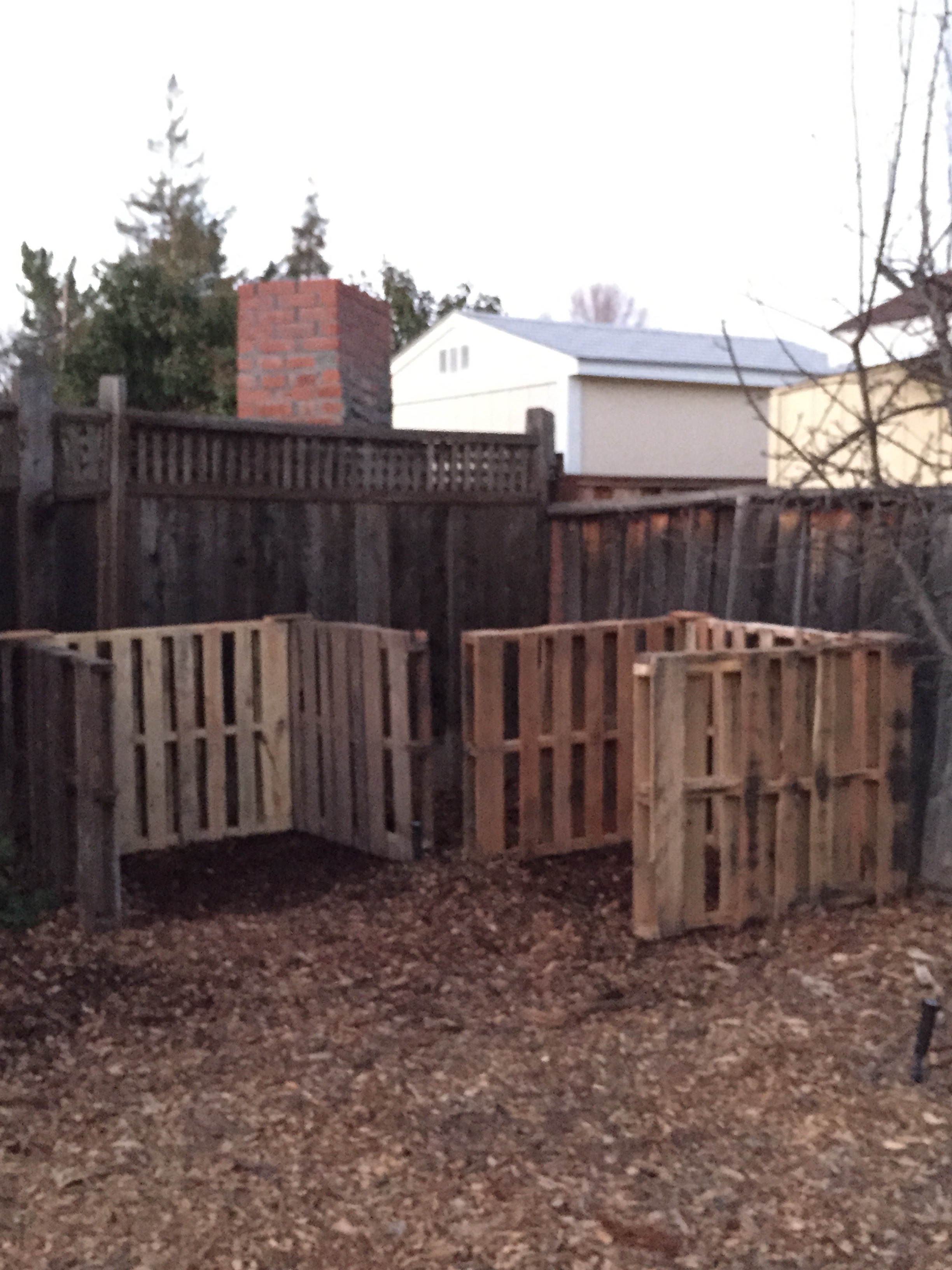
Then I started a new pile with cabbage leaves and soiled garden straw (which had been used to hill potatoes). I'm much more conscious now about adding both green and brown to the pile - and in fact you want much more brown than green. It can be hard to find enough brown, actually, especially this time of year when I have so much green that I'm pulling out of the winter garden. It takes some planning. One of my goals this year is to make an area of the garden for leaves, so in the fall when I have an abundance of leaves, I can save some to add to the compost later. I'm not sure where to put that pile, but I'll worry about that later, when the leaves fall again.
Compost is only one part of soil health. Next, let's talk about tilling.
For a long, long time the common practice has been to till a vegetable bed to get it ready for planting. By 'till,' I mean anything that breaks up more than the top one inch of the soil. Rototillers certainly do this, but so do shovels, when you get in there and dig deeply and turn the soil over. This was thought to be the best way to 'loosen' the soil and keep everything light and fluffy.
Well, modern thinking is that this actually destroys soil. This is true for many reasons. Soil needs both large and small pieces of dirt and other matter; it needs variety in size. A rototiller pulverizes the clumps, making every bit of dirt the same size. This will compact the soil as the season goes on, making it hard for air and water to circulate. Rototilling and deep digging can kill or damage the microbiology of the soil, too. All those little creatures - the ones we can see, like earthworms, and the ones we can't, like nematodes, do their job best when undisturbed. Fungi, the miccorrhizae in the soil, is the symbiotic relationship that forms between the plant and the soil. "The fungi colonize the root system of a host plant, providing increased water and nutrient absorption capabilities while the plant provides the fungus with carbohydrates formed from photosynthesis." (from The New York Botanical Garden International Plant Science Center) The strands of the miccorrhizae form a vast network under the surface of your dirt, and can easily be destroyed by your shovel.
Of course, there are times you must dig, such as when you are planting tomatoes. Tomatoes need to be planted deeply, so you will often dig a hole a foot deep. This occasional disturbance is apparently ok, because you're not destroying the soil around it. It's a percentage game, in that case.
So, how I handle this issue is to do next to nothing. I don't turn over crops, I don't mix up the soil, I just leave it be. When I cut down a crop, like I am doing now with winter greens, I cut the plant at the base, leaving the roots intact in the soil. They will decompose and feed the microbiology under the soil. Then I take my hoe, and I slide it gently into the dirt, and I simply lift a bit to loosen the soil. After that, I add a bit of compost, and either very lightly rake it in, or just leave it on top like a mulch. This way, the underground community is undisturbed.
Next, let's talk about Bio-Intensive planting. This is a method used by famous gardeners Eliot Coleman and John Jeavons, in somewhat different ways, but they come to the same conclusion more or less, which is that intensive plantings (very close to each other) provide many benefits for the soil. When plants grow closely together, they form a canopy, which creates a microclimate between the canopy and the soil surface that is close to perfection. It's shady, so weeds don't germinate. It's cool, so the soil stays moist. That in turn creates humidity, which plants like.
I've done a small amount of experimenting with this method of growing vegetables, and it certainly provides you with a bigger harvest. The thing I find difficult here in perennially dry California is that I have trouble getting the proper amount of water to the plants at the roots. But as I explained in my recent tomato post, I'm going to try a different way of watering which should help that. Deeper watering should help with capillary action - the way that water spreads to the side rather than just going down, which is important when the emitters are every eight inches and the plants are every two inches, say. I'll experiment more with that this summer and let you know the results.
Fourth, let's discuss cover crops. Most organic farmers never, and I mean NEVER, leave their soil bare. Bare soil invites weeds. Rain erodes bare soil. The sun cooks the nitrogen out of bare soil. The wind blows bare soil around. Bare soil is just not efficient.
The way to get around this is to have a crop growing all the time, yet having back-to-back vegetable-producing crops can leach the nutrients out of the soil. We need a way to put those nutrients back in (and compost can't do all the heavy lifting). The way to do this is with the use of cover crops.
Now in Northern California, I will say that I struggle to find a time to actually use cover crops. This is because we have nearly year-round growing. It's hard to give a bed up to hairy vetch, say, when I could have spinach. But I have very much become committed to making sure I have some sort of CC (cover crop) on each bed at least once each year. To do that, I need to be ready to sow my CC when the vegetables are nearing the end of production. For instance, when the cucumbers start to slow down in late August/early September, I would sow some sort of CC to grow underneath those cucumber plants that will then be ready to go when I take the cucumber plants out. The CC gets a couple of weeks to do its thing, then I would cut the CC and use it as a green mulch, laying it directly on to the planting bed, into which I would plant the next crop. The CC will decompose while the new crop is growing. In much the same way, I should have had a CC to go as soon as the greens were waning this spring, so that I could get some nutrition back in to the soil for summer. Live and learn.
*A side note. I have used cover crops in a limited way. You may recall my adventures with buckwheat. And this winter I sowed fava beans at the edges of each and every raised bed.)
To that end, I have ordered some mixes to have on hand. I have discovered a seed house in Ohio that makes only CC mixes. (There is a lot of evidence that a mix is better than a single CC, but any is better than none.) The seed house is called Walnut Creek Seeds (which is a fabulous coincidence, as we live in Walnut Creek California!), and I learned about them from a video I watched about cover crops and soil health. This video was made by Living Web Farms, which is an instructional farm in North Carolina (a rabbit hole all its own - there is a lot to watch and learn here). Here's where you can view Part 1 of the video. It's really worth watching all five parts (or maybe it's six), I learned a lot from this scientist. Enjoy.
*A side note. Peas and beans do not need cover crops because they actually act as one, along with producing tasty food. Legumes fix nitrogen in your soil, taking it FROM THE AIR and converting it to nodules at their roots. Nodules of nitrogen goodness. Now that's just way cool.*
I'm looking forward to doing a better job of increasing the health of my soil. I am considering amping up production, and certainly in that case, I need to take extra good care of it. All of these things take time and a willingness to do some extra work, but the benefits should far outweigh some sore muscles and a little less sleep. I'm determined to be a good steward of our soil here at Poppy Corners, so we leave it better than we found it, and along the way, have some good eats.