First Watermelon!

The corner of the South Garden where melons are growing has become an inaccessible place for humans. Watermelon vines have taken over everything, including some basil, a good chunk of the pollinator garden, and part of the cantaloupe bed. I need to get back there and weed, but it's nearly impossible. We noticed over the weekend that we had several ripening watermelons on the vine, and this morning I picked one up that weighed easily 25 pounds. It had a nice yellow spot on the bottom, which is a sign of ripeness, but the vine hadn't quite died back where it attaches to the fruit. Still, I removed it and brought it inside to see how things were going. We cut in to it, and it wasn't quite ripe. Almost! Maybe another week on the vine would have turned it a darker pink and made it sweeter.

So the chickens got this one. (A side note: I've always composted, and never felt like I was 'wasting' food if I did something like this, because it would go back in to my beds as compost at some point. However, it feels even less wasteful to give it to the chickens, who are much faster 'composters' than I am, and will eat less expensive grain, the more they are given garden scraps.)  In a week, I'm expecting more watermelon, some we can actually eat. Hooray! Last year I had melons in a part of the South Garden that didn't get as much afternoon sun, and we never did get a fully ripe melon. So it's exciting to have a bumper crop this year.


The potato vines are dying back, so I think it might be almost time to harvest potatoes, as well. We really need a root cellar.

For the past year, I've been sowing Tithonia, and they've finally bloomed. First I noticed a huge sunflower-like plant coming up, but with very very soft fig-like leaves, and I wondered, hm, what is that I planted? (I sow so many flower seeds, I forget what I've sowed; plus I sow so many new things that I may not recognize them until they bloom.) When they reached six feet, I despaired of them ever blooming and telling me what they were. But they were blooming when we came home last weekend, and they are simply delightful. Tithonia is a member of the sunflower family and is often called Mexican Sunflower. They like it hot and dry (perfect for here!) and the deer don't like to eat them. I was told they were a beacon for butterflies, and guess what I saw yesterday?


Look at that beautiful Monarch  Gulf Frittilary! She stayed around the garden for quite a while. I don't get a lot of butterflies here, other than those annoying Cabbage Whites, whose innocent flutterings distract humans from the fact that they are laying very hungry caterpillars on everything from my nasturtiums to my tomatoes. So when a Monarch/Gulf Fritillary shows up and hangs out, it's special. I'm hoping a Swallowtail might be next.

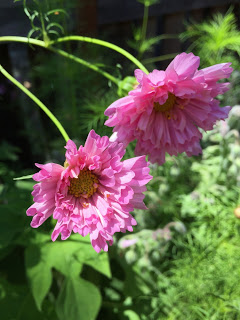
I haven't noticed bees on the Tithonia, though they are known to like it. I notice bees all over the cosmos. So far the bees seem to be continuing to bring in plenty of nectar and pollen. As we move in to an even drier, hotter August, I'll think about feeding them sugar syrup, but as long as I have a lot of stuff blooming, I can avoid that. However, it was 105 here yesterday and supposed to be even hotter today. Who knows how long we can keep up with all the flowers, veg and fruit, with our limited water ration? Better enjoy everything while we can!

Collecting, Cooking, Canning, and Chickens

When we came home from Tennessee, of course the garden was prolific with produce. We knew that we'd have to get busy eating and preserving some of the bounty, ASAP. So Tom and I got picking and  cooking.

Romaine Lettuce, for lunch
String beans, several pounds of them
All kinds of tomatoes
some cucumbers went right to the chickens, but
there were plenty left for us
Apples
Pesto
Hot sauce
Sweet pickle relish
Tomato Paste
Apple Pie Filling
Bread and Butter Pickles
Freezing eggs for winter
The new pollinator garden is coming along nicely; we were glad to see it in full bloom! Here are  some especially pretty new flowers:

the bees like the cosmos
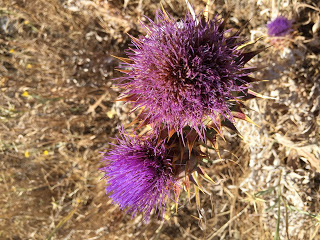
Tithonia
This cosmos has ruffles!
While we were gone, we had a very capable friend living in our house and taking care of all the animals and the garden. She called us Thursday to let us know that she found one of our chickens, Minerva (a Plymouth Barred Rock), dead in the corner of the run. It was fairly traumatic for her, and very sad for us, as it was rather sudden. The chickens had all seemed healthy and happy, with plenty of food and water, so the cause was not readily apparent.

But the more I research it, the more I think I know what happened. In the week before our trip, we started getting five eggs instead of six. It was very hot, and I didn't think much of it, because you're always told that chickens might lay every day, but might not. I thought because it was so warm, maybe someone was taking a break. And I knew which one it was, because Minerva was the first one to lay in the morning, leaving an egg in the box before 6:30 when I went out to clean the hen house every morning. Suddenly that egg wasn't there each morning. What I should have realized is that after two days of not laying, something was wrong. Minerva was young, in her first year of laying, so to go two days without laying is extraordinary, let alone more than that. I should have realized, and should have looked at her more carefully. But all the chickens seemed fine, I was busy with camp, and then  packing and organizing to go away. I think what happened (and this is all speculative; our house-sitter's father buried the chicken for us before we got home, bless him) is that Minerva became egg bound, and then died because she wasn't able to get that egg out of her body.

This is horrible, and shows both our inexperience dealing with livestock, and my casual attitude about caring for the chickens. It's a case of bad husbandry, there's no way to sugar-coat that. So you can be assured that I am now much more involved in watching the chickens and counting eggs and making sure things are a-ok in the coop.

We'll miss Minerva, she was the first chicken of our flock to start laying, she was a curious and inquisitive bird, though often quite mean to the lower chickens in the pecking order. We are fond of our birds, but since we don't pick them up often or spend a lot of time cuddling them, we weren't as grieved as we might have been. What upsets me is that she was sick, and possibly suffering, and I didn't know it.  A hard lesson.

RIP Minerva (on the left)

Vacation in Great Smoky Mountains National Park

We arrived home late last night after a wonderful week on the Tennessee side of the Smoky Mountains. My folks are celebrating their 50th wedding anniversary, and wanted the whole family to head back to the place where they spent their early married years. It was super fun! We had two days exploring the Park, one day exploring the places where my parents lived and worked 50 years ago, and another day at Dollywood. It was also quite nostalgic for my brother Stewart and me, as we spent a good deal of time camping here as children, but it was new for Tom and our kids, as well as Stewart's fiancee Niki.
The first thing a Californian notices about Tennessee is the water. Lakes, rivers, creeks, water seeping out of rocks, rain falling nearly every day in the Park, and thunderstorms. Tennessee is rich in water. We took long morning showers and nightly baths, which was a true luxury. Of course, what comes with all this water is humidity, and it took us a couple of days to get used to that again. But by the end of the week we were acclimated and starting to think it's not a bad trade-off.

We stayed at a wonderful inn called the Buckhorn, sharing a large house and walking to the main inn for breakfast. The spring wildflowers were fading, and the fall wildflowers were just starting to bloom. But what you notice more is the trees - the forest - so different from California Redwoods and Manzanitas and Live Oaks and Madrone. I had to have a refresher lesson on poison ivy, as it looks very different from our own poison oak. The bugs were abundant and marvelous - apparently both the 17-year and 9-year cicadas were out at the same time, and the noise at night was a true cacophony. I couldn't get over the butterflies everywhere you look, all different kinds, and of course we were delighted all over again by fireflies.

The Park is spectacular. We only had two days to explore it, and naturally we wanted to hike. My daughter Kate is not a hiker at all, she doesn't mind short walks, but really doesn't like to go uphill for very long. My son Adam enjoys hiking and seemed to like challenging himself by keeping up with his extremely fit grandpa. The first day we tackled the Chimney Tops trail, which gains 1400 feet of elevation in two miles, so is challenging, but is so memorable that both Stewart and I remember hiking it from when we were kids. Kate had a rough time of it, but we all made it to the top. We had seriously underestimated how much water we would need in the humidity and elevation; sweating was immediate and copious. At the top of the trail there is an additional shale cap which is steep and treacherous to climb, especially when wet. I had every intention of climbing it but as I starting stepping on to the flakes of shale, my feet protested (I've been having some serious foot issues in the last few months) so I begged off. But Adam, Stewart, Niki, and Dad all made it to the very top. Niki said Adam looked very comfortable climbing, and I was glad she kept an eye on my boy as they shimmied their way up there.

Starting out

Following the river

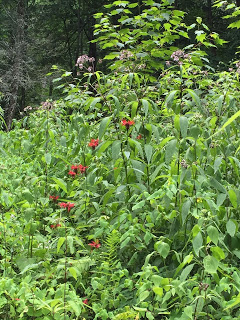
Bee Balm

Jewelweed

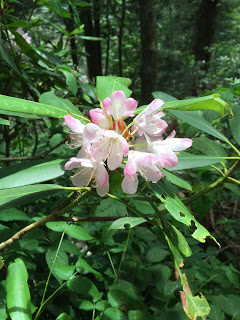
Rhododendron 

Chimney Tops

Cold soak

Feels good

Our second day in the Smokies was spent in another corner of the Park at Cades Cove. The cove is full of pioneer cabins, and this is where we also saw our first bear, high up in a tree. The other tourists also ooh-ed and aah-ed over deer and turkeys, but we see those every day in our neighborhood, so we ignored those and looked for more bears! We took a truly beautiful hike to Abrams Falls, which was a longer walk than Chimney Tops, but not quite so difficult. There were many more flowers on this trail, butterflies everywhere, and some interesting scat to look at. As we started the return hike, the sky opened up and it poured for the last 2.5 miles, which was fun while it was happening but very uncomfortable for the drive back to the Inn! Thank goodness we weren't camping! (Though had it been 35 years ago, we would have been.)
Four log bridge crossings on this hike

red mushrooms

Shelf mushrooms

Joe Pye weed

Blackberries. We passed a hiker who saw a bear
100 yards down the trail, feeding on these. By the
time we got here, she was gone!

Even the lichen blooms here

Narrow-leaved Sunflower, which I believe blooms
only in the Cades Cove area

Abrams Falls

Dollywood was my least favorite part of the trip, but it was still fun. It's a typical amusement park, with roller coasters and water rides, but there are also a lot of shows. We saw a gospel show, a family show (with relatives of Dolly performing), and a bubble show. We all like Dolly and her music, but decided from now on we'd just go see one of her concerts.


The day we spent exploring Treadway, Sneedville, and the parts of Hancock County where Mom and Dad lived was very interesting. They remember it as very 'country,' and it still is, but I suppose rural areas are all changing as we all become more connected through technology. It's beautiful back there, with the Cherokee Reservoir (where Stewart and I learned to waterski with Dad's old boss, way back in 1980) and the misty hills and everything so very green. People are awfully friendly in Tennessee. We often asked folks questions just to hear their beautiful accent as they replied. We got to look at my parent's old house, the abandoned mine where my dad worked, the place where mom had taught school, gone now. The forest takes back the buildings and begins to hide them within kudzu vines and Virginia Creeper. Every house has a porch, and every house seems to have a creek running through the yard. We had an excellent lunch at a tiny cafe/store in Kyle's Ford and visited all the places where my parent's friends had lived. It was really fun.

Heading back to our bus after exploring the old Zinc Mine
Queen Anne's Lace takes over anywhere humans will let it

You can see how it forms seeds, and why it spreads so quickly

There are vegetable gardens in a lot of yards, but I didn't see a whole lot of beehives or chicken coops. The food scene is still a little behind, though we had delicious and fancy meals at the Inn, and a some great local trout at a spot called Crystelle's in Gatlinburg. There's a lot of fast food and chain restaurants, but of course Gatlinburg and Pigeon Forge are very touristy places.

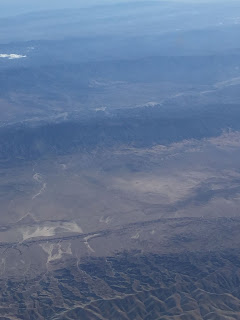
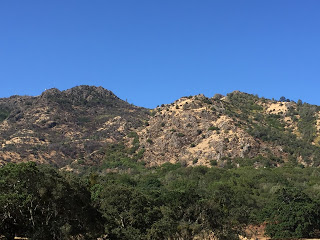
Flying back in to California was a harsh reminder of what our state faces in the months ahead. We passed over the Mojave and Death Valley, and the mountains are just as brown as you can imagine, barren and dry. What a relief to finally fly over the coastal mountains and forests and near Santa Barbara, where the Pacific cools your eyes. Back to short showers, water turned off as you soap up, back on as you rinse. Back to saving water from the kitchen and putting it in the garden.

Looks a little different than Tennessee

Speaking of the garden, everything is lush and blooming and producing and ready for harvesting, so that's today's job, in between loads of laundry. Our first task last night was picking tomatoes for a quick pomodoro pasta dinner, which tasted fresh and delicious and healthy, after a lot of heavy (but tasty!) tourist food. We'll blog about what we're finding, as we make our way through the weekend, harvesting and canning and cooking.

Girl Scout Camp

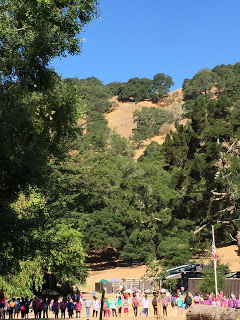
I've been spending the week at our local Girl Scout day camp in Briones Regional Wilderness Park; I participate every year as head of the Nature Unit. I take two days to rove around the camp, doing some sort of activity that fits the theme (this year, it was "Come Play With Us!"), and then two days are spent taking groups on hikes. The last day is always spent preparing food for the camp and helping out with the 'Friday Fair.' The week is always a lot of work, but also a lot of fun, though I'm always so filthy and tired when I get home, it's hard to appreciate it in the moment, and absolutely nothing gets done at home or in the garden. Usually about a week afterward I'm like, hey, that was cool! And I know I'm going to do it again next year.

It's always a challenge to figure out nature activities that fit the theme, and it occurs to me now that I should blog about it ahead of time, because I'm sure you all would have some ideas. One year the theme was Native American, and I did a fun thing where we collected a bunch of veg and fruits and stuff from nature, then smashed it with a hammer into fabric to see if we could create natural dyes. Green cabbage made purple! Onions made bright yellow! It was interesting. One year the theme was Halloween, so the kids and I made habitat webs and figured out if one thing vanishes in nature, it affects all other parts of nature. This year I decided to help the kids make compasses using needles, magnets, and a bowl of water, then we talked about directions, and found something interesting in each direction to learn about.

I also usually figure out something fun to do on the hikes, so we're not just walking up a hill and sweating. This year I made a nature scavenger hunt, and truly there is so much to discover while hiking, we're never bored and always seeing something new.

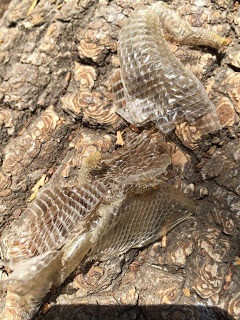
For instance, one of the kids found a lizard skin; at first we thought was snake skin until we saw a little claw/hand shaped bit on it. I had no idea lizards shed their skins, but they do, and in fact alligator lizards shed them all in one piece. Inside the skin we found a chrysalis. Odd!!! and cool!!!

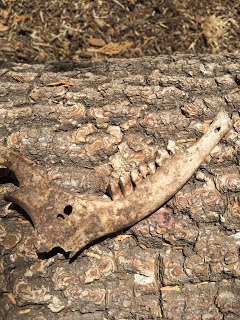
Another kid found a jawbone with teeth still attached, right in camp. Turns out it's a mule deer jaw, and I didn't even know deer had sharp teeth.

There are always a couple of kids, on the hikes, who clearly hike a lot with their parents, and know as much as I do about what we're looking at. That's fun, and I can count on them to help me present everything to the rest of the group. But it's even more fun to expose the rest of the group to nature. Many of these kids don't ever spend time outside, camping or hiking or climbing trees and rocks. Most of them don't know what trees grow in their neighborhood, or what the flowers are, or the difference between a robin and a blue jay. I love those kids. One said to me, "This is the first hike I've ever been on!" and I adore that. I have a chance to help them fall in love with it. What could be better than taking them to a blackberry bramble, showing them which ones are ripe, and watching them eat the sour, warm fruit? Or pointing up high to a Valley Oak and showing them mistletoe growing in clumps hanging from the branches, the same mistletoe that put in their doorways at Christmastime? Or finding coyote poop, and trying to figure out what the coyote ate that day? Or coming upon a steer, grazing in the open space right in front of us?

So, as tired as I am, and as dirty as I am, I feel satisfied that it was a good week, and the kids learned something. Now, I've got to get back to cooking stuff from the garden, ASAP, or we're soon to be overrun!

Morning Flag Ceremony

Mule Deer jawbone

Lizard skin


The Good, the Bad, and the Delicious

Well, let's get the crappy stuff out of the way first, shall we? Last night about 1:30 a.m., I heard the unmistakable sound of leaves crunching under the feet of deer, outside our window. This is a sound I used to hear nightly, so I knew immediately that the deer had somehow breached our fence. I got up and drew back the curtain, and though I couldn't see anything in the dark, heard a tremendous clattering and then silence. There was nothing for it but to go back to bed.

This morning, sure enough, evidence of deer everywhere: The cucumbers, cantaloupe, pumpkins, and a recently planted hibiscus in a container, all snipped. Over in the North Garden, trampled tomato vines and half-eaten green tomatoes.

The damage is not terrible, it could have been far worse. But here's the thing: There's no obvious broken bits of the fence, no obvious source of entry, and the gates were shut. Therefore we can assume that this deer somehow jumped seven feet in the air to clear our fence. And now that she's done that, and sampled the goods, she'll be back. And possibly not alone.

I cannot adequately describe how defeated this makes me feel.

On top of that, we had some hive-fixing to do today, which depressed us. Last Thursday, Tom and I attended the monthly meeting of our local beekeeping club, the Mt. Diablo Beekeeping Association. We went to hear the speaker, Rob Keller, of Napa Valley Bee Company. It was an inspiring talk about the biodynamic side of beekeeping, with which, of course, we agree. Rob was adamant in his opinion about the management of varroa mite, which is to do nothing. If the bees die, they die. The colonies that genetically can fight of the mite should survive and thrive and be allowed to go through this process with no help from us. I had pretty much made up my mind not to treat with any kind of chemicals, even though it is heartbreaking to lose a hive, especially one that is doing well otherwise. But the bees have to evolve on their own.

While at the meeting, we talked with another top bar beekeeper about our recent bee problems. I think I mentioned here once or twice before that the bees are building the comb just a hair sideways, instead of the comb being plumb with the bar. Why does that matter? Well, every time we try to lift up a bar to inspect it, the comb tears and falls off, undoing hours and hours of the bee's work. This is disheartening. So we've sort of stayed hands-off with the bees, adding bars if it looks like they need more room, but mostly not messing with them. This isn't good either because, while it's fine to just let the bees do their own thing, if something goes wrong in the hive, we'll never see it in time and have an opportunity to correct it. Beekeepers need to be aware of what's going on in their hives.

Here's what the master keeper told us: Bees build comb according to gravity. If the hive isn't level, the bees won't build in a level way. Remember when I moved the hive to put the entrance on the opposite side? I didn't level the hive when I did that, which was an idiot move. Because I didn't take the time to do it, the hive has been messed up for months. The bees aren't being stupid, or difficult - it's all completely my fault. Ugh.

Our mentor continued on to say that we needed to level the hive and cut off any herky comb, no matter how difficult it feels to do that.

So, today, we took care of business. We leveled the hive. It was so janky, I don't even want to confess it. I guess I have a good enough eye for hanging pictures straight without leveling, but clearly the same eye doesn't apply to bee hives. Once the hive was leveled, we opened it up and inspected it.

First, the good news: The bees have built on every bar, and there is an incredible amount of brood and nectar and pollen. On Thursday night, keepers were talking about how much they've had to feed their bees this summer, because of the drought. But our bees clearly have plenty to eat, thanks to our vigilance in the pollinator garden and our vegetables and fruit, as well as the cactus garden down the street and the blooming Chinese Tallow trees next door. Also, the fresh new combs were plumb with the bars and looked amazing.


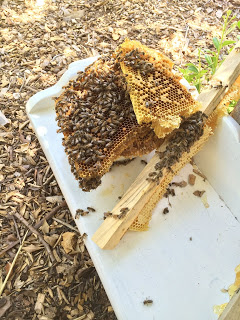
The bad news: We had to remove two full bars of brood and honey, as they were built sideways instead of plumb.


This feels terrible, and there is no way to sugar coat it - we killed a lot of baby bees today. The only sweet side to this, and it's bittersweet, is that we can save some of the honey we removed, and we'll maybe get a cupful.

We replaced the bars with fresh ones, and added more bars, and closed up the hive, feeling sober but better about the whole thing, moving forward. I won't be making the leveling mistake again. As Anne Shirley says, "One good thing about me is that I never make the same mistake twice." Gaining experience is sometimes painful.

On to happier subjects.

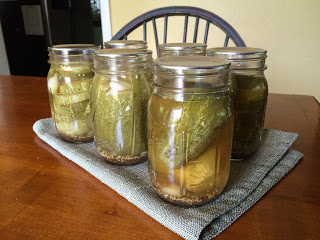
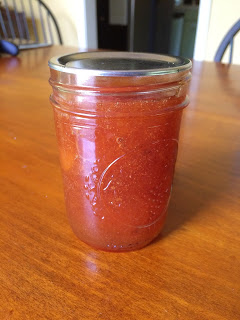
Tom spent a good portion of his time off this week cooking and canning. He's already written about his hot sauce adventures, but he also made pickles from the first of our cucumbers, and both peach and strawberry jam.


We had a lovely hike on the back side of Mt. Diablo this morning as a sort of 'last-hurrah' before the kids return from camp, and it's back to work for Tom. I'm heading up the nature unit at Girl Scout camp this coming week, which is always rewarding but exhausting. So it was nice to have this week of projects and adventures, just the two of us.