Spring Garden Plan 2015

After months of thinking about it, ordering seeds, ruminating on sun and shade, and changing things around several times, I've finally got a working plan for my spring planting.

First, I downloaded some graph paper and printed it out. Then I drew a very simple outline of the raised beds. Then I had Tom scan my drawing and save it for me, so I won't have to redraw it twice a year. My simple drawing does not include any of the fruit trees, bushes, vines, or canes; nor does it include the herbs in the spiral. It also doesn't show any perennial plantings or large trees. This is just a plan for the raised beds. So I will tell you that I am planning to put artichokes behind the chicken coop. No one walks around back there, and they can grow as large and pokey as they'd like.

So, here's the plan for this spring:

North Garden


South Garden

List of plant varieties

I've decided I have to call the two gardens something, as Tom and I kept saying "the garden near the coop" or "the garden by the shed." And North and South is where they are on our property. If you picture a long rectangle with North at the top (makes sense), our house is just between the North and South gardens. On the East side we have the Top Bar Hive, the asparagus patch, four small Chinese Pistache trees, a Toyon, a Manzanita, a California Buckeye, two blueberry bushes, a small strawberry patch, and a flowering currant (Ribes). On the West side of the property, everything is dominated by a large Brazilian Pepper tree, and there is dappled shade. That's where I planted the Woodland Garden, and also that's the front of our house. To the northwest is our driveway and a strip along it that is shaded by a Valley Oak, but each side of the strip gets shade at different times of the day. The side that gets morning sun has my original worm/compost bin, lemon verbena, spirea, a few old fashioned roses, the six new raspberry canes, some bog salvia and daffodils. The side that gets afternoon sun holds the herb spiral, checkerbloom, lavender, and some other things that I've forgotten the names of!

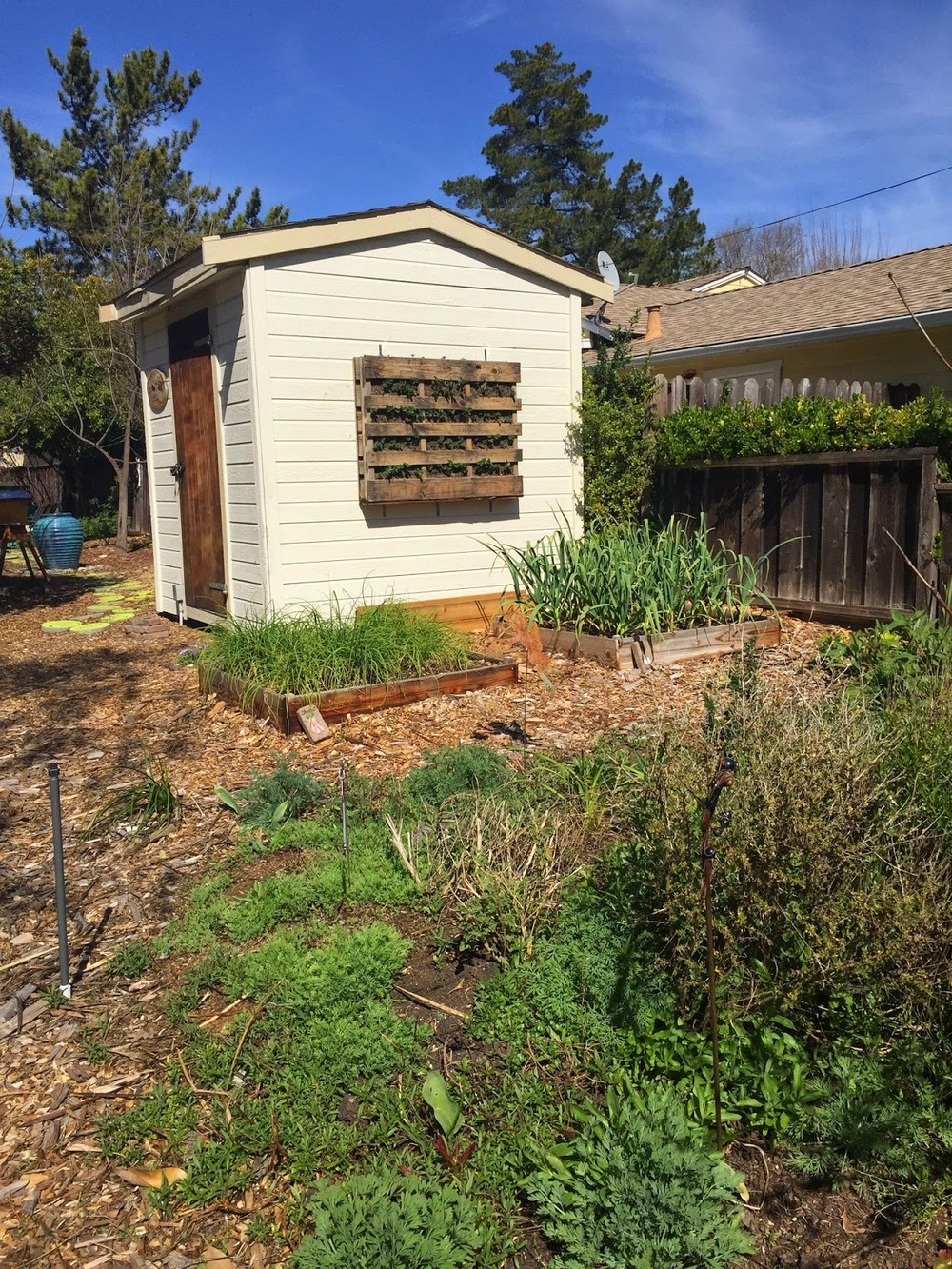
The South Garden is the one we started last winter. I used to garden on the East side, but the pistache trees got too large, so that's why we decided to sheet mulch the lawn and plant over in the South area. It gets plenty of sun and everything does fine there, but there is one large Chitalpa tree that provides just enough shade that I felt some things could have done even better, like melons. So that was the impetus for the North Garden, where it's all sun all the time. So vegetables who can take a little shade, like peas or potatoes, will go in the South Garden, and things like tomatoes and peppers will go in the North Garden.  There is one area of the South Garden that gets full sun all day, and so that will house the melons after garlic and shallots are harvested. That's also where the strawberry wall is, and the pollinator garden. The six new blueberries are also in the South Garden, in a spot that gets morning sun but afternoon shade, since it seems that's how blueberries like it in my garden.

I should also say that the fruit trees (apple, peach, fig) are on the borders of the North Garden. I'm hoping to add a dwarf lemon to a little area next to the house that gets part shade.

I'm excited to get planting, but first we need to build the raised beds in the North Garden. That's a project for Spring Break, which is (thankfully) coming up. First we have to finish the sprinkler project and the fence project.

We got a sprinkling of rain today, so I seeded more red clover into what is left of our lawn. There are several bare spots, and I won't mind more clover for both the bees and for it's tolerance of dryness.

The rain made the wildflowers on my walks today look wonderful.

Lupine
And a neighbor's ornamental apple tree is looking so gorgeous, I just want to live under it.


Converting Sprinklers to Drip, and other random stuff

This weekend, Tom embarked on what will end up being a multi-weekend job, which is converting our sprinkler system to drip. We had the sprinklers put in our yard ten years ago, and as long as we had a lawn, they were adequate. Now that we've revamped our yard to be mostly food production and natives, sprinklers just aren't doing the job. So much of our water gets lost to evaporation; the wood chips get watered regularly, promoting weed germination and wasting valuable water; and the water spray often is too strong or too weak. Not to mention that the foliage is getting wet, which promotes disease. So, we knew it was time to switch, and were very convicted when it looked like December was going to be our only rainy month this year. I know you're tired of reading it, and I'm sure tired of typing it, but we're in a serious drought here, and any way that we can save water is a bonus. Our water bill is still very cheap; about $100 a month in the summer months and half that in the winter, but honestly at some point they've got to raise the rates just to get people to stop washing their cars and watering their grass. This conversion to drip is costing us about $200, which will pay for itself in water savings.

A side note: Many folks in our area have wells, and they water their lawns from their wells. (We do not have a well.) But I am uneasy about using wells to water monoculture. Isn't this still using a precious resource? So many homes have little signs on their fences proudly stating "well-watered," as though they are worried someone is going to comment on the lushness of their lawn and they need to go on the defensive at the outset. But how is using well water any better than city water? Is it because it just drips down to the water table again? I'm just not sure about this. Please weigh in if you can help me understand. And also, this goes without saying, but WHY WATER GRASS???? We drive pass a city park every morning which is a couple acres of grass, with sprinklers arcing across it nearly every day. Why is the city blatantly using up our precious resources on something that produces nothing? It burns my butt, I tell you. I'm gearing up to write the Mayor a letter.

Anyway, this project is muddy (because existing sprinkler heads need to be dug up and either capped or repurposed), fiddly (because trying to figure out which parts go where is a little bit of a puzzle), and frustrating (because trying to determine which sprinklers are on which station requires turning them on and off and getting wet a bunch). Tom's more than halfway done, and hopefully by next week we'll have a working system. Meanwhile I'm watering everything by hand, which is interesting because I'm having to spend a lot of time getting to know my plants and becoming intuitively connected with their water needs, which is something I haven't been in a long time. So it's not all bad, but it does take too much time. I've also now used up all the water in the rain barrel and it doesn't look like that will be filling up again any time soon. Before next winter, we need to figure out more catchement systems.

A friend of mine was hoping for more current pictures of the vegetable beds, so here's one.


It's hard to get a good picture of everything in one shot. The closest bed has braising greens, beets, and broccoli. The next one up has romaine and spinach. Next one has kale and chard. And the final one has peas. Everything is big and lush and delicious.

Here's one of the shallots, garlic, and strawberry wall.

In the forefront are native flower seedlings

The strawberry wall is doing great, but tends to run very dry. I have to stay on top of it with water. I'll get a closeup next week.

The asparagus aren't doing anything further, yet. The blueberries are blooming, as well as strawberries in the ground. The peach tree is blooming.


The herb spiral is doing just great and I harvest from that every couple of days. The mint is starting to make a break for it, as mint is wont to do, so it just takes an eagle eye from me to prevent it from spreading.

The chickens are growing and happy to eat greens from the garden every day. I've cleaned their house several times already and have a good start on the new compost bins. I dug out some compost from the smaller bin and sprinkled some on the new bin, to get those good microbes working. I also begged some grass cuttings from a neighbor to spread on top of the straw. He also promised to bring me grass every time he mows. (I guess lawn is good for one thing, at least.)

Bees are on order and arrive April 11; I'm constantly adding to the flower garden, as well as pruning everything in sight. I took a trip to an interesting nursery today in San Francisco. It's called Bay Natives and it's on the southern waterfront. I bought a bunch of neat plants: checker bloom, yampah, mallow, phacelia, yarrow, salvia, and a few things I can't remember the name of.


The nursery was next door to a place that rents out goats for weed control. They were cute! We enjoyed feeding them scraps from the nursery.


The spiders are growing, they are yellow with black legs and a black spot on their rumps. Anyone know what these are? I'm going to have to let them go soon, I think. But I'd sure like to know what they are first so I know where in the garden to put them.


Adam is working on a great project; he wants to change the school district's lunch program. To that end, he's been interviewing everyone from the lunch staff at school to the district's CFO. He also went on a tour to The Edible Schoolyard in Berkeley, which is Alice Waters' pet project. I had to work and couldn't go, but my folks took him and it sounded like a great, educational time. Here are a few pictures of their day.


Next, Adam and I are going to visit a chef who changed her school lunch program in the district next to ours. I can't wait! I love this project!

As soon as Tom's done with the drip system, we're going to make a serious start on raising the height of our fences, so deer can't get in. The fence part isn't hard, but we'll have to make three new gates, yikes. After that it'll be time to make the new raised beds for the chicken coop garden, and get planting!

Baby Spider Video

The spiders are much bigger (though still very, very tiny)! I spent some time watching them today. They are pretty cute! This video is not great, but gives you a good idea of their size. They have black legs, and orangish bodies.


I still can't figure out what kind of spider they are. No amount of searching yields me my answer. I may have to resort to emailing some kind old college professor.

In other news, we had peas! Fresh peas! From the garden! Only about a 1/4 cup, but still...  I suppose it won't be long before I'm tired of stringing fresh peas, but today I really enjoyed it. Last weekend, I sowed more, so we'll have succession crops.


And the chickens REALLY like the pods.

Interesting Wildlife

Today Adam is competing in the local Odyssey of the Mind competition, and we have just a few hours here at home to relax in between events. And two wonderful and interesting things have happened!

First, when we arrived home, I took out the jar with the unidentified eggs in it - the ones I think are spider eggs - to show my folks. When we looked at it, we noticed it was moving. (This is on a very tiny level - I mean you can barely see this happening - but the more we looked, the more we were convinced things were moving.) We realized that we needed greater seeing power, so I rummaged in Kate's room for her microscope. I took it outside and we spread apart the egg sac on a slide, and sure enough, they are hatching!

Dad, taking a look

Now, since we saw them through the microscope, of course I couldn't take a photo. They are translucent white with black threads running through their legs. There are millions and millions of them. I must confess that even though I thought the whole thing was cool, it also gave me the serious heebie jeebies. I put the egg sac into a larger, clearer jar, and I'm hoping by tomorrow I'll have better evidence to show you.

Then, while I was putting Kate's microscope away, I noticed activity outside her bedroom window, on our front porch. I have recently rearranged things out there, and on a whim, I put a decorative birdhouse on the porch railing, just 'cause it's cute. I never dreamed any bird would actually get interested in it. I've had it 10 years and no matter where I've put it, no bird has ever been interested. But guess what? Two tiny birds were taking turns putting sticks in the house, building a nest together! I did some research and they are Bewick's Wrens, a bird I've never seen in our yard before, even though they are apparently quite common. My pictures are crappy (the link above gives a much nicer one) because whenever I tried to get close, they stayed away.

I got this shot before he got hip to me, but I couldn't get any closer

Through Kate's screened window, but at least you can see him holding a stick!
I could not be more thrilled and hope to have lots of photos for you in the future of these cute little guys. Poppy Corners was just recently certified as a Bird-Friendly Habitat through the National Wildlife Federation. We are pleased to have this, along with our 2007 certification as a Wildlife Habitat.


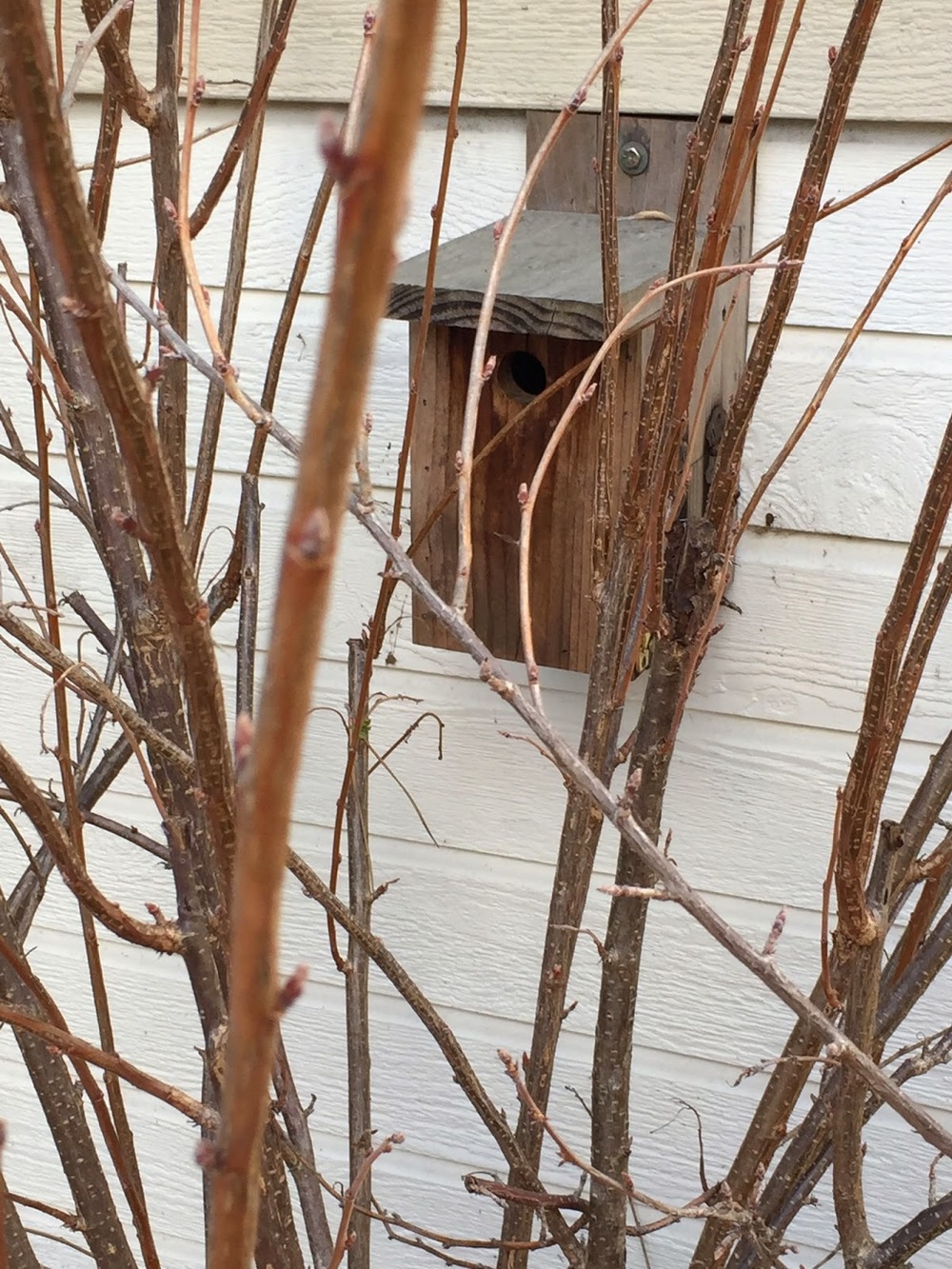
I've actually been reading up on building more nest boxes, as we only have one other that Adam made with Dad years ago, and it gets a lot of action.

It's behind a large Ribes (flowering currant), which is why I think birds like it
We also have a nesting perch that Dad built when we starting getting lots of Mourning Doves in our yard. They don't like boxes, just these sorts of things:


But so far, nothing has built a nest on it, not even a Scrub Jay, who tend to like these sort of things too.

So I'll let you know what I find out about building nest boxes. Meanwhile, back to Odyssey of the Mind...

Insect nest, chickens, a new resource

While showing a visitor the top bar beehive last weekend, I noticed an interesting nest attached to the roof. As you know, the hive has been empty since the end of November, and some intrepid spider or insect decided to leave a legacy in this warm, protected place. I scraped it off and it is full of orange eggs.


Now, I've done a lot of searching on the web about who this nest might belong to, but I'm coming up baffled. It could be an orb weaver nest. We get a lot of these spiders in late summer, and apparently they lay one last clutch of eggs before dying in the first fall frost. The eggs overwinter, then hatch when the days get warm. It could also be a yellow sac spider, and the sac does look a little yellow. However they tend to lay either in houses or in the garden, I suppose they could pick an outdoor structure. We get a lot of black widows, but I've seen their nests and they don't look like this, and the nests are usually in the web.

Anyone have an idea?

I have put the nest in a jar and poked holes in the top. I hope it hatches and I get to see what comes out. I'm keeping it outside. I appreciate spiders, but I don't want them in my house, no siree!!!!


Of course, they may not even be spiders!

The chickens have been fun and interesting. First of all, they poop an awful lot. But it doesn't smell, at least not yet. Either that's because it's not hot yet, or because I have a good amount of bedding in the coop, which I do. I've had to clean out the house part once in the past week, because it got so poopy. I'm glad we got the new compost bins built in time.

The chickens themselves have a very nice smell, their feathers I mean. It's distinct but I feel like I've smelled it before, if that makes any sense. It's warm and barn-y. But extremely pleasant.

They make the most adorable peeping noises, all the time, even when eating. Then they make another sound when they are startled, kind of like "whaaaa?" That's what I hear, anyway.

They couldn't figure out how to get up or down the ladder from the house to the run for a while, but a few days ago they learned how to get down (gravity helps, doesn't it?). It took them until tonight to figure out how to get up, but they've finally done it.

They have access to food and water at all times in the run, but we've been giving them a daily treat of dried mealworms in the morning, and cracked corn in the afternoon. I also have been giving them greens (and hopefully slugs) from the garden, which at first they couldn't figure out how to eat. Every time I open the door, I make a sort of chirping sound, and it's working - now they associate me with delicious things. But they are still very cautious and don't like me making any sudden moves. The Rhode Island Reds are the bravest by far, also the biggest. Molly has even pecked my shoes. In the chicken world, she's a hero.

Actually, this is Ginny.

The Barred Rocks are the most aggressive, flying mostly at the Easter Eggers and keeping them away from the treats. Well you know I don't have that. Everyone gets their fair share. But even though aggressive, they are also the first ones to sink to the sawdust and nestle down with their eyes closed, which is pretty cute. The Easter Eggers seem shy and really don't like being handled, but they are scrappy. They are also the prettiest, in my opinion. But I think the Reds have really earned the first place in my heart because they are so brave and curious.

And finally, as I was out cutting greens for dinner, an acquaintance pulled up and asked me some questions about my garden. Turns out she runs a wonderful nonprofit called Sustainable Contra Costa. I've been perusing their website for an hour now, and I've even signed up for a class in greywater systems, something Tom and I have had on our list for a while now. They have some terrific classes. If you're in the 'hood, check 'em out!