Stash the Phone!

Thought you all might appreciate this little gem from Tom Stienstra, outdoor writer for the San Francisco Chronicle.

Get your 5 senses’ worth from outdoors


Updated 4:14 pm, Sunday, December 14, 2014

On a walk last week, on the trail from the other direction, a hiker approached who was holding his cell phone in front of his face.
As we crossed, he held up a hand to stop me. “Is this the right way to the waterfall?”
Turns out he was reading one of my stories on his phone as he walked.
Yet the trail was right there in front of him. A stream was running alongside. It sounded like a water symphony. Ferns were electric green. Mosses oozed water. Just ahead, a newt was trying to make its way to a mate, walking as if each leg operated independently of the others.
“The waterfall is right there,” I said, pointing, “just upstream.”

This has happened a half-dozen times or so this year. It seems that the advancement of cell phones, electronics and gadgets in general has people more disconnected from the land than ever.
It has a lot of people living in a bubble. You can miss all the sensory triggers, the smallest of sights, like all the mushrooms that emerged last week, the smell of the woods, the taste of clean air, the sounds of the wild and how a trail, softened by rain, feels underfoot.
When you become aware of all the senses, that’s how you have experiences you never forget, especially when you share them with people you care for.
In addition, you can learn to read the land and water. You often don’t need a map. You get so tuned in to the landscape that you can figure out, on your own, where everything is.
On trips on BART last week, it seemed every person on every train had a phone in his or her face. No books, magazines or newspapers, and nobody ever looked out the windows.
Life in a bubble might work on BART, but it isn’t the best way to enjoy the outdoors.
On your next trip, stash your phone deep. Or better yet, venture to where it is out of range and doesn’t work anyway.

Tom Stienstra is The San Francisco Chronicle’s outdoors writer. E-mail: tstienstra@sfchronicle.com Twitter: @StienstraTom

Honey!

Today, Adam and I got out the big bucket of wax and honey that has been draining since Sunday, curious to see if we had much product.

The comb was cut off the bars into this bucket, made for the express purpose of harvesting honey. If you have a Langstroth Hive, you can also drop some big bucks on centrifuges for harvesting those frames. Since I have a Top Bar Hive, that isn't an option for me. This bucket suits the purpose perfectly, with a screen inside to keep most of the wax out of the honey, which drains underneath. I borrowed this bucket from my dad.


The front of the bucket is fitted with a pipe for draining the honey into jars, which is secured by a flap and a wing nut.


Just open the flap, and out comes the honey. It's fun to fill the jars.


You can see a little impurity here, coming out with the honey. It's impossible to keep all the wax and pollen out. I did not filter the honey any further, because I don't mind the impurities. However we might gift this honey to someone who does, in which case, they can just pass it through a finer sieve.

We filled up all the the little Mason jars I purchased for this purpose. There was still more honey. We got out some medium sized jars. Still more honey! Adam kept saying "WHAT????" I got out a big daddy jar, the only one I had left unused in the cupboard. There's still more honey. I'm going to have to go buy more jars tomorrow.


Isn't it pretty? We finished just as the sun started going down. I stirred up the wax in the bucket, breaking it up further, and put the bucket back in the garage. I'll jar the rest of it, tomorrow.

Next I had to clean all the bars that had had combs built on to them. This was a messy job. I can't get all of the propolis off, because it's basically glue. So I left that on - you can see a lot of it at the right of the bars. Plus I left just the thinnest shaving of wax on top, so that the new colony will have a pattern to get them started. It looks like a spinal column on the bar. Kinda cool.


Adam and I weighed the honey we harvested today. We were amazed to find that we had 19 pounds of honey! Wow! I think my colony would have made it through winter with enough food, had they lived. I am so impressed with their industry. So much of this honey came from the flowers in my yard, and from all the flowers in my neighborhood. You just can't get much more local than that.

I am so grateful to my little colony of bees, and so sorry that they did not survive. But I have already ordered another colony, and will pick them up in April.

Beehive Post-Mortem

Today, my father came over and we opened the hive. I've been morose all week about the death of my bees, and I wasn't looking forward to going inside the hive again, but it had to be done. I wanted to know more about how the bees died, if possible, and I wanted to harvest the honey.

There had been absolutely no activity this past week around the entrance, so I expected the worst, and sure enough, we saw right away that there were no bees inside. In fact, as we made our inspection, we found only three live bees. The amount of dead bees littering the bottom of the hive was much less (which is a mystery), but because of that, the cause of their death became apparent right away. All along the bottom inside boards of the hive were tiny red circles. Varroa Mites. I was devastated all over again. These mites are a huge problem in the beekeeping industry, and most large operations spray with poisons to kill them. I won't do that, so it's possible that I will continue to have infestations. 

I picked up one of the three live bees, and sure enough, there was a mite stuck to its side.

Can you see the tiny red dot?

This mite is slowly sucking the life out of this bee. So incredibly sad. I never noticed these mites on the bees. They have a 10 day life cycle, and this infestation was so aggressive, it killed the hive fairly quickly. I'm not entirely sure how to help my bees resist this creature in the future.

We cleaned out the hive, finding the dead queen, right near the door. One of the combs had a queen cup on it, which means that the worker bees had been unhappy with the current queen's laying (and no wonder, as she was slowly dying), and they were getting ready to raise a new queen. They never got the chance.


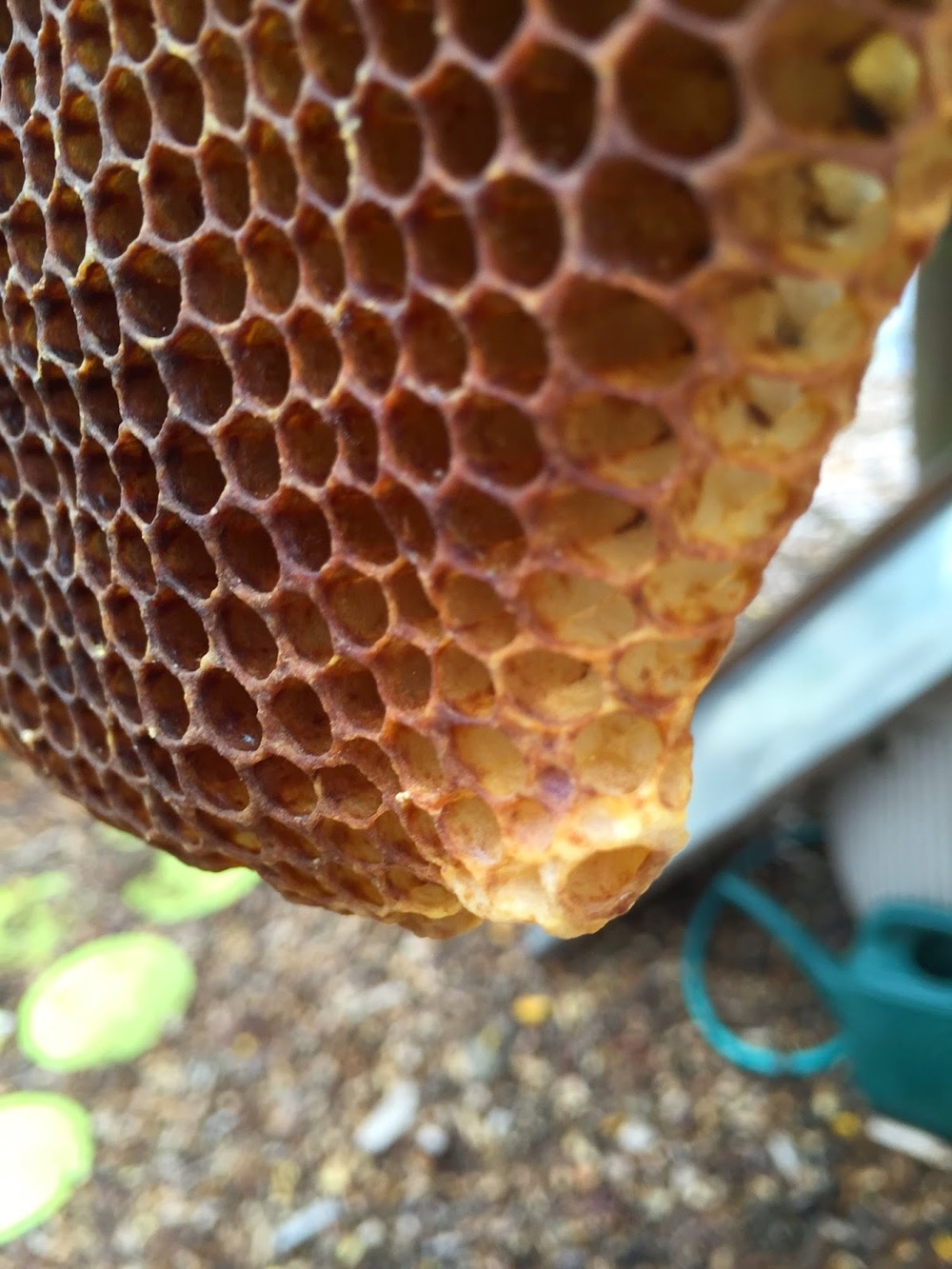
We cleaned all the bars, harvesting beautifully colored honey, about 10-15 pounds of it.


It's crushed and draining in a special bucket made for this purpose. In a few days, I'll open the spigot and fill some jars. I did save a bit of the honey in comb, for us to eat right now. I feel good about chewing the comb, knowing that the bees did not die of pesticide death. Chewing comb reminds me of being a kid; this was our version of chewing gum.


The hive will remain closed and empty through the winter, and the bars will be cleaned and stored in the garage. In spring, I will get a new colony and try again.

Adam and Tom are having a celebratory dinner with fellow opera folks, as the closing performance was today. I'll cook Kate a hot dog, and drown my bee sorrows by indulging in this delicious fellow. That's better than downing a pint of ice cream, any day.


World Soil Day

Happy World Soil Day!


You can watch the great video, "Symphony of the Soil," for free this week: WATCH

There's some really interesting information at the Food and Agriculture of the United Nations site.

Today would be the perfect day to start a compost pile in your backyard. It need not be complicated.
THIS would be a good place to start.

Another way to celebrate would be to visit a local, organic farm. For more information on where to find a farm near you, see HERE.

And if all else fails, go for a walk - in the dirt, not on concrete. Find a trail near you, check out an open space or a park. Get out and connect with your soil!

Back Yard, Mushrooms, Bees, and an Intruder

Tom and I spent a good deal of time this weekend finishing up the sheet mulching in the back yard. We are not quite done; we ran out cardboard.


We realized that this has been the biggest sheet mulch area yet. Tom has blisters, even though he wore gloves, and we consumed a good bit of Ibuprofen the last few days. Now, we wait: To find more cardboard, for the rain to stop, for the mood to hit us again. It'll be good not to use the wheelbarrow for at least five days.

The rain showed up in earnest today. It's been interesting to see what kind of mushrooms come from this new pine mulch.

One day closed....

the next, open!

Remember those mushroom plugs we inoculated into logs? They've done absolutely nothing. But the mulch grows every kind of mushroom I can think of, with absolutely no help from anyone.

The rain made it through the row covers and into the raised beds just fine, and I really notice a difference in the size of the kale and spinach seedlings - they grew a lot just in the time those have been up. So they must be benefitting from the increase in temperature under there.

As for the bees: I went out again yesterday, before the rain started, to see if there was any hive activity. There are a few bees going in and out, but they act strange - sort of drunk. Loopy. Not quite making it in to the hive on the first try, falling down, rolling upside down. There were several more dead bees on the landing. I'm going to wait a week, and if there is no positive change, I will clean out the hive and store everything for winter. (I can't wait too long before harvesting the honey in the hive, or wasps/mice/wax moths will get it.) I'll try again in the spring with a new colony; I'm a confirmed beekeeper, now. However, I continue to be quite upset about this event. It's a bit like losing a pet. I really cared about the hive. I think about the beekeepers (like my dad, and many many others) who have lost hive after hive, the same way, and it hurts my heart.

To add insult to injury, as I was sitting at the hive, this guy came out from under the house.

Yep. It's a rat.


Argh. I've had it with nature, for a while. Time to get back in the work/school routine.