July = Camp

Summer is traditionally a very busy time for us. Both kids go away for a week to a special camp in Oroville called Okizu; Adam always has a week in Healdsburg for the San Francisco Boys Chorus, plus some sort of tour (this year to Arizona), plus a week of Boy Scout camp; Kate has had theater camp for several weeks which culminates in an early July performance; Kate and I have Girl Scout Camp, which is a huge feat of volunteering for all the adults involved; and then if we have any family trips, they happen around this time. Then there are a couple of day camps thrown in for good measure and some family camping. I've been putting some miles on the car.

So there hasn't been much time to sit down and write, and honestly not much time to get out in the garden.

Last night we heard a strange noise around 10 o'clock, and went out to investigate, thinking someone's car was getting broken into. But it was a branch from our Catalpa tree, tearing off and falling into the basil, peppers, and tomatillos. Argh. Tom and I went out with flashlights and got the thing off the plants. Now I need to get a tree guy out here, and see if the tree is still viable. Luckily no one was standing underneath it when it calved its branch.


All the veg has recovered except for one basil plant which was just ready to pick for pesto. Oh well.

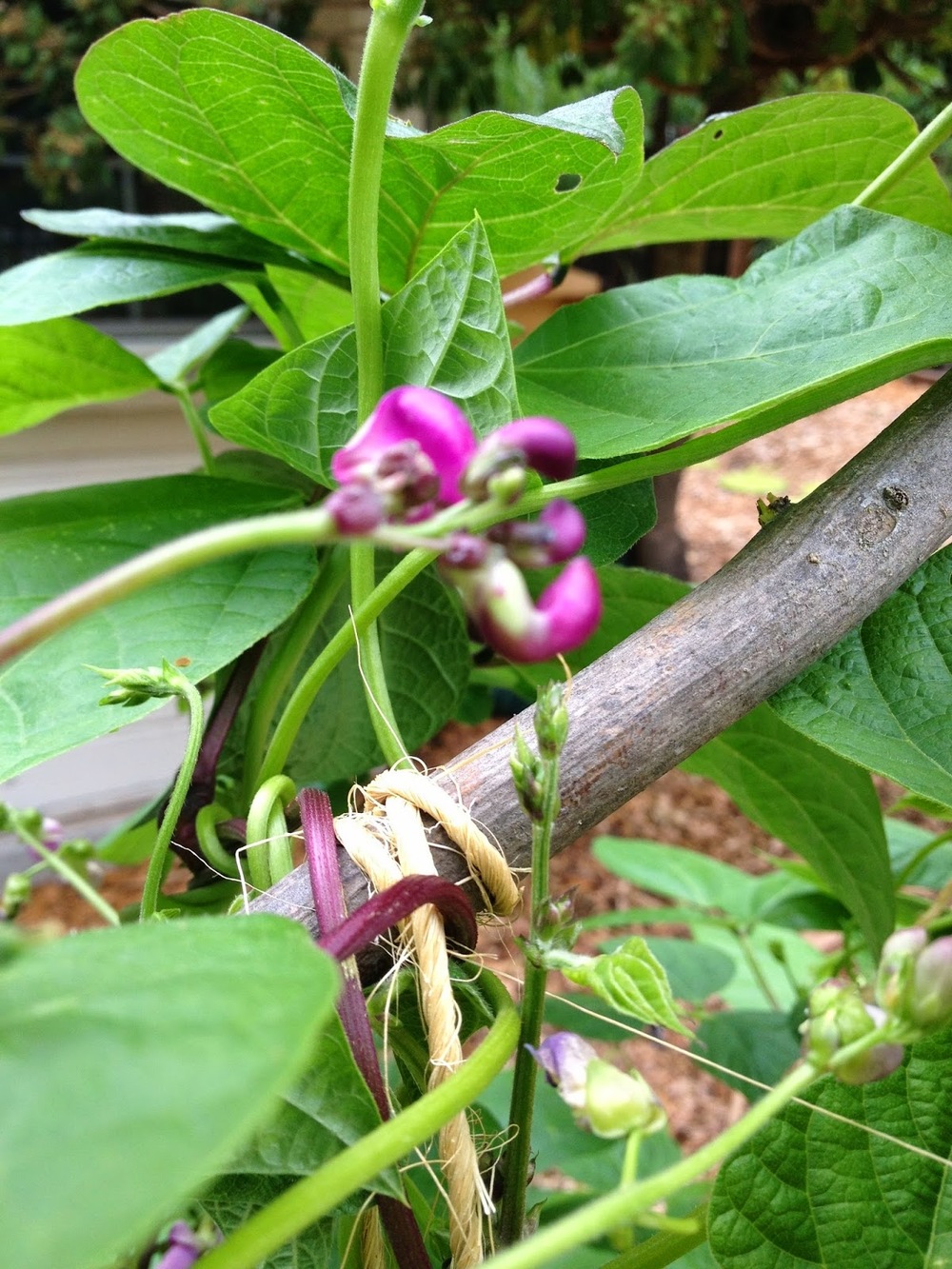
The beans are looking great, I think I chose a kind of heritage bean called "Rattlesnake" from Renee's Garden. The beans are a mixed green and purple, they're really pretty plants.

We ate our first green pepper, and are harvesting tomatoes daily. The greens are starting to bolt in our hot weather, as has the cilantro, which I'm letting flower because it attracts good insects. I'm also letting the dill flower. I need to harvest the rest of the greens tomorrow, and then leave that bed to the corn. The pumpkins are looking good, and starting to take over the yard.


I haven't been in the hive lately, but the bees seem to be doing all right. They are constantly on the Gaillardia, I'm so glad I bought them and wish I had bought 10 more. They are super cheerful plants.


I was hoping the bees could get nectar from them, but it looks like they are collecting bright orange pollen.

Speaking of nectar, I have lots of hummingbirds, but today I saw one feeding from a sunflower. Who knew they would do that? I didn't.

On my forays to camp, dropping kids off, I've gone through beautiful agricultural areas. In Healdsburg, the grape vine was king. Wineries everywhere, and it all just looks so quintessentially  California. Today, I took Kate up to Oroville and went through nut and fruit tree orchards. For lunch, I bought a bag of cherries from one of about a hundred roadside stands.
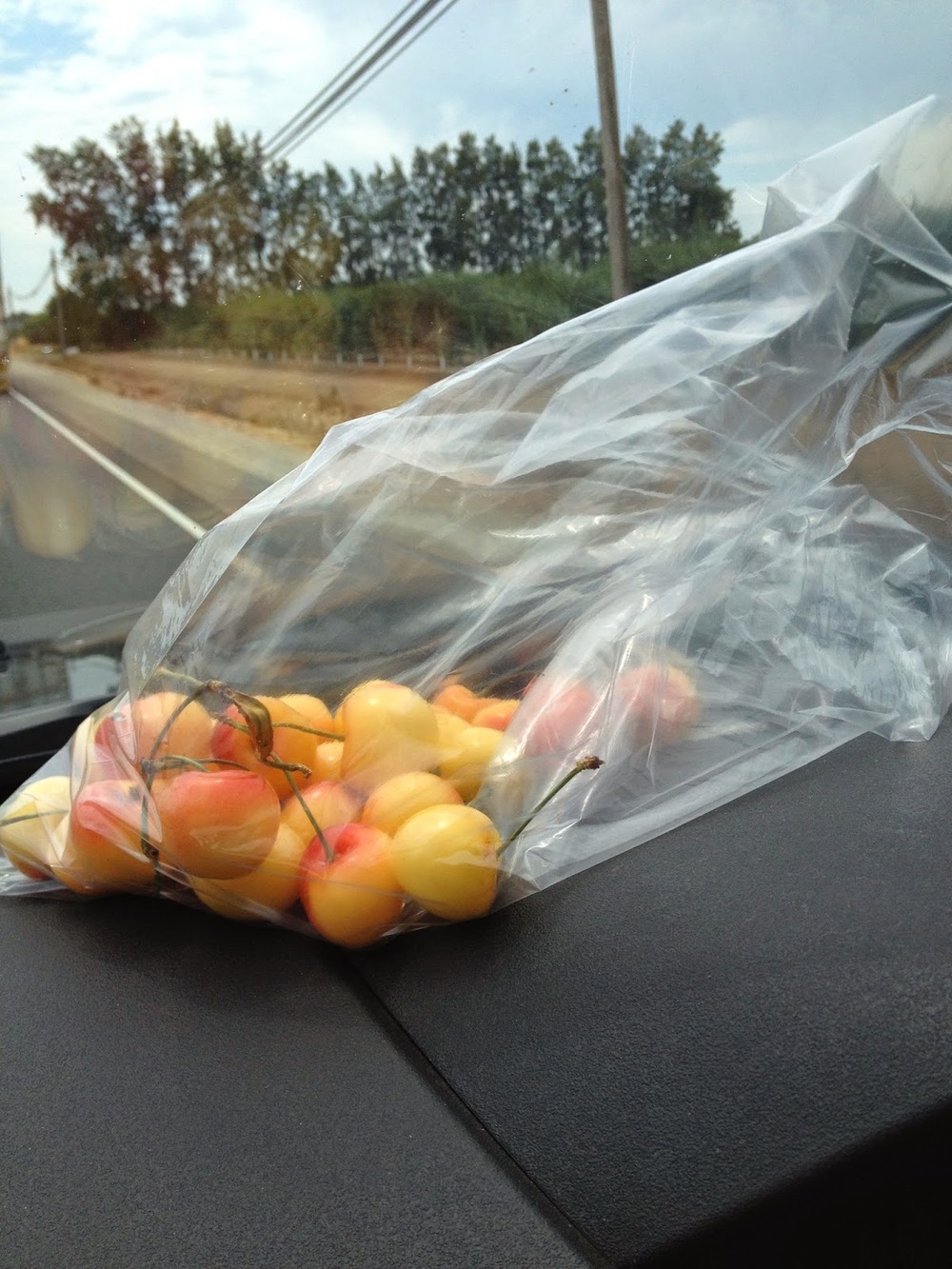

 It was fun to spit pits out the window while I was driving.

More Planting

I decided the bush beans had to go. They had produced about 6 beans, which were delicious, but that ain't very many, and the plants themselves just weren't growing any bigger. As our pole beans are going great guns, it was no great sacrifice to snip those bush beans off and put 'em in the compost. In their place, I planted Butternut and Acorn squash. We have a long growing season here in Northern CA, so I expect hot weather through the beginning of October, and warm weather until Thanksgiving. Therefore we have plenty of time for a winter squash crop.

Here's an overview of how the veg garden is looking.


You can see the tomatoes at the back are quite large, and producing well. Those little plants at the forefront are watermelons. They keep growing, incrementally, so I keep hoping.

I also planted some more flowers - bee plants, mostly. I went to the local nursery and stood in the drought-tolerant section for a half an hour and watched where the bees went. Then I bought those flowers. I came home with Rudbeckia, Gaillardia, Aster, and Germander varieties. The Salvia, Sunflowers, and Penstemons are already blooming well.


I'm hoping that some of those flowers will help my bees make it through Fall.

Many mornings, I take the kids to the pool with friends, and while they are swimming, I peel and slice peaches. I peel peaches every minute I have, and put them in the freezer. I don't mind, because I'm currently completely addicted to my peach smoothie every lunch. When we were away over the weekend, what did I dream about coming home to? My children? No. A frozen peach smoothie.


Honor Farm Stand

I've been reading up on Honor Farm Stands, and I really like the premise. You make a stand, you fill it with produce, you suggest a price per item, and then leave some sort of till for the cash. I don't have a lot of surplus, we're still getting started here at Poppy Corners, but I came back from a weekend away and zowie! The garden had exploded. I spent a good deal of time harvesting this morning, and realized we do have some extra today. So I made my own little honor stand.


I put out peaches (4/$1) and some paper bags, a few bagged bags of cherry tomatoes ($1/bag), and four large bags of mixed greens on ice in a garden trug ($2/bag). The signs say 'organic' and 'picked this morning!' and there is a jar for payment.

I'm not sure anyone will stop and purchase anything, but we can eat anything that doesn't sell. And as the summer goes on, folks might start to get used to seeing it here and look forward to buying some produce. Maybe the kids will get industrious and decide to build a real stand and take over the 'operations.' It's better than a lemonade stand, anyway.

Pesticides

Today there was a knock on my front door (just around dinner time). A young man told me that my neighbors, two of them, just a couple doors down, are spraying their yards for bugs. Of course he was hoping I'd do it too, it was a sales call after all. I asked a few questions - he showed me the sheet of bugs that they kill - it was a huge list, with pictures. Everything from spiders to ants. And mice were included. I didn't see gophers, but I can't imagine they'll like the spraying. I mentioned my bee hive. He said they use a 'natural' product, but that the company didn't claim to be 'environmental.'

We do have spiders here (even black widows, which are quite shy and only come out at night). We have ants aplenty and it sucks when they come in to the kitchen. We have yellow jackets, paper wasps, probably hundreds of native ground-dwelling bees. We have crane flies which are spooky looking. All of these creatures have their place in nature - even yellow jackets, though my human brain can't comprehend what it is. Ants are important predators in the yard. Spiders get rid of those pesky flies - though I must say, I've seen several flies pollinating my garden this year. Paper wasps not only pollinate, they lay their eggs on parasitic worms like hornworms. When the babies hatch, they eat the worm from the inside out, thereby helping the plants.

And then, there's my honeybees. Approximately 30,000 of them. Losing a few won't hurt the hive. But think of all those little feet, climbing over all the flowers in those yards. Think of those feet coming home and getting wiped on a doormat of comb. That wax is in the hive for years. Babies are born in that wax. People want to EAT that honey that is stored in that wax. In light of the great numbers of pollinators dying, and the recent news that many pesticides (well, duh) contribute to colony collapse disorder - I just can't understand why anyone would want to spray.

And it goes without saying that when you spray for bad bugs, you kill the good ones. All the hundreds of thousands of tiny creatures, things that live in the soil and make it healthy.

There's nothing I can do about it. Each person is entitled to their beliefs. Each family deals with things in different ways. Our daughter is autistic, and she went through a many-year period of being simply terrified of bugs. Like, scream and cry terrified. If a crane fly went in her bedroom, we killed it - we weren't going to torture her. But at the same time, we were constantly teaching her, helping her to know about bugs and the role they play in nature. We studied bugs, we read books about bugs, we watched nature shows about bugs. I'd point bugs out in the garden. We'd admire their structure, their wings. Kate was even afraid of pretty bugs, like butterflies. I think bugs were just too much out of her control. It was a nightmare, her fear. We had long talks about choosing to NOT be afraid of bugs. Choosing to live differently. We were very firm that the world held bugs, lots of bugs, and while we would kill a fly who came into her bedroom, we wouldn't kill indescriminately.

It was a long road, but now, Kate often helps me open the hive and check on the bees. If we had just killed everything in our yard, she would have lived out the rest of her life, afraid.

I'm sorry to confess that this attitude did not come naturally to me. In our previous house, there was a serious ant problem. It was new construction in a new development, and the ants were displaced, just looking for a place to go. But they were EVERYWHERE. It was impossible to stand in the yard outside without having ants crawl on us. We had babies. We were grossed out. We hired a company to come kill them. Once a month, this guy came and sprayed our yard and the foundation of our house. The ants didn't have a chance. A year later, my son developed leukemia. (Yes, we have one kid with autism, and one who had cancer.) Coincidence? Studies showed both diseases have a genetic link with an environmental trigger. Studies show both are affected by pesticides in the home. Years later, when I found this out, I was sick with grief and guilt.

Did we, in our ignorance, cause these things? I may never know. I will always blame myself for it. I will never, ever spray like that again. I'm emphatic about it. Yeah, I do put out borax for the ants, when they get in the hive, or in my kitchen. Yeah, I spray garlic oil on the aphids. Yeah, I selectively kill European invasive rats in my compost. I'm not a purist. But I've evolved enough not to do what my neighbors are doing.

Writing about all of this reminds me to recommend a book, Grass, Soil, Hope by Courtney White. It's about carbon sequestering in soil. Yeah, it sounds dry and scientific - but it's fascinating. The bottom line is that healing our soil can heal our climate change problem. In order to heal the soil, a lot of folks are going to have to change their minds about how we farm, how we raise food animals, and how we deal with weeds and bugs. This has been a constant process for me - switching to humanely raised animals first, then switching to all pastured meat. Starting out buying organic greens, then focusing on the Dirty Dozen, then switching to all organic produce, finally producing our own. It's baby steps. It takes a radical mind-shift: How do I want our bodies, our home, our yard, to look and function?

I can only hope for a moment, in the future, to bend my neighbor's ears. Perhaps one day they'll ask how the bees are doing. That might provide an opening to have a discussion about how bees are dying in radical numbers. I can plant a seed. They'll think about it. Maybe in a couple of years, they'll change their minds. I can only hope.


Maintenance

Not a lot to report about the garden, or the bees. Things are trucking along quietly, everything is taking care of itself, it requires nearly no fussing from me, which is great. We harvest strawberries, blueberries, peaches, greens (romaine, collards, kale, chard, various other Asian braising greens), and tomatoes every day now.


There is an abundance of fruit, so while much of it gets eaten fresh daily, more of it gets peeled, cut up, and frozen in small batches.

I eat greens daily and Tom and Adam almost daily, so the greens are welcome. I don't know what good organic greens cost in your store; in our local Whole Foods, it's $5 for a small clamshell. I can pick that every day, sometimes twice a day, right outside my back door. This is truly a huge cost savings.

When I planned the garden, I read a lot about planting 'high value' foods. I didn't exactly get what that meant at the time, but I guess I get it now. I simply planted what I knew we would eat. (I didn't plant even one summer squash, because I won't eat them.) I'm already planning my fall/winter garden and it will continue to include greens, as well as peas, beets, and broccoli. I'd also like to plant cover crops in the beds I will not be using. I will probably plant red clover so that the bees can get some advantage from it, on warm sunny winter days.

The bees are also quite happy, at last building one bar of just honey, instead of brood mixed in with honey. This means there might be surplus. We'll have to see what their supplies are, come fall. Right now they are heavily foraging the two Chinese Tallow trees on our street, for both pollen and nectar, and an agave blooming around the corner, for serious quantities of nectar. When those dry up, I'm not sure what they'll eat.

Since I notice the bees drowning in both the local pool and my various buckets/barrels that I have placed around my downspouts and water spouts, and they can't seem to find the water in the fountain (perfectly safe) or in the small dish I left near the hive, I made yet another bee watering station, which I hope butterflies might use as well. This is a piece of crockery that we inherited from the Boegel side of the family, which we weren't using, and some beach stones as well as some old marbles and tumbled crystals I found in Adam's room.


I put it in an entirely different place in the garden, hoping that the bees would find it. We'll see.

I walk around the garden both morning and night, pulling stray weeds and harvesting ripe produce. I notice that we are close to harvesting other things, like basil and peppers.


It seems I have failed to produce any bush beans this year, but the pole beans are doing great. I'm not sure whether to pull the bush beans out, or just hope a miracle happens.

We've got beautiful things blooming in the flower garden too, sunflowers and Russian Sage.


The weeds are honestly hardly a bother, and with all the organic matter and compost we laid down, easy to pull up. Some weeds end up being wonderful volunteer plants, such as the wild strawberry we have growing under our oak tree. I tend to let weeds go for a little while, just in case they turn out to be something good.

No mushrooms sprouting from logs yet, but you can bet I'll post the minute that happens.