My First-Grade client was unexpectedly sick this morning, and did not go to school. I suddenly saw the day stretch before me, promising and empty: Would I nap? Watch that recording about the making of "American Idiot - the Musical" that I have on the DVR? Start a new book? Play Plants vs. Zombies?
Then I remembered all the chores I had to do. Rats. However I have to say it does feel good to knock some things off my list.
First, I went for a nice long walk with Joe the dog, in Las Trampas. I was the only human on the trail, and it was SO quiet and peaceful. Suddenly a huge bird darted up before me and in to the trees. It was something I'd never seen before. I couldn't get a good picture, but when I came home, I looked it up - and it's some kind of grouse.

It was a beautiful bird, and one I never expected to see.
Later on, I discovered a funky bug on a gorgeous unknown blossom.

Further up and further in, we even found water in the creek. Joe enjoyed it particularly. I didn't much like the mosquitos.

Hard to believe there is any water in nature left anywhere in California by this time of the year.
Then I started in on chores. I won't bore you with most of them, but one I thought you might be interested in: I collected the seeds from the spent Clarkias (Mountain Garland), Poppies, and Tidy Tips. I strip the plant of all its seed pods and then put them in a paper bag. There they stay until next winter. At some point they dry up and pop, and then all the seeds will be down at the bottom of the bag when I want to plant them.

This is a bit tedious (the collecting part) but it's easy, and I'll not need to buy seeds next winter. Also, these big healthy seeds are from plants that did well in my garden, so I'm selecting the hardiest and prettiest plants. I left some seeds on the plants to open and scatter now, and it's possible that some will over-winter and bloom again next year. The Tidy Tip seeds are like dandelion seeds - they scatter like crazy - so I'll probably find them in a bunch of places I don't want them, next year.
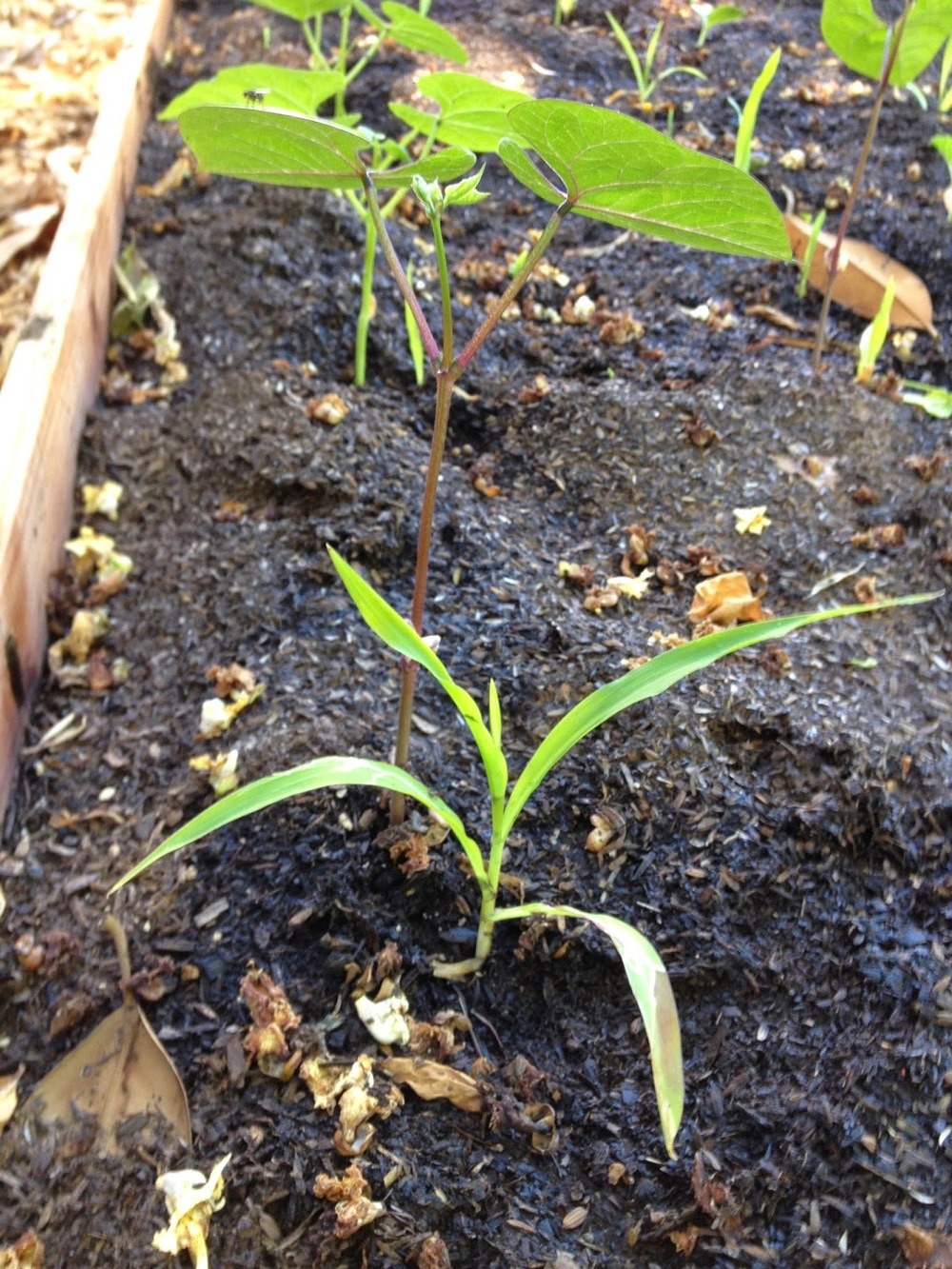
Another fun thing I did was begin the trellising for the pole beans. Originally, they were supposed to twine up the corn, but since the corn is struggling this year, the beans need support. So I fashioned something out of bamboo poles and a long branch that came off the catalpa.

Now I just need to drill some screws in the wood of the raised bed, and stretch some taut twine between the branch and the bottoms. Then the beans can grow, and if the corn wants to get its act together and grow too, it can work its way through the trellis. The pumpkins down below and in between have got a great start, and should soon be vining and mulching around the bottom of the bed, so the corn better get busy if it's gonna.
These hot sunny days, the bee hive smells particularly strongly. I can smell it through the open windows, and even when I'm out working in the street. It's not a bad smell, but it's different enough that I'm sure someone walking by would wonder what it was. It's hard to describe. Feral, gamey. Very rich. Somewhat the same words I use to describe tomato foliage smell, but where tomato foliage has a tangy green scent, the bee hive smells rounder and plumper, plummy. It's part honey, part wood, part wax, part propolis, part pollen, I guess. I like it.
Ok, now on to more mundane tasks like laundry. And I've got nothing to say about that, except that my idea of heaven? is a place without laundry.
Then I remembered all the chores I had to do. Rats. However I have to say it does feel good to knock some things off my list.
First, I went for a nice long walk with Joe the dog, in Las Trampas. I was the only human on the trail, and it was SO quiet and peaceful. Suddenly a huge bird darted up before me and in to the trees. It was something I'd never seen before. I couldn't get a good picture, but when I came home, I looked it up - and it's some kind of grouse.
It was a beautiful bird, and one I never expected to see.
Later on, I discovered a funky bug on a gorgeous unknown blossom.
Further up and further in, we even found water in the creek. Joe enjoyed it particularly. I didn't much like the mosquitos.
Hard to believe there is any water in nature left anywhere in California by this time of the year.
Then I started in on chores. I won't bore you with most of them, but one I thought you might be interested in: I collected the seeds from the spent Clarkias (Mountain Garland), Poppies, and Tidy Tips. I strip the plant of all its seed pods and then put them in a paper bag. There they stay until next winter. At some point they dry up and pop, and then all the seeds will be down at the bottom of the bag when I want to plant them.
This is a bit tedious (the collecting part) but it's easy, and I'll not need to buy seeds next winter. Also, these big healthy seeds are from plants that did well in my garden, so I'm selecting the hardiest and prettiest plants. I left some seeds on the plants to open and scatter now, and it's possible that some will over-winter and bloom again next year. The Tidy Tip seeds are like dandelion seeds - they scatter like crazy - so I'll probably find them in a bunch of places I don't want them, next year.
Another fun thing I did was begin the trellising for the pole beans. Originally, they were supposed to twine up the corn, but since the corn is struggling this year, the beans need support. So I fashioned something out of bamboo poles and a long branch that came off the catalpa.
Now I just need to drill some screws in the wood of the raised bed, and stretch some taut twine between the branch and the bottoms. Then the beans can grow, and if the corn wants to get its act together and grow too, it can work its way through the trellis. The pumpkins down below and in between have got a great start, and should soon be vining and mulching around the bottom of the bed, so the corn better get busy if it's gonna.
These hot sunny days, the bee hive smells particularly strongly. I can smell it through the open windows, and even when I'm out working in the street. It's not a bad smell, but it's different enough that I'm sure someone walking by would wonder what it was. It's hard to describe. Feral, gamey. Very rich. Somewhat the same words I use to describe tomato foliage smell, but where tomato foliage has a tangy green scent, the bee hive smells rounder and plumper, plummy. It's part honey, part wood, part wax, part propolis, part pollen, I guess. I like it.
Ok, now on to more mundane tasks like laundry. And I've got nothing to say about that, except that my idea of heaven? is a place without laundry.