Quiet

Things have been quiet at Poppy Corners, at least in the garden. The kids are super busy with end-of-school-year projects and events, in my first grade classroom we're counting down the days to the last day of school, and even Tom can breathe a sigh of relief as the college gears down for summer, when all the administrators can finally get some work done. We've had band concerts and musicals and special rite of passage projects and auditions for the opera and exciting, hectic times. The neighborhood pool opened, which means a daily swim wedged in there somewhere, and the house smells of sunscreen and chlorine.

But in the garden, it's been quiet. The days are warming up and lengthening, the trees are in full leaf, we're getting at least a few strawberries and blueberries every day now. The peaches are getting big and should be starting to ripen mid-June, I can't wait until my first peach smoothie. We're getting carrots every few days and the last of the spring peas.

The potatoes I was worried about are overflowing their cage - the shoots and leaves are strong, huge, and growing a lot every day. The asparagus has put out more spears and has 'fronded' - is that a word? - it's all big and ferny. The sweet potato slips are growing, putting up leaves. The herb spiral looks great, and I'm harvesting herbs from that frequently. I've found I really like sorrel mixed in with my daily greens in my morning frittata.

But there's lots of questionable things going on in the new raised beds, and I fear we may not have much of a crop this first year. The manure has helped. But several vegetables still look sickly and are not growing properly. I planted more corn in the bed which had the lettuces and cilantro. I figure if the lettuces finally take off (doubtful now it's getting hot), and the corn actually grows, they can hang out together for a little while. The pumpkins I planted have germinated and look pretty good, and the pole beans which were supposed to grow on corn are taking over said corn, so I'll have to figure out a trellising system for those.

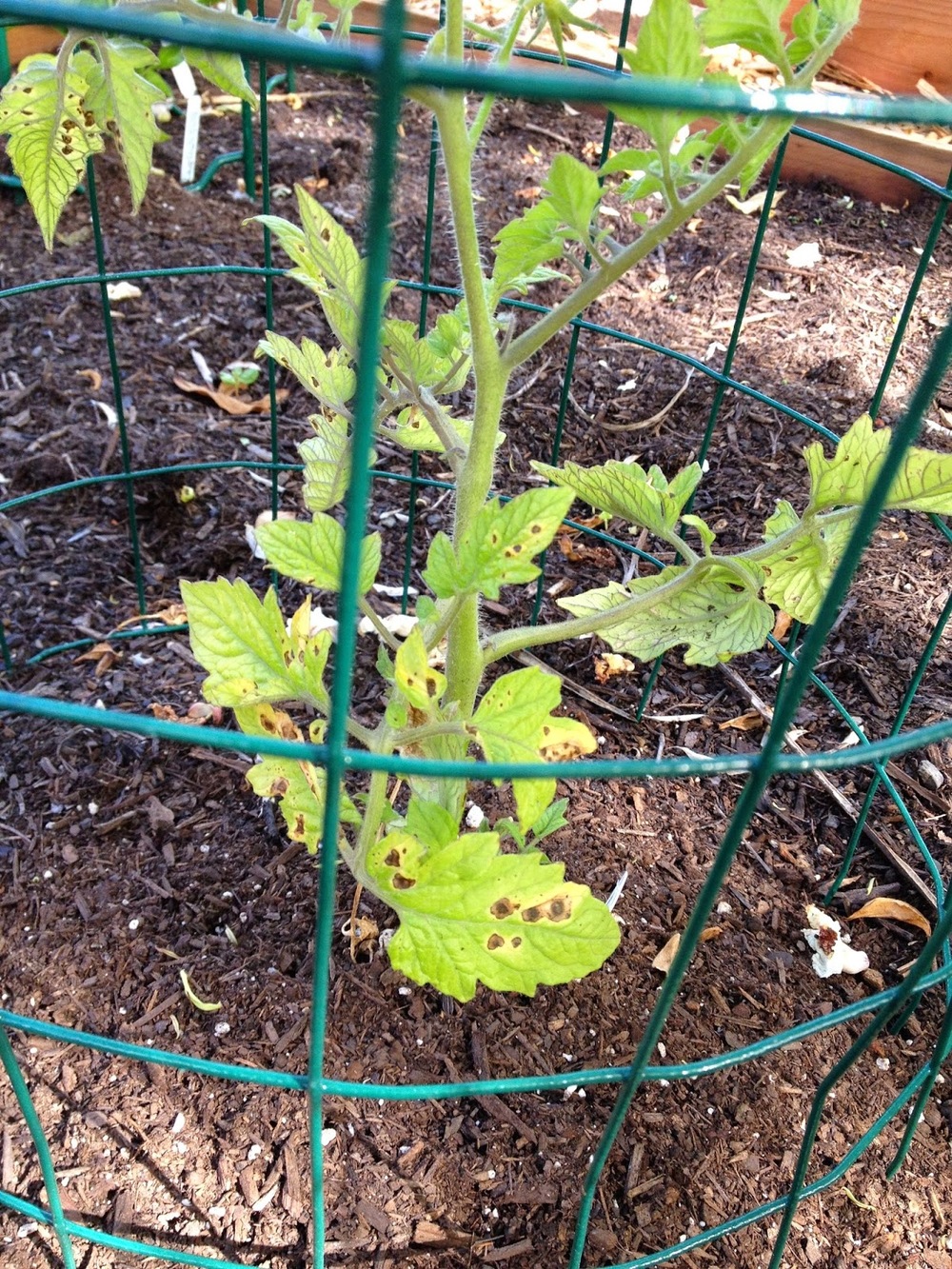
The cherry and slicing tomatoes are going gangbusters, but the paste tomatoes are in the new beds look very sad, and my dreams of canning lots of tomato paste are fading.

In the flower garden, sunflowers are growing up up up. I'm hoping some summer seeds of cosmos will germinate for the bees. In fact I need to plant a bunch of summer flowers for the bees, as their forage opportunities are definitely coming to an end. We opened the hive yesterday, and everything looks good - but the rate at which they are building new comb has definitely slowed, and we didn't even add another bar. They are making lots of bee babies but not a lot of honey. I didn't expect to harvest any honey this year for our own use, but I am concerned that they won't have enough even for themselves through winter. I look at my neighborhood with a different eye - what will bloom in the months ahead? Right now the bees are collecting from my catalpa tree, and any leftover spring poppies, lupines, wisterias. In June, there are two Chinese Tallow trees nearby which always attract lots of bees. In July, the sunflowers might sustain them. But what happens in August? And the driest, most arid months in Fall? I have to plant now to have forage for them, then. And I have to plant a lot. Masses of the same few flowers. So I've been researching late summer/early fall bloomers, that are loved by honeybees, and trying to figure out how to pay for a huge quantity of them.

Some branch trimming is to be done by me today in the back garden. Our apple tree is being quite shaded out by our flannel bush (which is much larger than the apple tree), so I need to cut back the flannel bush, now it's done blooming. But it's called flannel bush for a reason - the leaves are covered with tiny fine hairs which come off when bushed against - and it itches like crazy. I have to do it right before we go jump in the pool, or I'll go crazy with itching. Guess I'll be trimming branches in my swimming suit!

Baby robin, and chicken manure

I guess I have a strange talent for finding injured creatures, because today, whilst walking the dog in the open space, I came across a baby bird on the ground. Just sitting there, not moving, but bright-eyed and aware. As I approached it, two large robins, I'm assuming mom and dad, gathered in the walnut tree above me and hollered. So I walked away and watched for a bit. Nothing happened. I couldn't just leave the bird there, so I went and made a nest of dead grass in the crook of the tree. Then I lifted the baby robin into the makeshift nest, with mom and dad squawking at me all the while, and walked away again. I waited a minute, then walked back. The bird had stood up and walked to another side of the little crook, so at least I know it could walk.


It was the most adorable little thing, and it killed me to walk away for good, but I did, because mom and dad were there, and interested. I'm never sure how much to intervene. I hope the baby will be ok.

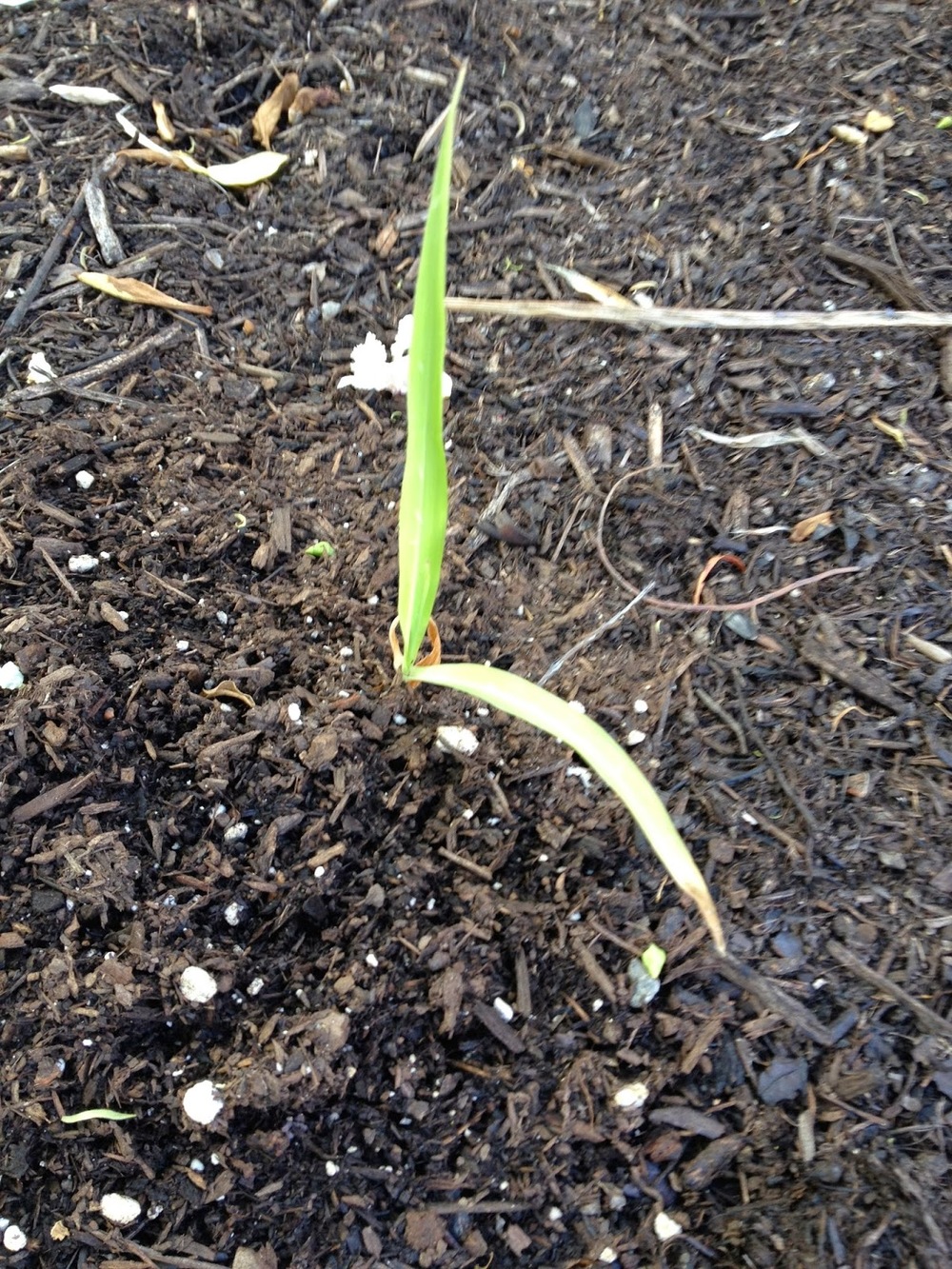
My vegetable beds are full of injured creatures - the plants. I'm really not sure what is happening. I'm talking about the raised beds we just built, which are above the sheet mulch. Everything germinated, and then stopped growing. Just stopped. And then started yellowing. First I thought it was a water issue, so I've been watering every day. Then I wondered if maybe filling the beds with straight compost was a good idea - though I've always done that before - I mean, we have clay dirt here, adding a lot of organic matter has always worked before. Then I began to suspect that the sheet mulching was the problem. Either the roots weren't working their way through the mulch, or the mulch we used was the wrong kind - I just didn't know.


Needing a more experienced opinion, I decided to consult my friend the biologist, who works for the USDA. And he told me the most obvious thing, and I was smacking my head in my hand while we were talking - of course! The nitrogen in the compost is bound up in the process of decomposing the mulch which is underneath it. I knew this! I have always known not to mix mulch into dirt, because it robs the plants of nitrogen. If you just lay it on top of the earth, it's ok. But mixing is bad, at least short term. And here I had put a foot of compost on top of the mulch, expecting the plants to be fine! Argh!

The biologist and I talked about how different composts have different nitrogen levels, which I hadn't realized, but of course it makes sense. So he told me to add a bunch of manure on top of the soil, all around the plants. I researched which kind of manure has the most nitrogen, and everything I read said that chicken poop was the winner, so I bought 8 bags of composted chicken manure and spread it on the garden today.


Believe me when I tell you, I smell bad.

I much prefer cow or horse poop, to be honest.

But if it mends my veg, I'm all in! I'll keep you posted.

Drones, larva, and dead bees

It's Saturday, so it's 'open the hive' day here at Poppy Corners. It's hard to wait until afternoon to see inside, but it's the best time of day to do it - it's warm, so we don't upset the temperature of the hive too terribly, and all the bees are busy doing their bee business, so not as many are home and none of them have time to mess with us! Which was particularly good today, as we had three kids here wanting to look inside the hive, so all available veils were taken by them. Tom and I figured that at the rate we're shedding extraneous bee clothing/paraphernalia, in a week or two we'll be opening the hive buck naked. Anyway, the bees were docile as usual, until near the end of our inspection, when they definitely began to let us know that we were unwelcome. As the hive grows bigger, and as we add more bars, there are more things to look at, and the whole process takes longer. I guess from now on I shouldn't look at EVERY bar, just a few in each part of the hive.

This morning as I was watering the plants, I noticed a dead bee on a flower.


Part of me was sad. But then part of me thought, how peaceful she looks! And dying in flowers, not a bad way to go. She's all curled up comfortably. I hope, as bee deaths go, this was a good one.

Bees literally work themselves to death, and the entire design of a bee's life is interesting. When bees are first born, they work in the nursery, tending young. After a while they move up to storing the honey and pollen the gatherers are bringing in. When they are old, they begin foraging, often flying many miles a day to gather nectar and pollen. This is a smartly evolved system, because bees then often die outside the nest, like the bee I found this morning.

If a bee dies in the hive, she is unceremoniously dragged to the front porch and thrown off, into the 'graveyard' below. Here is a photo of the cemetery below the front porch of my hive:


So, all things being equal, I'd prefer to die in the flowers, thank you.

Bees also don't like to poop in their nest. So they fly outside to take care of business. They are fastidious creatures.

Our catalpa tree is blooming, huge orchid-like flowers that must be a little like heaven for honeybees. The blossoms are too high up to get a good photo of the bees actually IN them, but here is the tree:


They flowers smell amazing and I like to just sit under the tree, as blossoms drift down around me.

Inside the hive, things look good. We saw so many drones. We also saw an awful lot of larva, so even though we didn't spot the queen, she's doing her thing. Here is a good picture of both a drone and the larva.


The drone is on the top left of the picture. You can see how much larger he is, and how much fuzzier. Also, his eyes are bigger.  Up on the top right of the photo, you can see the larva curled up. When the larva reaches the correct size, the bees will cap it off with wax so the bee can pupate. That's what the other capped cells are, in this picture.

Drones are fairly unnecessary for my hive. Or, I should say, I don't know what role they fulfill in my hive. My queen has already mated, long ago before I got her, probably - and she stored enough semen in her abdomen that day to lay 2000 eggs a day for the rest of her life. So she doesn't need to mate with the drones she is producing, which is good, since I guess technically they are her sons. So what do the drones in my hive do? Well, apparently, when they get to a certain age, they fly to a "Drone Congregation Area" where they basically drink beers and play video games, waiting for an available queen to fly by, and then they desperately try to mate with her. After one succeeds, the queen flies off afterward with his member still attached to her, and he's basically ripped in half, and subsequently dies.

So, if drones are unnecessary for my hive, why does the queen lay eggs that become drones? No one really knows. Big honey producers often rip off drone cells, killing the bee before it's born. They figure that drones just eat too much of the product. But I feel differently. I think, after thousands of years of evolving, that they've got it pretty well figured out. If there are drone cells, and drones, in the hive, there must be a reason. And I'm not doing this for the honey, anyway.

We put in only one new bar this week. Of the two we put in last week, only one is full of comb; the other is still being built. So they really don't need the added pressure of too much empty space to fill. Bees don't like empty space, but it takes an awful lot of energy to make comb, so I'm trying to balance where their energies are being directed.

Hot, for May

It's hot here. 100 degrees today, and we've had several hot days, with a few more expected in the near  future. We were already in a very serious drought, and this hot spell makes matters worse. The hills, which had turned briefly green, are now suddenly brown. When I hike, the ground is crunchy rather than soft and grassy. My grandmother used to say that California always looks like it needs a bath. We're already hot and dusty, and we don't expect another bath until Christmastime.

I have the sprinklers set to water everything three days a week, for a few minutes. This doesn't cut it in the heat. I find myself out watering the veg every day, twice on hot days. The peas are toast.


Even the hot peppers looked wilted this afternoon.

The bees 'beard' outside the hive, trying to keep warm bodies outside so the brood doesn't go above 93 degrees. Several stand in the door, fanning their wings furiously. Many more fly aimlessly in circles above the hive. They're listless and restless, about how we all feel when it's this hot.


At work, the First Graders are quite simply crazed. Summer is calling; the pool will be open soon; vacations beckon. No one wants to work in a hot, airless room.

Every time I stroke the dog, a handful of hair comes away. He pants constantly, noisily. The cat hides under the bushes. In the house, tempers flare, chores and homework are a constant battle.

The only thing loving the heat are the tomatoes - I think they grow inches a day.


My chief pleasure on these afternoons is a glass of iced coffee with heavy cream.


And it's not even summer, yet.

Bees Being Born

We opened the hive for inspection this afternoon; my goal was to find the queen. I don't know why I feel the need to SEE her so desperately, as the evidence of her is all over the hive. I guess I'll have to  keep hoping, because she stayed hidden today.

However, we watched bees being born!

As we inspected the bars of brood, we saw lots and lots of empty cells, because so many bees had hatched. Then, as we looked closer, we saw lots of bees emerging. In the following video, you'll see empty brood cells, and if you look in the center, you'll see a bee halfway out, and another below it just beginning to eat its way out of its cell. This was way cool to watch, I'm sorry the video is shaky, I guess we were just too excited.


We had added two bars last weekend, and both were already full of comb, and some honey. So we added two bars again today. Got to keep ahead of those productive ladies!

A pretty cute beekeeper joined us today.


This was a treat, because generally the kids are not all that keen on the bee hive.

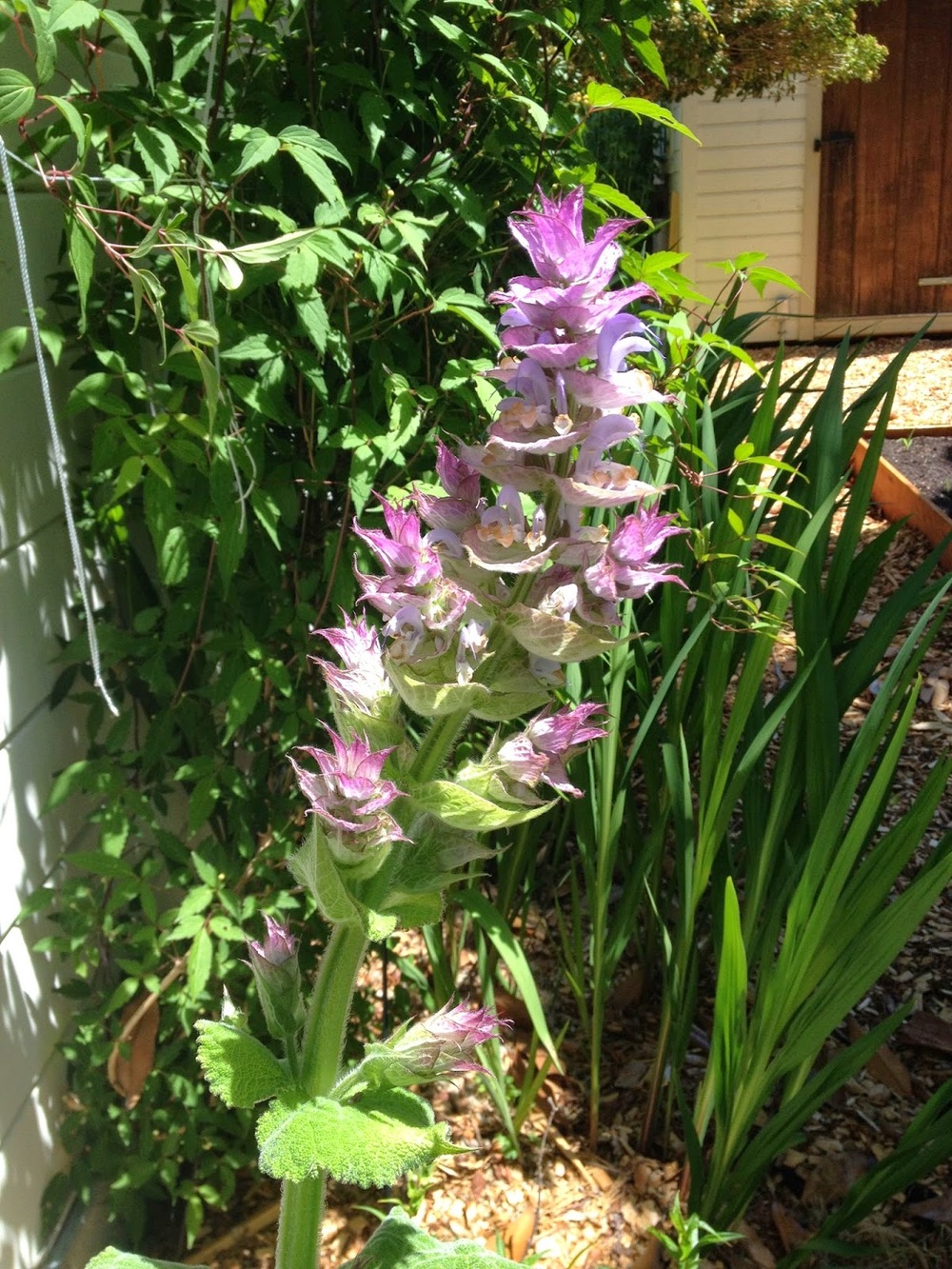
There are some interesting things happening in the flower garden, as well. Plenty of forage for the bees.

I don't remember the name of this plant. It's a native, it has white flowers and a sort of rosemary looking leaf, and after it blooms, the seed pod looks like this:


And I can't remember what this giant thing is, but it sure is spectacular:


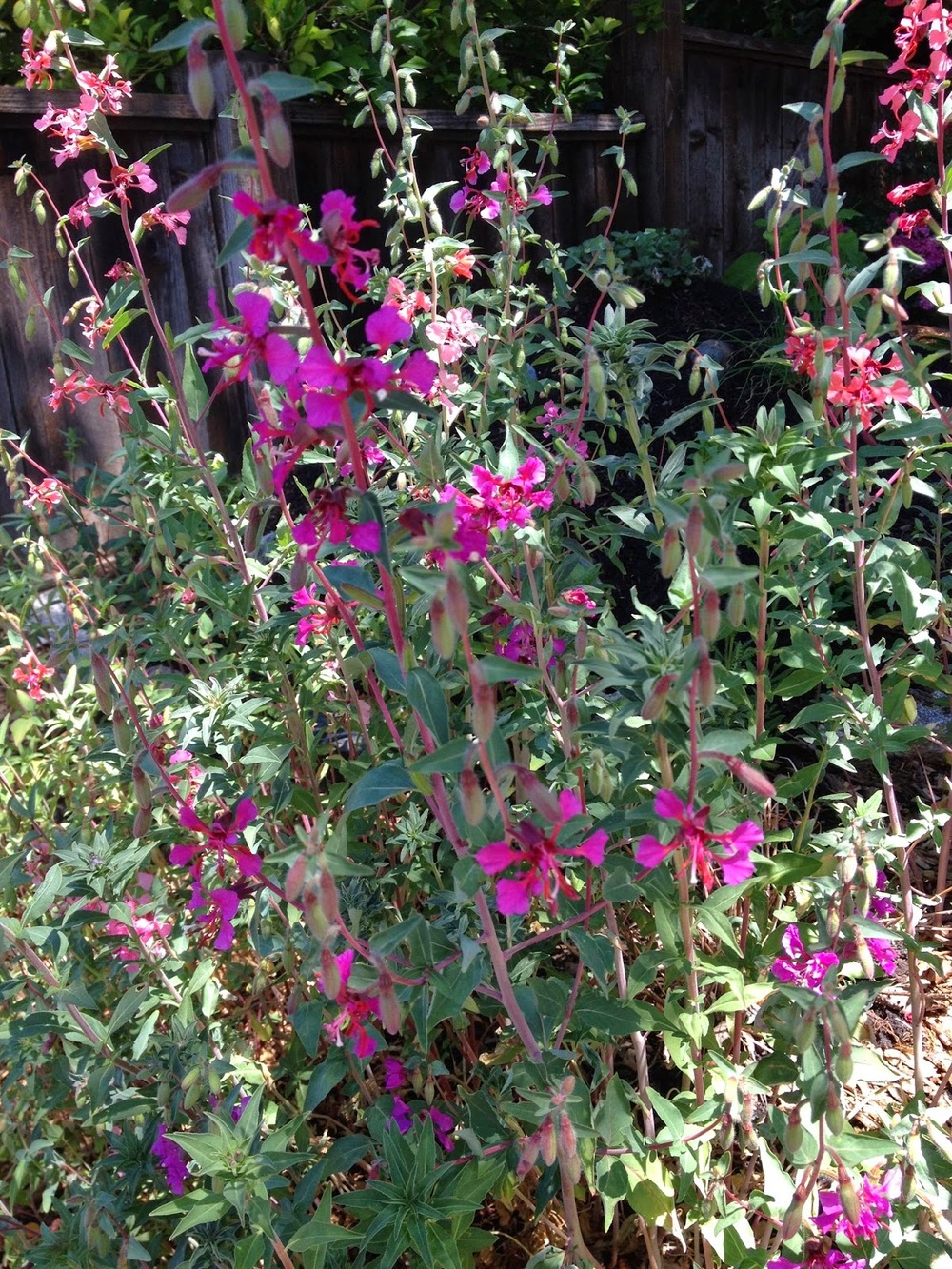
The early spring clarkias are blooming. I love this variety - Mountain Garland:


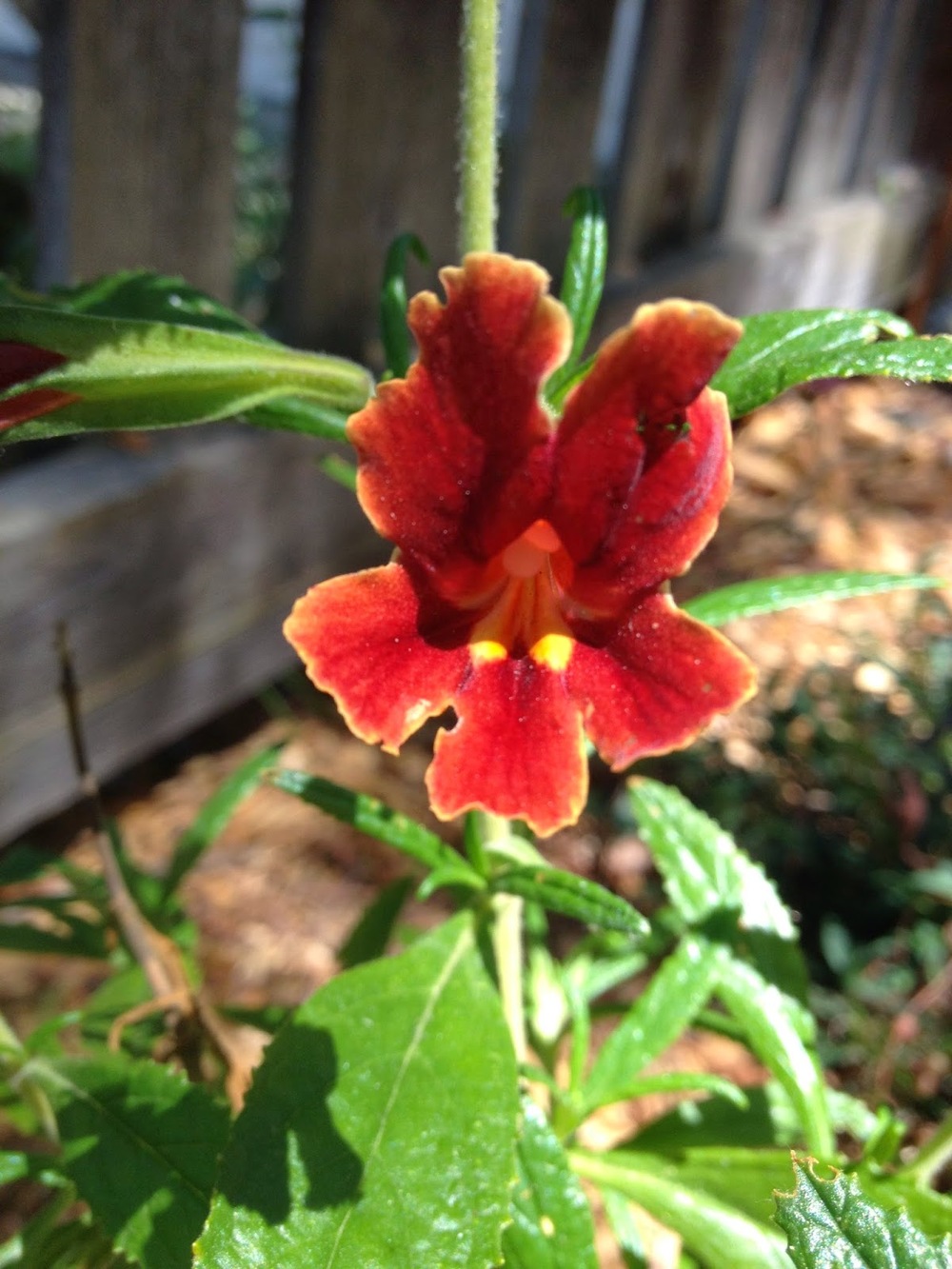
And all the Sticky Monkey Flower is blooming, both in my yard and in the hills. This is a rare variety of Scarlet Monkey Flower (can you see the monkey face?):


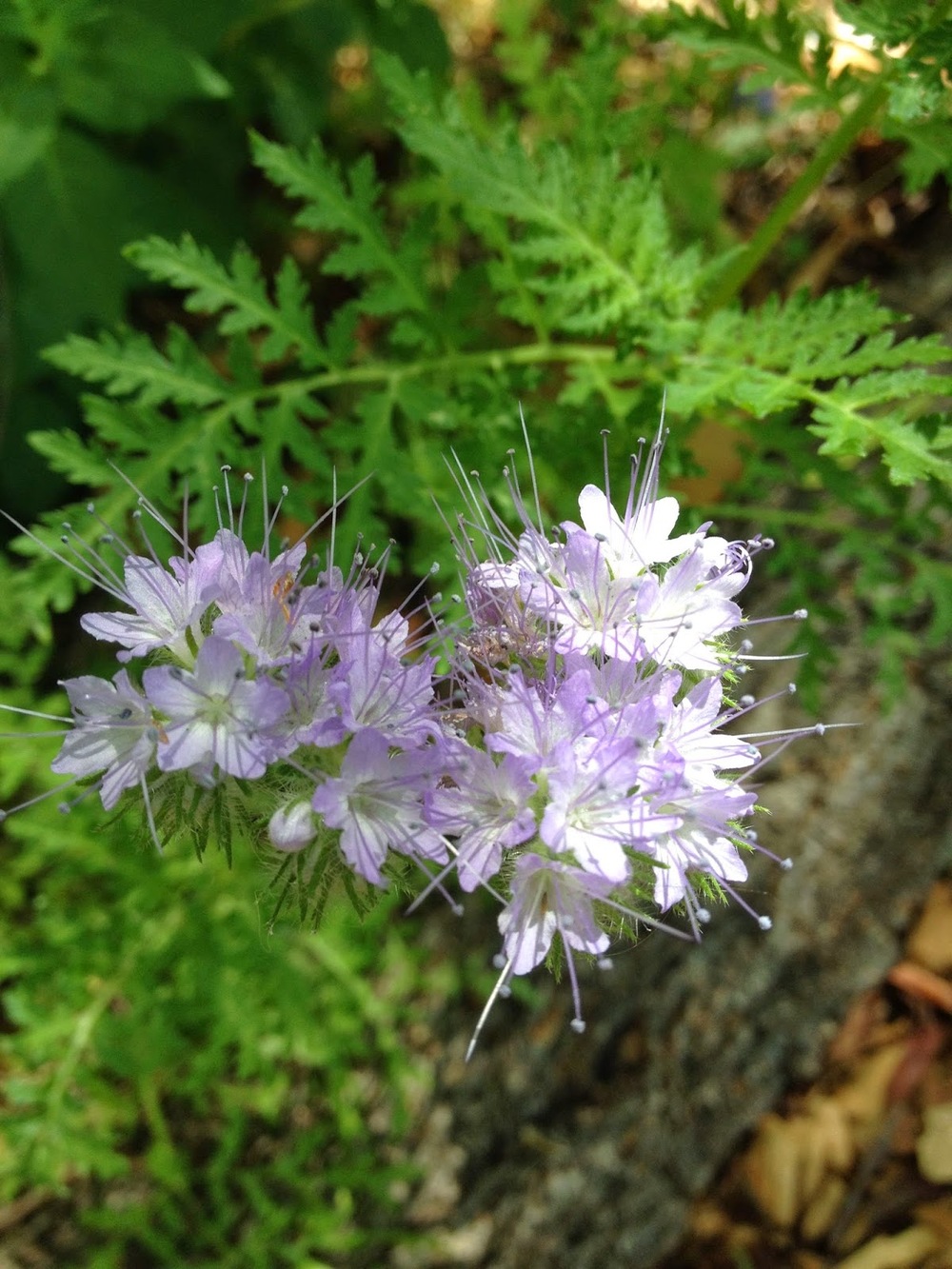
A delicate little flower is blooming in the front shady area, I got it in seed form from Larners last Mother's Day, a Tansy-Leaf Phacelia:


And I have a Flowering Pomegranate that was a volunteer from the neighbor's yard. I liked it so much I left it, and now it's huge and very showy:


So exciting things all around in the yard, though I wish more was happening in the veg garden.