Preparations for the Week

Sundays are always busy days for us, but whenever we have a moment of unscheduled time, we prepare for the week ahead.

There are three of us in this house that do not eat any grains. That means that the usual breakfast foods, such as cereals or breads, are not an option. So we buy lots of pastured eggs, bacon, and pastured pork sausage to have on hand, as well as spinach, kale, and chard for frittatas. We always have fruit in some form, either fresh or frozen - with berries being our favorite choice. But several things have to be made - some sort of grain free breakfast bread, yogurt, and what we call nut-ola (instead of granola).

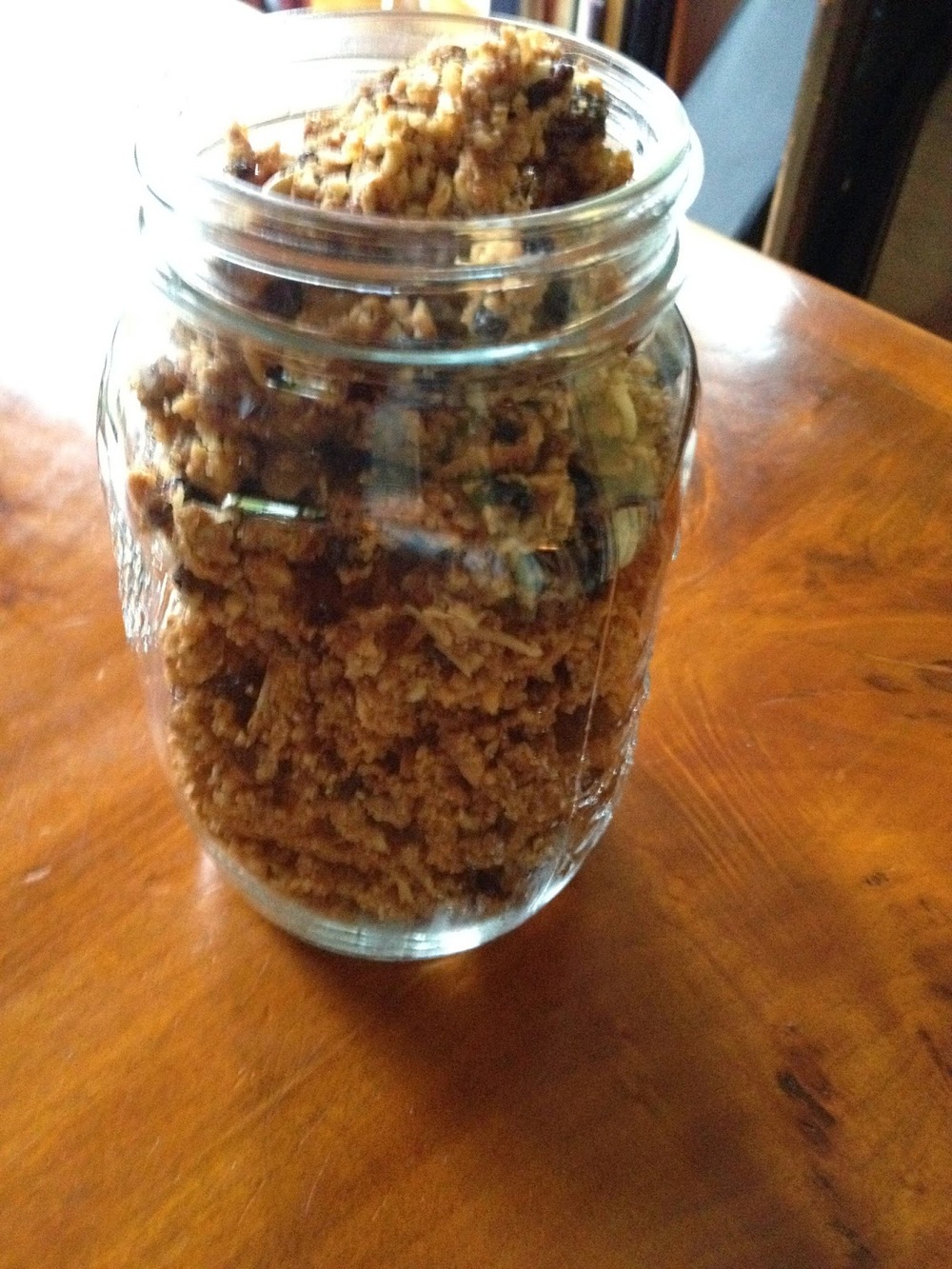
I have found some great sources for grain free recipes. I love Danielle Walker's Against All Grain blog, her recipes are always fabulous. I use her grain free Vanilla Granola recipe, with a few tweaks. Instead of hazelnuts, I use macadamias. I soak all the sunflower seeds at once, to save bowls and time. I add the raisins in before baking. I spread it out on an oiled cookie sheet and bake it in a 200 degree oven for several hours, turning once. This yields enough nut-ola for us to have for the week, sprinkled on berries and yogurt, or by itself as a snack, or even in whole milk.

Today I made The Civilized Caveman's delicious Banana bread, but I added some honey (from Dad's hive) and chocolate chips. I try not to eat this very often, as it is definitely a trigger food for me (baked goods, yum), but the rest of the family loves it, along with a bowl of berries, for breakfast or snack.


Yogurt is easy to make, but fiddly. You will need several pots, a heating pad, and a food thermometer. You'll also need milk (whole, organic - it can be pasteurized, but not ultra-pasteurized, and raw and/or grass fed would be best) and some yogurt for your starter (whole, plain organic yogurt - very important to read the label and make sure there are live cultures in the yogurt). You may also want flavorings.

I make a double boiler out of our large pasta pot and a smaller pot. Water goes in the bottom pot, milk (1/2 gallon or more) goes in the top pot. As you boil the water, it will heat the milk gently, and you won't have to worry about it burning.


Keep taking the temp of the milk. You want to heat it to 180 degrees. Stir the milk every so often, as it's heating.

Once it reaches 180 degrees, plunge the top pot into an ice water bath.
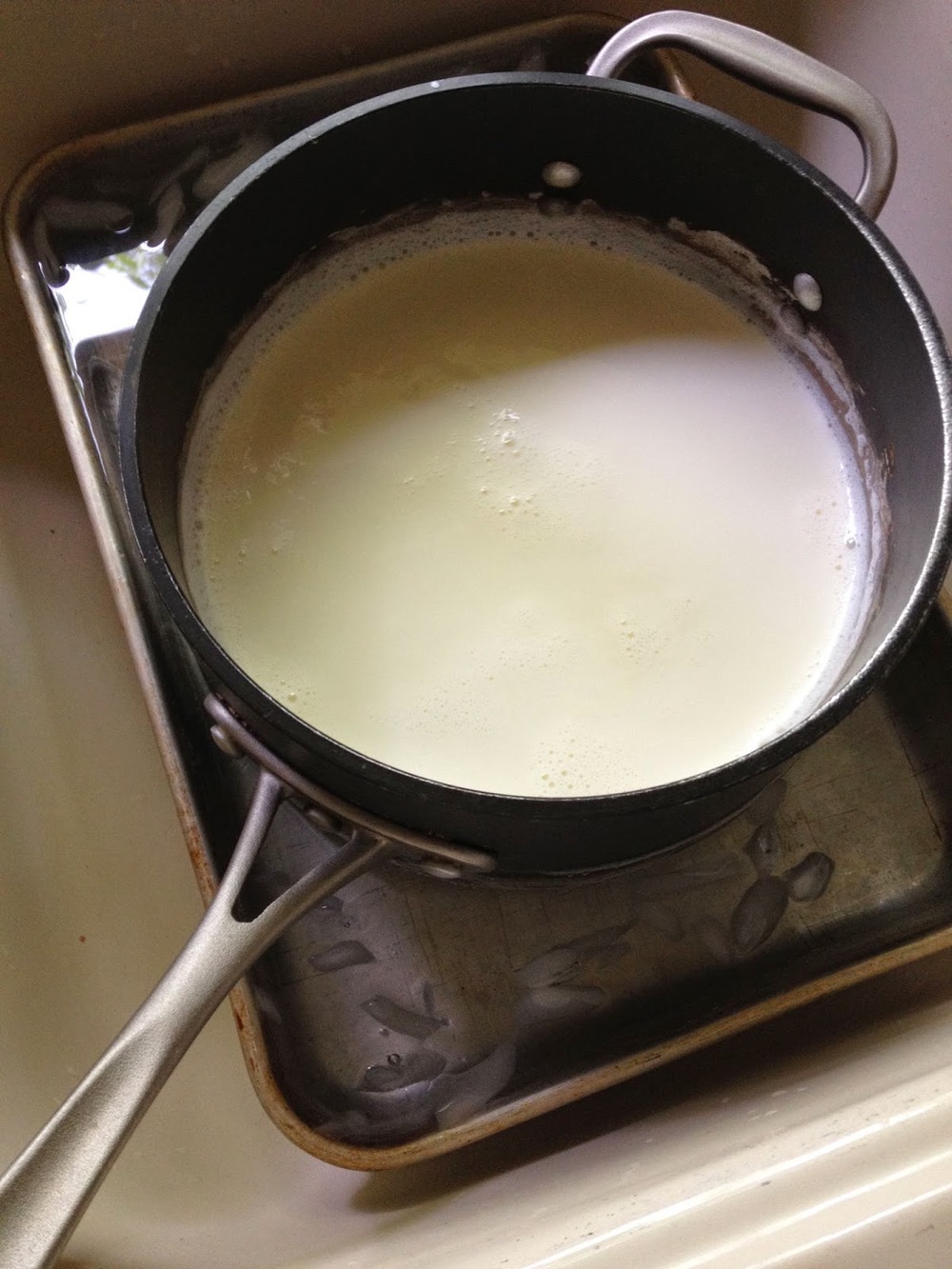

Keep stirring and taking the temperature of the milk, until it is down to 110 degrees. (I love the smell of hot milk. This is my favorite part.)

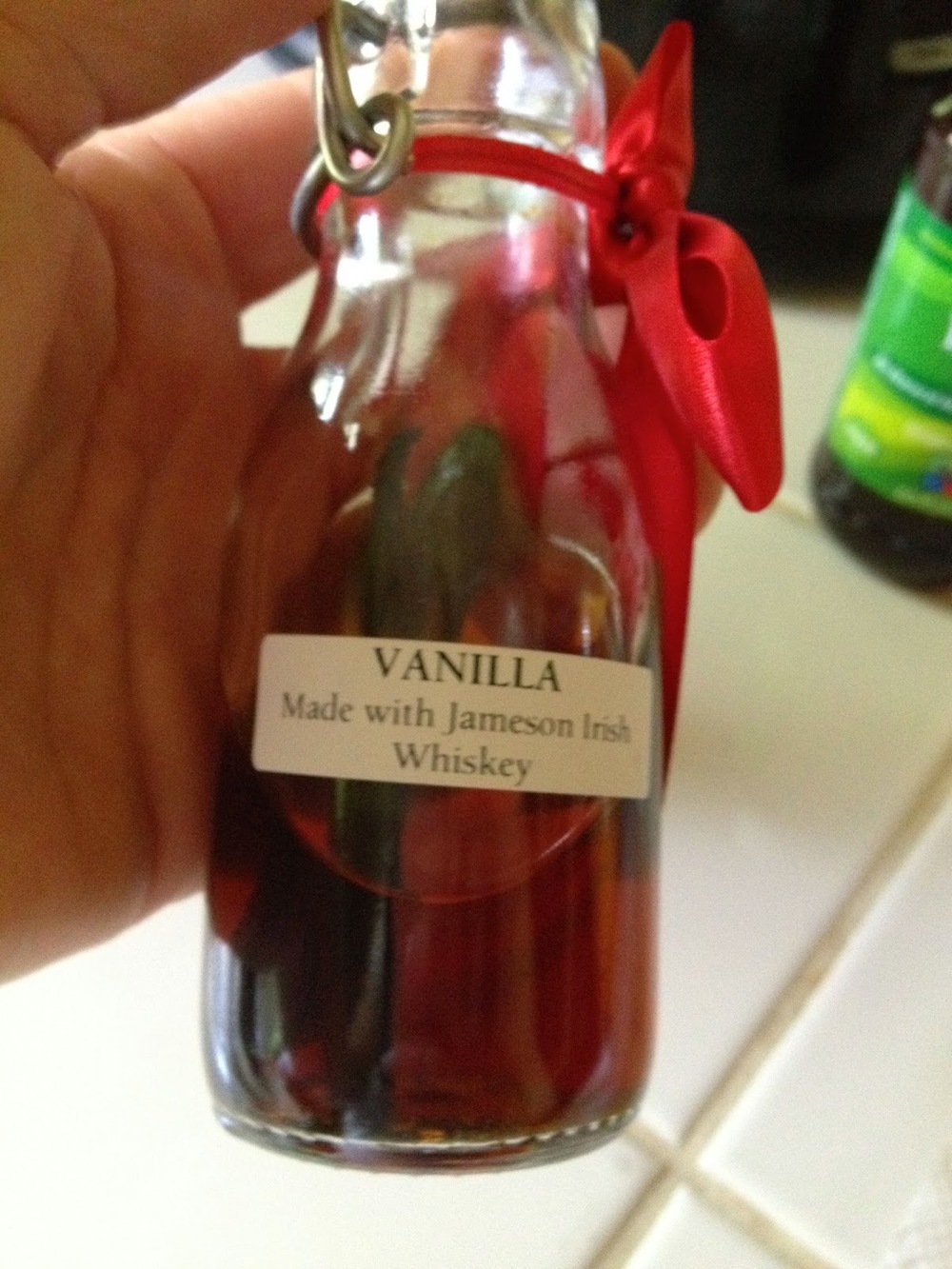
Once it reaches 110 degrees, take the pot out of the ice water bath and stir in the yogurt, about 1/4 C of it. At this point, I like to add some vanilla extract (especially nice is homemade extract! we have enjoyed this batch from Tom's brother!) and some liquid stevia.

Then, set a lid on the pot, and put the pot on a heating pad set to the medium setting. Leave it there for at least eight hours or overnight.


In the morning, the yogurt will have thick curds, which you will stir to break up. Then ladle into jars, put it into the coldest part of your fridge, and you're all set!


Sometimes we mix this with jam, but more often we have it plain with berries and nut-ola, or in smoothies. Don't forget to save some for your starter next time. I store it in 1/4 cup amounts in the freezer, and thaw it when I need it.

Today, Tom and Kate went to a local farm stand, and bought a ton of strawberries, blueberries, and cherries. We have been freezing batches of berries all day. We use these in smoothies throughout the week.

Tom also marinated and grilled two pounds of chicken, two pounds of beef ribs, and a couple of steaks. The steaks were for dinner, but the rest of the meat will be used in lunches for the rest of the week in salads, or eaten plain.

I also make homemade chocolate milk and lemonade for the kids' lunches. Adam likes Vitamin Water Zero, but I don't like the artificial sweeteners in it. And Kate likes to have a chocolate milk at lunchtime, but I don't like the ultra-pasturized milk in those boxes, and I like having more control of the sugar content. For the lemonade, I mix 6 cups cold water with 1 cup lemon juice (which is usually the juice from six lemons), and one generous teaspoon of liquid stevia. For the chocolate milk, I most often heat 6 cups of milk, and add 1 scant cup (or less) of Ghiradelli hot cocoa powder. It has sugar added already. I need to start experimenting with unsweetened cocoa and stevia, but I haven't gotten around to it yet.

These are made and put into pitchers in the fridge for the week.

I also try to plan my dinners for the week and make out shopping lists. I take in to account what's ripe in the garden and can be used that week, or what is in season.

All of this makes Sunday an even busier day, but it provides so much peace of mind and such an organized feeling, that it's well worth it.

Slowing Down (or, What Asparagus Can Teach Us)

Lately, I've been having an interesting back-and-forth conversation with one of my oldest and dearest friends, by email. This is a person I love deeply and will hold close in my heart for the entirety of my life, and on top of that, he works in an industry that has its finger on the pulse of What People Want. The discussion has been about how we connect, what we have time for when it comes to hearing about our friends and family. And his position seems to be this: Facebook is the only possible way to stay connected to people in these busy times.

He posits that there is only enough time for quick updates, read between busy days at work and home, in a brief spare moment, maybe while making some dinner, or walking the dog.

I don't think this position is unique. It seems that pretty much everyone I know buys in to it. I certainly did for many years - I was the queen of brief, entertaining updates on FB.

One day, I realized that these snippets, while convenient, only showed folks the part of my life I wanted them to see. That, if you were to read my updates, you'd mostly think that my life was busy and full, that there were small challenges, but I was making my way through them with humor and courage, that nothing was terribly awful, and that I had it all together. It seemed an advertisement, somehow, for the life I wanted people to think I had. And it wasn't lying, exactly. All those things were happening, and my attitude toward them was often breezy. But it wasn't the whole story.

And if I wanted to be more honest, and share something that really was troubling me, or worrying me, I didn't want all 300 people on my 'list' to know about it. I really only wanted to discuss those things with those closest to me. And I wasn't doing that - in fact, instead of growing closer to people, I was growing apart from the people I cared about the most - I saw that by merely making and reading updates, we were taking shortcuts. We were actually spending LESS time talking about the things that really mattered to us. It was all image and no substance.

So I quit FB. I made a conscious decision to have more authentic connections. I vowed that I would call my friends more often. I promised I would email more. Some friends and I made a pact to write actual in-the-mail letters. I said I would meet people more, have coffee, have dinners, invite them over.

Well, I've failed.

I don't email more often, I don't call more often (I really don't enjoy talking on the phone), and the person I vowed to exchange letters with? We've done it exactly once. In only one way have I improved, and that's to get people together more often. But I'm not consistent. And so I can say that I'm NOT making more authentic connections.

But my heart longs to. And while I'm truly an introvert, I honestly care about my friends and want to know what's going on with them. And I don't think reverting to FB posts is going to make things any better. So I re-resolve to do a better job in this arena. I've made several changes in the past year that involve a slower and deeper connection, and I know I can do this with people, too.

The ultimate expression of 'slower and deeper' is the Slow-Food Movement. One thing I resolved to do, last Fall, was to cook more. I've always cooked for my family, but I often took shortcuts or 'heated' things rather than cooking. I also allowed my kids to buy school lunch more than I wanted to, and our breakfasts consisted of boxes of cereal or waffles from the freezer. I knew both our health and our budget would improve if I vowed to do more cooking. This has been an unqualified success. One of our kids is a very picky eater, but she's tried more things this past nine months than she had probably her whole life before that. She hasn't necessarily LIKED them, but she's tried them. The other kid is always willing, and has discovered a new love for many new foods. As this experiment went on, and as my own health improved, I got more hard-core about it, and I began to do more things like make our own yogurt, or  buy only grass-fed meat. And ultimately this is what led to expanding our garden and growing more food.

None of these things is all that unusual or out-of-the-box: People used to have gardens regularly, keep a pot of broth on the stove, raise chickens in their backyards for eggs and meat, make all their own sweets rather than buying a cookie at Starbucks. None of this is subversive. But it sure sometimes feels like it is, when I'm pouring hand-squeezed lemonade into glass bottles to send with my kids to school.

All this takes time, time that no one says they have. I sure would have said, before, that I didn't have time to do this stuff. And it does make for fuller days with less time for things like reading, or catching a quick TV show. My mornings can be pretty hairy, cooking breakfast, starting things for dinner, making lunches, trying to get the dog walked and the laundry moved around and a trip to the grocery in and all this before heading out to work. But while it's a little crazier around here, the time spent enjoying these homemade items is greater, and the rewards sweeter. Dinner tastes better. Snacks are more wholesome. My time is spent improving the health of my family, not to mention I am voting with my dollars (and even keeping more of those dollars than I used to!) every time I pass by the processed food section at the store.

I discovered that people were calling this 'homesteading,' which made me laugh at first, but then I realized that no one makes time for these arts anymore, and the old-fashioned word was appropriate. While baking bread was a weekly occurrence in my house growing up, now, unless you're a foodie in a major city that celebrates this sort of thing (giving it the 'cool' 'factor), baking bread is a bit of a lost art. It's so easy to go buy it. But when we just go buy it, we are losing something.

I think a lot about the knowledge that's being lost. I go to beekeeper meetings, and I'm the youngest person there, and I'm 46. Who is going to learn the art and skill of making furniture in the future, the way my father does? Who is saving the seeds, so that we have heirloom varieties instead of GMO corn? When I think about these things, I'm glad that urban farms are becoming mainstream. That chicken coops are happening all over the suburbs. That younger people are embracing organic produce from their local Farmers Markets. That a local school teaches fermenting and cheese making. That people are going back to the farm.

And speaking of which, there's no 'fast' in a garden. Once you begin to look at the processes of nature, and growing food, you realize that all your hurry-ups have no place here. A tomato will ripen in its own time, no matter what you do to it. You can make the conditions right, and you can provide everything it needs - but the fruit may still not do what you want it to do.

Take my asparagus bed. Oh, I had high hopes for this, back in February. I bought 24 crowns at my local nursery, envisioning 20 years of delicious spring spears.


Well first of all, you can't even harvest asparagus until the third year after planting, so there's that. Then you have to dig foot-deep trenches for the crowns. So I dug, down through our clay soil, for an afternoon. After you put in the crowns, then you cover up with a very light soil, only an inch or two. I did that. Then you wait until they sprout, and as they grow, you continue to cover them up, until they are flush with the ground. Some of my crowns sprouted, some didn't. I didn't know whether to cover them up, or wait until more sprouted. I kept dithering. Finally I just covered them up. And only one has broken the cover of soil.


Brave asparagus, you are my hero.

I keep waiting for more to pop up, but so far, nada. I may never have the bed I want.
Here's what they should be looking like, right now.


Sigh.

This is the definition of slow. I want asparagus, NOW. I might get it in three years, but even that's not looking likely.

I realize this is good for me, this slow moment, waiting for the asparagus. It's good for me in the way it's good to make an all-day spaghetti sauce, or catch up with a friend over coffee. These things take time, and as priorities go? I think these are the right ones to have at the top of my list.

Bees and Berries

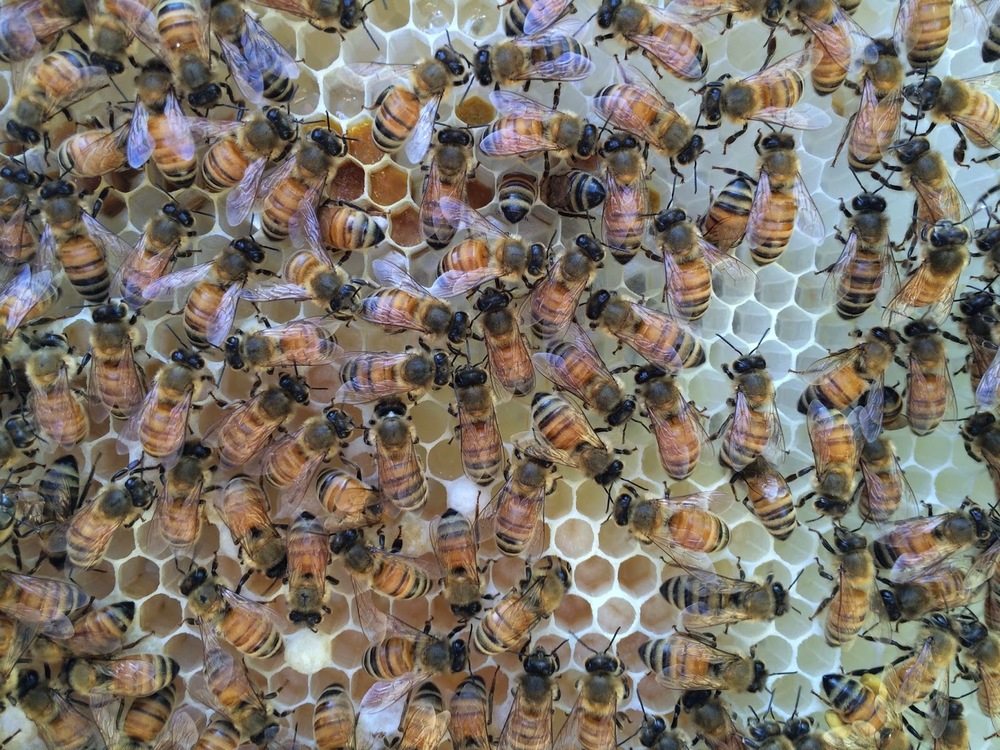
This past weekend we opened the hive, and everything looked terrific. Here's a good shot of some comb with capped honey at the top, then uncapped honey further down, then pollen stores in the middle.


In this close-up, you can see some drone comb near the bottom - at least that's what I think it is, anyway - the puffy domed cells are drone larvae.


My hive is configured in such a way that it's difficult to see the brood - the baby worker bees - but I'm hoping to remedy that next weekend.

This was the first time we used smoke in opening the hive, and the only reason I used it was to get the bees back down into the hive so I wouldn't squish them when I pushed the bars back together. I use my hive tool, a brush, and my veil - and that's it.


I don't like to cover up or wear gloves. The more I read, the more it seems unnecessary. The goal is to look as unlike a big, hairy bear as possible. So as long as I wear light colored clothing and cover my hair, I feel ok. Bees DO aim for faces - eyes, nose, and mouth - when they feel threatened, so I'll probably continue to use my veil. I also read last night that when they sting you, the sting leaves a scent, so other bees know where to find you and sting you as well! So far, I have not gotten stung, but I imagine it is a part of beekeeping and eventually it'll happen. No big deal.

My bees arrived after my fruit trees bloomed, which is a bummer. But the blossoms got pollinated this year just as they have every year, and we have baby peaches and baby apples on the trees. Also baby quince, though I'm never as excited to see them as I am to see the others. (Recipes or suggestions for quince welcomed.)


The blueberries are all formed, but not turning blue. What's up with that? When do I get to eat them?


We get about one strawberry a day lately, and usually it's me that eats it on the fly. If we ever get more than one, I might share.


I'm always afraid the birds are going to get to it before I do.

I'm starting to think a lot about how many strawberry plants we would need to have a pint of berries per day, in season - which is about how much we eat. I have five strawberry plants. They are incredibly slow to ripen at the moment. It's possible that we will get a deluge all at once - and that would be fine - but I would like to have enough varieties that we could have a steady supply for a month or two. That would be ideal. I have no idea how many plants to have next year, or which varieties. That will be something I will have to figure out.

It's the same with the fruit trees. When the peaches are ripe, they're all ripe - and it would be nice to have a staggered harvest. The apple tree is the same. I need to plant other varieties - or graft several varieties on to one tree. But that seems terribly advanced, and I'll need to do a lot more studying before I can make that happen. Then there is the issue of space...

We're harvesting peas every day, they are always welcomed and delicious, everyone in the family enjoys peas.


And the tomatoes have started flowering - I hope the bees are taking advantage.


Everything else is in the seedling stage. This week, hot weather is on tap. I imagine things will move more quickly with the hotter weather.

Hugelkultur Herb Spiral

When I started reading about permaculture, every single book mentioned hugelkultur. Here's a good description by www.richsoil.com:

"Hugelkultur is nothing more than making raised garden beds filled with rotten wood. This makes for raised garden beds loaded with organic material, nutrients, air pockets for the roots of what you plant, etc. As the years pass, the deep soil of your raised bed becomes incredibly rich and loaded with soil life. As the wood shrinks, it makes more air pockets, so your hugelkultur becomes sort of self tilling. The first few years, the composting process will slightly warm your soil, giving you a slightly longer growing season. The woody matter helps to keep nutrient excess from passing into the ground water - and then referring that to your garden plants later."

Everything I read raved about how good this system was - and how anything planted in it thrived.


I also couldn't get away from herb spirals. Here's an explanation from www.gardeners.com:

"Unlike a flat garden, an herb spiral is in three dimensions. The high spots get the most sun and have the best drainage, making it ideal for plants that thrive in sunny, well-drained sites. The bottom of the spiral is the right place for plants that like more moisture and some shade. Plants planted on the eastern side will get shade after noon, while plants on the west side will take the brunt of the afternoon sun."


So I thought, why not put the two together, and make a hugelkultur herb spiral? Sounded like a good idea. I have a place next to our driveway that gets a LOT of afternoon sun, and it's under a valley oak tree, so I don't want to use the sprinklers there too much. The only other things I had growing were some native plants seeds and some drought tolerant plants, plus some bulbs like daffodil and naked ladies. Perfect place, right?

I got some wood from our wood pile - not much, just some clippings from some trees in our garden. I also grabbed a bag of sawdust Dad had given me. I also had a ton of moldy leaves next to my compost bin. Then I went and begged grass clippings from the neighbors. I piled it all up.


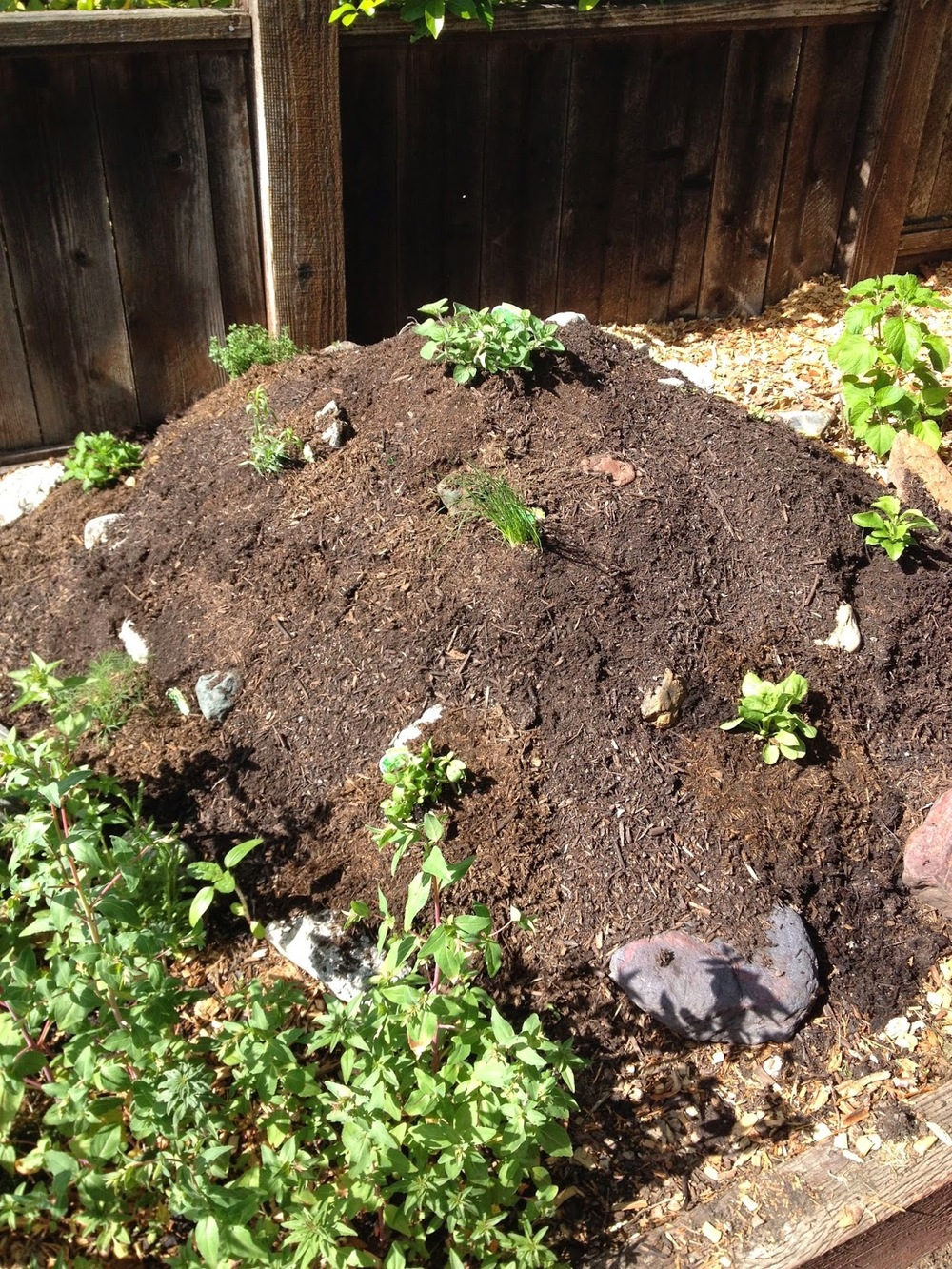
And covered the whole thing with compost.


Our neighbor Pia donated the stones. She has a whole pile of them in her backyard - her ex-husband used to collect them. She has said anytime we need stones, just come get them. It was fun picking out the pretty ones.

Then, I planted 8 different herb seeds in pockets all over the hooba. (Tom and I call this the 'hoobastank' instead of the hugelkultur. I have no idea why - we never listened to that band - it's just a fun word to say, I guess.)

That was over a month ago. Since then, very little has changed in the hooba. There are a few sprouts. But nothing like what I expected.


I have a few theories about why the hooba's not taking off. One, I think I created a 'living' compost pile, with serious heat. Maybe the seeds burned up. Or two, all the neighborhood dogs and cats have decided this is their favorite pee spot, and the ammonia killed the seeds.

It's also possible that herb seeds just take more time to germinate than veg seeds. But I do have cilantro, oregano, basil, and borage seeds sprouting in the raised beds, and they were planted more recently, so I'm doubtful about this theory.

An interesting note is that seeds are sprouting on the cool eastern side, and nothing is happening on the hot western side. ???

So, I gave up and bought some small herb seedlings today, if for no other reason than to stop all the passerby from wondering what kind of Wiccan mound I was worshipping on my driveway, or what was buried there.

It looks better, even though the stones are all buried in soil now.


And hopefully, in a couple of months, there will be herbs all over this baby. I'm hoping it takes off.


We'll see. So far, the jury is out on the hugelkultur.

Spuds, or duds?

I planted potatoes about a month ago. I bought seed potatoes from Orchard Nursery (Yukon Gold), brought them home, kept them cool and dry in a brown paper sack, then built a potato cage to plant them in. Tom and I chose a small-mesh chicken wire, made it into a cage, then put it in the dirt in full sun. I placed newspaper around the sides, put in two inches of compost, planted six potatoes (with sprouts), added two more inches of compost, planted six more potatoes, and finished the whole thing off with a couple more inches of compost.

Since then, we've been waiting anxiously to see growth. Nada, day after day. It's been incredibly discouraging.


Everyone's told me how fun it is to grow potatoes, and I did extensive research to figure out how to grow them in less space. The cage seemed ideal. As the potato plants grow, you add more compost until they are flush with the top of the cage. Then, at the end of the season, when the foliage dies off, you just pick up the cage and shake out all the glorious potatoes.

But nope. It looked like our spuds were duds.

I went outside to take this picture and write about this failure. I decided to look a little closer, because the soil seemed excessively dry (you want it dry until they grow foliage - but this seemed too dry). And guess what I found?


Yahoo! Growth! The spuds aren't duds, after all. Or at least two of them aren't, as I have two small seedlings.

So! I will update the potatoes as they grow. Supposedly they will bear beautiful blue/purple flowers.

Last week, since I was feeling morose about the potatoes, I decided to try to grow my own sweet potato slips. SP's aren't really potatoes. They belong in the same family as morning glories. White potatoes are part of the nightshade family, like tomatoes. Anyway, I bought some organic Japanese sweet potatoes at Whole Foods and set about making my own slips. They have to be organic - if they are not, they will not sprout. By the way, many SP growers will not ship slips to CA, I'm not entirely sure why, but apparently it is super easy to make your own. We will see!

I cut the SP's in half.


Then I set them in a dish, cut side down.


I added water and put them in a sunny, warm window.


In about six weeks, they should have significant growth, and then I will transplant them to the garden. I'm hoping to put them in where the peas are right now, as they will likely be done fruiting by then. If not, I may build more cages. SP's need HOT weather, so my timing is good, I hope. I'll keep you updated.

I adore sweet potatoes and eat them a lot. But they are not to be eaten fresh - they need to 'cure' for a while after harvest. So this is something that we are planting for future eating. That's a hard way to think, but more and more I am thinking ahead, when it comes to eating out of the garden. I imagine that food preservation will become a prevalent part of our summer.

Meanwhile, in the garden, some interesting things are blooming:


Goldfields and Tidy Tips, both CA native annuals.


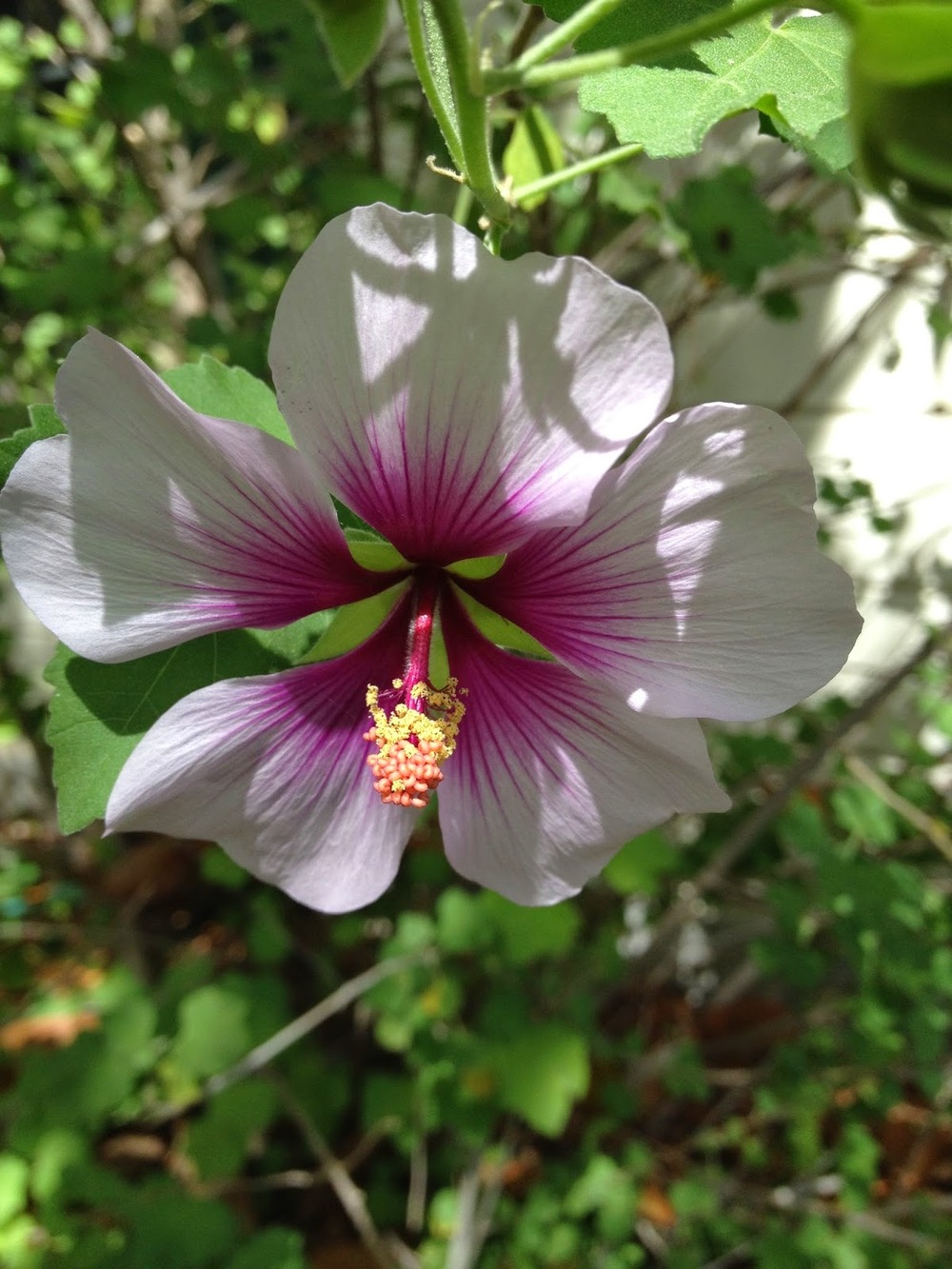
Mallow, which always reminds me of hibiscus. I can't remember which kind of mallow this is, but I believe it's a native.


A peony someone gave me as a gift years ago. I planted it near our mailbox and it's never bloomed again. But it has this spectacular bloom this year!


Along with orange, yellow, red, and white poppies, I have these pink beauties. I believe they are from a mix "Mission Bells" that I got from Larner Seeds.


Hummingbird sage, which creeps along the ground and likes the shade, and is a native.


Speedwell, not a native, that I planted in hanging pots.


And the Sticky Monkey Flower has started blooming, as well.

I hope to have an exciting veg garden update for you this weekend. Everything is sprouting!