• About
  • Blog
  • Contact
  • Favorites
  • Archive
Menu

Poppy Corners Farm

Street Address
Walnut Creek, California
Phone Number
Walnut Creek, California

Your Custom Text Here

Poppy Corners Farm

  • About
  • Blog
  • Contact
  • Favorites
  • Archive

The Misunderstood Western Black Widow Spider

July 21, 2024 Elizabeth Boegel

I found this female and her egg sac about a week ago, nesting behind a large planter made out of wood and gutters. At the moment, this planter is filled with nasturtiums which died in our most recent heatwave, so I won’t be showing you the planter itself. I will say that I’ve tried many a flower (and berry) in these shallow gutters, and the nasturtiums fared the best yet; it’s hard to keep things wet enough here to stay happy. Anyway…. I was inspecting the dead flowers and trying to figure out what to plant next when I came across this beautiful Western Black Widow.

Now, I want to start out by acknowledging that if you do get bitten by a WBW, the bite will be quite painful and you’ll need emergency care. However, death is unlikely. WBWs are the most poisonous American spider and as such, they get a bad rap; but like many insects, they feel no need to sting humans, unless the humans happen to be messing around in their territory. Even then, unless the spider’s body is pinched repeatedly, it will not bite.

Despite knowing this, when I had little kids, I confess I killed many WBWs. They used to nest inside our wooden perimeter fence (they probably still do), and I was worried that a kid (either my own or a neighbor kid) would climb the fence and grab a spider inadvertently. That would have been bad. But I do feel terrible for killing them back then. If I had little kids now, I would explain all about the spiders and get the kids aware of how and where they live, so that we could all live in peace together. Oh well. We all evolve.

In fact, WBWs are described by arachnologists as ‘shy.’ They tend to hide in dark places where they will go unnoticed. They spin a huge, strong, messy, complicated web (not pretty at all), which is very unique to its species. I see far more WBW webs than I do the actual spiders, and it’s the primary way I figure out where they are living. They catch a lot of flies in those webs (as well as other insects and arthropods). They bite their prey in several places, and suck out their insides, leaving the external shell in the web.

The females also put pheromones on their webs to attract males. The male then performs a sort of ‘courtship dance’ on the web to let the female know he’s a potential mate, rather than dinner. Female WBWs don’t always eat the males after mating, either - it just depends on how hungry she is, how fit the male is, and how fast he scurries away.

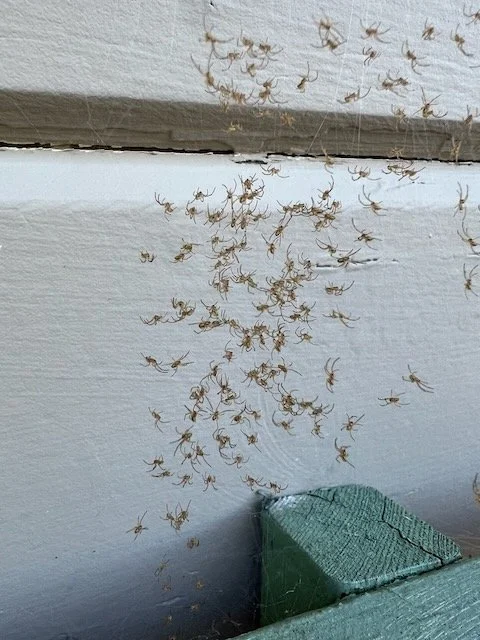
There are hundreds of baby spiderlings in that egg case you see in the photo. They will hatch inside the sac, and then emerge. Most of them get eaten right away by their siblings. Very few survive, and those eventually (like the spiderlings in Charlotte’s Web) spin a long silk that takes them flying through the air to another part of the garden.

It’s been interesting to watch how the mother spider behind my planter protects her egg sac. Since I water there regularly (the plants don’t need the water anymore, being DEAD, but the bees like to drink from the soil there - wasn’t that spider smart to build her web in such a place???), the spray naturally hits the sac sometimes. She doesn’t love that, and will often move the sac behind a crosspiece to protect it. But spiders aren’t really ‘good’ mothers. Not in the sense we think of, anyway.

I must confess that spiders are not my favorite thing. I really like insects in general, but it’s tough for me to like spiders, and I’m not sure why. The way I combat this is to learn all I can about them. Anytime I see a spider than I’ve never seen before, I take a picture and use iNaturalist to ID it. Then I read about it and learn all about the ecosystem services it provides. This usually helps me to get over my ‘shivery’ feelings about spiders. I will say this is a work in progress for me, and I may never really like spiders. But I appreciate them, and see that they are an integral part of biological processes. We need them. So - every time I walk by this WBW, I crouch down and say hi. I’m actually looking forward to seeing the eggs hatch, and hope I get the privilege to witness it.

EDITED 7/22/24: SHE’S FEASTING Check it out!

Edited August 9, 2024 - the babies have hatched!
Tags IPM, insects
5 Comments

A Week's Worth of Tomatoes

July 17, 2024 Elizabeth Boegel

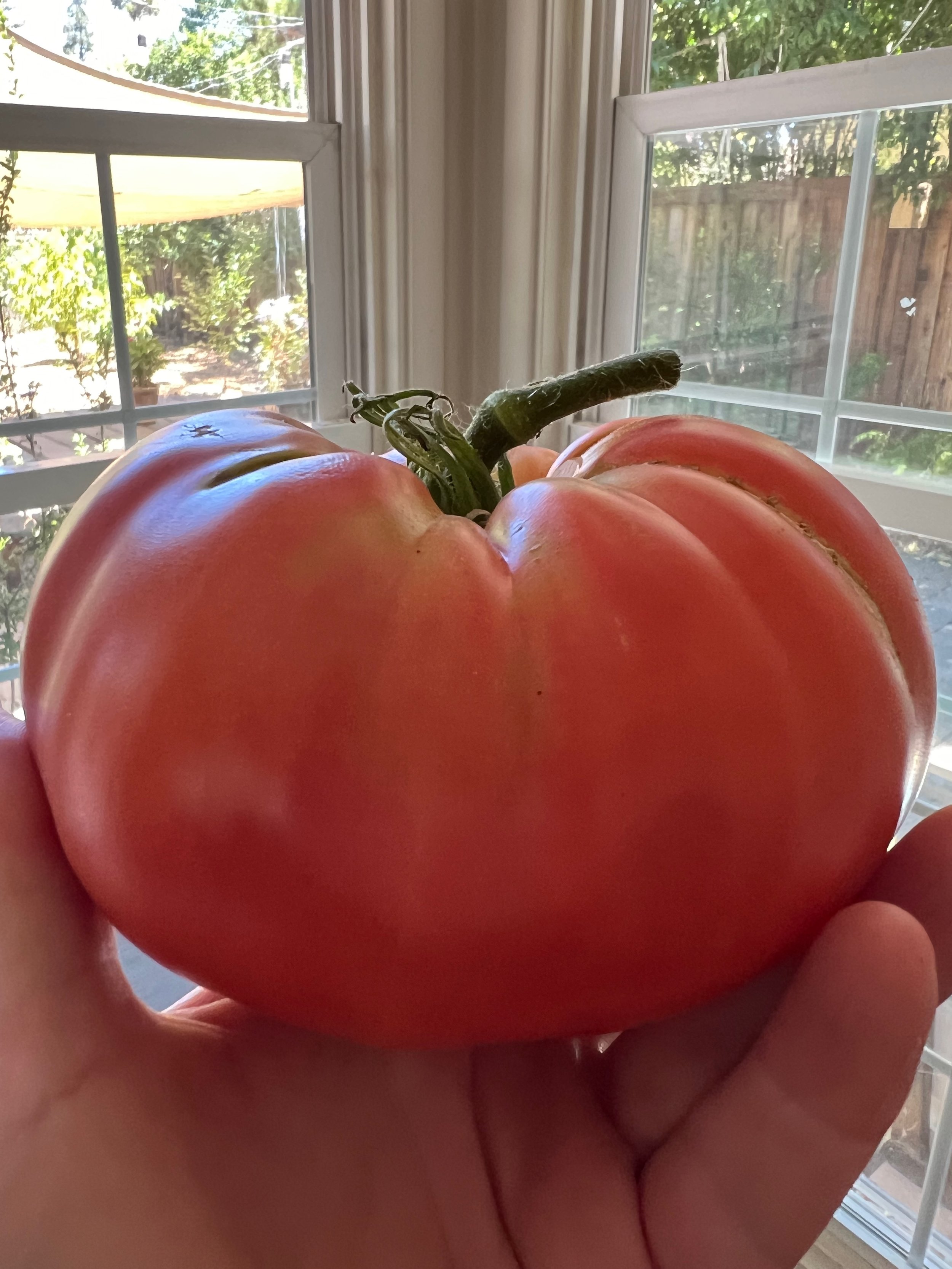
It’s that glorious season when every time I go out to check the garden, I see another tomato ripening on the vine. I’ve had a few bad years of tomatoes at Poppy Corners, and have had to rely on my school garden supply; this year I’ve gotten lucky. Somehow I’ve found the right place (morning and late afternoon sun, midday shade) with the right watering plan (every other day, deeply), with the correct amount of pruning (none!), and with the right method of staking (Florida weave, sort of) - or at least ‘correct’ and ‘right’ for this particular summer in this particular climate. I may do the exact same thing again next year and get entirely different results - that’s the way things are going, my friends. I’ll never take a good harvest for granted again.

Anyway, it’s been glorious to have our fill of tomato dishes. I love summer cooking - lots of grilling, and picking of basil, and shucking of corn. I ask you, what else does one need for a delicious meal?

Here are some recipes that have been in heavy rotation here.

  1. Summer Steak with Corn and Tomatoes: This one comes from the always-reliable Deb at Smitten Kitchen. This is an easy, delicious meal, and if you double it, you’ll have great leftovers for lunch the next day. You don’t have to use cherry tomatoes; slicing work just as well. And any ‘flat’ steak will do - skirt, flank, flap, flat iron. I also use another ear of corn because why not?

  2. Chickpea Tagine with Tomato Jam (and fresh-caught halibut!): Adam is spending the summer with us as he works his way through job interviews. He’s been lucky enough to go out on a friend’s boat several times, fishing in the Pacific. He’s caught rockfish and halibut. He grilled the halibut to go with this tagine and it was amazing. We just piled the fish with the chickpeas and ate it all at once. Alexandra at Alexandra Cooks is a wonderful recipe-writer and has a lot of fabulous vegetarian recipes. I made my own ras-el-hanout and used some as seasoning on the fish, too. You could also have this with any protein of your choice although I think pork chops would be delicious with this.

  3. Garlic Lime Steak and Tomato Salad: Another Smitten Kitchen recipe, this uses up a lot of ingredients we have in the garden right now (beans, cucumbers, cilantro, basil, jalapenos) and has a real Vietnamese flavor. I usually double the dressing/marinade and up the fish sauce a little bit.

  4. Pasta Pomodoro with Grilled Chicken: You don’t need a recipe for this. Just throw together plenty of chopped tomatoes, garlic, basil, salt, and olive oil on a sheet pan and roast in a 425 degree oven for 20 minutes or so. Marinate some chicken in lemon juice, sherry, garlic, and salt, then grill it. Cook some thin noodles. Wham! You’ve got pasta pomodoro. Any leftover sauce can be frozen and used later as a topping for pretty much anything!

  5. Polenta-baked Eggs with Corn, Tomato, and Fontina: This is another Smitten Kitchen recipe that I got from one of Deb’s cookbooks. It’s especially great this time of year because eggs are also usually quite plentiful from our backyard chickens. Cook 1/2 cup polenta following directions on the package (I like Bob’s Red Mill or Anson Mills). When the polenta is nearly finished cooking, add 1/2 cup of corn kernels (fresh or thawed frozen). Stir and cook for a few more minutes. Add 1/2 cup grated fontina, and season well with salt and pepper. Then add 2 tablespoons of creme fraiche or sour cream. Stir until everything is creamy. Coat a cast iron skillet with butter, and transfer over the polenta mixture. Stir in a chopped tomato (or two) or some pureed tomato sauce. Smooth the surface, and make four indentations. Crack an egg into each one. Sprinkle with salt and pepper, and with more grated fontina. Bake in a 400 degree oven until the whites are set. You might have to broil it for a few minutes to finish it up. It’s a trick to get the whites set but the yolks still runny, but the end result is delicious with a good crusty baguette.

  6. One-pan Farro with Tomatoes (and Tom’s homemade Italian sausage!): Tom made a huge amount of Italian sausage this past spring, and it’s been fun to add it to all kinds of dishes. I love the chewy nuttiness of farro (I also like Bob’s Red Mill farro), and it goes really well with meaty things. Again, you can use any kind of tomato here.

  7. Savory Tomato Galette with Tomato, Corn, Caramelized Onions, and Gruyere: Tom doesn’t love this because he has trouble with any soggy bottom pastry, but I don’t find this recipe all that soggy (the corn and cheese at the bottom help a lot) and frankly I wouldn’t mind if it was. Have I mentioned that Alexandra has my favorite focaccia recipe of all time? It’s worth checking that out, too. Both Adam and Rin make it regularly for sandwiches. Alexandra’s good at bread, in general, and has written both a bread cookbook (‘Bread, Toast, Crumbs’) and a new pizza cookbook.

Happy Cooking!

Tags seasonal recipes, cooking, tomatoes
3 Comments

Evaporative Cooling

July 4, 2024 Elizabeth Boegel

I don’t think there is anyone who hasn’t experienced an extreme heatwave this past month. Rin, who is spending the summer in Savannah, experienced their first East Coast heatwave (with accompanying high humidity) a couple of weeks ago. Here in the West, we too have had our share of extreme heat, though not the humid kind. Our backyard weather station hit 116 degrees several times this week, and I instantly start sweating the moment I walk outside.

I have discovered recently that I am a ‘sweater.’ I don’t mean that I’m always sweating; but yes, when the circumstances are right, I will sweat more than the average person. I learned this because Tom and I have joined a local gym. The reason for joining began with injury recovery, but quickly morphed into something else - another tool to build our resilience. We are planning a month-long walking trip next summer for our 25th anniversary, so we are both working hard to build muscle, improve balance, regain agility, and increase flexibility. We’ve added all kinds of different exercises to our daily routine; simply hiking up a hill is not going to prepare us for hiking 16 miles a day for weeks on end.

So now we are in training. And man, when I train, I sweat. I mean not just in the usual places. When I’m done with, say, a spin class, my calves are slicked with sweat. And after a TRX class, my forearms are dripping. I suppose it could be embarrassing, but I don’t look at it that way - I consider it a sign of a healthy vascular system that is performing one of the jobs it has uniquely evolved to do.

Sweat is a beautiful human adaptation. Chimpanzees and macaques have sweat glands, but humans have 10 times the amount that they do and are the sweatiest among the great apes. Scientists have discovered that “the higher density of sweat glands in humans is due, to a great extent, to accumulated changes in a regulatory region of DNA that drives the expression of a sweat-gland-building gene.” This happened through repeated mutations and contributed to an evolution of higher sweat gland density in humans. We are meant to sweat! It’s our primary way of cooling ourselves. As the water in sweat evaporates, the surface of our skin cools. This is true of any evaporative cooling. A liquid will remove latent heat from a surface, and that evaporating liquid will cool the air around it.

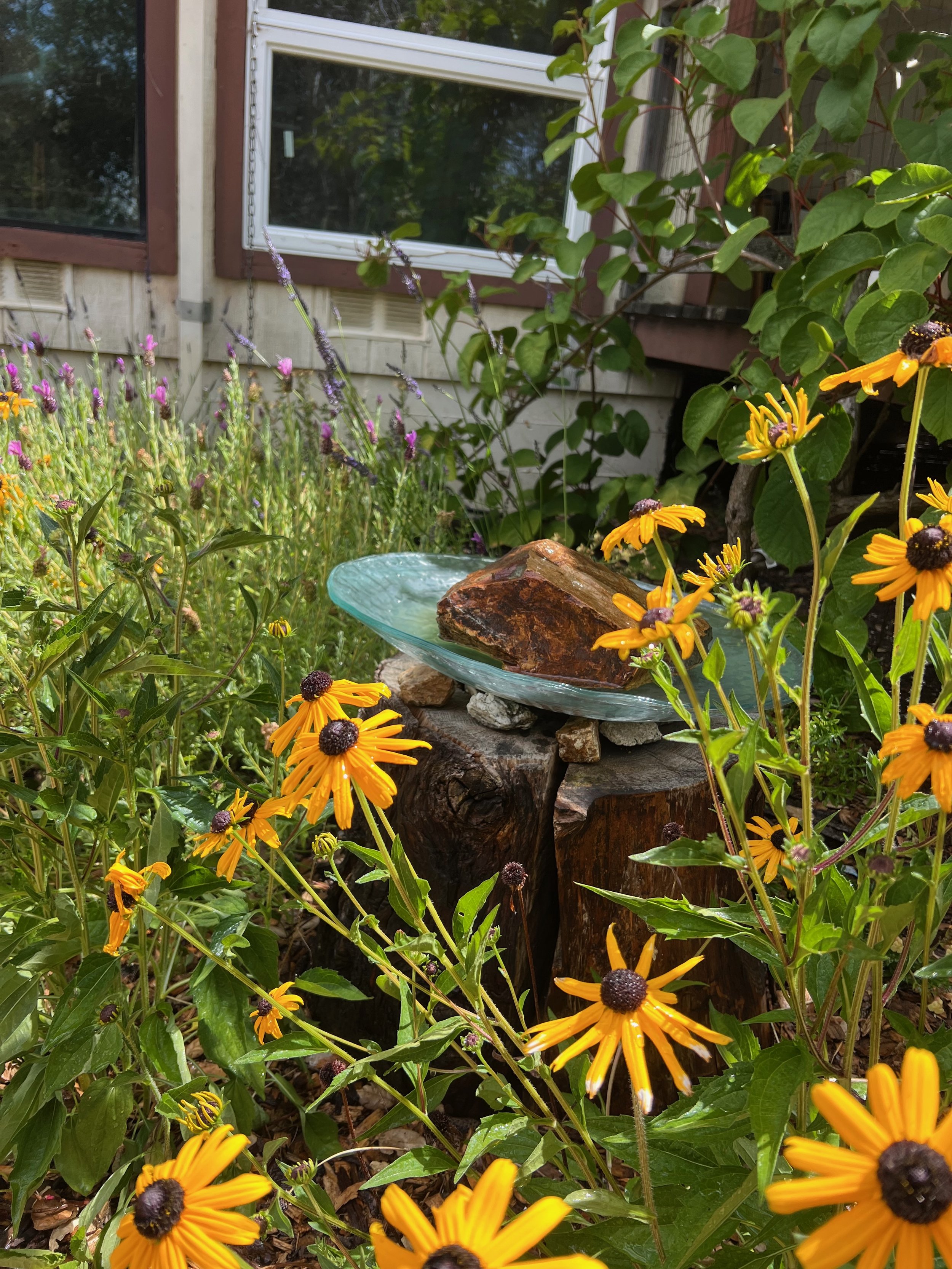
Since most animals do not sweat, they have to cool themselves in other ways, and sometimes they too use evaporative cooling. During this heat wave, we’ve been closely watching the behavior of our backyard bees on our water fountain.

Bees use water to cool their hive. Some worker bees are tasked with finding, collecting, and bringing water back; it is spread in a thin surface over the surface of the comb and the bees then fan their wings to evaporate it. A hive may use a quart of water a day in the hot months for this purpose.

Honeybees are not the only ones who do this. Some wasp colonies (many wasps are social insects and, like honeybees, live in large groups) use water the same way. They collect it and spread it on the surface of their nests. Today, while filling the one of the water bowls at the school garden, I watched both paper wasps and yellow jackets collecting water from the edges.

This is one of the most important ways we can help insects; we can place shallow bowls of water around our gardens and yards. Put a rock in the bowl, or several rocks, so that the insects don’t drown (they have poor depth perception). If mosquitos are a worry, change the water daily or weekly (it’s good to do this anyway to keep the water clean). Birds will love this, too.

Many insects will also get water from the soil in your garden, so it’s nice to have a bare space which you keep wet for this purpose. Butterflies especially adore a muddy spot.

Another creature in our garden that appreciates evaporative cooling is the chickens. Chickens, like dogs, pant when it’s hot, and this past week they’ve been panting from dawn until full dark. I actually spray them with water, and though they seem to dislike me doing that, they really love when the ground in their run is wet. So when the temperature is over 100, I go out several times a day and spray them, and the dirt in the run, thoroughly. Immediately afterward, the chickens will congregate in the wet place, and they really perk up.

Chickens also dig holes in the dirt to find the cooler place under the surface. Many creatures do this, too. While dogs and coyotes pant, owls use something called ‘gular fluttering’ which is flapping the loose skin under the throat to move air over the throat cavity. Vultures urinate on their legs to keep cool, another form of evaporative cooling!

That last fact makes me appreciate anew the way we humans use sweat to keep ourselves from overheating.

Stay cool, everybody.

Tags insects, wildlife, water, climate, weather
2 Comments

Don't Forget...

July 2, 2024 Elizabeth Boegel

To order your garlic (for fall planting) NOW!

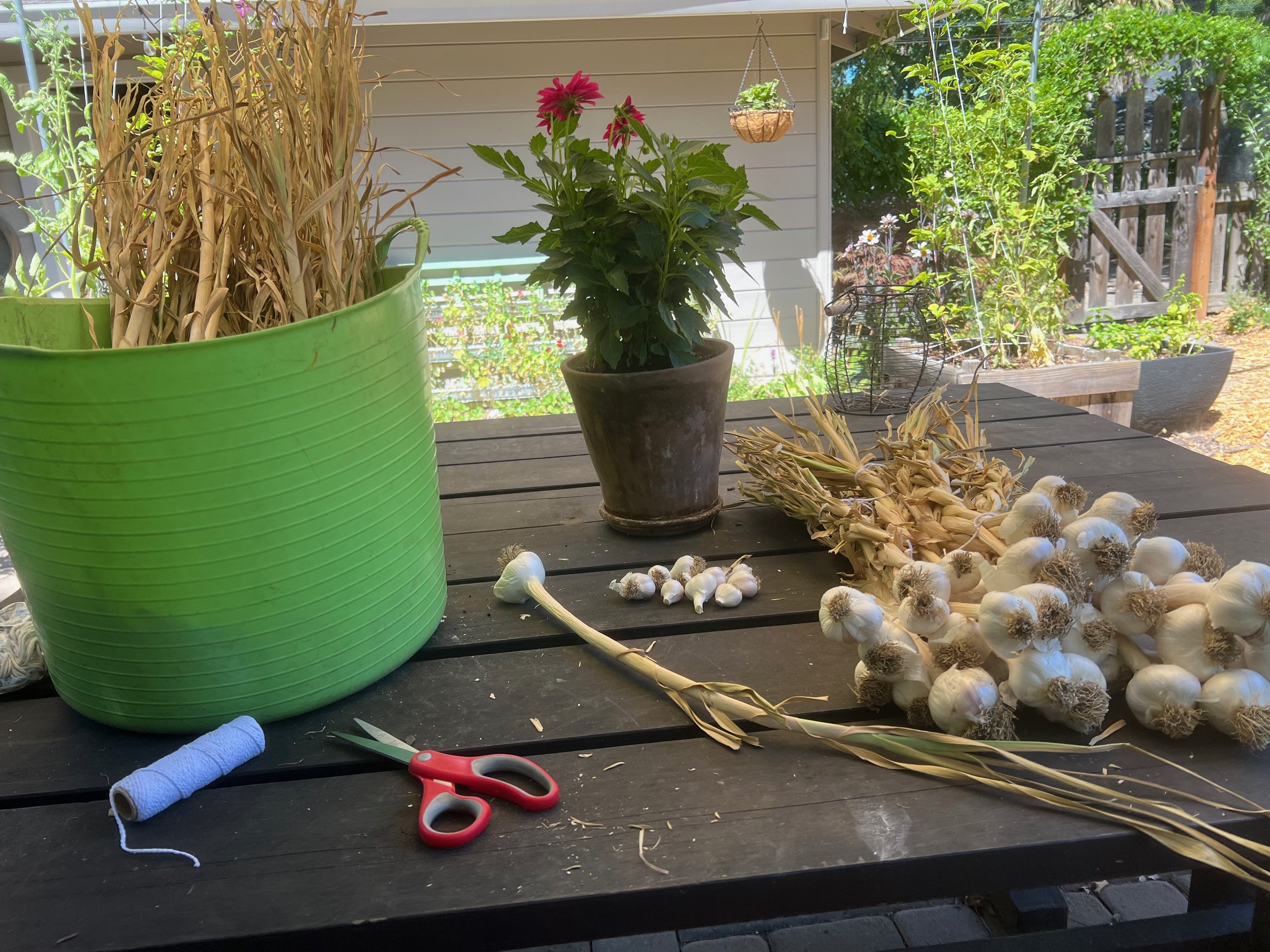
Because I was late ordering last year (I ordered in summer rather than spring), I ended up getting a variety of garlic that I’d never planted before, and as you can see from the above picture, the bulbs ended up being quite a bit smaller than the type I prefer (which is Inchelium Red). It’s ok, the garlic will be fine, and home-grown garlic of any kind beats the pants off of anything you can buy in the store. But still, I wish I had my old faithful hanging on the ceiling racks.

So - don’t be like my 2023 self - be like my 2024 self and make sure you order now! I actually order it in March for delivery in October. My favorite place from which to order seed garlic is Filaree Farm in Oregon. They have so many different varieties. I like the softnecks so I can braid them for hanging, but if you like garlic scapes, you’ll want to order hardnecks.

Anyway, our garlic harvest was late this year, in early June rather than late May, and then the stalks hung on the garage racks for a month in order to thoroughly dry out. This past weekend, I braided them for hanging in the house. It’s a fun task.

Then I cut up all of the old cloves left from last year, all of which were bolting. I cut out the green shoot, put them in the food processor and made a paste, then spread it on a sheet and put it in the dehydrator. After drying, I whizzed it in our dedicated spice grinder (an old coffee grinder) and voila, we’ve got our garlic powder supply for the next year.

The smell of the house on ‘garlic’ day is really something. It feels good to provide ourselves with this necessary kitchen ingredient each year. Garlic is a beautiful and easy crop to grow, it’s used in practically everything we cook, growing it ourselves saves us money and time, and it looks great hanging up in the house.

Tags garlic, herbs
2 Comments

Follow-up to 'Relevance'

June 25, 2024 Elizabeth Boegel

You might remember my post about my experience at the Chesapeake & Ohio Canal Historic National Park. I am pleased to report that I received a response today from Tina Capetta, who is Superintendent of the park:

“I just received your correspondence a few minutes ago, and please let me apologize for the delay in its reaching me and for the poor response to your question that you received at Great Falls. The park has identified that we lacked sufficient scholarship about the indigenous people who were and are associated with the Potomac River Valley, and we commissioned a study.  In 2020, the College of William and Mary launched a Tribal Affiliation Study for the C&O Canal National Historical Park.  It identified dozens of tribes that were affiliated with the valley, and park staff have done outreach to all of the identified tribes.  While most of them no longer consider themselves affiliated with this area, we are working to establish strong relationships where we can.  We will use information that we learn from the tribes and from the study to help inform updated exhibits throughout the park.  We have identified that the person you spoke to was an intern.  Clearly, there is training gap that needs to be remedied, which we will do promptly. Thank you for calling this to my attention.”

I am satisfied with this response, and very glad that the park is working on fixing the problem. This cements for me that letter-writing, and advocacy in general, is not a moot exercise.

Tags sovereignty
6 Comments
← Newer Posts Older Posts →

Subscribe

Sign up to get email when new blog entries are made.

We respect your privacy. We're only going to use this for blog updates.

Thank you! Please check your email for a confirmation notice to complete the subscription process.

Summary Block
This block is invalid. Please check the block settings and try again.
Featured
Aenean eu leo Quam

Powered by Squarespace