• About
  • Blog
  • Contact
  • Favorites
  • Archive
Menu

Poppy Corners Farm

Street Address
Walnut Creek, California
Phone Number
Walnut Creek, California

Your Custom Text Here

Poppy Corners Farm

  • About
  • Blog
  • Contact
  • Favorites
  • Archive

New Things

June 7, 2021 Elizabeth Boegel
IMG_7368.jpeg

There’s some new things going on here at Poppy Corners, and I think an update is warranted.

First up, my summer class has begun. I’m taking “The History of Environmentalism in the US and California,” and so far, it’s quite interesting, although I’m only in the second week.

Secondly, I have accepted an internship with a non-profit organization in Oakland called Friends of Sausal Creek. My job title is ‘Communications and Community Education Intern,’ and I’ll be working on things as varied as the monthly newsletter, restoration projects, updating the website, and leading school field trips (when they resume). Friends of Sausal Creek works to restore, maintain, and protect a watershed which runs from the hills of Oakland all the way down to the San Francisco Bay. For more information about this excellent organization, visit their website here. The picture above accompanied my introduction in the newsletter.

IMG_7378.jpeg

The summer garden has really taken off in June, with the arrival of some hot weather and warm nights. We’ve even eaten our first hot peppers of the season! I’ve done some succession planting with annual herbs and cucumbers, and will do so with beans, as well, this week. The tomatoes have lots of blossoms, so I’m looking forward to that first end-of-June cherry tomato.

IMG_7384.jpeg

And it’s soft fruit season, with berries coming on every day. It’s delightful to have an assortment with our dinners each night. My raspberries in particular have taken off this year, and have put out runners all over that side of the garden. I’m going to have to figure out how I want to manage them in the future. A thicket, while in theory sounds great, will be hard to maintain easily as raspberries are thorny.

IMG_7400.jpeg

Rin has graduated from high school, and I loved this bit they contributed to the last issue of the school newspaper. It echoes my own feelings about being a student, and the ways in which I best learn. Perhaps you can identify with this as well.

We are very excited for Rin’s matriculation at Savannah College of Art and Design in the fall. It seems the perfect fit for them! We are so proud we could burst.

IMG_7370.jpeg

Adam is home from Cal Poly (for now); he’ll be going back and forth to San Luis Obispo this summer, as he is renting a house with two other students, and they have planted a new garden in the backyard. It’s pretty fun to be sharing gardening knowledge with him. I expect he will soon surpass me, just as he has done with cooking and music.

Tags vegetable garden, fruit garden
8 Comments

Who's Eating the Eggs?

May 25, 2021 Elizabeth Boegel
IMG_7294.jpeg

Almost every day these past two weeks, when I go out to put the chickens up for the night, there is an egg that’s been eaten. Nothing left but some slime, maybe a bit of shell. The other eggs are untouched - beautiful and perfect (if sometimes a little dirty).

If I make an effort to go out and collect them during the day, nothing has been eaten - so this event seems to happen at dusk. We wondered: Was one of the chickens getting into the habit of eating the eggs? And if so, why was the shell also gone? Would they eat the entire thing?

I had definitely been noticing some rat activity in the coop, especially around dusk. I no longer keep the chicken food in the coop - I keep it out in the run, so that if a rat wants it, they’ll have to brave being out in the open to get it (owls and hawks, where ARE you???). At night, I bring it inside. I keep the water outside in the run at night, too, though it’s in the shady part of the coop during the day. I decided that it was rats eating the eggs. They were crawling up the ladder (a flat piece of wood, basically) into the coop and gobbling it up, right before the chickens started making their way up to go to bed. The chickens don’t really use the ladder - they fly in and out of the coop instead - so I removed the ladder entirely. This seemed to stop the egg problem and I was patting myself on the back.

Then one night I waited until later than usual to go get the eggs and shut in the chickens, and darn it! An egg eaten. My working hypothesis was, and still is, that rats had figured how to get up into the roost without the aid of the ladder. They are canny little buggers.

However….

IMG_7283.jpeg

I found this in the coop this morning. Not up in the roost, but down on the ground, dead. Stretched out to its full length, it was probably about a foot. So a small snake, then, and it had clearly eaten something before expiring.

You may recall that we found a sharp-tailed snake under a brick in our garden last year. I believe this dead snake is the same kind. To be sure, I wrote to Gary at California Herps and asked for verification. He’s always so responsive and helpful when I have a lizard or snake question. Here’s a copy of our conversation:

Me: Hi Gary, I found this snake dead in our chicken coop. If stretched out, would be about a foot long. The only snakes I have ever seen in our garden are sharp-tailed. Do you think this is also a sharp-tailed?

Gary: Hi Elizabeth. From the size, the scales, the tail, what look like dark bars on the underside, and your past history, it could be a sharp-tailed snake. There are three other species of similar-looking small snakes in your area, but they don't have the blunt tail with a sharp tip that this one appears to have. All of them eat small invertebrates and small mammals but I don't think any of them would pose a threat to your chickens. The larger snakes in your area - gophersnakes, rattlesnakes, whipsnakes, racers, and kingsnakes - might try to eat chicks and maybe eggs, but I don't think they would try to eat adult chickens.

Me: Thanks Gary! I really appreciate your expertise. I’m not worried about the chickens, but we have had something predating on the eggs.... I can’t imagine this little guy could have managed that though. I assumed he was eating slugs. We also have some huge rats, so I would very much like some bigger snakes in our garden! I’ve been trying to attract them for years, so it’s exciting to see some activity finally.

Gary: The subject of the possibility of snakes in California preying on chicken eggs came up recently when I read an article about a rat snake in the east that ate a golf ball that was put in a chicken coop to encourage egg laying. There are no rat snakes in California, but gopher snakes and California king snakes have been known to eat birds eggs and chicks, and could probably prey on chicken eggs.

IMG_7285 (1).jpeg

Well, as you can imagine, I found that exchange fascinating. I still don’t think this little guy is eating the eggs, but WHY was it in the coop? And what WAS it eating (could it handle baby rats???)? How did it die? And are there other snakes in our garden that I’ve just not seen? As usual, the answer to a question begets more questions.

Time to set up the wildlife camera in the coop, to record both day and night. We can answer a few questions that way, one of them being, who is eating the eggs? I love a good mystery.

Tags wildlife, chickens
4 Comments

So Much Promise

May 17, 2021 Elizabeth Boegel
IMG_7257.jpeg

Friends, it’s here: If not in the weather forecast, at least in our hearts - Summer! Can you feel it? At the end of last week, I turned in my final papers, presentations, and tests; the next two weeks stretch in front of me like an open road (my summer class begins June 1). Garden, here I come.

IMG_7247.jpeg

And there is so much promise in the garden right now. There’s not much to actually eat (this is the ‘hungry gap’ after all), but all the ingredients are there, and in a month we will be eating like kings.

Our bees swarmed twice in April (one of them was boxed up by my dad and given a new home in his backyard) and during Tom’s last hive check, he decided to take some honey, so at least we have several jars of that!

IMG_7244.jpeg

I dug out all the compost from the chicken pile and added it to the tomatoes, then clipped them to their growing strings. I harvested the garlic, which is now drying in the garage. I cleared the last of the peas and carrots and planted five varieties of winter squash, ten different kinds of basil, and several kinds of cucumbers. Oh yeah, and some pole beans. Gotta have beans.

IMG_7132.jpeg

I’ve been watching the fruit start to flower and form. We’re going to have berries - so many berries! - marionberries, and loganberries, and blackberries, and blueberries. We’re going to have apples - I made sure to prune our tree quite dramatically over the winter - and now we have what looks like a bumper crop on the way.

IMG_7248.jpeg

We’re going to have peppers - several serranos and a couple of bells have already formed nicely. We’re going to have cilantro and dill - volunteer plants have been coming up all over the place. Cosmos has likewise seeded everywhere as well as borage.

IMG_7246.jpeg

The gulf fritillary butterflies are going quite mad, and the passionvine is full of eggs and caterpillars and flowers. My new perennial pollinator garden is doing very well, with the grasses and coral bells flowering next to foothill penstemon and wooly blue curls.

IMG_7255.jpeg

Some of the soil in our raised beds was quite compacted, which I found mysterious as I add compost every year (and those beds produced a great crop of peas!). To improve it, I used the hunks of clover cover crop that I cut out of some other beds, and laid them down on the surface of the questionable soil. Soon we had worms coming up to work on it and simultaneously aerating the soil. Now pumpkin and cucumber seedlings are coming up through the dead and dying clover, and I’m thrilled. This was a good reminder for me to plant clover in ALL the beds, between ALL the veg in the winter. I really noticed a difference in the soil where it was growing.

IMG_7243.jpeg

You may remember the saga of the disastrous winter garden (I planted it up five times. FIVE TIMES! And still I had very little success. Just the aforementioned peas, some carrots, some arugula, and a little kohlrabi - not nearly the bumper crops we usually have over the winter). I was worried that this summer might just continue that trend, and I wondered if maybe my gardening luck had run out.

But so far, the summer garden is chugging along just as it should, so I’m breathing easier.

In other news, during my last week of school, we had a solar system installed. I’ll write in detail about that experience (spoiler alert - we are very happy with the entire process) as soon as I have some hard data to share with you. More soon!

Tags vegetable garden, fruit garden, herb garden, flower garden
4 Comments

Mount Diablo Fairy Lantern

April 26, 2021 Elizabeth Boegel
seen on the Little Yosemite Trail in the Mt. Diablo foothills, 4/25/21

seen on the Little Yosemite Trail in the Mt. Diablo foothills, 4/25/21

Friends, I promise: Soon, my semester will be over, and I’ll be free to write long rambling posts about the garden again. Oh, I can’t wait! The garden is calling me powerfully, but for a time yet I must resist and stay at my computer, only emerging to take walks for my mental and physical health. I’m presenting my capstone project titled “Facilitating Native Bee Populations in the Urban Bay Area,” on Friday, and I am hastily editing and refining (and biting my nails).

Meanwhile, I wanted to show you this pretty little flower that is only in bloom for a short while each year, in a very narrow endemic range. Isn’t it sweet? This is the Mount Diablo Fairy Lantern, Latin name Calochortus pulchellus, and I’ve only seen it on one other trail, and that many years ago.

Calochortus is an interesting genus, with several fascinating local species. To learn more about it, you can’t beat this article in Bay Nature, published in 2015. The entire story is cool, from the way they were ‘discovered’ (by Douglas, of “Douglas fir” and “Douglas iris” fame), to the way they grow, to the places in which they grow. I thought you too might want to learn more about these pretty little ephemerals!

Side note: Tom, the kids, and I have all had our Covid vaccinations, and it feels like freedom. I am looking forward to in-person garden tours, in-person plant sales, and hugs from all gardeners in a 20 mile vicinity!

Another side note: A month ago Tom and I decided to section hike to the top of Mt Diablo (the western side) from our house, over the course of several weekends. This can be done because there are roads going to the summit on the west side, so we just had to figure out where/at which points to hit a road where we could stop and start again. It took us a few weekends, about 14 miles up (and 14 miles back down), and a gain of about 4300 feet in elevation. It was a fun project to figure out how to get up there from here. Now we want to hike the east side, but there are no roads there except the one at the staging area, so we’ll have to do about 10 miles (round trip) and 3600 feet of elevation in one day. So that’s a summer goal!

Tags natives, hiking
Comment

A New Trellis

April 21, 2021 Elizabeth Boegel
IMG_5134.jpeg

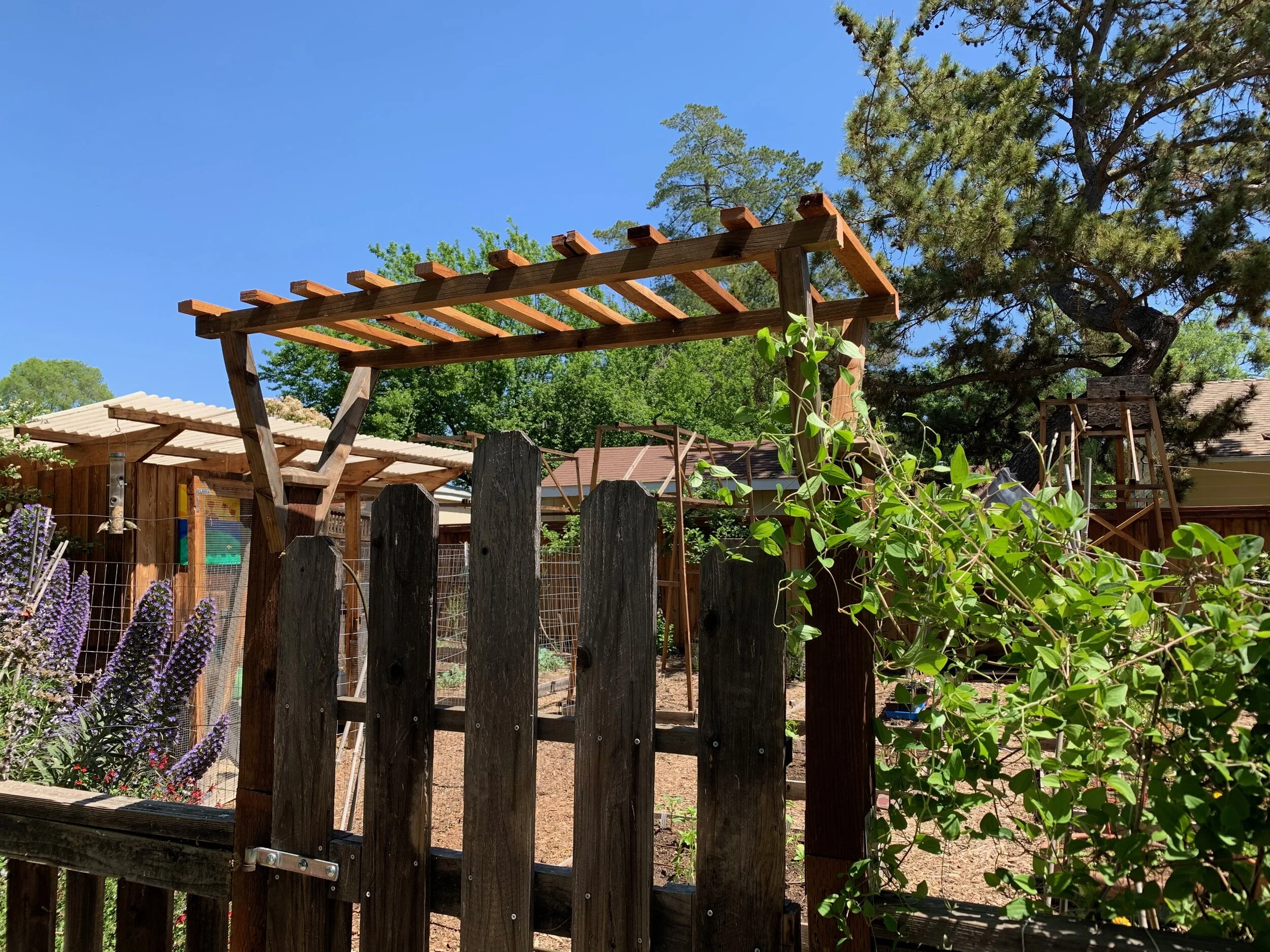
Last year, I planted a new clematis (Clematis paniculata, also known as Sweet Autumn Clematis), which turned out to be a very vigorous grower with really amazing flowers (seen in the photo above in September). We enjoyed it so much, all the way through December, as it went from millions of white flowers to gorgeous winged seedpods that looked like little plumed helicopters. I was hoping that it would scramble up on top of the garage roof, but it seemed to want to grow the opposite way, towards the chicken coop and over the gate. So, this spring, as it’s putting on a lot of new growth, I asked Tom to make me some sort of arch for the gate; this way the clematis can grow the way it wants to. Tom went into his wood-store and found some reclaimed redwood, and cobbled together a fetching little trellis.

IMG_6976.jpeg
IMG_6974.jpeg

I’m excited, because this means that the clematis can grow up and over the gate, and across the wire fence on the other side, mingling with the blackberry and loganberry we have growing there. It should be beautiful, come September!

A word about pruning this kind of clematis: Sweet Autumn Clematis belongs to Group 3, which means it blooms on the current year’s growth. It needs to be pruned vigorously in late winter, and the new growth in spring will produce that year’s flowers. Clematis come in three groups. Group 1 includes the ‘Montana’ types and should be pruned after flowering in the spring as it creates flowers on old wood, and you want it to have time to grow through the year after pruning - it’ll bloom the following spring. Group 2 also flowers on the previous year’s wood so should be pruned after flowering in the summer; this group has the largest and showiest blooms.

A great source for clematis (other than your locally owned nursery, which would be best) is Brushwood Nursery. They have varieties from all three groups, and dozens of each kind. It’s hard to choose one!

IMG_6972.jpeg

In other news, I broke down and put the pepper seedlings in the ground. The soil was quite warm, and the plants were getting too tall for the makeshift greenhouse. So far, despite temps at night in the high 40s, they are doing just fine! I’ll wait until early May to get the tomatoes in the ground. The rest of the summer garden can be sown in batches, as I have time and space - beans, cucumbers, herbs, and squash, will all do best with warm soil, but if you’ve got that, it’s just a matter of walking that fine line of nighttime temps.

Tags projects, vegetable garden, flower garden
2 Comments
← Newer Posts Older Posts →

Subscribe

Sign up to get email when new blog entries are made.

We respect your privacy. We're only going to use this for blog updates.

Thank you! Please check your email for a confirmation notice to complete the subscription process.

Powered by Squarespace