Join me on a morning stroll in the garden, today, the first day of Autumn 2019.
The morning of September 23, 2019
Your Custom Text Here

Join me on a morning stroll in the garden, today, the first day of Autumn 2019.

Ok, it’s not quite casserole season yet, but this sure tasted good anyway on a rainy (rainy?!) and cool (cool?!) September day. The original recipe, from a website called KalynsKitchen, called this a ‘gratin.’ But it wasn’t really a gratin. A gratin has a sort of creamy sauce. That would taste good here, too, but that’s not what the recipe called for. I would like to take this recipe and make it a true gratin, but as is it’s pretty delicious. It reminded me of a gluten-free pizza casserole, or gluten-free lasagna sort of thing.
I love when delicata squash starts coming on. It’s such a beautiful fruit (a berry, actually, as are all squashes and melons) and so easy to prepare, as you don’t have to remove the skin. It tastes great just roasted with olive oil and salt, but it’s nice to find new recipes that become ‘keepers.’ And this is one. Enjoy!
P/S this recipe says it feeds 6-8. I’d say 6 is more realistic, especially if you have a teenaged boy around.

“Delicata Squash and Sausage Gratin (or, as I am calling it, a simple casserole)
- 3 delicata squash, about 8 inches long (or however many you want/have, really is there such as thing as too much?)
- 3 Tbsp olive oil, divided
- 2 tsp Italian Herb Blend, divided (I just used some oregano and basil that I had drying/hanging on the rack)
- salt and pepper
- 1 to 1-1/2 lb sweet or hot Italian bulk sausage (we used a pound and I think that was the perfect amount)
- 1 medium onion (or large shallot or two smaller shallots), chopped
- 1 large green bell pepper, chopped (or a sweet red, or several sweet red, whatever you’ve got in the garden)
- 2 C mozzarella cheese, shredded (I wish I had used a combo of two cheeses, or maybe used ricotta in the casserole with only a sprinkling of parm on top)
Preheat oven to 400.
Cut ends off delicata, then slice longways in half and scoop out the seeds and give to your chickens, then slice into half-moons. Put ‘em on a baking sheet, drizzle with olive oil, put on half the herbs, and roast ‘em for 20 minutes.
Meanwhile, heat some olive oil in a skillet and saute your sausage. Once browned and crumbly, remove to a plate and saute the onions/peppers in the remaining fat along with the rest of the herbs.
Grease a casserole dish (9x12 ish). Layer the roasted squash on the bottom, cover with the sausage, onions, and peppers, then sprinkle on the cheese. Cook in oven for another 20 minutes or so.”

image credit: UnitingWorld
I’ve been letting everyone know that I am unavailable next Friday the 20th, as my daughter and I are attending the climate strike in San Francisco. What surprises me is how many people say, “What strike?”
Young people around the world have been striking from school every Friday for the past year. This movement was started in August of 2018 by a teenager from Sweden named Greta Thunberg. More and more youth have been joining every week, and Greta asked that adults join the movement on September 20, as a huge global movement, three days before the UN climate summit in NY. San Francisco has a big march planned, as does Oakland. You can find a march/protest/strike near you at 350.org.
I haven’t talked about climate here on this website in a while because I’ve been trying hard to maintain positivity in the face of what I consider to be the greatest issue of our time. Positivity is important, but so is civic engagement and working for measurable change. I really appreciate these young people standing up and making themselves heard. If you agree with me, you too might be interested in taking the day to show your support for our youth.

I had an email from Austin at All Power Labs this evening; I had made several mistakes in my post about biochar, and of course he would like to make sure the information is correct, and so would I! I don’t ever want to mislead my readers. So, I am going to copy his email in full here. He also sent me a lot of photos of before/after biochar, which I will share with you if you like (just contact me and I’ll send them on) - they are impressive (although I haven’t seen any results in my own garden yet and will report them when I do. I have to say my artichoke plants are just as big as the ones in the pictures, so … jury is still out for me on this. The proof will be in the pudding! The important part is that Gill Tract saw a huge difference in their garden).
Here is the email, and I want to say that I really appreciate a company that is 1) local, 2) taking something out of the waste stream and making it work for good, 3) invested in solving the climate problem, and 4) totally committed to their company and feel it’s important to make sure that the info is correct and not distorted. SO thank you very much to Austin for pointing out my mistakes and setting the record straight!
“(Austin wrote:) In this paragraph, the highlighted portion ought to be corrected:
(Elizabeth wrote:) So, here’s the scoop. All Power Labs was originally created to make renewable energy using biomass. That is, make power by burning the waste products of agriculture or even our urban yards - tree trimmings, wood chips, etc. In the process of making this renewable energy, a by-product was produced - bits of what looked like charcoal, very light and made of pure carbon. Originally they just threw this product out. Then they realized it was biochar, and high quality biochar at that, and that it was a coveted resource for farmers and gardeners, as it does a lot of cool things in the soil (which I will detail in a bit). The original purpose of the company, making renewable energy for use, was having trouble finding a niche in the very large solar and wind energy economy we have in California. So, they pivoted a little into the biochar side of things.
(Austin) The biochar is not pure carbon. It is about 70% organic carbon. (Organic carbon—in a from derived from an organism— as opposed to mineral carbon, such as in chalk. Chalk is calcium carbonate. Carbonate minerals contain CO2 in their crystal structures.) The remaining 30% is a mixture of ash, and residual oxygen and hydrogen. Our walnut shell biochar is about 15-16% ash.
Charcoal is the “fixed carbon” fraction of woody biomass. About 80% of the mass of a chunk of wood consists of volatiles, which come off as wood smoke. The volatiles contain about half of the carbon of the wood, along with most of the hydrogen and oxygen in wood. (Remember, wood is largely cellulose, which is a carbohydrate. That’s where the hydrogen and oxygen come from.) The remaining 20% of the mass is fixed carbon—the carbon that is left once all of the volatiles come off of the material. That’s where the other half of the carbon content resides. The fixed carbon remains, and if it goes through high temperatures, resists decomposition because the enzymes used by bacteria and fungi to break down most organic carbon compounds can’t decompose most of the structures that are produced by fire. The higher the temperature, the more resistant to decomposition pyrogenic carbon tends to be. This quality of resisting decomposition is called “recalcitrance”. It is not an absolute quality; lower temperature processed biochars have a larger fraction that eventually decomposes; the high temp processed stuff (like ours) has a very small fraction that eventually decomposes.
(Elizabeth) Now more about the process. Above is a photo of the “Powermass Gasifier” which is the machine that turns biomass into both energy and biochar.
(Austin) The name of the machine is the “Power Pallet.” It is a Biomass Gasifier genset.
I attached a process explanation for you to get a sense of how it works. (If anyone is interested in this - let me know and I’ll send it on to you - E)
(Elizabeth) Biochar doesn’t decompose. It’s already been processed into its permanent form - pure carbon. This happens in the process of Pyrolysis. The volatile carbon in the biomass is burned off (and used for energy), and what is left is like the embers of a campfire. Totally indestructible, permanent bits of carbon.
(Austin) This description, of being “indestructible, permanent bits of carbon” is more apt for diamonds or pure graphite. Biochar is not totally indestructible. Depending on how it is made, a certain fraction can very slowly decompose, but the bulk of it does not participate in the carbon cycle. The proportions depend on the temperature of processing. The proper way to state this is that the carbon content of charcoal does not revert to carbon dioxide without combustion. When charcoal is interred in the ground as biochar, it is essentially “reverse coal mining”—the production of concentrated black carbon and putting it in the ground.
Also, for pyrolysis, we have an explanatory page on our website that would explain it in the context of how we make biochar. If you would link this page, we would appreciate it:
http://www.allpowerlabs.com/gasification-explained
(Elizabeth) They have a very high CEC (cation-exchange capacity) which means that they add nutrient density to the soil.
(Austin) CEC doesn’t add nutrient density, but it does add the ability to store nutrients. It is more like nutrient storage capacity. The key thing is that water soluble cation nutrients don’t just dissolve into water and leach out; the CEC sites act like velcro and cling on to water soluble cation nutrients, but hold them loosely enough that plants can get them off as they need them. High CEC soils can store a massive amount of nutrients without burning plant roots because the nutrients are not all dissolved in the water at once.
(Elizabeth) I also really appreciate that the biomass used to make this biochar is nut hulls from California orchards. This is taking something out of the waste stream, something that takes hundreds of years to decompose, and putting it to good use.
(Austin) The nut shells don’t take hundreds of years to decompose. Depending on how they’re disposed of, within a few years, all the carbon content in them is back in the atmosphere. This is sort of like how wood chips and nut shell mulch disappears like compost. ”
Let me just say again: I totally appreciate these corrections. I want to learn, too!
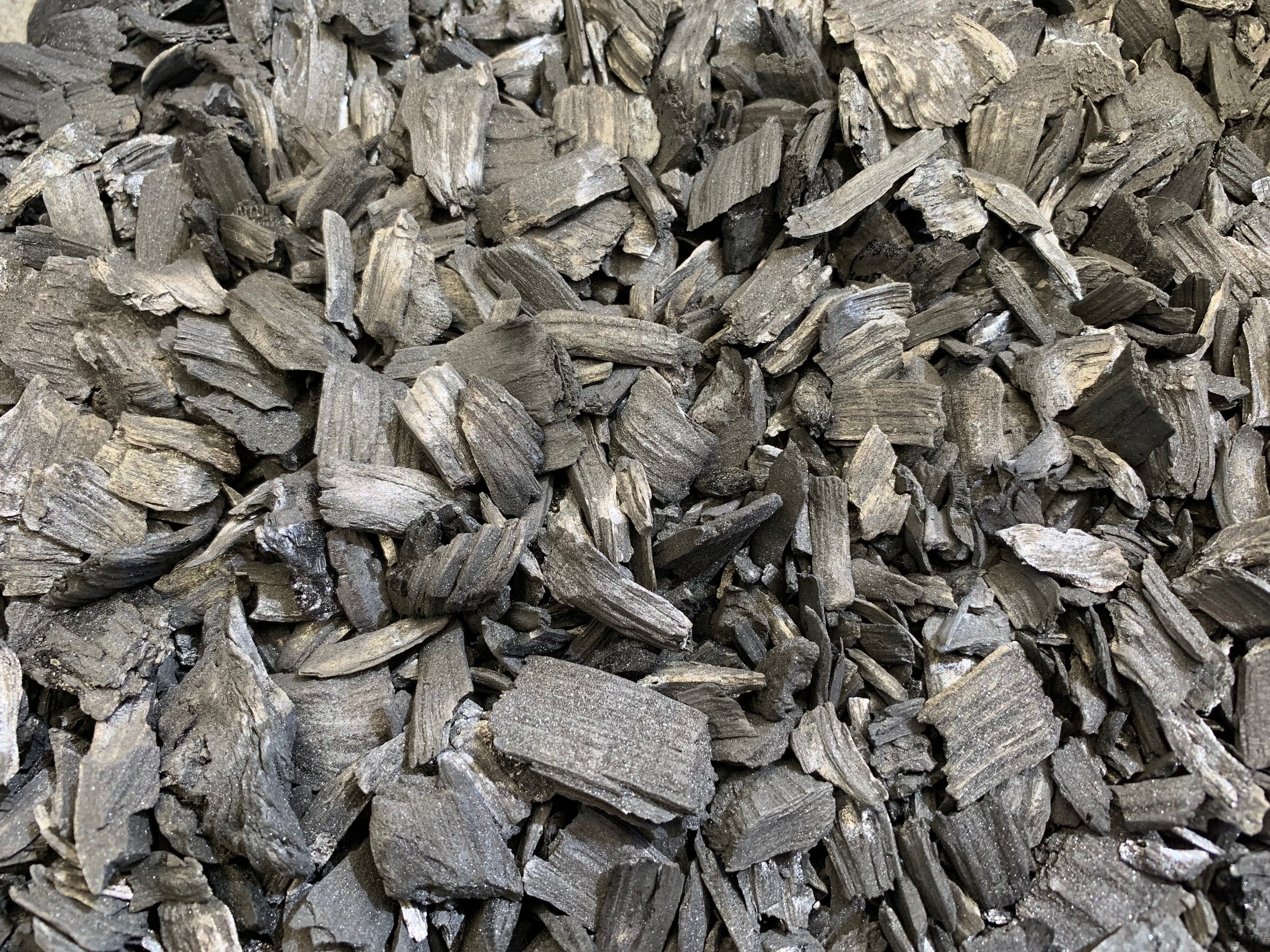
This is biochar!
A couple of Tuesdays ago, I gave a talk at the Merritt College Horticulture Department, in their Design Forum. The talk was centered around how to create an urban farm in a typical residential yard, as we have done here. It was a great night, filled with interesting questions from the audience, and as usual, I not only doled out some learnin’, I also received some learnin’. Every conversation I have with gardeners or farmers leaves me with new impressions and new knowledge, and then, of course, new questions.
One audience member asked me if I had any experience with biochar. The short answer was no. The slightly more detailed answer is that I’ve done some reading about it, and watched some educational videos from Living Web Farms about how to make it and apply it to your garden. I’ve also heard some negative things about it - that it’s a hoax - and I also have had some reservations about the way it is made; I have worried that the process of creating the biochar is actually releasing a lot of carbon into the atmosphere. The student who asked the question showed me some pictures from her own garden, of plants grown side by side, with and without biochar. Looking at those pictures, it was clear that there was a difference in the size, health, and production of the plants that grew WITH biochar. This intrigued me and I wanted to source some biochar of my own to try.

As my friend Lawrence likes to say, serendipity is everywhere, and that same night I happened to pick up a free copy of the fall edition of Edible East Bay magazine (which they make available in the Hort Dept), which I always enjoy and learn a lot from. And wouldn’t you know it, there inside was a huge article about biochar, and a story about a company that makes it in Berkeley (All Power Labs, more on them in a minute) and a community farm, Gill Tract, that has been trialing the biochar in their compost and raised beds systems. Well. I immediately contacted the lab and signed up for a year’s subscription of biochar. Today I went to pick up the first batch, and was absolutely blown away by the welcome I received from Aidin at All Power Labs, who then spent a good deal of time showing me around the joint and explaining the process of how biochar is made. He also welcomed me to the Local Carbon Network, which is a “community-powered local drawdown network.” I love this and I love that I’m a part of it, officially, though honestly I’ve been a part of it for years. :)

At the end of my visit, I mentioned Merritt and said that the Hort Dept should do some trials of their own with this product, and Aidin said, “What a coincidence, my coworker Austin is giving a presentation at noon at Merritt,” which turned out to be in my friend Lawrence’s permaculture class! I texted Lawrence and asked if I could drop in and hear the lecture and he kindly allowed me to do that, and I got to hear the details all over again (and take notes this time) which really helped cement the ideas in my brain. More serendipity!
So, here’s the scoop. All Power Labs was originally created to make renewable energy using biomass. That is, make power by burning the waste products of agriculture or even our urban yards - tree trimmings, wood chips, etc. In the process of making this renewable energy, a by-product was produced - bits of what looked like charcoal, very light and made of pure carbon. Originally they just threw this product out. Then they realized it was biochar, and high quality biochar at that, and that it was a coveted resource for farmers and gardeners, as it does a lot of cool things in the soil (which I will detail in a bit). The original purpose of the company, making renewable energy for use, was having trouble finding a niche in the very large solar and wind energy economy we have in California. So, they pivoted a little into the biochar side of things.

Shortly after that, they partnered with Gill Tract farms to do some trials and figure out how this stuff really works. Bob Flasher at the farm has been working closely with APL and seems to be quite sold on how the char performs in his garden and has documented how the plants perform. Knowing that he has been an early adopter of the char helps me to feel good about moving forward, trying it in my own yard.
Now more about the process. Above is a photo of the “Powermass Gasifier” which is the machine that turns biomass into both energy and biochar. The energy now is used to run the machine, so it’s a closed loop - no emissions or volatiles are escaping into the atmosphere. In fact, the carbon that is trapped in the biomass is turned into a product which can help sequester carbon into the soil. At this point, you might be saying, “Well, doesn’t compost do that too?” and the answer is yes, it does. It helps feed the microbiology which are turning the compost into humic acids in the soil, which do sequester carbon. There are some problems with compost, though, which you might have experienced (I know I have). One, it doesn’t last more than a season. I put a couple inches on my beds each fall, and by early summer, the beds look like they never had it. The soil surface is quite low, several inches below the top of the wooden beds. What happened to the compost? Well, some was turned into nutrients for the plants by the microbiology in the soil. Some, however, was off-gassed, releasing carbon into the air again as it decomposes further. Compost does continue to decompose, it doesn’t stop just because you’ve moved it to your veg beds.

walnut hulls, an abundant waste product from California orchards, which will be turned into biochar
Biochar doesn’t decompose. It’s already been processed into its permanent form - pure carbon. This happens in the process of Pyrolysis. The volatile carbon in the biomass is burned off (and used for energy), and what is left is like the embers of a campfire. Totally indestructible, permanent bits of carbon.
These bits of carbon, if applied to a garden/farming system, become hosts for a ton of microbial life. They absorb humic material. They have a very high CEC (cation-exchange capacity) which means that they add nutrient density to the soil. It improves drainage (tilth) while helping with water retention, as they can absorb many times their size in water. They improve friability of soil. They store the mineral nutrients from biological processes. They even, apparently, bind heavy metals and immobilize pollutants.

These are the composter tumblers that they are using at All Power Labs to do their own trials with biochar. And Aidin was clear that they recommend that we compost biochar first, not just add it directly to planting beds. There the biochar will be inoculated with the microbia of the compost pile and start to do work. There is a lot of evidence from Gill Tract Farm that adding biochar also increases the temperature of compost piles by quite a lot (this is something I desperately need). Not only that, Gill Tract has seen the temperature spike and then remain at high temperatures for six weeks after an application of biochar! I’m hoping to see this in my own compost piles. I came home with a large bucket of char, and added only a cup to the worm bin and about 10 cups to the large compost pile in the chicken run (they recommend adding 10% biochar by volume, an estimate is ok. My bucket should last three months). We’ll see how that works to activate heat and decomposition.
I also really appreciate that the biomass used to make this biochar is nut hulls from California orchards. This is taking something out of the waste stream, something that takes hundreds of years to decompose, and putting it to good use.
If you’re interested in your own subscription of biochar and live in the area, you can contact Aidin at The Local Carbon Network. It’s not cheap, I’ll warn you now, but I imagine that in time, when the benefits of biochar are documented and realized, the price will level out. I also believe it is worth it, if it will help me process enough compost to add two inches to all of my planting beds once a year. This would be terrific because I’m tired of buying compost, for many reasons: price (a lot more than this biochar), the unknown ingredients and their provenance, and the work/energy to get it here. So I’m invested in trying it to see if I can start to produce more compost here, in my yard.
To learn more about biochar, another good resource is the book Kiss the Ground , which is also, I believe, a movement that is part of the Marin Carbon Project.
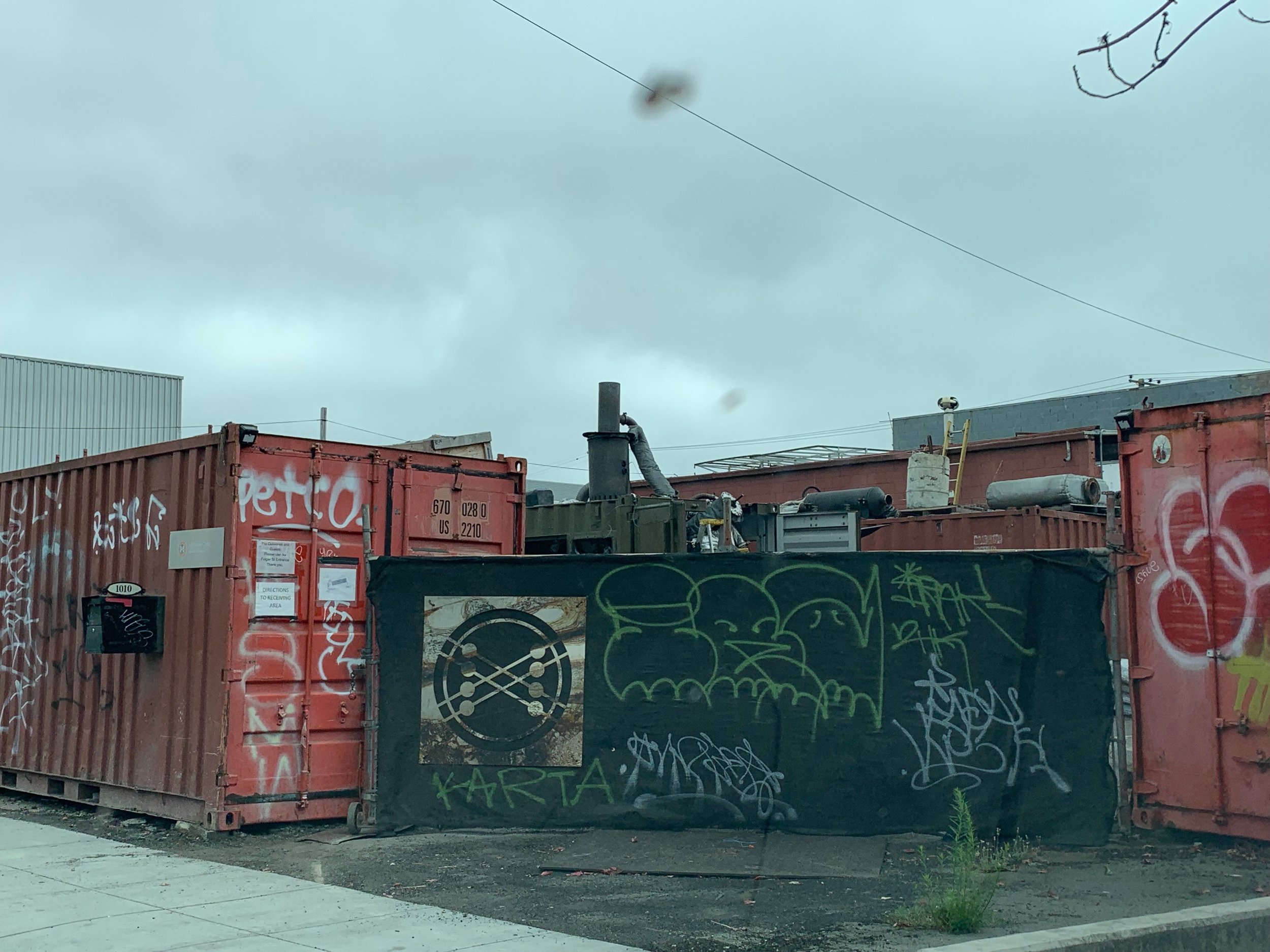
The back of All Power Labs, which I just love. So Berkeley!
Have you tried making or using biochar? If so, I’d like to hear about it!