• About
  • Blog
  • Contact
  • Favorites
  • Archive
Menu

Poppy Corners Farm

Street Address
Walnut Creek, California
Phone Number
Walnut Creek, California

Your Custom Text Here

Poppy Corners Farm

  • About
  • Blog
  • Contact
  • Favorites
  • Archive

New-to-Me Tomatoes from Wild Boar Farms

July 14, 2019 Elizabeth Boegel
None of these are from Wild Boar. I just wanted to show you what will become our first Caprese salad of the year!

None of these are from Wild Boar. I just wanted to show you what will become our first Caprese salad of the year!

Every year, there are certain tomatoes that I grow because they have been proven in our garden; they are consistently excellent and I can count on them. Tomatoes like Black Krim, Cherokee Purple, Ukranian Purple, Italian Heirloom, Hungarian Heart, Sun Gold… I could go on, but I’m pretty sure I’ve written about all of these tomatoes before. Today I want to share some varieties that you may not know and that are also in my garden for the first time. I’m finding them very exciting and I think you might, as well.

These are all from Wild Boar Farms, local to us in Vallejo. Brad Gates is the owner and main propagator, and he is famous for his wildly colored tomatoes. I’ve grown his Pink Berkeley Tie Dye in years past and liked it very much, so when I saw him at the Heirloom Expo last year, I bought a few new kinds to try.

First up is Indigo Apple, a small slicer or salad tomato, which starts out green with deep purple shoulders and then ripens to a reddish plum color. They also have these funny little horns.

IMG_2684.jpg
IMG_2685.jpg

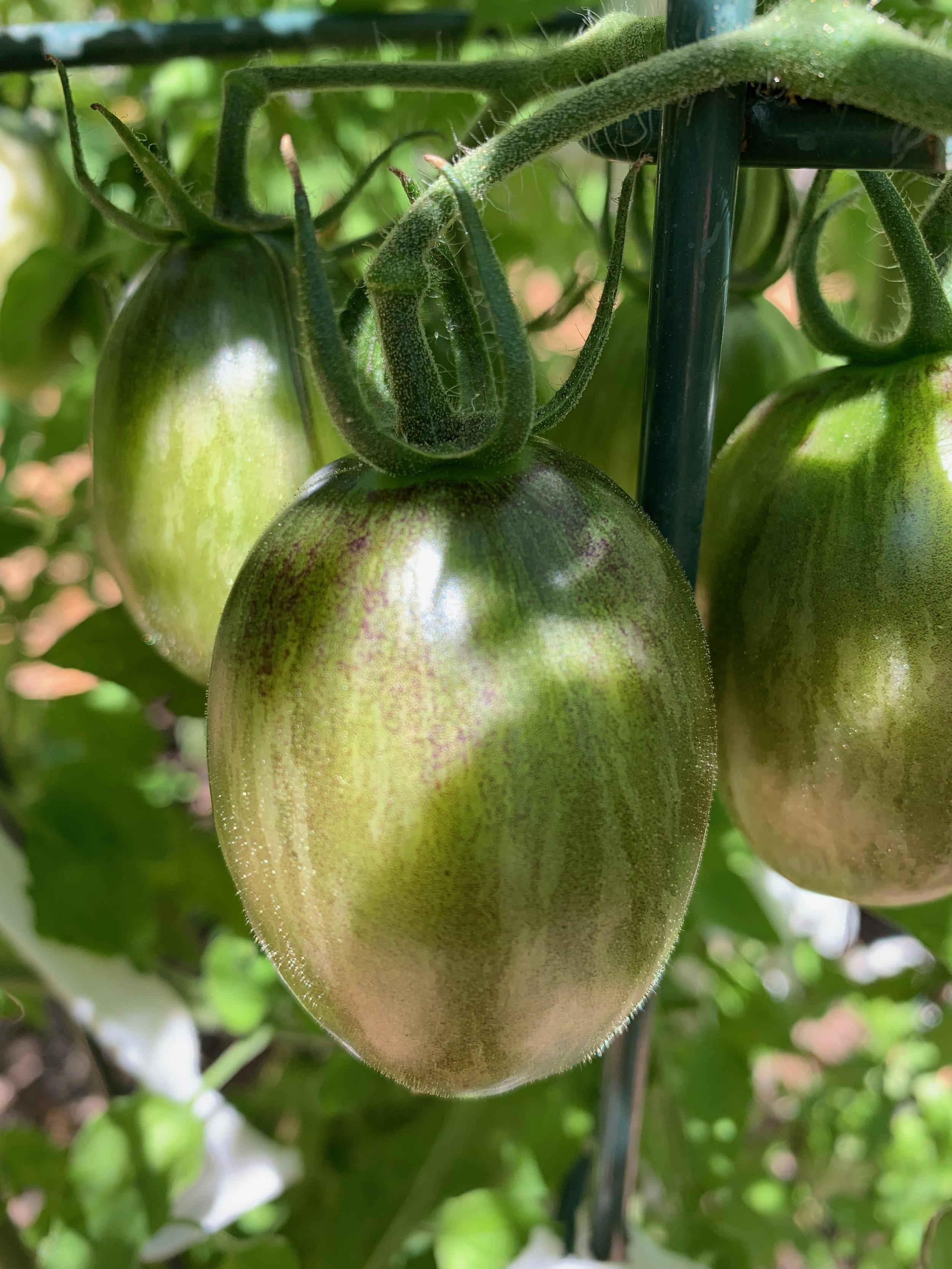
The second is called Brad’s Atomic Grape, which is probably the tomato Wild Boar Farms is most known for. It’s a grape tomato, but an extremely large one, larger than some of my plum/paste tomatoes. It starts out green with deep purple stripes and then turns a deep red/purple/green stripe.
IMG_2687.jpg
IMG_2686.jpg

The third is a cherry, absolutely prolific (maybe the most prolific cherry in our garden so far), called Blue + Gold Berries. These apparently take quite a while to ripen and we have yet to get any even close to ripe. They start out blue and white, and then deepen to a rich gold color. I’ll have to show you how they look ripe at a later date!

IMG_2688.jpg

The fourth tomato that I am trying is a slicer called Black Beauty. It is almost entirely black, but the inside will apparently be a deep, rich red when ripe.

IMG_2691.jpg

There is a fifth I’m trying called Lucid Gem, but the colors in that one will show on the inside when it’s ripe - it’s supposed to look like a stained glass window. At the moment they are still fully green, so not much to see there.

All of these have heightened anthocyanins, the compound that gives them these rich dark colors. That means that they are particularly good for us (although all tomatoes are good for us, truly).

The one drawback is that they are all hybrids, so the seed won’t come true if you save it and plant it next year. But, I’m happy to support Wild Boar Farms and this fabulous propagation project by buying fresh seed. These tomatoes add so much color and interest to the garden and, eventually, our plates!

Tags tomatoes, vegetable garden
2 Comments

Cooper's Hawks in our yard

July 13, 2019 Elizabeth Boegel
image credit: Geoffrey Groom on Cornell Lab of Ornithology

image credit: Geoffrey Groom on Cornell Lab of Ornithology

I mentioned that Tom and I had seen three young Cooper’s Hawks learning to fly, around our yard and our neighborhood. Well, now they are learning to hunt, and it’s so fascinating to go outdoors with the binoculars and watch them as they learn to navigate life.

I’ve made a three-minute video, below, of the hawks in our pepper tree and in the neighbor’s pine tree, which is right on the other side of our fence and easily viewed. Our neighborhood has lots of hawk habitat. There are stands of mature trees all around the houses - pines, oaks, eucalyptus, and redwoods. Then there are open areas for hunting - the yards. Our yard is especially good for hunting because we have created as complete an ecosystem as we can, with available water, food, and shelter for all kinds of creatures, including lots of birds. Our neighbor with the pine tree also has birdfeeders, so there are an abundance of little birds. Hawks tend to eat medium-sized birds, like blue jays and mourning doves. But they also eat mammals like squirrels and rats, and they also eat chickens. These juveniles are too small, and do not yet have the skills, to take down larger prey, but they will be able to eventually. This morning, on the pine, we watched them trying to figure out squirrels. It was so interesting.

I have yet to discover why the juveniles are calling to each other as they do in the video. You’d think they’d want to be silent while hunting, which is how the adults do it. My best guess is that they are ‘keeping in touch’ with each other, trying to stay together as a group as they are learning and growing.

I hope you enjoy these sights as much as we do!


Tags wildlife, IPM, birds
2 Comments

Why are so many flowers yellow?

July 10, 2019 Elizabeth Boegel
IMG_2660.jpg

I’ve been out in the garden this morning, picking some almost-ripe tomatoes and bringing them in to their usual place on the piano, to ripen. As I was doing this, I realized that an awful lot of flowers are yellow. This intrigued me and I started to wonder why that is.

IMG_2387.jpg

We live in a time of miracle and wonder, as Tom likes to say. Remember the days when we had to go to the library to find stuff like this out? Or to the World Book Encyclopedia? We had a shelf of those that my parents bought in 1964. As a child, whenever I was bored, I would go look through them. Oh gosh, remember boredom? Does that exist anymore?

IMG_2492.jpg

Heavens, before I croak out something like “well, sonny, back in my day,” let’s move on, shall we? What I meant to say was that you can go to Google Scholar and type in ‘why are so many flowers yellow?’ or ‘color in flowers’ and get to read all kinds of interesting scientific papers, most of which don’t really answer the question, only pose more questions, but that is why we are never bored anymore, right? All hail the Google rabbit hole.

IMG_1290.jpg

ANYWAY. It’s actually hard to find the percentage of yellow flowers in plants. I did see that early spring plants are often yellow, which is a way to signal early food for pollinators. Wait, let me back up. Why would flowers have color to begin with?

IMG_0488.jpg

Fossils suggest that early flowers didn’t have much pigment, but rather were a dull yellow or pale green before they evolved over 100 million years ago to produce colors. It is assumed that they evolved that way to attract pollinators. Apparently many plants have evolved colors that match the specific visual systems of different insects or birds.

IMG_2493.jpg

You might remember that bees (and many other pollinators) have compound eyes. Our own eyes can only detect three colors - red, blue, and green. Bees cannot see red, but they do see blue and green, and also UV light - that means they can see colors we cannot see. Many flowers have ultraviolet nectar guides, a sort of pattern that we cannot see, that are like runways lighting the way down to the inside of a flower.

IMG_5372.jpg

Bees have awful long-distance sight, so they use scent rather than sight to find nectar, but those compound eyes provide amazing up-close vision, allowing them to see these specific colors and patterns once the smell has lured them to the flower.

IMG_2071.jpg

Color we see in flowers is the result of reflected light from various plant pigments. These pigments can be anthocyanins, compounds that make autumn leaves red, or blueberries blue. Flavonol pigments make yellow and chlorophyll pigments make green. There are flavanoid pigments that are colorless to us, but also absorb UV light and make colors available to bees and other pollinators.

IMG_5511.jpg

Therefore, a bee balm that appears red to us might appear white to an insect. Yellow and white flowers (to us) may appear blue to insects. In the course of my research, I also learned about flowers such as borage or fleabane, which turn different colors over a season (like from pink to blue), are doing so to signal to pollinators which flowers are new and have a lot of nectar, and which are too old to produce (thank you to the University of Vermont for much of this post’s information!).

IMG_0411.jpg

Native bees have evolved to drink from the blossoms of the plants that evolved with them, which is why it’s a good idea to have a percentage of your plants as natives. But they will readily drink from exotic species, and honeybees will forage on almost anything - it is a generalist species. However, there is evidence that bees prefer (what appears to us to be) blue and white flowers. Birds tend to prefer (what appears to us to be) red flowers. Have you ever noticed (I have!) that many red flowers seem to have yellow centers? Could that be those UV light patterns directing bees to the flower, even though it is red?

IMG_0127.jpg

Evolution is crazy, yo.

I couldn’t find any solid information about yellow flowers in particular and why it seems that nature makes so many flowers yellow (it could just be a coincidence that I’m seeing so much yellow this time of year). But I’ll leave you with this paragraph of an abstract which I found, entitled ‘Pollinator Preferences for yellow, orange, and red flowers of Mimulus verbanaceus and M. cardinalis’ which are both monkey flowers. It is authored by Paul K. Vickery, Jr of the University of Utah.

“Red, orange, and yellow morphs of Mimulus verbenaceus and M. cardinalis were field tested for pollinator preferences. The species are closely similar except that M. verbenaceus flowers have partially reflexed corolla lobes, whereas M. cardinalis flowers have fully reflexed corolla lobes. On the basis of over 6000 bumblebee and hummingbird visits, highly significant (p < .001) patterns emerged. Yellow, which is the mutant color morph in both species and is determined by a single pair of genes, was strongly preferred by bumblebees and strongly eskewed by hummingbirds in both species. Orange and, to a lesser extent, red were strongly preferred by hummingbirds but eskewed by bumblebees in both species. Thus, strong, but partial, reproductive isolation was observed between the yellow mutants and the orange- to red-flowered populations from which they were derived. Color—yellow versus orange and red—appeared more important than shape—partially reflexed versus fully reflexed corolla lobes—in determining the preferences of the guild of pollinators in this particular test environment for Mimulus verbenaceus and M. cardinalis."

IMG_9536.jpg

So it would seem that native bees prefer yellow, at least on those particular flowers. So interesting!

Other news:

*Tom and I watched three juvenile Cooper’s Hawks fledge over last weekend. They hung about in our yard and on the nearby power lines, together in a group, for quite a while. It was an amazing thing to see.

*Highwire coffee, a local roaster and the place I go to collect coffee chaff for chicken coop and garden purposes, has just been awarded a seal by the Rodale Institute for their organic ‘Conscientious Objector’ line of beans. We think Highwire makes truly delicious coffee and we are happy they are being recognized for the work they do with organic farmers. Their coffee bags are also compostable which is a huge bonus.

*Just another urging to go see The Biggest Little Farm if it is playing near you. Tom and I saw it again this past weekend, and it’s just such a great movie.

*Shoutout to the Merritt Horticulture students from LH1 who came by for a garden tour and talk last night. What an amazing group of people, with some amazing projects and ideas in the works, and many of them already ‘farming’ just like I do here. It was great to hang out with like-minded folks and plant nerds again. I’ve missed the Hort department and was super glad to be a part of it again for a night!

*Did you know I put ‘tags’ at the bottom of each post? This is so if there is a subject that interests you, such as pollinators, you can click on that tag and see everything I’ve ever written about pollinators. It’s not a fail-safe program; the other day I tried to find Tom’s instructions on how to build our garden trellises, and I’m still looking (you should be able to find it under the ‘projects’ tag, but clearly I didn’t tag it that way). You can also go to the Archives and search a word or a term, like ‘cooking,’ and find all the recipes I’ve talked about.

*The harvest has begun. Cucumbers, beans, tomatoes, and some hot peppers are starting to come ripe. This caused me to see that I was not prepared to start preserving the harvest. Here is your reminder to make sure that you have plenty of mason jars, lids, rings on hand; labels, pickling salt, pectin, etc. Here we go!!!


Tags flower garden, pollinators, insects, learning
7 Comments

It Happened AGAIN

July 7, 2019 Elizabeth Boegel
IMG_2645.jpg

Hundreds of shallots, hanging on new racks in our dining room, looking beautiful. We had grown them from October to May, cured them over the chicken coop, tied them into bundles. Given many away. Been cooking with them regularly. Two days ago, a black aphid hanging out at eye-level on the wall by the piano; '“hm, what’s an aphid doing in here?” then yesterday, passing by the rocking chair which is underneath the hanging shallots, noticing the floor littered with black things. I look up. The shallots are covered, simply covered, with allium aphids.

We cut them down, we take them outside, we clean the floor and the walls and the rocking chair thoroughly. We sit and talk, what to do now, can they be saved. Allium aphids will eventually eat the bulb, in storage, if the greens are gone. We decide to chop them all up and freeze them. In the process of that, noticing them everywhere, in the bulbs too. Some bulbs are already rotted. Frustration and annoyance and pure disgust. We throw them all in the green bin, unwilling to put them in our compost and possibly breed more aphids.

Neotoxoptera formosana, the onion aphid, or allium aphid. Dark red to black. They do not lay eggs; the females give birth to pregnant females. Populations increase very rapidly. The aphids carry viruses and can cause disease in the plant. They prefer juicy green leaves but will eat bulbs in storage.

image credit: influentialpoints.com

image credit: influentialpoints.com

So. Failure. Again.

What happened? I was too angry and disappointed at first to think about this from a logical standpoint, but after a good sleep and some time to calm down, I can start to figure out the chain of events that led to this.

Much like the disaster of Chernobyl (have you watched this on HBO yet? SO GOOD), there wasn’t just one thing that caused the problem, but rather a group of things.

One, the soil was probably not sandy enough or loose enough to keep the bed well-drained. Two, I grew them alone, without another crop - intercropping with a flowering herb or annual (such as clover) would have brought more predators down in to the bed. Three, we had a hot spell (a week of temps near or at 100) in April that caused the plants to start bolting, which caused me to think (reasonably) that the plants were done growing. Four, I didn’t remove the irrigation the last 2-4 weeks of growing, which would let them dry out in the soil before harvest. Five, I harvested them too early, with too much green growth still on them (it’s hard to leave them in the ground long enough, with the summer garden needing to go in). Six, I didn’t let them cure long enough, and I had so many that they were crowded in the curing space (preventing good airflow). Seven, and final nail in coffin, I brought them into the house where predators couldn’t keep the aphid population in check. If even one aphid was left alive on a stalk, the population would grow exponentially until finally covering the shallots completely.

Our garlic crop was also compromised by these same mistakes, though we haven’t yet (knock on wood) noticed an aphid explosion. The Spanish red garlic came out ok, though the size of the bulbs and cloves is too small. The German red garlic came out ok (though very small), but somewhere in the curing step, about 90% of them started to soften and rot, and we were able to keep only about 10%. Not ideal.

The amount of expense, and really TIME, that it takes to grow these crops is huge. This is not a small loss. It is extremely frustrating. At first I said to Tom, maybe we just can’t grow them here, maybe they just take too much time and we’ve had too many failures, maybe our first few successful years were just luck? But after figuring out the list of reasons why they failed, I see that I can do better growing them. I can’t do anything about the weather, but I have a plan for that too.

So, this Fall, here’s what I’m going to do. One, order seed bulbs directly from the grower (Filaree Farms has been recommended to me). Two, I’m going to plant them later, in November rather than October. Three, I’m going to plant less of them, only one bed for shallots and one bed for garlic. Four, before I plant, I’m going to break my no-till rule and make sure the soil is loose and that I’ve added plenty of compost and maybe some grit to increase drainage. Five, I will interplant with crimson clover, which should add a place for the good bugs to proliferate. Six, I will plant them in a place that has more shade in April (and maybe cover them too), and not in the place where I want to put tomatoes next year, which need to go in May 1, which is part of Seven, I will leave them in the ground until June. Eight, I will remove the irrigation lines for the last month of the growing season. Nine, I will make sure they are totally ready before harvesting. Ten, I will cure them differently, in a different place, allowing more airflow and more time (this will be difficult because they need to cure in shade). And finally, I will allow them to cure for longer, and inspect them thoroughly, before I bring them in the house.

Having a plan makes me feel better, but I’m still extremely pissed and sad about the fact that I’m going to have to buy shallots for another year.

I’ve been preparing a talk for some students that are coming to visit this coming week, and it has become clear to me that I need to talk a little bit about failure, because it happens. Even when you’re doing everything right (which I wasn’t this time), some things just don’t work, and it’s hard to figure out why. It can be difficult to weather those failures and still keep going. And so I’m interested; how do all of you, my readers, handle these disappointments in the garden? If you have a story to share, please do so in the comments.

Tags learning, vegetable garden, IPM, problems
2 Comments

Garden Hurdles

July 5, 2019 Elizabeth Boegel
IMG_2638.jpg

There’s a show on the BBC that I absolutely love, called Gardener’s World. It features Monty Don, who gardens a plot of land called Longmeadow. The garden is in Herefordshire, west of the Cotswolds. I can’t get this show on my TV, but every week some intrepid YouTuber puts it up on his channel. Invariably it is taken down within hours, as it of course is put up without permission. If I catch it just right, I can see the whole episode. I ALWAYS learn something. And I love looking at the gardens, both Longmeadow and the ones the hosts visit, and learning how different people do things.

In a recent episode, Monty was saying how they had had a lot of rain, and it caused all his border plants to flop into the paths, which caused anyone walking there to have soaked pants in seconds, and of course the plants were getting trampled. So he was using hurdles to prop them up, off the path. Ding ding ding, my brain was singing, this is what you need, Elizabeth! So of course I texted Dad immediately. “You have any of that French Broom laying about, from the garlic rack project?” and one thing led to another, with Dad taking a trip to a local open space, braving the thick stands of poison oak, chopping down more broom, and then making me five hurdles out of it.

IMG_2636.jpg

I love ‘em and I could use another 20, honestly. I see endless uses for them. Originally these weren’t used in the garden, however. The UK have a long history with hurdles. They were used as a temporary pen for sheep, for shearing, or tagging, anytime the farmer needed to corral some livestock temporarily. They had to be lightweight so that the farmer could carry several at a time on his shoulder. They had to be flat for easy storage. They were often made from coppiced wood (another ancient term which no one uses anymore), which was a method of cutting down fast-growing trees to a certain height every year, using the cut wood for farm projects, and allowing the tree to regrow for the next year. Willow was a common wood used for this purpose, or hazel. Eventually the advent of modern sheep containment overtook these old ways of doing things, and folks used their old hurdles for garden fencing. Now artisans make them for high-end gardens, often woven, costing a whole lot of money.

IMG_2633.jpg

I found an interesting website for the Heritage Crafts Association in Britain, whose President is HRH the Prince of Wales! The association explores all kinds of crafts in the history of the country, reports them alive and well or endangered (as hurdles are), and discusses the history of the items and any other interesting tidbits. If you’d like to read more about hurdles (and I think you should, it’s fascinating), you can see that website HERE.

Their mission statement reads “The Heritage Crafts Association supports the 2003 UNESCO Convention and its goal of safeguarding traditional craftsmanship by supporting the continuing transmission of knowledge and skills associated with traditional artisanry – to help ensure that crafts continue to be practiced within their communities, providing livelihoods to their makers and reflecting creativity and adaptation.”

I love this. I went down a very interesting rabbit hole looking at all the different traditional crafts that are endangered or the knowledge of creating them has become extinct.

IMG_2635.jpg

On the more modern side of things, Dad created a series of YouTube videos to show how to make these,. If you’re looking for a summer project for your garden, you can find that series HERE. I imagine that there are lots of different kinds of wood or supplies that can be used to make these.

Tags projects, art
6 Comments
← Newer Posts Older Posts →

Subscribe

Sign up to get email when new blog entries are made.

We respect your privacy. We're only going to use this for blog updates.

Thank you! Please check your email for a confirmation notice to complete the subscription process.

Powered by Squarespace