• About
  • Blog
  • Contact
  • Favorites
  • Archive
Menu

Poppy Corners Farm

Street Address
Walnut Creek, California
Phone Number
Walnut Creek, California

Your Custom Text Here

Poppy Corners Farm

  • About
  • Blog
  • Contact
  • Favorites
  • Archive

Morning Fruit

July 2, 2019 Elizabeth Boegel
IMG_2604.jpg

One absolute delight this time of year is picking fruit for breakfast. I go out around 6 am to let the chickens out anyway, so from there it’s an easy detour to whatever fruit patch looks most promising. It’s hard to think of something better than a handful of fruit to go with our eggs or cereal.

We’re finally at a point where a lot of our fruit vines/bushes are reaching the maturity to produce more regularly, or maybe we’ve just learned how best to care for them. Take that statement with a grain of salt, please, because we lost two fruit trees this year, the Santa Rosa plum and the Asian pear. The plum blossomed beautifully and then just died, I can’t figure out why. The pear died after I transplanted it too late (I was trying to give it a place with more sun). I also think we will be losing our peach after this season; it’s quite old and very damaged. Over the last five years, I’ve planted and lost two cherry trees and six raspberry canes. So let’s just say that the learning curve has been steep!

Our current fruit inventory consists of two apple trees (one ancient and still bearing, one very young and just starting out), one peach (ancient, and as I said, on its way out - I’m thinking of replacing it with a mulberry), one ‘Panache’ fig (growing to a monstrous size), one quince (ancient and produces no matter how we hack it up), one naval orange (still very young and not yet producing), one elderberry (very young, still not producing), two Arbequina olives (in pots, producing just enough olives for us), strawberries in gutters and in the ground, eight blueberry bushes which are about five years old, ten rhubarb plants, one native huckleberry, and a thornless blackberry. I’ve just ordered six marionberry plants, which are a hybrid blackberry; we fell in love with marionberries in Oregon a couple of years ago and have trouble finding them at the markets.

IMG_2622.jpg

We finally found the best location for strawberries in our garden; it has taken years and many failed plantings to figure that out. The strawberries in gutters, and the ones growing in the ground beneath those, are doing just great. They get a couple of hours of direct early morning sun, and then are in shade the rest of the day. We don’t have irrigation going to them, so I water them every day, and feed them with fish emulsion every month. Keeping them mulched has helped with slug pressure, as is the fact that they are right next to the patio, in a place slugs rarely visit, and most are high off the ground. I had about 25% failure rate with the plugs, but I’ve been replacing them with runners from the other strawberries. What this has done is mix up my record-keeping; I no longer know which berries are which variety, but that really doesn’t matter. What matters is we are getting a large handful every day.

I’ve got several different high-bush varieties of blueberries, and they’re also doing great this year, I think because I pruned them hard last winter, taking out all of the older wood and leaving only young canes. Some of the young canes aren’t producing yet, but will next year. They are on drip irrigation and mulched heavily with coffee chaff (low-fertility organic matter is key for blueberries). I do not like to add sulfur because it hurts soil life, but about two years ago I did add a little blueberry fertilizer. The native huckleberry is also doing quite well after a rather severe pruning last winter. We all tend to stop and graze from that shrub throughout the day, as the berries are incredibly small and it takes an awful lot to make a handful.

Our thornless blackberry vine was a freebie from a neighbor. It likes where it is planted (morning and late afternoon sun, shade in the middle of the day) and is trained up on our fence. However, for years it suffered deer pressure because it is outside the fence rather than inside. I finally got that area planted up with ornamentals (mostly Leonotis leonurus), and that has reduced the deer pressure on the blackberry. It is loaded with green berries right now, I can’t wait to start eating those. I’ve never fertilized it, but it is on drip irrigation and is heavily mulched with wood chips, plus it sits next to one of our worm bins so it probably gets some leachate from that.

IMG_2624.jpg

Even with all these plantings, I still have to buy fruit any time I want to make a pie (except maybe apple), or when Tom makes jam - we can never get enough! As you know, fruit trees take years to produce a substantial crop, so adding new trees a little at a time makes sense. Also planting trees and vines that will do well with the changing weather is smart. As I said up top, I’m thinking of replacing our peach tree with a mulberry rather than another peach. There are many reasons for this, and one is the weather. We all have to start thinking ahead with regards to climate change - what is our weather going to be like in five years, or ten? Most peaches need a lot of chill hours, and it’s likely that we’ll get less chill hours here in the future (and we don’t have that many to begin with). Peaches also need spraying for peach-leaf curl, which is a fungus, and the copper in that spray, though technically ‘organic,’ harms soil life. I don’t want to spray anything in my garden that harms soil life. We love having fresh peaches off the tree, but it’s just not the right choice for the way we garden and the climate we garden in. It’s an old-fashioned choice, and we have to look to the future. Mulberries are drought-tolerant, don’t need chill hours, don’t need any kind of spraying, and will feed both wildlife and us. Probably there are other good choices I should be looking into, like guava.

There will be more musings on this subject later, but meanwhile, I’m just happy to have fresh fruit every day to eat first thing in the morning. What a great start to the day!

Tags fruit garden
4 Comments

Oiling Outdoor Furniture

July 1, 2019 Elizabeth Boegel
IMG_5820.jpg

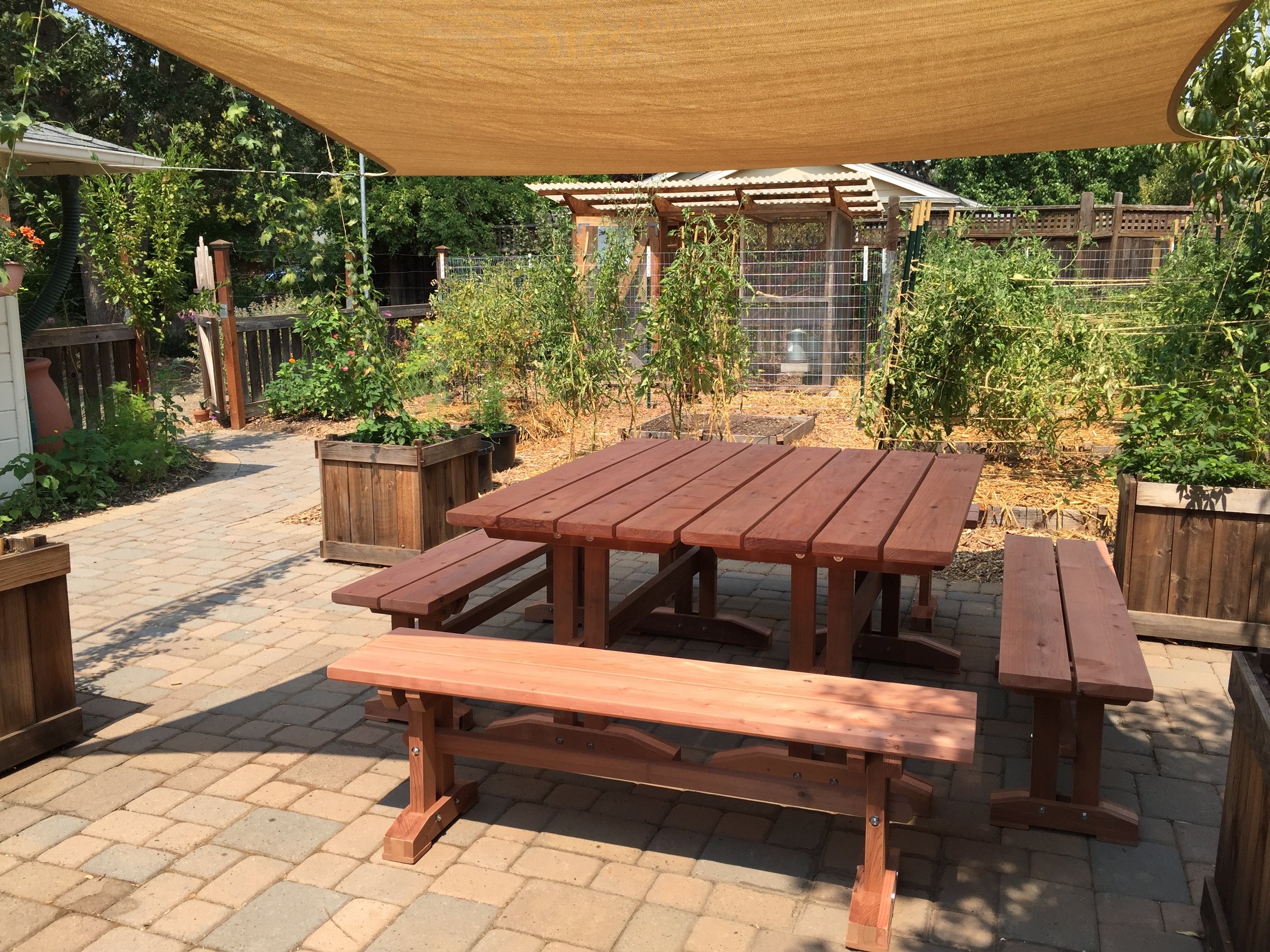
Back in the summer of 2017, Tom asked my father to teach him how to make a farm table for our back patio. They made it together out of redwood, and when it came home, it was beautiful.

IMG_5830.jpg

The table and benches have been outdoors for two years now, and we use them almost daily - really, every day unless it’s raining. The tables get no protection other than the shade sail that you see in the above picture, and that’s only up in the summer. It gives scant shade, enough to eat or work at the table without getting sunburned. Otherwise, the table is open to the elements. After two years of that, the furniture was looking pretty worn out. The redwood had weathered to a lovely grey, but the wood was dry and unprotected.

Growing up the daughter of a woodworker, I had seen the summer oiling ritual play out every year, but somehow I avoided actually performing this chore myself. We have other outdoor furniture that I have never oiled. Once in a while my dad does it for me, or Tom does it. But really, this is a job I knew I should be handling myself, especially in the summer when I am out of school and am available for projects. So, Adam helped me move the farm table and benches out to the driveway (a surface we don’t care about messing up), and after putting on my ‘painting’ clothes, I armed myself with paintbrush, shop towels, and Penofin, and spent a cool morning working on protecting these priceless pieces of furniture.

IMG_2598.jpg

Penofin is the product my dad recommends for any piece of furniture that’s going to be outside, especially if it’s in the sun, as it has some UV-blocking attributes. I used the Penofin that is formulated for redwood. It is made from the seeds of the Brazilian rosewood tree. I don’t know how sustainable that is, but the company assures us that no trees are ever cut down to provide the oil.

There are some steps you should take before oiling your furniture. One is to wash the pieces you will be oiling. I did this with a rag and water, the day before oiling. Dad also recommends giving the furniture a light sanding, as the wood will then take the oil better. Apply the oil in a thin layer with a brush, and then let it sit for 20 minutes to soak in. If your wood is really dry, it might need more than one coat (or multiple coats). After oiling and letting it sit for the requisite 20-30 minutes, wipe off the excess with rags or shop towels. CRUCIAL NOTE: whatever you wipe with cannot just be put in the trash can, as oily rags/towels can self-combust. The company recommends soaking them in a bucket of water, which you can do until your trash pick-up day, moving the sodden material to your trash can. The problem then is, what to do with the soaking water? Our street drains go right to our Bay, so I wouldn’t want to put this oily water down that drain. I suppose you could put it in an area of your yard filled with wood chips, but I’m not sure I’d like an oily residue in any area of my yard - especially in flammable CA. Dad uses shop towels (thick blue paper towels you can get at your hardware store) and after they are used for wiping the furniture, lays them out on the driveway to dry until the next trash pick-up. Skipping the wiping step doesn’t work either, as the residue will dry in a tacky layer, and then no one will want to use that furniture.

Dad also recommends applying a layer of epoxy on the bottom face of the feet, to limit any end-grain soaking of water from the resting surface. I did not do this step.

You can really see the difference between oiled and dry furniture, and it really extends the life of your outdoor pieces. You can also see how the used towels are laid out to dry. It looks terrible, but better that than a fire. It might make sense to do your oiling as close to your garbage pick-up as possible.

IMG_2602.jpg

You also want to make sure to do the oiling a couple of days before a party, as you’ll need time for the wood to fully cure. The brochure says that you can sit on it after 12 hours, but take it from me - a few days is better, and a week is optimal.

Tags learning, preserving
Comment

Just a Little Snooze

June 24, 2019 Elizabeth Boegel
IMG_2178.jpg

We have a LOT of Carpenter Bees in the garden, including one I’ve never seen before, which is almost two inches long and has a golden color on top of the head and back, which may mean that it is male. I have watched a California carpenter bee making a home in our newly painted porch roof, because the power washer cleaned it up and made nice little cavities. I think many have made homes in our fence, and in the rotting wood that I leave lying about in piles. I like carpenter bees, so I don’t mind this one bit.

There are 1600 species of native bees in California alone. The Urban Bee Lab has recorded 400 of them in their UC Berkeley garden (in the middle of the city), so it stands to reason that there are nearly as many that could possibly visit my garden in Walnut Creek. Carpenter bees belong to the family Apidae, along with honey bees, bumble bees, and digger bees. Carpenter bees are the in the Genus Xylocopa, and there are three species that live in California; X. varipuncta, X. californica, and X. tabaniformis orpifex. Most of the ones I see in my garden are X. californica, distinguished by the metallic sheen to their wings. It seems to be rather hard to distinguish the male California carpenter bee from the female, as they are both black - the male has grey eyes, and the female black eyes. I also see a lot of X. varipuncta, the Valley Carpenter bee; the males are golden all over with green eyes and are called, fondly, Teddy Bears.

Lately I’ve been noticing something new - the carpenter bees motionless on a flower for hours at a time in the middle of the day. I know they are alive, because the antennae move when I blow gently on them. But I can even reach out and ‘pet’ them, and they do not stir. I was worried because this seemed unusual behavior, and I’m noticing it nearly every day on different flowers.

IMG_2506.jpg

So I wrote to the Urban Bee Lab, hoping they could shed some light on this behavior. I received a reply almost immediately.

“Hi Elizabeth,

Many bee species have actually been observed 'napping' on flowers! This is especially common in native/solitary bees like carpenters, which don't have a large warm + well-defended colony like the honey bee. Foraging can also be very energetically exhausting for bees so sometimes rest while finding nectar is necessary.

Here's a quick link to a photo of long-horned bees, many of which are native to the U.S., napping: https://honeybeesuite.com/melissodes-sleeping-in-a-thistle/

Best,

Aaron”

Isn’t that cool? More research has revealed that the males often spend the night outdoors, waiting for the sun to warm up their chilly bodies before heading out for the day. However, I’m pretty sure that I’m mostly seeing females having a little nap on a flower in the middle of the day. Sounds good. Wish I could nap in a flower.


Tags insects, bees, IPM, wildlife
Comment

First Day of Summer

June 21, 2019 Elizabeth Boegel
images.png

Hooray for Summer! I’ve posted a four-and-a-half minute video of our garden on June 21, 2019. Enjoy!

Tags videos, vegetable garden, chickens, bees, pollinators, flower garden, herb garden, fruit garden
8 Comments

#ShowYourStripes

June 18, 2019 Elizabeth Boegel
California

California

This is a handy graphic that was invented by Ed Hawkins of the NOAA to show the warming trend of our world. Each stripe is a year; the color is its average temperature over that year, with dark blue being below average, and dark red being above. Most countries start in 1901, but the United States starts in 1895. As you move right, the years move forward, ending with 2018.

With this graphic, it’s quite easy to see how, over time, the world is warming. Above is California.

Go to #ShowYourStripes to input your own information and see how your state, or country, has warmed over time. Check out the FAQ’s. I think it’s a very straightforward and striking way to see how things are changing.

Tags climate, learning
Comment
← Newer Posts Older Posts →

Subscribe

Sign up to get email when new blog entries are made.

We respect your privacy. We're only going to use this for blog updates.

Thank you! Please check your email for a confirmation notice to complete the subscription process.

Powered by Squarespace