• About
  • Blog
  • Contact
  • Favorites
  • Archive
Menu

Poppy Corners Farm

Street Address
Walnut Creek, California
Phone Number
Walnut Creek, California

Your Custom Text Here

Poppy Corners Farm

  • About
  • Blog
  • Contact
  • Favorites
  • Archive

the Biggest Little Farm movie

May 19, 2019 Elizabeth Boegel
Unknown.jpg

Today I saw a GREAT film. You’re gonna want to see it too! Beautiful cinematography, heartfelt story, important wisdom, and a great all-around experience. To get tickets, go HERE.

I truly believe that if we support and develop farms like this all across the United States, we can do away with large-scale monocultures. Really - go see this film.


Tags learning, regenerative, organic
Comment

Blue Pollen

May 11, 2019 Elizabeth Boegel
IMG_2241.jpg

Look closely at the pollen baskets on the bee above. Can you see it? I watched this bee for a long time, and she was definitely collecting blue pollen. You should have heard me hollering at Tom across the yard, “PURPLE POLLEN!” He came running, worried that I was having a medical emergency. I have NEVER seen blue pollen before, either on a bee coming into the hive, or in the hive, or on a bee foraging. It’s very exciting and is worth hollering about. I mean, orange, yellow, white pollen - a common, everyday occurrence. Pink? Less common, and means there is cilantro blooming in the neighborhood.But blue? Never!

IMG_2253.jpg

Turns out, we have lots of flowers growing at Poppy Corners that produce blue pollen, so it’s somewhat strange that I’ve never seen it before. This flower above is Phacelia tanacetafolia, or tansy-leafed phacelia. I have several different kinds of phacelia growing, and apparently they all have purple/blue pollen. Other plants that produce it? Chicory (growing here). Caryopteris “Bluebeard” (growing here). Siberian Squill, a bulb better known as Scilla (not growing here, but maybe soon!).

The color of the pollen hasn’t been really studied in terms of affecting honeybee health, although a simple question such as “what makes blue pollen BLUE?” can yield some interesting correlations. What makes blueberries blue, for instance? It’s anthocyanin. This is the same compound that makes leaves turn red in the autumn. There’s been a lot of research about these compounds and how they help keep humans healthy. So it wouldn’t be too far of a stretch to imagine that blue pollen is rich in anthocyanins, and perhaps helpful to the bees’ health. But again, I had trouble finding any proof of that. The simplest explanation for why the bees eat pollen is that it’s protein-rich, whereas nectar is carbohydrate-rich. Bees need both to live, though the larvae get the lion’s share of pollen to aid in development. Pollen is stored in the frames with brood (eggs and larvae) for ease of convenience, one would imagine. Sometimes it is fermented and capped for later use. It’s fun to look at pollen storage in the hive and note all the different colors. But blue. I mean. Cool, right?

Tags bees, insects, pollinators, flower garden
6 Comments

Cutworms?

May 8, 2019 Elizabeth Boegel
suspicious…

suspicious…

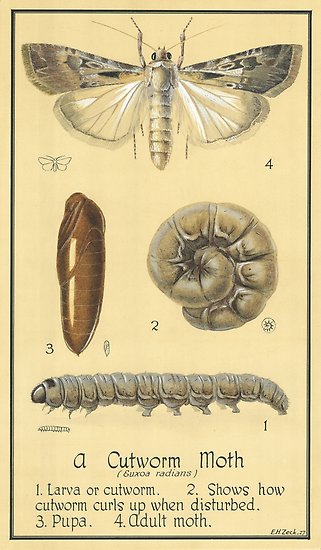
I think I’ve got cutworms in the bean patch. I keep seeding, and they keep germinating, and then something comes along and cuts the stem at the base. It looks suspiciously like cutworms, something I’ve never dealt with before.

Cutworms are the larvae of, you guessed it, cutworm moths.

flat,550x550,075,f.u2.jpg

Kinda cute little guys. But I am not happy. I am tired of reseeding beans, just to have them cut down in their new growth. It’s lucky that I have a generous stash of bean seed saved up from last year to use, because I’m going through it like crazy.

UC IPM says to dig through the soil and search for the pupae and larvae, and remove by hand. So I did that. I want you to picture me, digging through brown dirt, for brown pupae. You see the futility, right? I did not find cutworms. I did find some slugs, though, so my search wasn’t completely in vain.

What I might do, the next time, is plant for a two-fold defense: I will plant very densely (hoping that the sheer volume will cause some to succeed), and I will place little ‘collars’ over the germinating seeds. I was thinking maybe cardboard toilet paper rolls (the inner part) for these, cut into smaller portions, would work. What do you think?

Have you dealt with cutworms? How did you manage them?

Tags insects, IPM, pests, vegetable garden
Comment

"The faint sweet smell of the green things growing"

May 3, 2019 Elizabeth Boegel
IMG_2180.jpg

That title comes from a poem by Dinah Maria Mulock Craik. One morning not long ago, I opened the front door of the house and was hit by a smell. It was delicious. I just couldn’t place it. I sniffed and sniffed and finally decided it was the smell of green. I went to the computer and started looking up what makes things smell green, and there was this charming poem by Craik.

That was all well and good, and described how I felt about it, but I wanted to know WHY. The science behind that smell. So first I needed to know, exactly, what is a smell? It turns out that smells exist mostly in our heads. “Molecules exist in the air, but we can only register some of them as smells,” reports smell expert Avery Gilbert. According to brainfacts.org, “smell begins at the back of the nose, where millions of sensory neurons lie in a strip of tissue called the olfactory epithelium. The tips of these cells contain proteins called receptors that bind odor molecules.” We have about 450 different types of these receptors, and each is activated by different molecules. What we think of as a single smell is actually a combination of molecules acting on a variety of receptors.

So, when I opened the front door, many different molecules combined to make the scent that I was smelling. But my brain couldn’t figure out what the smell exactly was. Those molecules binding with those receptors sent electric signals to my olfactory bulb, which then relayed that signal to other areas of my brain for processing, such as the piriform cortex, and the thalamus (which tries to marry smell with taste), and then to the hippocampus and amygdala, adding a layer of memory to what I was smelling. You’ve experienced that, haven’t you? Smelling something and having a very clear memory? That comes from the hippocampus and amygdala, which are key regions for learning and memory.

On top of that, this was just after dawn, and it seems that everyone’s smell sensitivity has a circadian rhythm. Your sense of smell may be different at different times of day. Also the amount of pollution can change the smell of the air, so smells in the morning are different than smells later in the day. Smells also move by diffusion. I wonder, do the smells collect in the air and sink overnight? Who knows?

Anyway, what are the exact molecules that are attaching to my receptors and causing me to smell this certain scent when I open my front door? This is what I see outside: Flowers. Trees. Green leaves. Wood chips. Soil. The grass across the street. The concrete of the sidewalk and road.

Certainly flowers have a distinct odor. Right now in the garden there are two dominant flower smells - one from the Mock Orange Tree, and another from the sweet peas. Both are very strong and sweet, and perfume the air around them, which can move, as we said, by diffusion. It’s hard to find any data on the smell of green leaves. I’m probably smelling ‘Green Leaf Volatiles’ which are organic compounds that are released when plants suffer tissue damage. This is happening all the time - snails and slugs munching the leaves overnight, people mowing their grass, or using a string trimmer to cut weeds, deer eating the tops of all the stuff I have planted outside the fence, birds ripping leaves for nests and for eating. Then there is the smell of the soil, which is very strong. It is actually not the soil we smell but the bacteria and microbiology in the soil, processing and releasing minerals and organic matter. The wood chips are breaking down, and again that’s the smell of well-oxygenated decomposition by the soil life.

So all of those compounds are moving through the air by diffusion to my little freckled nose, where they all attach themselves to different receptors, which send an electric signal to my brain, causing me to smell. That’s the scientific explanation. But how about this: Maybe all these smells were simply created for my pleasure? So that when I open the front door in the morning, I start the day with a smile on my face. Yeah. Let’s go with that one.

Tags learning, flower garden, soil
Comment

Painted Lady Migration?

April 28, 2019 Elizabeth Boegel
Painted Lady on Borage

Painted Lady on Borage

I’ve been seeing SO MANY painted lady butterflies in our garden this spring. I’ve never seen so many here. At first I congratulated myself, thinking “oh wow, I’ve created a perfect habitat for these beauties, they are visiting because they love it here!” And that’s sort of true, but I knew something else had to be going on. And then I remembered how I had read articles in March about an enormous butterfly migration starting in southern California and moving north. Experts expected the horde to mostly stay inland, near I-5, but figured some might draft their way into the Bay Area. Well, I think I must be seeing that happening here.

Borage has reseeded itself freely around our garden, and some is even growing in our patio, in the cracks next to the planters where we have the hops - clearly taking advantage of the water seeping out of the bottoms of the planters. I was watering the hops today and watching the bees in the borage, when I noticed a webby sort of nest within a group of buds. There were all kinds of brown pellets, which hello, I know insect poop when I see it. But these pellets were big. I broke the webby thing open and found this…

So perfectly camouflaged with the spiky white hairs on the borage. And guess what. These are all painted lady nests and caterpillars. In fact I think you can see one of their eggs on the picture above this one; the eggs are green and barrel-shaped with tiny lines running up and down.

IMG_2134.jpg

Once I noticed them, I started seeing these guys everywhere. My borage is inundated with them!

Butterfly migration is one of those things that breaks my brain. The butterflies only live for 2-4 weeks, but the next generation knows exactly where they are on the migration trail, and continues the journey? I mean. That’s just too big to absorb. And then they do it back the other way too. A miracle, I tell you.

Apparently the explosion of these butterflies this year is due to the wet winter we had. I’ve honestly, I think, only ever seen one other painted lady in my garden before. It’s fun to see so many this year.

Comment
← Newer Posts Older Posts →

Subscribe

Sign up to get email when new blog entries are made.

We respect your privacy. We're only going to use this for blog updates.

Thank you! Please check your email for a confirmation notice to complete the subscription process.

Powered by Squarespace