• About
  • Blog
  • Contact
  • Favorites
  • Archive
Menu

Poppy Corners Farm

Street Address
Walnut Creek, California
Phone Number
Walnut Creek, California

Your Custom Text Here

Poppy Corners Farm

  • About
  • Blog
  • Contact
  • Favorites
  • Archive

April Cooking: Baby Artichokes

April 27, 2019 Elizabeth Boegel
IMG_2118.jpg

Our artichoke plants (we have three very small beds-full) have grown to gargantuan proportions. Two of them are about six feet tall, and another is extremely wide rather than tall (I guess I planted different varieties, though at the time I didn’t write the names down. Reminder: Keep good records!). Some have already gotten so large that we will eat them the usual way, but there are also a lot of baby artichokes, only two inches or so. These can be eaten whole. There are a lot of benefits to eating them this young: Less waste (we of course compost anything we don’t eat, but when they are small, you can eat a lot more of the flower bud than you can when they are older and tougher), and a lovely tenderness, but the best benefit of all…. no earwigs! Or maybe only a few….. our artichokes are the perfect nesting place for those detestable critters. When we eat the big ‘chokes, I have to soak them in a bucket, then wash nearly every leaf carefully. It’s a pain. Not so with the babies!

IMG_2124.jpg

I only have about eight babies at a time. You can probably buy a greater amount at the farmers’ markets, and if so, just scale up this recipe. I know a lot of folks like to just roast baby artichokes, but I still find them a little tough that way. So the key is to boil them first, then roast them. Finish them with a lovely lemon sauce and you’re golden. This recipe is very loosely adapted from Food + Wine.

Rinse off your baby artichokes, about eight of them. Slice about 1/4” off the top (more if they are bigger than 2” each). Slice off the stem, or leave on and peel it. Peel off ALL the small, hard outer leaves, until you reach the tender thin ones. Slice them in half. They should be young enough that there is little choke. If there is any fuzzy center at all, scoop it out. Place them in a saucepan with 1-1/2 cup dry white wine and 1-1/2 cup water. Add a splash of olive oil, salt, pepper, thyme, and a bay leaf. Bring to a boil, then turn down the heat and simmer (with lid halfway on) for 20 minutes or until tender. Drain, and lay on a towel to dry for 15 minutes.

Meanwhile, heat your oven to 450 degrees. When artichokes are dry, place them cut-side up on a cookie sheet. Drizzle with oil and sprinkle with salt and pepper. Roast for 8-10 minutes. Turn the artichokes over and roast for a further 5-10 minutes until crispy.

Whisk together a little olive oil, lemon juice, minced garlic, capers, salt and pepper. Drizzle over artichokes (or serve as a dip, in which case you’ll want to emulsify it by blending until it’s smooth).

Growing artichokes in our zone 9b garden is a lot easier than I originally thought. We have them planted in an area that gets early morning sun, very late afternoon sun, and shade the rest of the day. They are watered on the drip system according to the seasons, except in winter when we get our rain. We started out with one plant in each of three beds - the beds are triangle shaped and are about 1-1/2 ft by 3 ft. The plant grows, produces flower buds (the artichoke), which you either eat or let flower (we do both), and then senesces. When droopy and nearly dead, I cut that branch down to the ground. Another branch will grow from the roots. Usually we have 2-5 flowering branches at a time. And the branches are huge.

I keep them well-mulched, but I have never fed them with any kind of fertilizer, just a side dressing of compost every year or two. They’ve been flowering and re-flowering for six years now.

Do you grow artichokes? What’s your favorite way to eat them? I’d like to pickle some, but haven’t done that yet, and am looking for some suggestions/recipes - please share!

Tags seasonal recipes, vegetable garden
Comment

Early Warmth

April 24, 2019 Elizabeth Boegel
IMG_2074.jpg

We’ve had very hot weather for the past few days - it is 92 degrees here today, which is quite warm. Looking back at my records, this happens every April. For about a week we have July temperatures, and we all wish the neighborhood pool was open. Then it calms down again and we get temperate weather in May. So even though I broke down and turned on the air conditioning today, we can be assured that the fog will come in and cool things down, soon.

But what does this hot spurt mean for the garden and the livestock?

IMG_2069.jpg

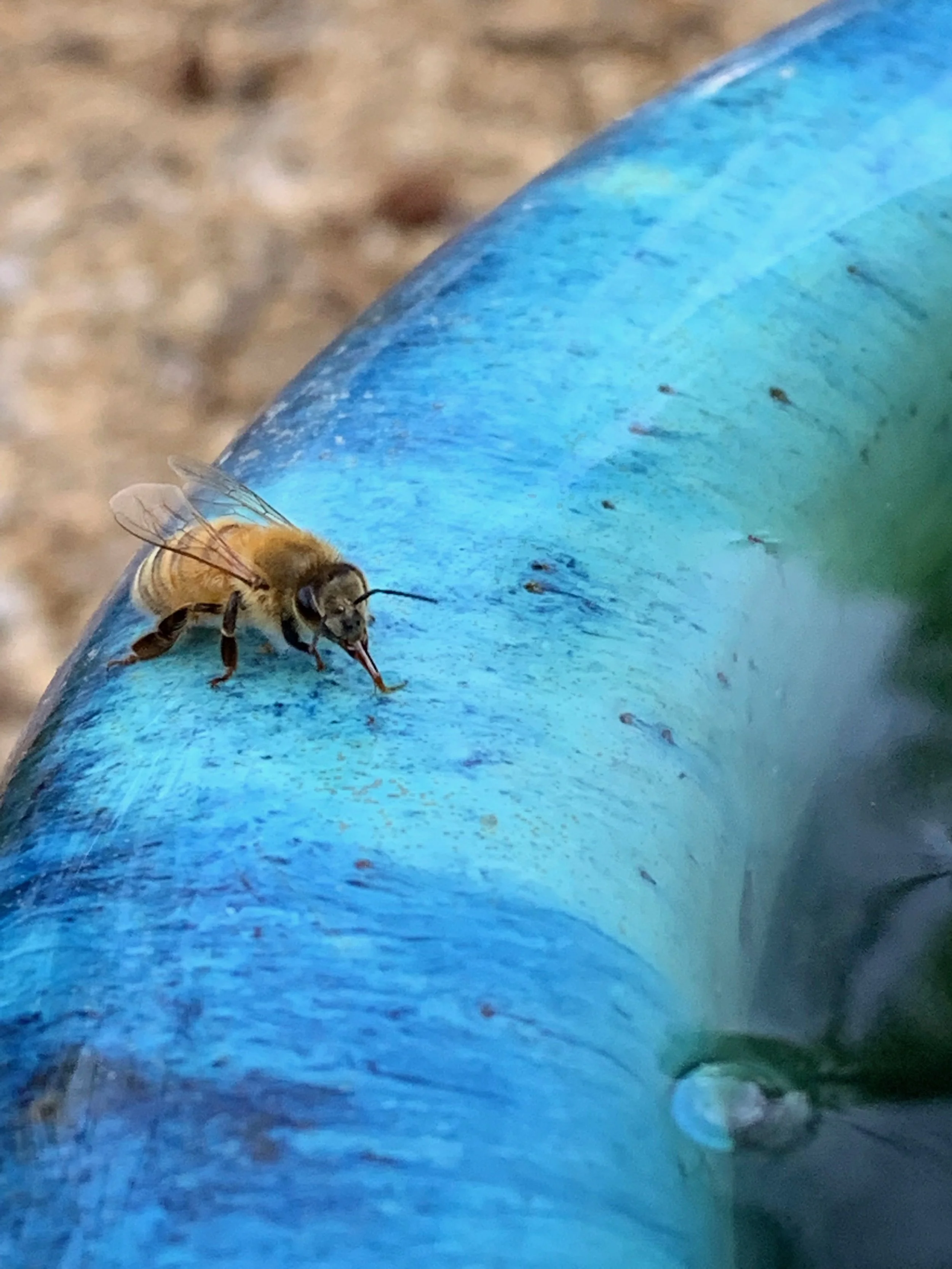
Well, the bees have again found the water feature. All the bees that were alive last summer are long dead, and so this new generation has to find the water source. And they have, finally. The lip of the fountain is ringed with bees, long tongues stuck out, collecting water. Bees cool their hive with water; they put droplets down, and then fan their wings, creating evaporative cooling. Water is extremely necessary for the colony’s health. That’s why, in the summer, you’ll find all kinds of bees in your pool, especially in arid places where there’s no other water to be found. One kindness you can do for the bees is keep a shallow dish out with water at all times. Put some pebbles in it, or rocks, or broken dishes, and fill it every day.

IMG_2094.jpg

The chickens spend most of the day on the shady side of their run, under the quince tree. They dig down in the mulch with their sharp claws and make a cool depression in the earth, and sit in it. Later in the day, I spray their run with water, and they love that; it seems to give them renewed energy. I don’t know if it’s because the water evaporates off the ground and cools them off, or just because they prefer a damp surface to a dry one, but after I spray the ground, they start scratching it like crazy. Maybe the bugs come up when I water. The oak tree provides shade starting about 3 pm, and the chickens visibly perk up and start to roam again. Thank heavens for big trees.

IMG_2099.jpg

And the garden? The garden loves the heat. It’s a bit tricky with just-sown seeds, however. Tom and I pulled up the shallots (all five million of them; they are curing on the roof of the coop) and I planted beans, cucumbers, butternut squash, delicata squash, and pumpkins. We’ve got the drip system going full bore, but water them again in the late afternoon, because seeds simply cannot dry out when they are in the germination process. The garlic is still in the ground and will be until at least May, maybe longer. I am intending to interplant peppers and melons in that space.

IMG_2100.jpg

And the tomatoes, of course, do much better in warm weather, especially before fruit is set, so they are growing like mad. I’m going to have to tie them up this weekend.

Lastly, the flower garden is going crazy. The Phacelia tanacetifolia has begun to bloom and I see many different species of bees on in throughout the day.

IMG_2101.jpg

Since I have a full course load, I am spending way too much time inside on the computer, which is why I’m not blogging as often. When I get a minute away from homework, the garden calls me. I like to just sit on the mulch and watch the activity in the flowers. It really grounds me. Of course then I start to see some weeds that need to be pulled, and a spot that needs some seeds, etc etc etc. So the sitting doesn’t happen for very long! ‘Tis the season for busy garden days!

Tags vegetable garden, flower garden, bees, chickens
Comment

New Dairy Information

April 17, 2019 Elizabeth Boegel
image credit: NZ radio

image credit: NZ radio

I subscribe to Modern Farmer, which used to be a print magazine but is now online only. I like their articles about modern farming practices, and they are deep into sustainability and accountability. They recently published a new report from the Cornucopia Institute about the best dairies in the country. The Institute supports economic justice for family-style farming. This particular report studies several aspects of dairy farming: 1) the percentage of grass in a cow’s diet; 2) How much pasture is available for grazing; 3) the level of control a brand has over its milk supply; and 4) How the farmer suppliers expand their milking herd.

I was anxious to read the report and find the best dairy in our area. We have been buying from Straus Family, mostly because they use glass bottles that can be reused, and they are an organic farm. But I was distressed to see them at only the ‘good’ level on this list. They did not meet the criteria for grass-fed. Here is the list.

The highest-rated farm in our area is Organic Pastures, which I have trouble finding in our local stores, so more research is needed there. Meanwhile there are several other options for us on that list, which is helpful. One thing I have noticed is that a lot of grass-fed milk is not homogenized. I do have trouble convincing my family to drink ‘lumpy milk.’ One brand that we like that IS homogenized is Maple Hill. It’s got a 5-cow rating from Cornucopia, which is great, and I can find it easily in our Whole Foods. I just wish I didn’t have to buy milk from New York! So I will keep searching for a local dairy that has milk that is just-right for us.

image credit: spruce eats

image credit: spruce eats

We have some beautiful flowers blooming right now.

sage-leaved rock rose

sage-leaved rock rose

heirloom violas

heirloom violas

Geum

Geum

Echium

Echium

poppies

poppies

checkerbloom

checkerbloom

Spring is definitely fully HERE. What’s happening in your garden? And where do you get your dairy products?

Tags learning, organic, flower garden
Comment

We have Babies!

April 14, 2019 Elizabeth Boegel
the nest

the nest

We have babies! Bewick’s Wren babies, that is.

We have a male wren that hangs around our yard every year, making nests. Apparently the male wren makes several nests each year to impress the female, and then she chooses where she wants to live. Well, the male has never attracted his female to our yard before, that I know of. I guess his nests were not good enough, or our yard not safe enough. But this year, I noticed a nest going in the Williamsburg jar house that we have on Adam’s train shed. And a little while later, I surprised Mama Wren by looking inside. She flew out, startled, and I was mad that I scared her. I took this picture of the nest, but I didn’t think she came back.

She did! And yesterday I noticed cheeping! So today I sat outside and filmed one of the birds coming back to the nest to feed the babies. It’s only 30 seconds long.

This makes me very happy, indeed. I hope I can see the babies fledge.

This weekend, we noticed a few things: One, the weather was going to be good for the next week (we were told HOT), and two, the tomatoes needed transplanting into bigger pots. I decided to go ahead and just plant them in the ground. It’s way too early. Here’s how I know: I just looked at the weather for the next week and it’s totally changed. It’s not going to be hot at all. Argh. Oh well, the tomatoes are in, and now it’s up to them to survive.

IMG_1986.jpg

40 varieties. Oh, I used paint stirrers as my compostable plant labels, this time. They are quite large and stick up out of the ground beautifully, so I don’t have to squint to see them.

IMG_1987.jpg

Next weekend we’ll hope to get basil and cilantro planted, plus beans and cucumbers. The peppers need a while longer in the greenhouse, which is good, since the shallots and garlic aren’t ready to come out yet. Although it’s getting closer to that time!


Tags video, birds, wildlife, tomatoes, vegetable garden
2 Comments

Soldier Beetles

April 10, 2019 Elizabeth Boegel
a soldier beetle hunting cabbage aphids

a soldier beetle hunting cabbage aphids

Since I let all the brassicas bloom (that is, the cabbage, kale, mustard, broccoli, and cauliflower), I’ve been seeing a lot of beneficial insects in the garden. My kale is riddled with cabbage aphids, and I knew it wouldn’t be long before the predators started showing up.

Soldier beetles (or more accurately, leatherwing beetles) are an insect you want to invite into your garden. Less than an inch in length, and brightly colored (like a soldier wearing a uniform, hence the common name), these carnivorous bugs overwinter in leaf litter and debris, and lay their eggs in the soil. The larvae hatch underneath the soil and eat the tiny bugs they find there. As adults, they roam plants looking for eggs, or caterpillars, or aphids. They do not damage plant material. They will eat pollen and nectar, which also makes them excellent pollinators.

Soldier beetles (Pacificanthia consors) look a lot like lightening bugs, but they do not have light-producing organs. When I put this picture up on iNaturalist (and, are you a member yet? It’s such a great citizen-science site!), someone identified it as a Downy Leatherwing Beetle. Researching them online is difficult because they haven’t been studied extensively. I did find some advice on how to attract them to your garden: Choose flowers that bloom over a long season. Provide water, as they are known to frequent moist habitats. Provide undisturbed, mulched soil in which to pupate. Include permanent perennials in your planting scheme to help keep that area undisturbed. Do not till, but rather add organic matter to the top of your soil (good all-around advice, anyway). And let me know if you see them in your garden!

IMG_1974.jpg

Here’s another beauty I found flitting about in the chard, today. A Painted Lady! I haven’t seen a painted lady (Vanessa cardui) in my garden in a long time. And it’s early in the season for butterflies. Favorite host food for the caterpillars includes hollyhocks (I’ve got those), legumes (I’ve got those), and thistles (the nearby open space has got those). I’m delighted to see this beautiful butterfly and hope this means I can look forward to lots more in the summer to come!

Tags insects, IPM, beneficials, pollinators
Comment
← Newer Posts Older Posts →

Subscribe

Sign up to get email when new blog entries are made.

We respect your privacy. We're only going to use this for blog updates.

Thank you! Please check your email for a confirmation notice to complete the subscription process.

Powered by Squarespace