• About
  • Blog
  • Contact
  • Favorites
  • Archive
Menu

Poppy Corners Farm

Street Address
Walnut Creek, California
Phone Number
Walnut Creek, California

Your Custom Text Here

Poppy Corners Farm

  • About
  • Blog
  • Contact
  • Favorites
  • Archive

Swings

February 27, 2018 Elizabeth Boegel
Mt Diablo from the Alamo Post Office

Mt Diablo from the Alamo Post Office

It seems like every day, there is some new crazy weather story. Temperature swings are now the norm. Here's just a couple things that I've read lately:

1) The arctic circle is experiencing a heat wave, over 32 degrees.

2) Los Angeles has had only one rain event in 365 days, and that netted .3". This is data coming from a scientist I've recently started following on twitter.

3) California's almond crop is in danger from freezes.

4) Early spring is expected in Washington DC.

5) Record warmth for the east coast, after an extremely tough and cold winter.

In our own experience, this winter has been crazier than usual. Firstly we got hardly any rain - Martinez (north of here), before our 'big' storm yesterday (more on that in a minute), had amassed only 7 inches according to the Contra Costa County Flood Control Dep't. In early February, we had a strange heat wave, with two weeks of soaring temperatures - it was 85 here in our yard one of those days. You know what happens when we get an early heat wave like that - everything starts blooming. Pears, plums, peaches, almonds - everything put on buds during that period and started to bloom. Then late February arrived, with below-freezing temperatures, very unusual for this area (our last frost date is February 15th). We had one morning of 28 degrees, several others of 30. 

Then, yesterday - hail. 

IMG_7666.jpg

This is also extremely unusual for us. Even my teenaged kids went out and played in it (as much as teenagers can allow themselves to 'play') and took pictures. And this morning, on my trip to the post office, I was not surprised to see snow on Mt. Diablo, which usually happens a couple of times a year, but in December or January, never this late.

I swear, when that hail started, my first thought was "oh no, the wheat!" and when I texted Tom that it was hailing, he texted back, "oh no, the wheat!" So far it seems ok this morning, but my goodness, it really brings home how hard it is for people who make their living growing crops, and how their entire yearly income can be destroyed by one weather event. I have serious respect for farmers, who constantly experience what it's like to sometimes have zero control over outcomes. 

Seems to me that climate change is beyond obvious, and it always surprises me when certain folks deny that it's happening. I really feel that it is time to start thinking and planning for the future - the near future - when it becomes even more extreme. Do you agree? If so, in what ways are you preparing?

Meanwhile, a reminder about native bees. Even though we all love mulch (and there's lots of reasons to love mulch!), remember to leave some areas of your yard uncovered. This allows our native bees to make their nests and raise their young, underground. Before this cold snap, I noticed a lot of native bee activity, so they'll be emerging for good soon. Also, leaving a little dish of water out for pollinators is helpful; make sure it's shallow, and put some rocks, broken pottery, or sticks in it so that the bees don't drown. If you're worried about mosquitos, just change out the water every 1-2 days (and throw the old water in the garden somewhere - in other words, don't waste it).  And speaking of emerging creatures, Vector Control recommends putting out yellow jacket traps around now, to try and catch the queens before they lay babies. I find that this brand is the only one that really works.

Now I'm off to do some homework. I have one class that requires me to memorize 250 trees by Latin and common names, and family names. Spelling is crucial. I can definitely feel my brain working hard when I'm studying these trees. Hopefully the knowledge will stick for the rest of my life, and I'll be an ace at identifying both native and imported trees!


Tags climate, environment, bees, IPM, insects
Comment

Four-Egg Days

February 24, 2018 Elizabeth Boegel
IMG_7633.jpg

Did you know that eggs are seasonal?

Usually, during the winter, older chickens take some time off laying. Then, when the days start to grow longer, some sort of internal timer goes 'ding!' and they start laying again. And oh, when they do, happy day.

IMG_7651.jpg

We have six chickens, two of whom are done laying for good and need to be 'taken care of' (insert mental picture of me drawing my finger across my throat). But the other four, two of whom are older, and two of whom are younger, are all laying regularly again. This is great news, because it means eggs are back on the menu. We love them scrambled with diced bacon, fresh greens from the garden, and a little turmeric. We love frittatas with leeks and herbs from the garden, broiled with a little parmesan on top for salty color. We love chocolate pudding made with the bright, fresh, orange yolks. Having eggs again is like being rich.

IMG_7631.jpg

Have your chickens started laying again? What are your favorite egg dishes?

Tags chickens, eggs, vegetable garden
4 Comments

Sunflowers

February 22, 2018 Elizabeth Boegel
Summer 2017, 'Cinnamon Sun'

Summer 2017, 'Cinnamon Sun'

We can all agree that sunflowers are beautiful, but I'd like to propose that they are also one of the most complicated and interesting flowers on this planet. 

We admire them for their height, their large inflorescence, their cheerful presence, their ability to move in a breeze and make the garden dance.

But they also have attributes, both good and bad, that make them extremely fascinating. Let's go through them one by one and discuss.

1) Sunflowers track the sun.

You may have witnessed young sunflowers following the sun with their heads (this is called heliotropism), but it wasn't until 2016 that scientists discovered the why and how of this process. They determined that sunflowers, like humans, have a circadian rhythm, a behavioral cycle tied to an internal clock. But the plant's 'turning' is actually different sides of the stem elongating at different times of day.  This has to do with a plant hormone called 'auxin,' which does a lot of neat things, like assert apical dominance, but also elongates cells on different side of the stems at different times of day. 

Here's a neat video that explains this process very simply:

2) Pollinators love sunflowers.

We all know sunflowers are great for bees. Honeybees collect both pollen and nectar from the flowers, but native bees are actually more efficient pollinators of sunflowers. Here's why: Honeybees tend to forage either nectar or pollen on a single foraging trip, which means they visit different flowers on the sunflower inflorescence, neglecting others; native bees collect both nectar and pollen on foraging trips, ensuring cross-pollination. This is due to the kind of flower this plant makes, which I will discuss in the next point. But if you'd like to see more about this, you can check out this page from the Xerces Society. 

3) An odd, interesting, cool flower

Sunflowers bear a type of inflorescence called a 'capitula,' which is actually composed of two different kind of flowers: Ray and disk. The inside of the sunflower is comprised of a lot of little tiny flowers called 'disk' flowers. Each has five tiny petals that are fused into a cup-like structure, 5 stamens (male parts), and a pistil (female parts). Each disk flower makes one seed. On the outside of the flower, the things that look like petals are called 'ray' flowers. They have all five petals fused to make one huge petal, and they also have five stamens and a pistil, and make one seed. This is a feature of all plants in the Asteraceae family, though each species can have vary in the amount of ray and disk flowers it has. 

Photo credit: Smith College

Photo credit: Smith College

4) Allelopathy

Here's one of the not-so-great features of sunflowers. They are allelopathic, which means they exude chemicals that act as herbicides to the surrounding plants. All parts of the sunflower - seeds, hulls, leaves, flower petals, roots, root exudates - act this way, and can inhibit the growth of other species. Many plants do this - you might be familiar with the allelopathic qualities of walnut, for instance - and it ensures survival of their species, which is a good thing. But it's not a good thing for us gardeners, as we usually want to grow sunflowers mixed in with other, lower plants. Apparently grasses, potatoes, and beans are particularly susceptible, but I have noticed that even native wildflowers will not grow well around sunflowers. 

Which is why I vowed, last year, to stop growing them, as a gardening friend reminded me when he saw pictures of 200 sunflowers in my 'greenhouse.'

IMG_7629.jpg

Usually I add sunflower seeds to my wildflower seed mixes and broadcast into the pollinator gardens. I never have good luck with this, because most of the sunflower seeds get eaten by birds or squirrels immediately. This is why I decided to germinate the seeds inside the greenhouse this year instead of directly in the garden. But I also have noticed that, in the areas where a sunflower does manage to germinate and grow, there is little growth around it. 

What I have discovered in my research that the allelopathic compounds in sunflowers especially affect the germination rates of other seeds. So, if the other seeds have already germinated in the pollinator gardens (and they have), and I've already got the sunflower growing well in cups in the greenhouse (I do), it might work to add these plants in and see how the other plants do around them. But, do I really want to take that chance? I'm just not sure. I might plant a couple in with other things just to see for myself what happens to more mature plants. But the bulk of these sunflowers are going to be planted in an area with no other plants around them, I think. 

IMG_7630.jpg

What about you? Do you grow sunflowers? Have you noticed this affect? Do you see lots of bees on your flowers? Have you seen sunflowers tracking the sun? Do you love these flowers as much as I do?


Tags flower garden, allelopathy, sunflowers, bees, pollinators, science, horticulture
2 Comments

Crocosmia

February 18, 2018 Elizabeth Boegel
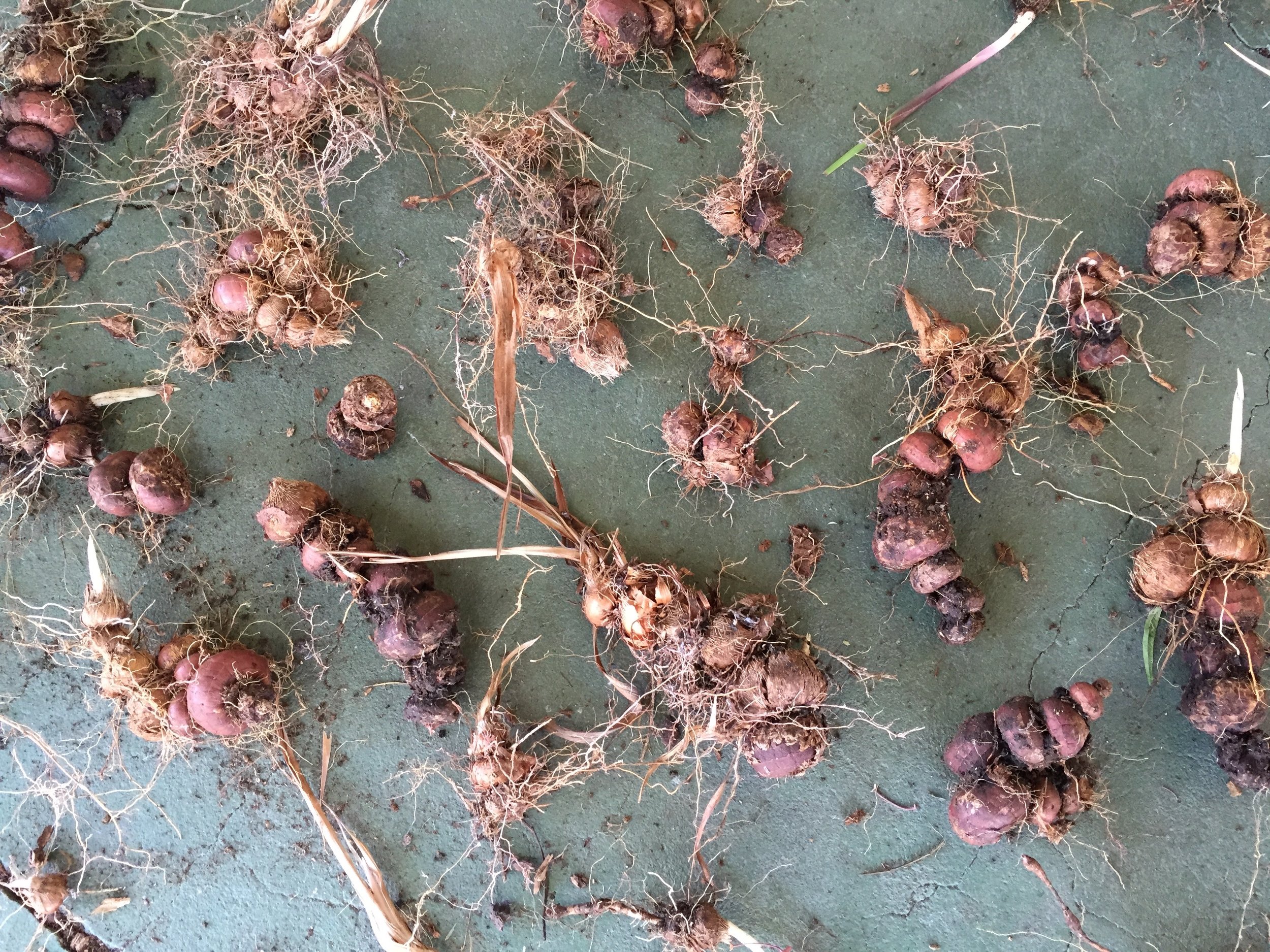
This is NOT dog poop.

This is NOT dog poop.

Do you know the flower crocosmia? It's a South African native, a corm in the Iris family, and spreads so rapidly that it can be a bit of a bully in the garden.

This is not a photograph I took, but here is how it looks when it blooms.

crocosmia-01.jpg

It's  a lovely plant and the hummingbirds do like it. 

About 12 years ago, a friend gave me some corms and I planted them (unknowingly) in the wrong spot. I think they've bloomed twice in those twelve years, though the greenery comes up every year like clockwork. I thought it was time to dig them up and see what they looked like, and replant them in various other places in the garden to see if they'll do better somewhere else.

IMG_7588.jpg

Corms are interesting because the 'mother' corm is at the bottom and is the oldest in the 'chain.' The 'daughter' corms are above the mother and continue to form new daughters as the years go by. Several of the corms I dug up had over 10 daughter corms. As the chain grows, the mother corm actually pulls herself down deeper into the soil in order to make room for the daughters.

It was fun to dig down deep and discover the chains of corms. Some were shriveled and used up, some were papery, some were red. Some had already sprouted.

Being South African, you'd think these plants would want full sun and dry conditions. But that's where I've had them all these years, and they haven't flowered much. So I replanted them in shadier conditions near the drip line. They'd probably like some looser, richer soil, but I'll see how they do without any amendments first. 

Do you grow crocosmia?

Tags flower garden, bulbs
6 Comments

Heading

February 17, 2018 Elizabeth Boegel
IMG_7581.jpg

Growing heirloom winter wheat has been such an interesting experiment. Grains are an excellent rotation for any cropping system, as they build soil and feed microorganisms with their extensive roots. They prevent erosion, cover the earth, and provide a great deal of biomass that can be used as mulch or compost material. There's very little pest pressure.  And, if you're lucky, you get a crop on top of all that.

Our wheat crop, which was 'lodging' (or falling over) has righted itself and is now 'heading.' The plants generally go through an aggressive growing process in early spring, then form a type of leaf called a 'flag,' which is easily seen in the above photo. The flag leaf produces a shaft wherein the grain begins reproduction. Those flowers you see are self-pollinating, and after the pollination process, seeds will form.

IMG_7583.jpg

I grew up near farming communities on the east coast, but I don't ever remember seeing grain. I know very little about it. I imagine if you grow up in the mid-west, you're very used to seeing these crops. I have had a good time researching how wheat grows; I've needed to consult the experts at every stage. It's evident that my crop is heading quite a bit earlier than wheat usually does in our state, early April being the common time. We had very warm temperatures for about two weeks in early February, which I think triggered the plants to begin reproduction. February 15 is our last frost date, so I'm hoping that it won't get too cold now (temperatures have dropped!), and that the seeds can withstand that chill. If they do withstand it, this early heading is a great thing, because I might just get a small crop in before I plant out tomatoes in May. Normally wheat isn't ready to harvest until late May or early June here.

When the plant has set seed, it will start to brown and dry up. Then I will know it is time to harvest, sheave, and then thresh. Of course, the right amount of water is very important now, so I'm glad we have an irrigation system, as it hasn't rained here for the entire month of February, and actually I don't remember getting any significant moisture in January either. 

IMG_7585.jpg

Meanwhile, I'm in the process of potting up over 200 sunflower seedlings. I may have overdid, just a little.

Tags wheat, winter garden, greenhouse, starting seeds
2 Comments
← Newer Posts Older Posts →

Subscribe

Sign up to get email when new blog entries are made.

We respect your privacy. We're only going to use this for blog updates.

Thank you! Please check your email for a confirmation notice to complete the subscription process.

Powered by Squarespace