• About
  • Blog
  • Contact
  • Favorites
  • Archive
Menu

Poppy Corners Farm

Street Address
Walnut Creek, California
Phone Number
Walnut Creek, California

Your Custom Text Here

Poppy Corners Farm

  • About
  • Blog
  • Contact
  • Favorites
  • Archive

Peppers and Poop

February 11, 2018 Elizabeth Boegel
IMG_7436.jpg

Yesterday, I got all the peppers seeded, 50 in all! I want to make our own powdered paprika, so I planted three different kinds of Hungarian paprika peppers. We've got the usual other hot peppers, as they seem to be reliable for us, and a great mixture of both bell and horn-shaped  sweets for roasting and eating fresh.
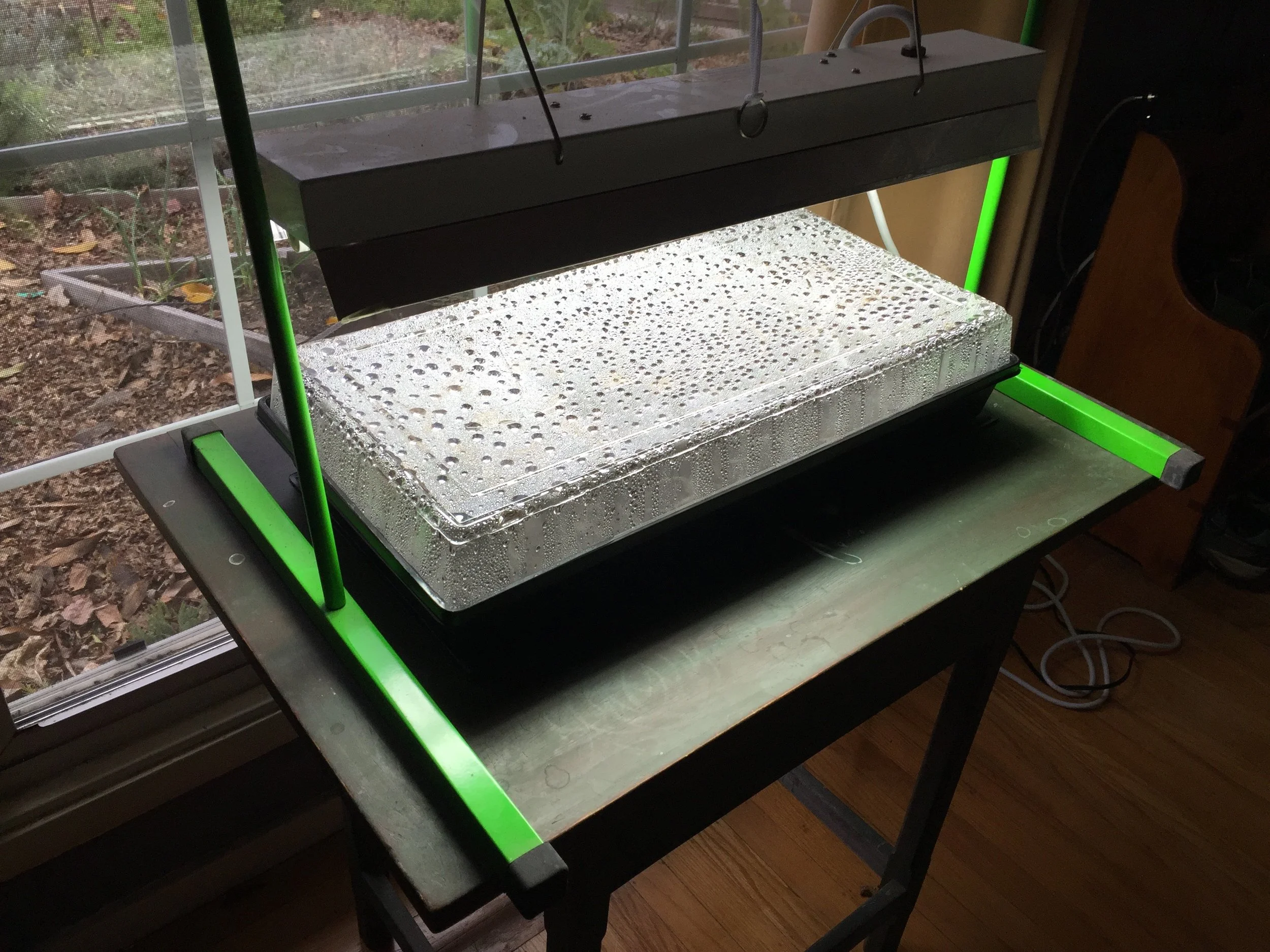
Peppers take a little while to germinate, so I wanted to start them a couple weeks earlier than tomatoes. I'm glad to have them in a tray, on a heat mat, under lights. Our house was feeling curiously bare without any seed-starting activity. It feels weird to start everything so late, but I'm trying to time our big harvest for August rather than July.

I do believe I might plant all of the peppers in 10 gallon pots this year. Room in the beds is always at a premium, and peppers do well in containers, some say even better than in beds. This is because the roots stay very warm. 

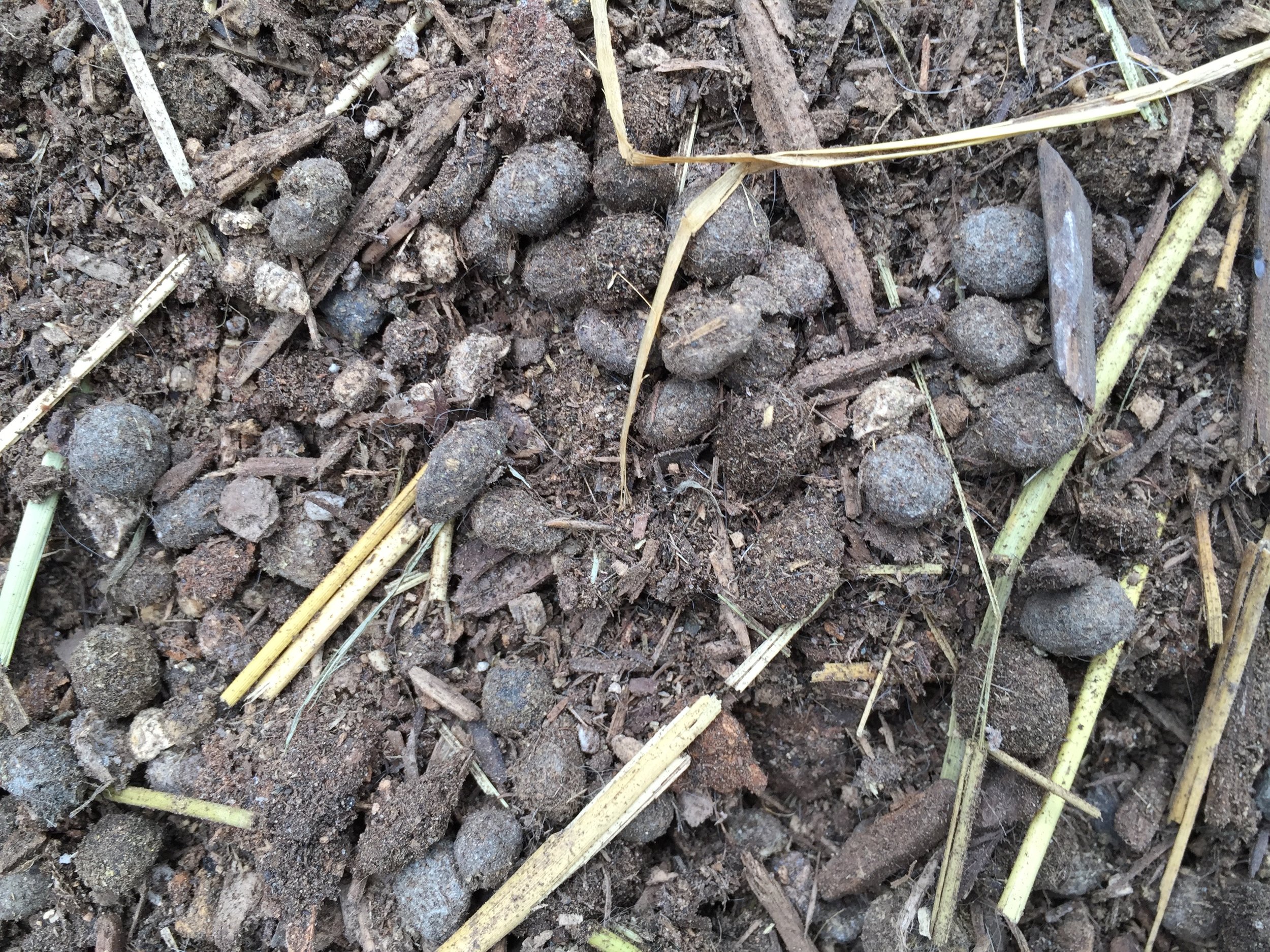
In other news, we had a poop windfall. A friend of mine raises rabbits in a large coop-like structure outdoors. The floor of the coop is concrete so the rabbits don't dig out, and on top is a mixture of garden soil and hay. Over the last many months, the rabbits have added their feces and urine to this mixture, all while digging and aerating it. My friend wanted to remove it and replace it with fresh dirt and hay, and called me to see if I wanted to take the old mixture away. Oh yes, I giddily replied. Today Tom and I made two trips and ended up with a nice big pile of enriched soil, which will sit under the apple tree until I'm ready to plant tomatoes, and then we'll amend the beds with it.

IMG_7438.jpg

Rabbit poop can be used right away around plants, as it's not as 'hot' as chicken manure, which needs to be composted first. However it will only improve with a little sitting. Here's a close up of the soil:
IMG_7440.jpg

It's so good to have friends who think this way and call me when they have this sort of thing to give away! I'm not going to have to buy compost this year, or maybe an extremely reduced amount, which is stellar.
Tags compost, manure, vegetable garden, seed starting
Comment

Today

February 9, 2018 Elizabeth Boegel
IMG_7419.jpg

"If ever there were a spring day so perfect, so uplifted by a warm intermittent breeze ...

IMG_7382.jpg

... that it made you want to throw open all the windows in the house...

IMG_7408.jpg

... and unlatch the door to the canary's cage, indeed, rip the little door from its jamb, ...

IMG_7404.jpg

... a day when the cool brick paths and the garden bursting with peonies ...

IMG_7388.jpg

... seemed so etched in sunlight that you felt like taking ....

IMG_7399.jpg

... a hammer to the glass paperweight on the living room end table, ...

IMG_7428.jpg

... releasing the inhabitants from their snow-covered cottage ...

IMG_7410.jpg

... so they could walk out, holding hands and squinting ...

IMG_7423.jpg

... into this larger dome of blue and white, well, today is just that kind of day."

IMG_7398.jpg

- Billy Collins, 'Today'

IMG_7394.jpg
Tags flower garden, fruit garden, vegetable garden, macro lens, photography
2 Comments

New Macro Lens

February 6, 2018 Elizabeth Boegel
superior foreground focus

superior foreground focus

I'm taking a class this term called 'Insect Identification and Management' and we have to make an insect collection. Yes, that means what you think it does; we're supposed to kill and pin insects to keep as a scientific record. Several of us students are opposed to this practice and have convinced the professor (a reasonable man) to allow us to make photographic collections instead. Many of the students taking photographs have excellent cameras with huge intimidating lenses. I adore taking pictures but want something I can carry in my pocket, as I'm sort of an on-the-fly photographer. So my iPhone does the job well enough. However it has become clear that in order to get good pictures of tiny, flying, wriggling,  ALIVE insects, I needed to step it up. And so I went searching for something I could carry in my pocket that could attach easily to my phone. And I think I've found a serviceable item.

this millipede was super small - like the size of a grain of rice.

this millipede was super small - like the size of a grain of rice.

It's made by a company called Xenvo, and it's a lens attached to a clip. Actually there are two lenses; one for wide shots, and one for macro shots (the tiny stuff). The clip just attaches on to your phone, and the lens covers the lens on your phone. Easy.

This is just one of the lenses.

This is just one of the lenses.

It was packaged very nicely, coming with a clip-on light, and a cord, and a special carrying case, and lens caps. It was all cushioned beautifully. And it only cost about $30.

I took it out in the yard today to play with it a bit and see what kinds of shots I could capture. One thing I noticed right away was the ability of the lens to focus on something small. So often, when I try to take pictures of a very tiny thing, the iPhone lens focuses on the background, and it takes a long time for it to focus on the item you're trying to take a picture of - and sometimes it never focuses at all. With this lens attachment, the focus is right there, no waiting.

a close-up of lichen 

a close-up of lichen 

I'm hoping this lens will help me take better pictures of insects and bugs. 

I'm also looking forward to trying out the wide lens when I'm hiking, and trying to take pictures of the views. These lenses are both small enough to keep in my pocket when I'm walking.

IMG_7253.jpg

I love the idea of having a big fancy camera (there's also something attractive about the ability to hide behind it), but the logistics are just difficult for me. Am I going to take a heavy thing around my neck when I hike? Doubtful. And what if I'm gardening and I see something I really want to phtotograph (this happens ten times a day at least)? Am I going to want to run into the house to find my fancy camera? No! Whatever I wanted to take the picture of might not be there when I come back! So this is much easier. A little more power in my pocket.

IMG_7250.jpg

What about you? Do you like to take nature photos? Do you have a big rig, or do you just use your phone?

Tags photography, flower garden, insects, IPM, bees, macro lens
2 Comments

February Wreath

February 2, 2018 Elizabeth Boegel
IMG_7201.jpg

The last half of this week has been glorious, for instance today it has been 75 degrees and there is a warm wind. I'm not supposed to enjoy it - we've had hardly any rain, and this means the meager snowpack in the Sierra is melting early - but it's hard to feel glum about that when spring is bursting out all around you.

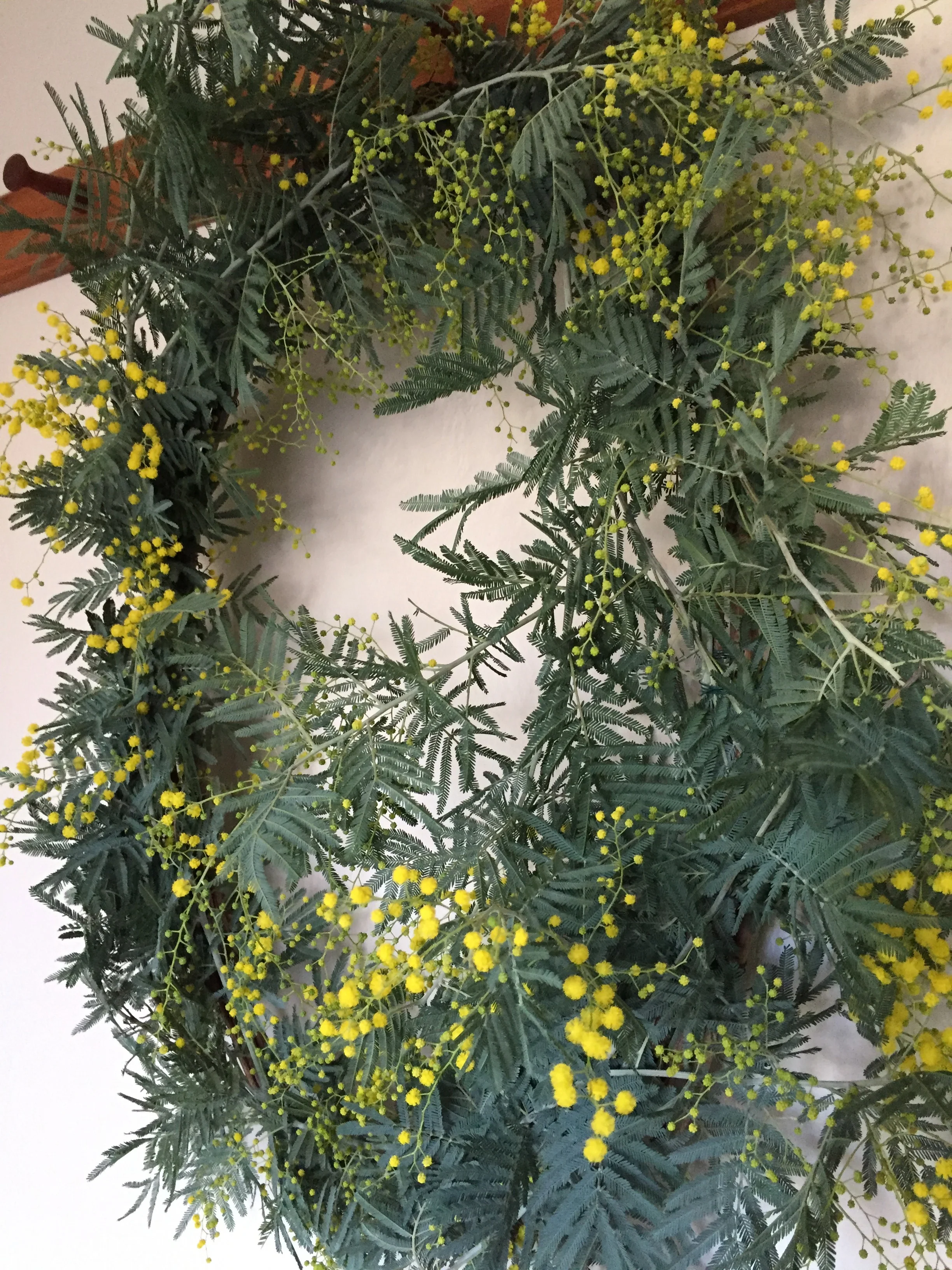
I made February's wreath with Acacia dealbata, or Silver Wattle, native to Australia, naturalized here. It's really beautiful but it's terribly weedy, and takes over the Oakland/Berkeley hills around this time of year. I don't find it growing out my way very much, but there is one enormous specimen on a trail near here, so that's where I went to take cuttings. The tree can easily support that; I in no way injured it or even slowed it down. Some people think this tree is a scourge and it's hard to disagree because it causes awful allergies, being loaded with pollen. And did I mention the weediness? 

Anyway, I have to say it makes a lovely, cheerful wreath.

rhubarb seedlings in the 'greenhouse'

rhubarb seedlings in the 'greenhouse'

This weekend, I intend to take out one bed of wheat, clover, and peas and put in my potato crop, as well as start sunflower seeds in the greenhouse. It's hard not to do more. I'll probably start my pepper seeds later on in February, since they require some extra germination time. But no tomatoes until March. 

IMG_7212.jpg

Meanwhile, I'm enjoying all the spring bulbs coming up, as the narcissus are starting to enter senescence. 

Borage is nearly a year-round plant for us here, but it takes a break in December and January, reseeds itself, and comes out gangbusters again starting this month. The bees are clearly in the spring swing of things and soon we'll need to do a hive check.

I'm growing watercress in a 10-gallon container, and it's really starting to look delicious. I'm anticipating some lovely greens in sandwiches soon.

IMG_7210.jpg

I bought four hellebores in December and I have them in pots on my front porch. Hellebores are not cheap, so this was a real investment, and they are starting to bloom which is fabulous. I have several different colors and I'm sure I'll be sharing more pictures as they open. I can't wait.

Tags seasonal wreath, flower garden, bulbs, herb garden, vegetable garden
Comment

The Wheat is Lodging

January 30, 2018 Elizabeth Boegel
IMG_7123.jpg

When you grow wheat, you begin to see what an important crop it is in our country. Google-research a problem with, say, kale, and you'll get a bunch of websites written by folks just like you and me. Google-research a problem with wheat, and BAM: You've got the big guns weighing in, from the USDA to the Land Grant Universities. According to the USDA, wheat ranks third among US field crops in planted acreage, production, and gross receipts. (You can guess the top two crops, I imagine.) However, wheat planting and production are actually down this year, due to lower returns and changes in government programs, as well as increased competition from global wheat markets. 

Again according to the USDA, wheat, along with corn, soybeans, cotton, and potatoes, accounts for about 80% of all pesticide use in our country. 

This makes you wanna find your local, organic wheat farm, doesn't it? It sure does for me. It also sure as hell solidifies my resolve to continue baking our own bread with said wheat.

Meanwhile I'm enjoying our own wheat-growing experiment. There are some definite downsides. The main one is space, which is certainly a limiting factor. The ratio of biomass-to-product is quite high; the huge stalks take up quite a bit of room for such little return. You have to plant a LOT of wheat to get any kind of poundage at the end of the process. It's also a long-growing crop; I planted these seeds in October, and the plant probably won't be ready for harvesting until late May, at the earliest. This is an issue when I want to get summer crops in the ground at the beginning of May at the latest. Some crops, such as potatoes, should go in in February. In order to do that, I'm going to have to cut some of the wheat early.

There are lots of positives to growing wheat, though, not the least of which is how beautiful it is. It couldn't be any more GREEN.

IMG_7120.jpg

Other benefits: The aforementioned biomass is actually a boon, as it can be used in several ways; as fodder for the chickens, or as a mulch for my summer plants. Finding organic straw is difficult, and I've basically made my own. It has acted as a wonderful cover crop over the winter, mixed with crimson clover as an understory plant. Live roots in the ground year-round really promote soil life and health. I mean, just LOOK at all the sunlight that's been captured in these beautiful leaves.

Here's another downside, though, at least in my garden. My wheat is starting to lodge.

IMG_7121.jpg

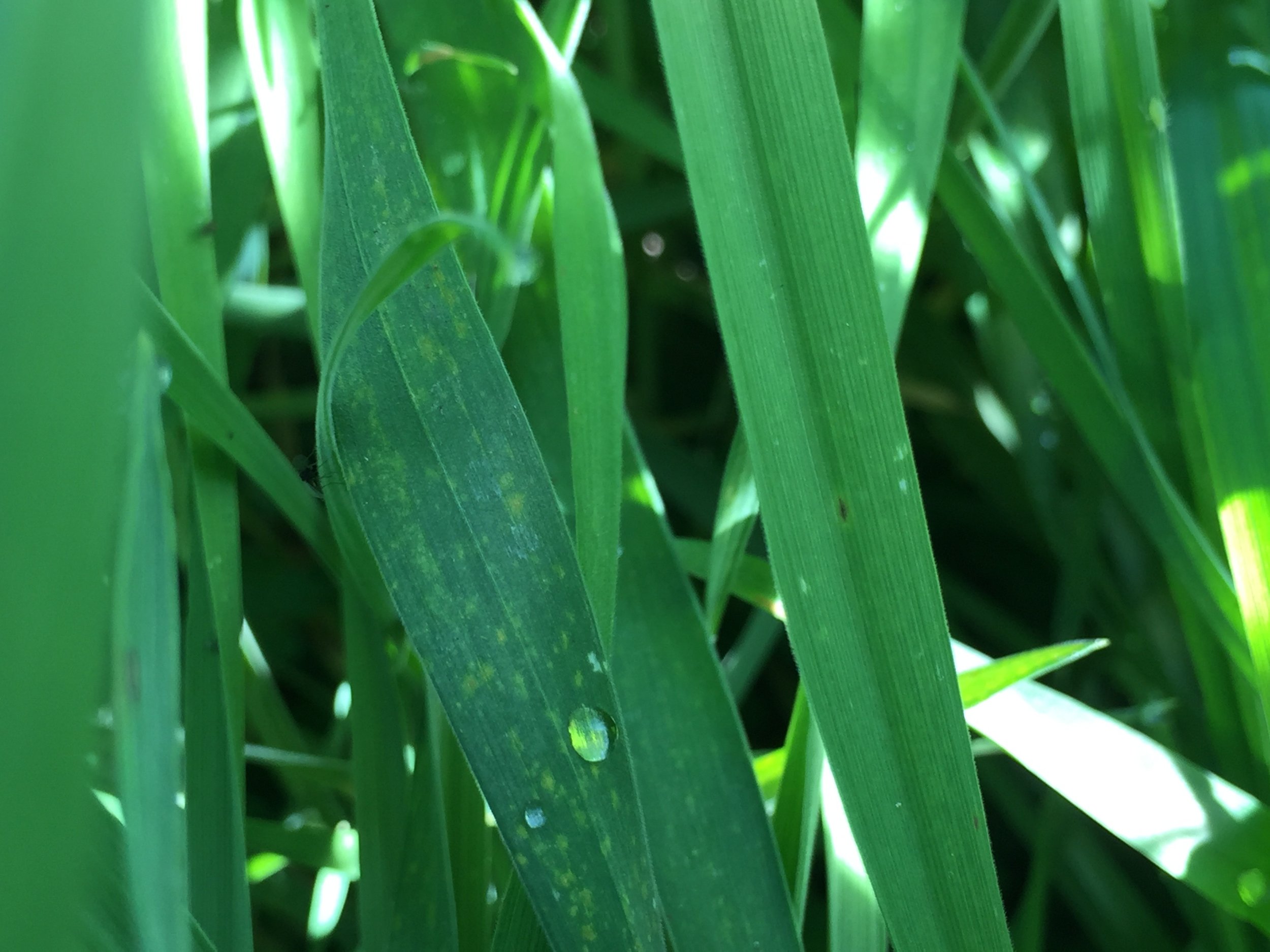
Lodging is when the wheat falls over. It's happening in every one of my beds. The outside rim of each bed is fine, beautifully upright, and then the inner portions have keeled over. There are many reasons this could have happened, but I don't see that any are applicable here. The plants could be suffering from excess nitrogen (never a problem in my beds, trust me when I tell you that all my soil nutrient tests come back deficient in nitrogen, which is why I planted clover too - but the nitrogen nodules in the roots of the clover won't be available to nearby plants until after I cut down the clover and let the roots rot in the soil). They could be suffering from a deficiency of potassium (though my soil tests say this nutrient level is ok). They could have fallen from high winds, which I suppose is possible, but honestly, are our winds higher than those in the Great Plains? I don't think so. It hasn't been particularly wet this winter. Interseeding clover is supposed to help with this issue, and I did that. 

IMG_7122.jpg

The only thing I can figure is, it's the variety of wheat. I planted all heirloom varieties, wheat that could be considered ancient and isn't used any longer on big commercial farms; Emmer, Sonora, and Red Fife. And from my reading, it does sound as though the lodging problem has been bred out of the newer strains, along with a lot of the nutrition. Honestly, I don't WANT to grow modern wheat. I want to grow the good, heirloom stuff.

I am cheered by reading that the lodging may not hurt the seed crop, if it happens before the seed develops. But I do think stems of wheat lying down and collecting water is going to invite rot; and in fact, some of the stems have some discoloration. So, this crop may end up being fodder and straw sooner than I expected, and I'll just have to keep buying my wheat berries from the local farmer. 

Have any of you ever grown wheat? How have you dealt with lodging?


Tags wheat, winter garden, organic, heirloom, problems
Comment
← Newer Posts Older Posts →

Subscribe

Sign up to get email when new blog entries are made.

We respect your privacy. We're only going to use this for blog updates.

Thank you! Please check your email for a confirmation notice to complete the subscription process.

Powered by Squarespace