• About
  • Blog
  • Contact
  • Favorites
  • Archive
Menu

Poppy Corners Farm

Street Address
Walnut Creek, California
Phone Number
Walnut Creek, California

Your Custom Text Here

Poppy Corners Farm

  • About
  • Blog
  • Contact
  • Favorites
  • Archive

Determining the Amount of Carbon Sequestered by your Trees

December 19, 2017 Elizabeth Boegel
our Quercus lobata (Valley Oak) in November

our Quercus lobata (Valley Oak) in November

This past semester, I took an Arboriculture class, and it was great - I learned SO much. As part of the class, we had to pick a tree we felt had some structural or health issues and write a report on it. It was a cumulative project; we had to know how to measure the health of the tree, how to do risk assessments, how to calculate value if the tree was to be replaced, etc., all of which sounds fairly simple but each step sort of builds on the one before. It was fascinating. I chose the valley oak in the photo above, for my project. 

The benefits of trees, particularly in an urban setting, are obvious and numerous: Trees save energy because they provide shade, they intercept stormwater and hold it on the property, they increase property value, and they provide benefits for local wildlife. There are many studies, both recent and ongoing, that show trees can improve the actual physical health of humans. They can intercept allergens and filter air, for instance, helping with breathing and air quality. Mental health and trees is also being studied. It's hard to quantify, but they can improve mental outlook and provide a very real sense of solidity and peace. Trees are also beautiful, a value hard to measure, but one we wouldn't want to live without. 

Another unseen way trees improve our environments is by sequestering CO2, which they use for making food through photosynthesis. Then they take those foods and store them deep in their root systems, in the soil. This kind of storage of carbon, or sequestration, is very important to the health of our planet. I won't go into the 'why' here, but if you're interested, see this article by the USGS, which explains it nicely.

It's rather interesting to take the trees on your property and determine how much carbon they are sequestering every year. There are several ways to do this. The industry standard is a tool called CUFR, which is provided by the US Forest Service.  They have an excel spreadsheet which will do this calculation for you. I had a little trouble with this interface, so I went searching for another way. I found another online calculator which is good if you have a common (not unusual) tree, called National Tree Benefit Calculator. You simply enter your zip code, then choose the kind of tree you have, and enter the diameter of the tree. 

***A word on diameter: This is a trunk measurement you take at breast height, about 4.5 feet up from the soil. It's called 'DBH' or 'diameter at breast height.' You'll see this in all the calculations; it's an important measurement and helps us to know the age of the tree. And remember (I needed a refresher course myself), diameter is the length across one side of the tree trunk; radius would be half that; circumference would be the length all the way around. (Hey you math people, stop giggling.) So for diameter, just take your tape measure or yardstick or ruler out to the tree and estimate about four and a half feet up from the soil, and then just put your ruler up to the trunk and see how wide it is. 

For those of you with multiple tree trunks at breast height, you'll need to do a different calculation (I'm thinking of your Coast Live Oak, Mom and Dad): please see this nifty explanation by the City of Portland. This also explains how to measure if your tree is on a slope.***

The Tree Calculator website is interesting, because it gives more data than just CO2. When you put in your info and it does the calculation, first you will see a pie chart overview; if you go to each tab above that, it will tell you more about each single factor. For instance, when I put in my oak tree, and I then hit the CO2 tab above the pie chart, it reminds me that "most car owners of an average car drive 12k miles generating about 11k pounds of CO2 every year." That's very helpful in context. According to them, my oak is sequestering 660 pounds of carbon per year, but I'm putting a much larger amount into the atmosphere by driving my car. I would need 20 oaks of this size to make up for the emissions from my car. 

So you start to see why trees can be very important even in unseen ways.

in full leaf, in September, a beautiful canopy

in full leaf, in September, a beautiful canopy

For my project, I wanted to actually DO my own calculation, so I found a research paper which explains how. For this calculation you will need to know the DBH and the approximate height of the tree, which can be difficult to estimate. I usually try to look at buildings near by, as one story is usually about 10 feet. I estimated my oak to be about 50 feet tall. 

Click on the box below to get a printable of how to do this calculation. It looks daunting but please don't let that dissuade you - I am the least mathematical person in the world and I was able to do it. It explains the 'why' of every step, but unless you really want to know that, you can just skip down to the bottom of each paragraph to learn how to do the next calculation.

Screen Shot 2017-12-19 at 7.13.54 AM.png

With this process, I determined that my oak sequesters 488 pounds of carbon per year, a bit less than the online calculator said. I think this is because the physical calculation only takes into account the age and size of the tree, whereas the online calculator takes into account the type of species and where it grows, which is important for several reasons. Certain species sequester more carbon - generally trees that grow slower are the ones who store the most. (Side note - slow growing trees are also stronger and live longer.) Plus how the tree is adapted to your climate is important, hence the reason you put in your zip code for the online calculator. If the tree is native to your area, it's naturally going to grow better and store more carbon. For instance, you've already heard the details about my oak tree, which is native here and well-adapted to this climate. However I have a large southern magnolia on the property (Magnolia grandiflora) - it's not quite as large, but it is significantly older than the oak. When I put that tree into the online calculator, I find it's only storing 180 pounds of carbon per year. I would be willing to bet that a similarly sized magnolia in Georgia would be sequestering much more carbon than it is here in California. It's also interesting to see the difference between these two trees when looking at the other factors: the oak is intercepting and storing much more rainwater (very important here in our dry climate), it's doing a better job of cleaning my air, and it raises my property value quite a bit more than the magnolia. I didn't plant either one of these trees, but it sure helps me decide which one I'd rather have going into the future on this property.

This would be a fun exercise to do with kids, leading naturally into a conversation about how the trees on your property are improving it. It's also worthwhile to spend some time observing the tree and how the wild creatures use it (I spent so much time watching the songbirds in my oak that it made me realize what a value it is to them, not just to us). You can discuss how the tree increases habitat for many different creatures, providing food for some, shelter for others. You can discuss how the tree shades the house, decreasing the need for air conditioning. If the tree is native, you can read up on how the native peoples would have used it hundreds of years ago. You could take the leaves and make some art with them.  

But even if you don't have kids, it's worthwhile information to know and absorb. We often pay little mind to the trees on our property, unless there is a problem with them. This helps us appreciate what they are doing, in seen and unseen ways, to improve our immediate and greater environment, every day. 


Tags trees, carbon, environment, learning, tools
Comment

Making a Simple, Free-Form Christmas Wreath

December 15, 2017 Elizabeth Boegel
IMG_6898.jpg

I've learned quite a lot about pruning this semester, and so I am slowly pruning all of my smaller trees, including the Chinese pistache (Pistachia chinensis). We have four of them, and they are in a location that is great, soil-and-climate-wise, but the space is a little too small. I underestimated their mature size, though they don't get all that large - 30 feet tall, with a similar spread. A nice compact tree, really. But I have four of them in a narrow space, and they are now quite crowded. Rather than remove them and start again with a smaller species, I thought I'd try to work it out by reducing several of the large branches and the leader. I think they will respond well to the pruning and be just fine, but honestly, I should have chosen different trees for this space. Live and learn.

Anyway, this pruning is providing me with a lot of wood for both garden and home uses. The larger pieces will be sawed into lengths suitable for the outdoor firepit; they will stay in a pile against the fence as they season and dry, and meanwhile be habitat for all sorts of creatures (I'm still trying to attract snakes!). However, the thin, flexible branches looked just right for making a wreath.

IMG_6893.jpg

I think the last time I made a wreath I was ten years old and it was a family project. I have absolutely no idea what I'm doing. But I just couldn't let this wood go to waste, and the cost was very minimal. This was a low-stakes project. I just had to buy 22-gauge floral wire, which is only a couple of bucks. Some wire clippers scavenged from Tom's tool bench, and I was ready to go. I also had greenery left from trimming the bottom of the Christmas tree, plus some beautiful branches from the yard. I had to cut these blueberry, huckleberry, and manzanita branches for a class presentation, and they are so beautiful that we've been enjoying them in a bouquet inside for several days. I thought I might add them to the wreath, but as it happened, I liked the look of just plain pine greenery and decided to leave those branches in their mason jar. But, you could add anything you want. Toyon berries, or whole lemons, or narcissus in those tiny plastic jars of water - practically anything could be tucked into this wreath. And in fact, I intend to change out the greenery with the seasons, or perhaps every month, if I'm really motivated. This wood frame that I wove should last for years. 

I just bent the branches into the shapes I wanted, and then wired them in place together. I made a sort of long, thin oval, but you could do a perfect circle if you prefer. I imagine it might be determined by your branches and their natural shape and flexibility. I added branches, about four thick on every side, securing them with the floral wire, until I felt the frame was secure. Then, I worked with the pine branches, adding them in, and hiding the floral wire with the next branch of greenery.

It took less than an hour to complete, and I love its free-form, wispy look. You could make a more formal wreath by tucking in all the spare ends, or you could make it really thick; frankly your only limit is the available materials, and your imagination. 

IMG_6908.jpg

I'll try to remember to post pictures every time I change out the greenery on this wreath. I think in January, I will try to make a wreath completely full of different berries found on my walks, and maybe some acacia blooms.

Tags projects, crafts, pruning
Comment

No More Copper Spray; and no more Sulfur for Acidity, either

December 12, 2017 Elizabeth Boegel
IMG_3888.jpg

In my last post, I stated that my goal for the 2018 gardening year is to improve my soil. There are lots of obvious ways to do this, and we'll talk about those too, but I also want to talk about some ways I might have been damaging my soil without even realizing it. 

If you have a peach or nectarine tree, you probably have had experience with peach leaf curl, a disease that is caused by a fungus. It puckers and blisters the leaves, and in advanced cases, can limit fruit production. It can also affect the twigs and branches, causing them to die back. 

One way to deal with this fungus is to spray fungicides made of copper. These fungicides are OMRI approved for organic growing - after all, copper is a natural substance. The usual prescription is to spray the tree three times in its dormancy; once when the leaves drop, once at New Year's, and once in February before the trees start to leaf again. I have followed this prescription for the last several years. (However, we STILL get peach leaf curl. Every dang year.) 

Though copper is a 'natural' substance, and it is approved for organic growing, it is not necessarily safe for humans or animals. The package has a 'WARNING' label, which means it has a Moderate Toxicity: "'WARNING' indicates the product is moderately toxic if eaten, absorbed through the skin, inhaled, or it causes moderate eye or skin irritation." One is supposed to wear gloves and a mask when using this product. One is also supposed to douse the entire tree - trunk and all branches, until the product drips off the tree. 

The package also comes with an environmental warning. When I looked up how copper affects the environment, I found a lot of scientific articles about runoff and fish. I found little that talked about its affect on the microbiology of the soil. But let's just think about it for a moment: If fish are so affected, after it runs off, goes through sewers, and finally into a place where they live, imagine what it's like to be a microorganism living directly beneath the tree. If this stuff can burn our skin on contact, imagine how destructive it must be to earthworms, beneficial nematodes, arthropods, protozoa, or fine threads of mycelium? And just as the microbiology starts to make a comeback after the first attack, we hit them with another? And then another?

I've done this every year without a thought for the creatures in the soil.

You may ask, why do these creatures matter? Nutrients in the soil are generally not terribly available to the plants, unless they are soluble. And soluble nutrients leach away quite quickly. The way the plants get regular nutrition is that the microorganisms process it in their bodies, then poop it out, making it available right away to the plant. This is a sort of constant fertilizer being made available to the plant in a form it can access. If the soil is dead - with no microbiota - the plant will struggle, and need constant inputs from us.

IMG_0609.jpg

In the same token, I've added sulfur acidifying fertilizer every year to my blueberries. We all know that blueberries prefer an acid soil, right? But what does that sulfur do to the microorganisms living in the soil? More importantly, what does it do to the mycorrhizal fungi that colonize the roots of blueberries? I recently did a report on plants in the Ericaceae family, of which blueberry is a member; plants in this family do not get their nutrition from soil. They get it almost solely from those fungal hyphae, which form attachments to the roots of the plant. Which means the blueberries will succeed only if those attachments form. If I use sulfur on the plants, am I killing the fungal hyphae? Will the plant succeed without my involvement? Well, it has evolved to do so. Why don't I trust that instead?

I have thrown out my Liqui-cop. I have thrown out my Espoma organic sulfur acidifying fertilizer. I intend to let the soil increase LIFE, for the animals to recreate all over the place and do what they do best, and what they were designed to do, and that is to feed my plants and ward off diseases, without any help from me. It may take several years for the soil to recover in these areas. The copper that I sprayed also affected the soil underneath and around some of my vegetable beds, which might be why the growth in that particular corner is always lacking, compared to the other beds. This is something I've been scratching my head about for a while now. The copper might be the answer to the lack of vigor in this particular bed, despite repeated applications of compost. Compost is seething with life. And then I come along with the copper sledgehammer and destroy it.

So, it will be interesting to see how the peach tree does this summer, and together we can watch to see if things improve. Of course the tree is also in its senescence and probably nearing the end of its life. In which case, I'll just start over - and plant a peach leaf curl-resistant tree. It will also be interesting to see how the blueberries produce. I'm excited to try this experiment, and hope you will join me in eschewing the 'organic' tools that we once relied on.

Tags fruit garden, organic, pesticides, chemicals, learning, soil
Comment

Gardening goals for 2018

December 8, 2017 Elizabeth Boegel
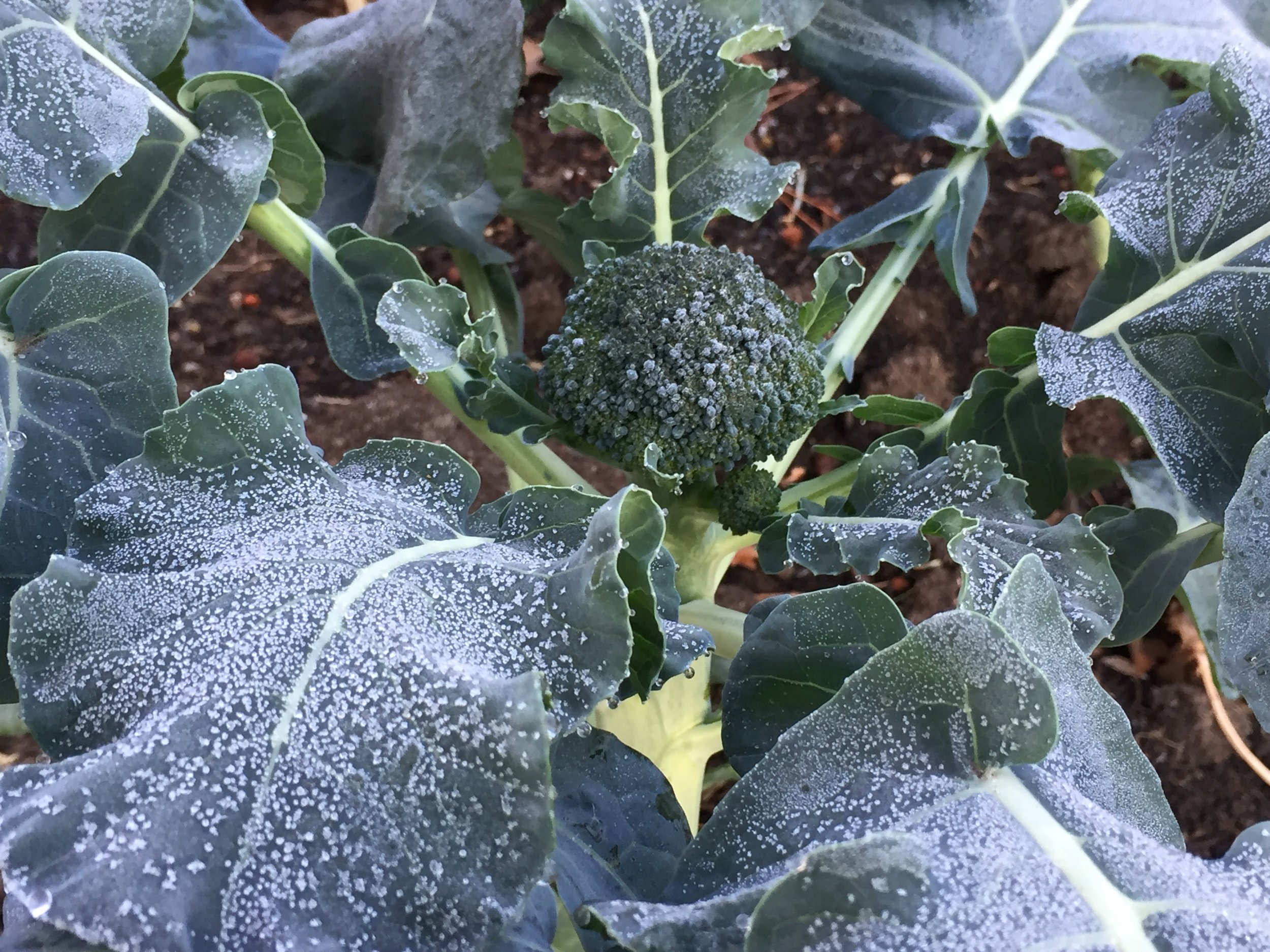
Cold broccoli

Cold broccoli

It's crunch time at school. The last two weeks of the semester (I've just finished with one of them) contain three finals, one lab practical, two large projects, two presentations, and one book discussion for credit. It's been a bit of a whirlwind. Not a whole lot of time to spend in the garden.

Spinach, with melting frost

Spinach, with melting frost

However I always try to stop doing homework several times a day and get out to do some sort of yardwork, which I find clears my mind, warms my body, and cheers my spirit. Sometimes I sweep up leaves from the sidewalks and add them to the paths between the beds. Sometimes I turn the compost pile. Sometimes I haul water from the rain barrel to the container plants. I find these breaks very necessary.

8 am, 32 degrees, and the bees are already working - astounding. So much for that old adage about them staying at home unless it's 50 degrees or above.

8 am, 32 degrees, and the bees are already working - astounding. So much for that old adage about them staying at home unless it's 50 degrees or above.

We've had lovely frosty mornings, but zero rainfall. We've had to run the drip system but I don't like to. The more I learn about what's in our municipal water (which has been added for good reasons), the more I learn it's bad for the garden. More on that in another post. I have to be in the right frame of mind to tackle that one. I must say, the news from my Soil class has been more depressing than hopeful of late.

This cabbage is so beautiful, with it's deckle edge of purple.

This cabbage is so beautiful, with it's deckle edge of purple.

I've been removing the summer annual flowers as they get burned up by frost - it's hard to say goodbye to the bright colors of the zinnias, the lacy foliage of the cosmos, and the cheerful orange-red of the tithonia. I'm sure the bees and hummingbirds will miss them too. I retrieved the hummingbird feeder from its summer storage, cleaned it and filled it with sugar syrup. It's hung in its usual place in the Chinese pistache tree right outside the kitchen window for optimal viewing. My tiny friends haven't discovered it just yet, but I know it will soon be a hub of activity. The hummingbirds are often the first birds awake in the morning, getting their bodies moving in the cold. Did you know hummingbirds lower their body temperatures at night so they can survive the low temperatures? We can thank my friend Barbara, birder extraordinaire, for that tidbit of information. It's good to know things, don't you agree?

Shallots in the foreground, wheat in the background.

Shallots in the foreground, wheat in the background.

It's rather freeing to be gardening without the row covers this year, but it also produces a bit of anxiety about how the crops are doing. As you can see from these pictures, everything growing at the moment is placed here because it can withstand cool temperatures. All these crops actually need or improve with a little bit of cold. The only thing that's on the edge is the wheat. 

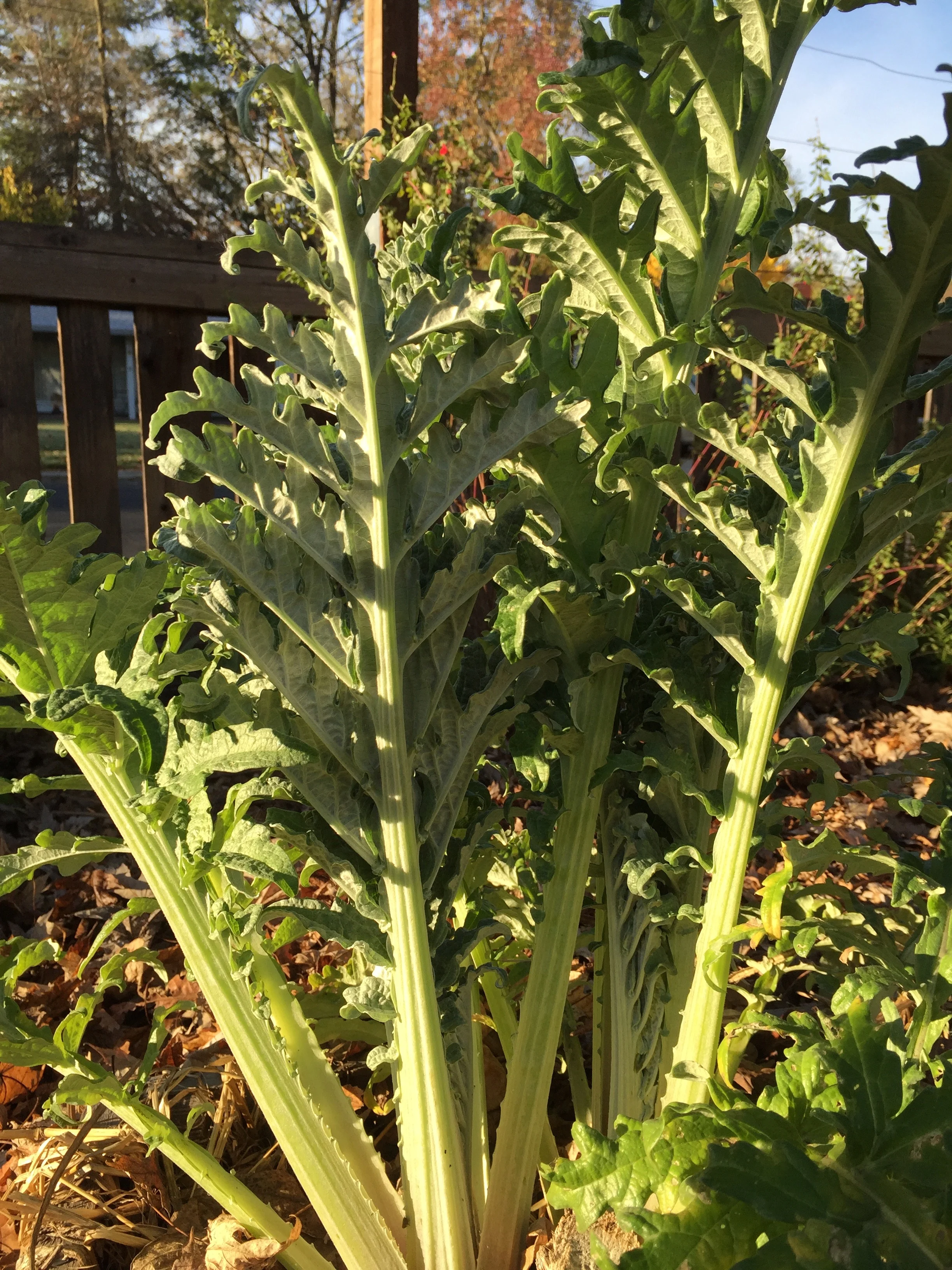
Artichoke

Artichoke

It's winter wheat, so it's meant to be grown now, so I think it'll be ok. It's just a new crop for me. And, as I've said previously, if it does die, at least it will be a green manure for the beds. But I sure would like a small yield for my sourdough baking. 

This is how the chickens look in the morning before the sun hits their yard: Hunkered down and fluffed up to stay warm.

This is how the chickens look in the morning before the sun hits their yard: Hunkered down and fluffed up to stay warm.

I'm a little disappointed in my clover germination rate, and have ordered more to spread around  all of the bedded plants, but it probably won't do much at this point, until it warms up a bit. I really need that nitrogen source for the beds. Next winter I might just plant all the beds to clover or vetch over the winter, in order to further improve the soil.

Narcissus blooming already!

Narcissus blooming already!

Speaking of improving the soil, I've ordered a quarter pound of lupine to scatter in the pollinator beds, along with the usual poppies and other California natives. I realize I haven't done much to enrich the soil in those beds, other than random handfuls of compost over the years. The lupine, being a legume, should help introduce some nitrogen into those areas. As I clear out the summer annuals, I'll add the spring wildflower seeds to compost and scatter them in place, so that as soon as the weather warms up in January, they can get started growing.

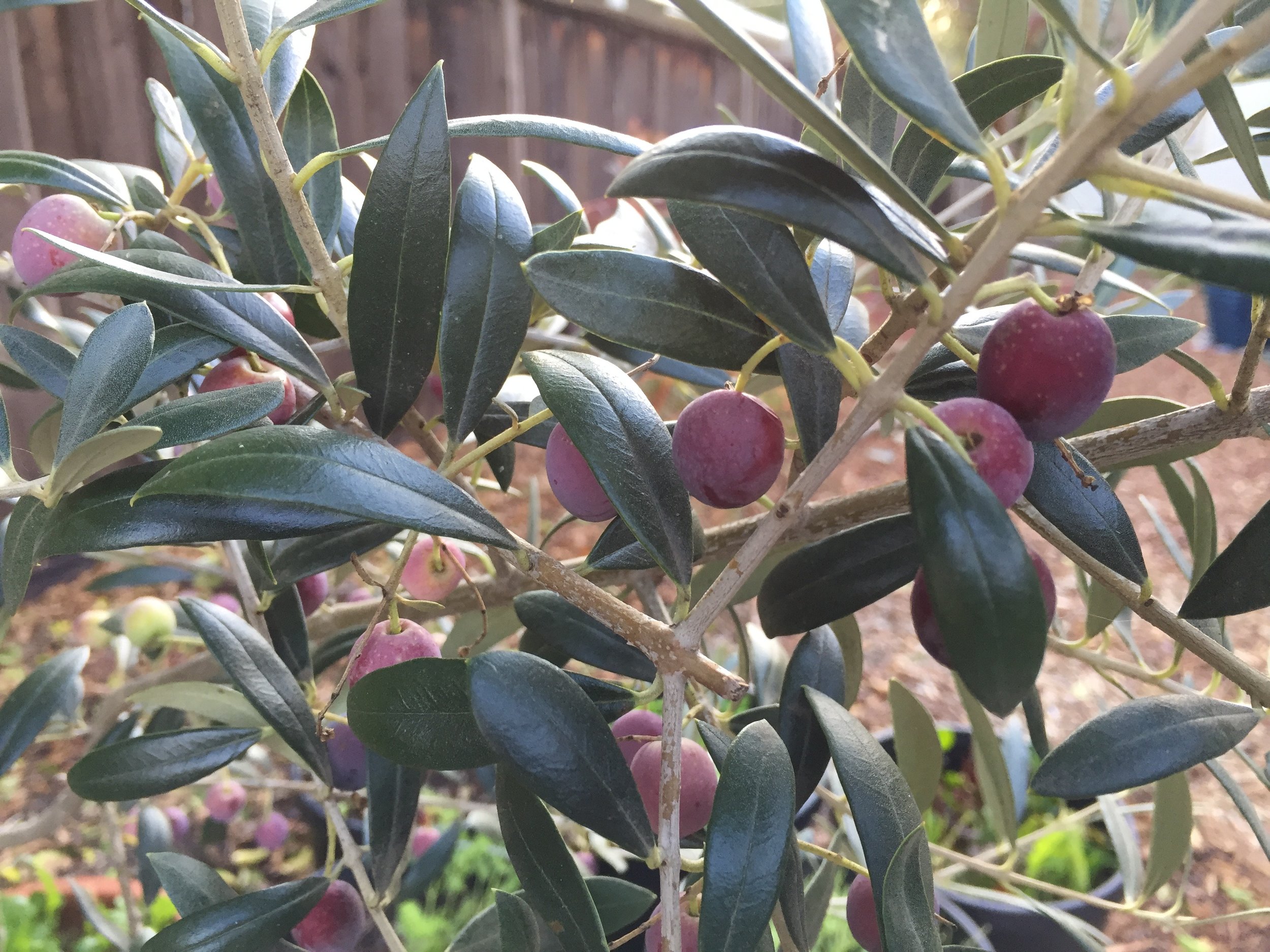
Arbequina olives, getting closer to harvest. These two trees are in very large pots, but I'm planning on transplanting them into a space where a privet has been. The privet is now a 15-ft tall tree, and is terribly good at reseeding itself, blech. T…

Arbequina olives, getting closer to harvest. These two trees are in very large pots, but I'm planning on transplanting them into a space where a privet has been. The privet is now a 15-ft tall tree, and is terribly good at reseeding itself, blech. The only reason I've left it so long is for the bees - they love the flowers. But it's time to remove it. And the olives will be happier in the ground, though they will need excellent drainage.

I'm actually rather unhappy with the lack of bed space for greens, though I planned it to be this way. All the greens are in containers, and they are doing fine, but I'm not getting the harvests that I usually do. I'd have to plant a zillion containers to equal the size of one 4x8 bed. I miss having overflowing baskets of chard, spinach, and kale. I have to be conservative with my use, which bothers me. This is greens season. We should be profligate with their use, eating them at every meal, getting all those good winter nutrients. Instead I am rationing them. 

shelling peas

shelling peas

So I'm not sure how to handle this. This is the problem with a small farm. You need time for the cover crops because the soil needs the rejuvenation. But that means there is less space for actual crops. If I had an acre, I could trade off half each season and have room for both. Somehow I am going to have to figure out how to incorporate both covers and crops into the same beds at the same time. Actually this would be good for many reasons. I just have to change my mind about how the beds are supposed to look and work. I have to be creative in my planting schemes. 

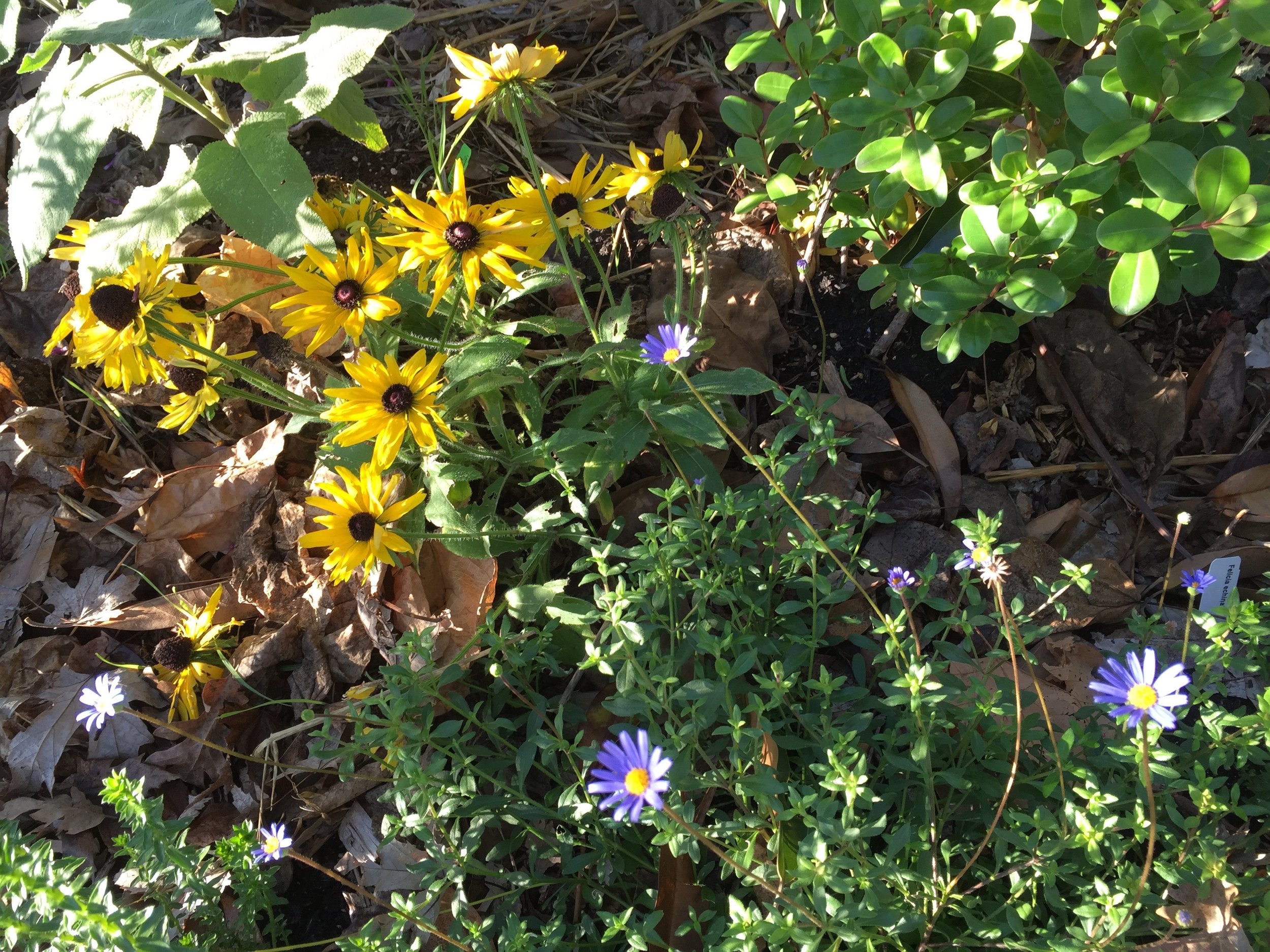
Some flowers are not minding the cold - the yellow is Rudbeckia hirta and the purple is Felicia echinata.

Some flowers are not minding the cold - the yellow is Rudbeckia hirta and the purple is Felicia echinata.

I think it's important to have an overarching goal for each gardening year. 2017 was our year of tomatoes: Our goal was to simply have more of those, both for fresh eating and for canning. And it worked! Usually we are out of canned tomatoes by about this time of the year. But I still have many jars of both tomatoes and tomato products on the canning shelf and in the freezer. This really feels good. We set a goal, and we accomplished it. 

Brussels sprouts, recovering after something ate them

Brussels sprouts, recovering after something ate them

So I think the goal for 2018 is to focus on the soil. Make more and better compost. If I must purchase it, buy the best stuff I can find (more on that later). Don't skimp. Find ways to incorporate living green manures in with my annual crop systems. Continue to utilize chicken manure from our own hens, but also continue to find other sources of clean manure (without any chemicals from antibiotics or other). Know sources. Try to provide as much from my own property as possible. Resource what I have here for best use. Make connections with my neighbors for more resources that might be going to the landfill.

Garlic. This is one of the beds where the clover just didn't germinate. Some rain would be helpful in this regard. I'll try again. This is an ideal crop to have intercropped with another species, as garlic doesn't take up much lateral space.

Garlic. This is one of the beds where the clover just didn't germinate. Some rain would be helpful in this regard. I'll try again. This is an ideal crop to have intercropped with another species, as garlic doesn't take up much lateral space.

'Better Soil' is actually a pretty large goal, and is one that can't be accomplished in just a year. And in fact it's been part of all we do here, and have done, for many years now; you've come along with me as I've learned best practices and tried to improve our soil all over the garden, whether it's for vegetables, fruit trees, or perennial ornamentals. But if I make it the primary goal, I think much more will be accomplished much more quickly, because everything I do will be to accomplish that goal first. 

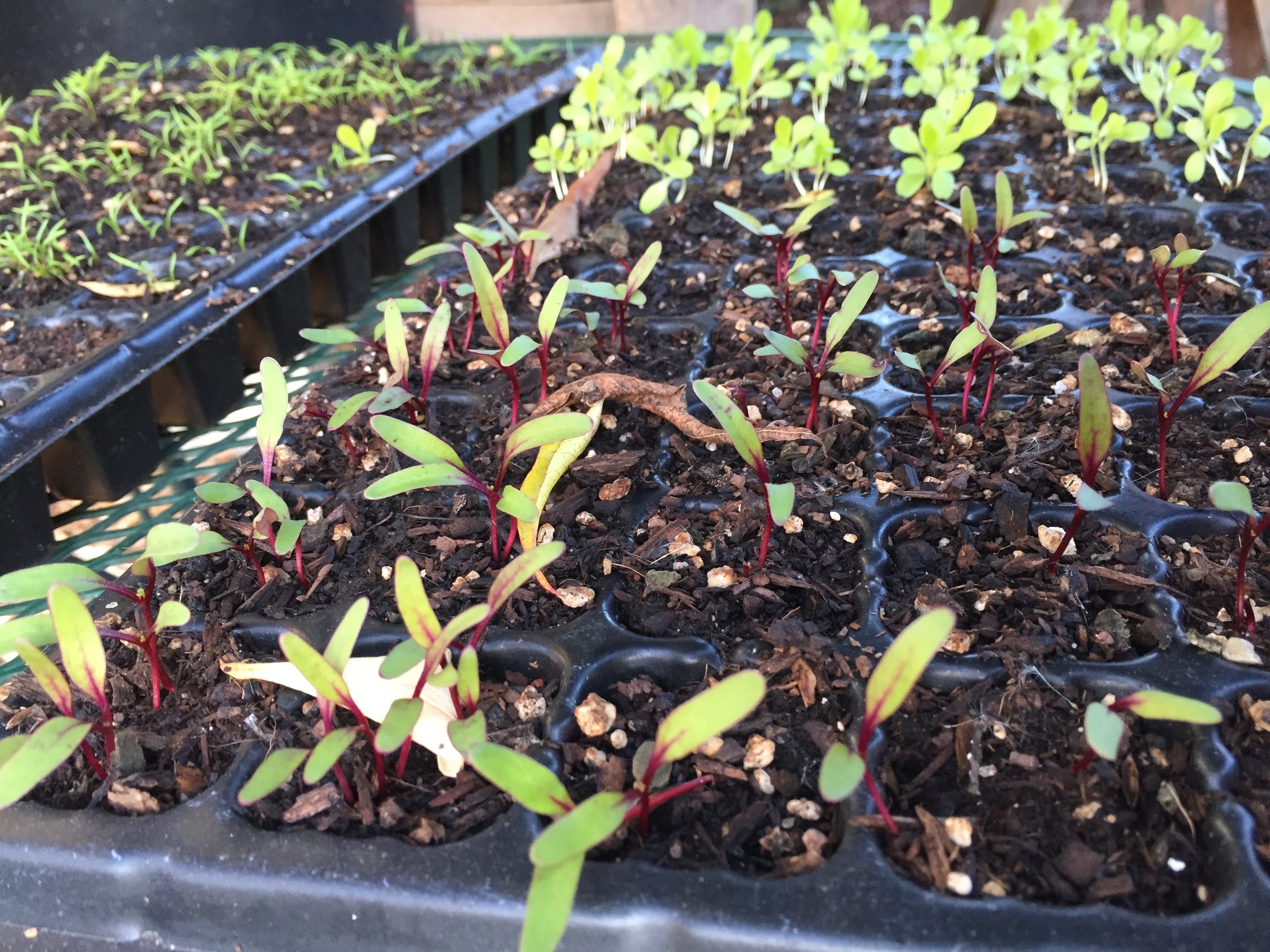
These trays of beets, romaine, and carrot starts have been on a table outside under the shelter of a tree. They are doing fine with the frosts. 

These trays of beets, romaine, and carrot starts have been on a table outside under the shelter of a tree. They are doing fine with the frosts. 

Some of my practices will have to change. I think I will do less direct sowing in the garden, and instead make use of our little homemade greenhouse for lots of seed starting this winter, so I can put starts in the beds. This means that it will be easier to keep things growing all the time in each bed. There will always be cover; there will never be a time when the beds are bare. For instance, I have a bed where I left Thai basil growing and flowering in half of it, but it is now dead from frost. So I'll take some of these starts I have and replace the basil with them. The other half of the bed has fully grown cauliflower plants, which succeeded pepper plants. I certainly couldn't direct-seed into that basil half of the bed now - well, maybe turnips or radishes - but it would be hard to germinate anything else in there at the moment. However I can transplant these starts in, and they should do just fine.

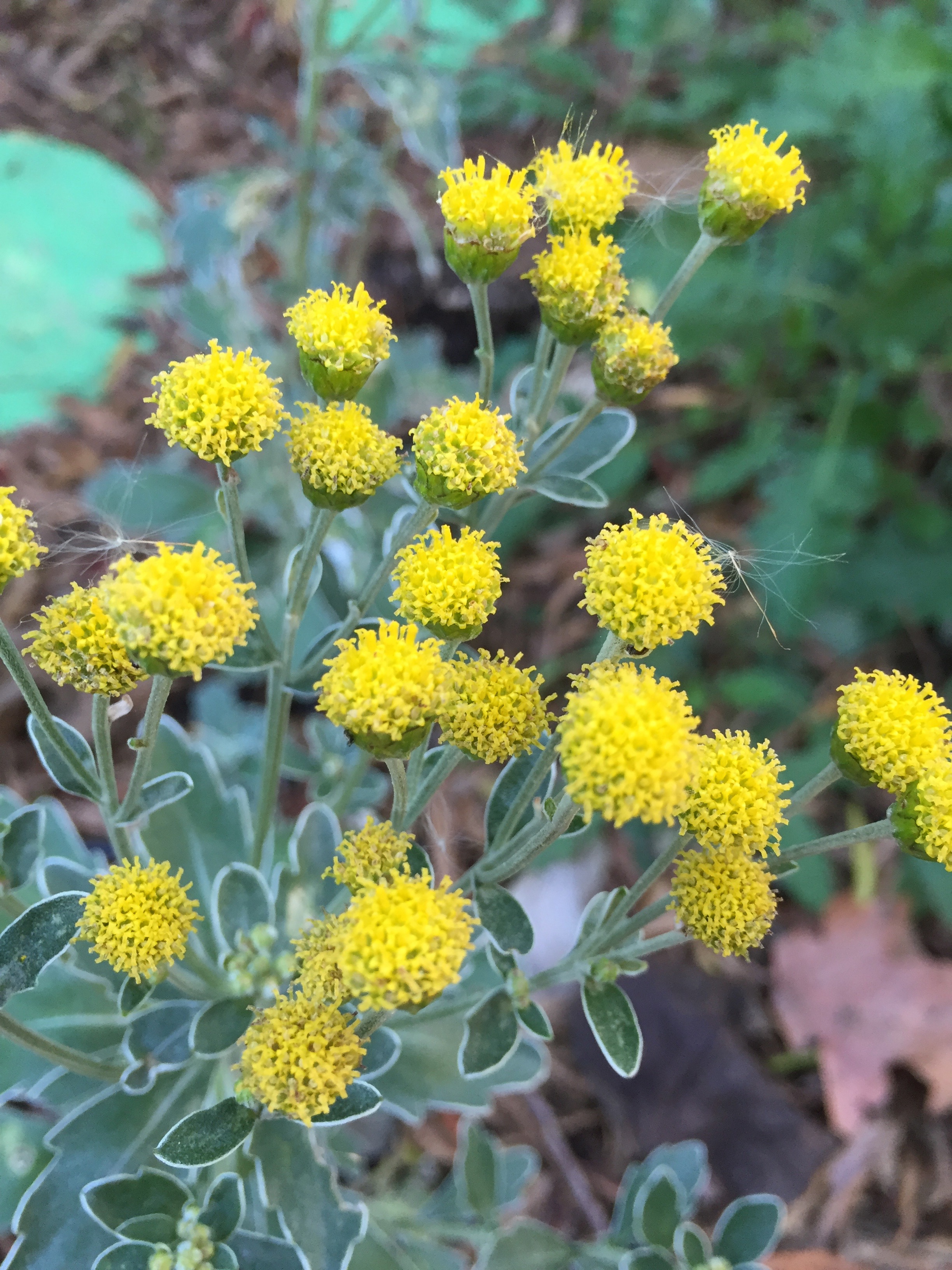
Ajania pacifica, or Pacific Chrysanthemum, a welcome winter bloomer in a protected space

Ajania pacifica, or Pacific Chrysanthemum, a welcome winter bloomer in a protected space

I'm excited to take you along with me as I work on this goal, and to see how much I can accomplish in one year. I'd also love to hear what YOUR goals are. Plus, has anyone started buying tomato seeds yet? I'm getting all the catalogs, and starting to make a list of all the new ones I want to try. Chime in on your favorites, please, and together maybe we can figure out the ultimate tomato list. 

Have a wonderful weekend, everyone.


Tags goals, learning, soil, compost, seed starting, vegetable garden, flower garden
Comment

December Planting List, Hoshigaki update, and Compostable Silverware

December 2, 2017 Elizabeth Boegel
IMG_6531.jpg

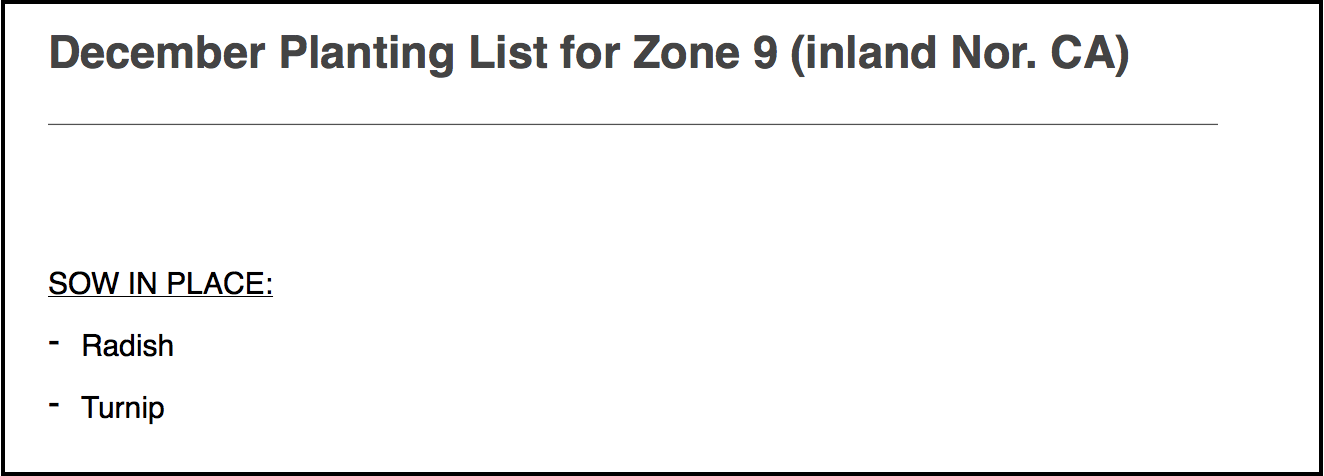
Goodness, this is a short list.

Screen Shot 2017-12-02 at 9.29.43 AM.png

I just recently planted parsnips in a container, though, and they have germinated. Also, I would say you could continue sowings of kale, chard, and spinach, as long as they are in a protected area (under cover, in containers, etc). 

Other to-do items for later this month: Prune blueberries and huckleberries, severely prune any California fuchsias (Epilobium or as it used to be called, Zauschneria), prune Caryopteris (must confess I've done that already), and divide any blanket flowers (Gaillardia). 

A couple other things:

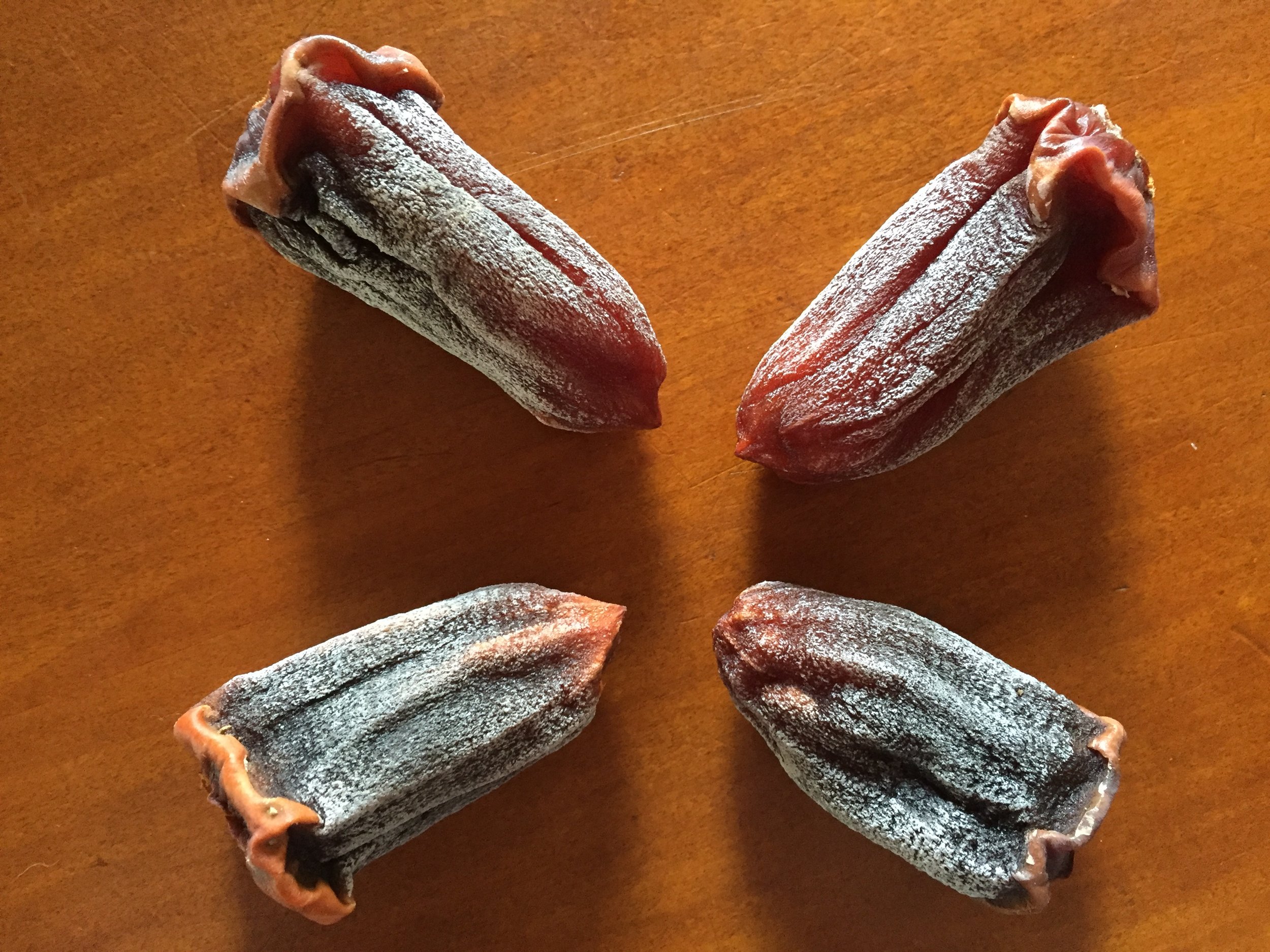
Remember how I started to make Hoshigaki over a month ago? I peeled some Hachiya persimmons, strung them up by a sunny window, let them hang there for over a month, massaging them every other day? Well, today they are finally finished. 

IMG_6840.jpg

This is exactly how they are supposed to look - like they are covered with powdered sugar. Apparently that IS the sugar, coming up to the surface of the fruit; that's what all the websites say. Personally, I don't think that's what's really happening - I think it's a sort of good bacteria - but either way, this is what the finished product is supposed to look like. We sliced one up and ate it. It's good. Not great - still tastes like persimmons, though not at all astringent. I guess I just don't like persimmons very much, in any form. I suppose these would be good in oatmeal, or baked into a fruitcake (if you like that sort of thing). 

IMG_6843.jpg

They are certainly pretty when sliced however.

It's another food preservation project that makes your head spin a little. Here's this juicy fruit, skinned and hanging in your house, being visited by fruit flies and such, and you just let it go and eventually it becomes edible again. And probably not just edible, but fabulously good for you, like kimchi or yogurt. My thoroughly Western mind balks though. It just doesn't seem right somehow, like how Tom felt about the country ham. But these are ancient ways of preserving food, that worked for thousands of years. Kinda twists the old noodle a bit.

One last thing. I've been learning SO MUCH in class that I want to share with you, about soil, about water, about trees.... it's just hard to condense an entire semester's worth of work into a blog post. So I'll just share tidbits when I can. Here's something I thought was worth passing on: We had a soil scientist from UC Berkeley as a guest lecturer the other night. He was talking about compost etc., and he mentioned that one of his classes did a study on those compostable utensils we see all over the place now. I've bought them myself for big events, thinking that if I send them to the municipal compost facility (in my green can), they would break down, and therefore be a better choice than plastic. Well, this class has had them in a hot compost for over two years now, and they still look exactly the same as they did when they put them in there 24 months ago. So much for them being a better option than plastic. Clearly it's still best to use regular silverware and just wash it. 

We're having very chilly nights and clear, sunny days. Last night, I wanted to look at the full moon, so I made a fire in the outdoor pit and sat there for a while. We have barn owls nearby; I've heard them before, and a lot again last night. This is wonderful news!

What's on your weekend gardening schedule? For me, there's more moving of leaves and cutting down a large privet, replacing it with the Arbequina olive trees I've had in containers for the past two years. Also, HOMEWORK. It's finals time! Have a great weekend, everyone.

Tags preserving, planting list, fruit garden, composting
Comment
← Newer Posts Older Posts →

Subscribe

Sign up to get email when new blog entries are made.

We respect your privacy. We're only going to use this for blog updates.

Thank you! Please check your email for a confirmation notice to complete the subscription process.

Powered by Squarespace