• About
  • Blog
  • Contact
  • Favorites
  • Archive
Menu

Poppy Corners Farm

Street Address
Walnut Creek, California
Phone Number
Walnut Creek, California

Your Custom Text Here

Poppy Corners Farm

  • About
  • Blog
  • Contact
  • Favorites
  • Archive

The Leaf Project

November 28, 2017 Elizabeth Boegel
The "South Garden" here at Poppy Corners

The "South Garden" here at Poppy Corners

Nearly every winter, I call around to the tree companies, or scour the neighborhood looking for the tree trucks, trying to get a load of free wood chips. Eventually I source them, the guys come in their big truck, and they drop 20 cubic yards of fresh wood chips in our driveway. Then Tom and I spend the next month with the wheelbarrow and shovel, moving all those chips around to the pathways in between our raised beds, and around the perennial plantings that border the gardens. It's always a slog, because it takes so darn long. Blisters abound. We can't park in our driveway for weeks. Often gates are blocked. Honestly, it's always wonderful for the garden (and yeah, ok, for our waistlines), but hard on the middle-aged humans who tend it.

It's necessary though, if I want to keep weeds from germinating all over the place. I've written here before that we don't have a lot of weeds, and we really don't. By that I mean, not much comes in with the wind or the birds. Oh, a stray purslane here (likely brought in on nursery stock), or a wayward willowherb there, but nothing very troublesome. Most of our 'weeds' are simply seeds from our trees. The Catalpa and the Pepper trees are notorious for sprouting all over the place. And the squirrels plant oak trees everywhere. 

And, this year, I brought in organic straw from a local farm to mulch the summer veg, which was great, but there were a LOT of wheat seeds left in it. And now wheat is sprouting up everywhere, all the places I DON'T want it. Like on the paths. Usually a thick layer of fresh wood chips, every winter, keeps everything manageable. 

But - this year I decided to do something different. 

The "North Garden" here at Poppy Corners.

The "North Garden" here at Poppy Corners.

I told you how I've been picking up coffee chaff from the roasters in Emeryville (Highwire Coffee), and they also have tons of burlap and jute bags to give away. So, I brought home about 100 bags and lined every pathway with them (they are completely biodegradable). Then I put out an all-points bulletin in my neighborhood: I wanted leaves. Some folks would call me after their mow-and-blow service came, and I'd go pick up several bags. Some neighbors would fill up their green waste cans, then wheel the can over and I'd dump them in the yard. Some folks needed help raking and sweeping leaves, so I did that too. It took a couple weeks, but I've finally got every square inch of this garden covered. Well, not the raised beds part. Those get green manures, or cover crops, and compost every spring. But the rest of the garden is covered in a nice thick layer of leaves - sycamore, tulip poplar, valley oak, tallow, red maple, liquidambar - I've got a cornucopia of different leaves on every path. Springy and soft, these leaves will slowly break down through the winter, feeding the soil life underground, and providing lots of nutrients to my garden. 

Time will tell how well this leaf layer suppresses weeds, though - I'm already seeing a few stray wheat sprouts come up, sigh.

Tags mulch, plant nutrition, compost, recycling
Comment

Forest Bath

November 23, 2017 Elizabeth Boegel
UC Berkeley campus, Strawberry Canyon, eucalyptus grove

UC Berkeley campus, Strawberry Canyon, eucalyptus grove

I generally don't eat too much on Thanksgiving (even though I very much like food and very much like my mother's oyster stuffing), but at some point I'll take a walk today, just because it seems like the right thing to do. Many of us will do this. Some will charge up a hill, or speed-step around a lake, making sure they've burned enough calories to make up for the later feast. Some will take a full-bellied, slow walk around after the meal, just trying to make enough room in the abdomen to breathe - or maybe room for more pie. Nothing wrong with either of these methods, but I'd like to suggest a little something different this Thanksgiving. How about a forest bath?

Ringtail Cat trail, Las Trampas Regional Wilderness

Ringtail Cat trail, Las Trampas Regional Wilderness

Have you heard about forest baths? This is a fairly new trend. I recently read about it on the NPR website. There are certified guides who take you on a forest experience. It's not about exercise exactly, though that's a nice side effect; it's about being mindful and in clear awareness of what's going on around you. Letting all of your senses fill with the forest. Looking for the little things, the treasures you often find on a walk - a striped acorn, or a birds-nest mushroom, or a woodpecker pattern in a tree trunk. Listening to the sounds of the forest, hearing a hawk call overhead, or a chickadee in the oak next to you, or the rustle of a lizard near your feet. Smelling the dryness of the leaves, the wet rot underneath, the salt of a coastline, the bark of a Ponderosa pine (vanilla!). Rubbing a smooth stone or a rough leaf with your fingertips.

Oak Harbor, Whidbey Island, Washington

Oak Harbor, Whidbey Island, Washington

I think it's great that there are certified guides that can take you through this process and remind you to be mindful, but I honestly don't think you need to pay anyone to teach you how to do this. It takes some practice, sure, but that's a task easily set and easily accomplished - just let yourself wander. It can even be on your regular trail. Maybe there's something you've been missing all these years, walking along a well-known path. You could even do this in your neighborhood or in your own yard. 

Wildcat Cove, Samish Bay, Larrabee State Park, Washington

Wildcat Cove, Samish Bay, Larrabee State Park, Washington

For some folks, today is a very stressful day, filled with family that you might not enjoy talking with, or with whom you have heated arguments. I think this is probably happening more and more in the tense political climate we live in. Well, what better time than now to get out and do some deep breathing? This kind of walking, in a mindful way, is scientifically documented to lower your blood pressure by up to 40 points. Charging up a hill is great for your heart in one way, yes, but it turns out that slowing down and tuning in to your environment is also extremely good for your health. So if you aren't exactly thrilled to go climb a mountain, or you can't get motivated to do that, perhaps it'll be easier to motivate yourself just to get outside and notice things.

a huge Aminita muscaria under an oak tree, in downtown Danville, California

a huge Aminita muscaria under an oak tree, in downtown Danville, California

Happy Thanksgiving, everyone. I hope you eat lots of lovely food, spend lots of time with your favorite people, and get a chance to wander in nature. 

Tags hiking, nature, wildlife, health
8 Comments

Our Resident Opossum

November 16, 2017 Elizabeth Boegel

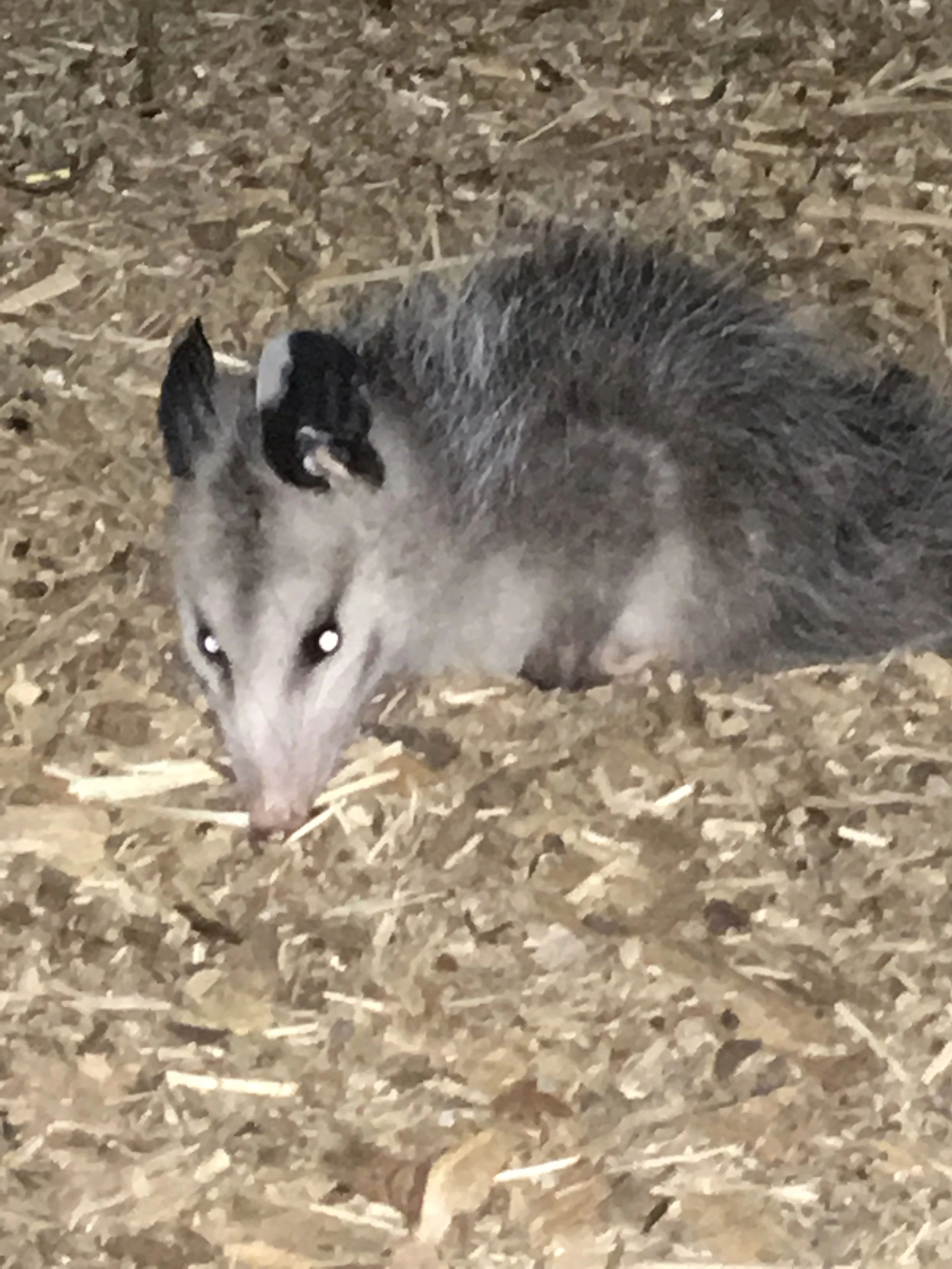
This picture was taken in September of 2016 - the first time we were aware of an opossum living on our property. It was juvenile at the time, pretty small and actually pretty cute. Over the year since we first saw this little guy, we've noticed a lot more opossum activity. It's quite a bit bigger now, and it lives under Adam's train shed - it's point of entry and exit is quite defined. 

IMG_6781.jpg

We've seen it waddling back to, and descending into, this den in the morning. It doesn't do us any harm. Opossums do not carry rabies, they eat nuisance pests such as ticks and snails (and even rodents), and they don't generally like fresh plant material - they prefer well-rotted fruit and veg. So it's likely that it feeds on any fallen fruit from our trees but unlikely that it's the leaf culprit I've been searching for (someone is eating entire leaves of my Brussels sprouts!). Opossums generally aren't interested in eating live chickens but they would probably enjoy eggs - and any eggshells that we throw into the compost (along with rotting food there as well). 

So we've let it live here for over a year now. It may have had babies (we don't even know if it's a 'she'). The Virginia Opossum (the kind we have here) is our only North American marsupial. They stay in dens during the day and come out at night to feed. And herein lies our problem.

We started feeding Tasha the cat in the garage when we got Joe the dog; he was very interested in her food, so we put hers outside to keep him out of it. We've just continued that habit even though Joe has been gone for nearly a year. Lately her food has been disappearing, but we chalked that up to the neighborhood cats and dogs - there is a grey cat who likes to visit, as well as a small dog named Owen, who adores cat food. Another thing that should have tipped us off is that Tasha also has been meowing more lately, especially when she's in the garage. We didn't think much of that, because she is now deaf, and we think she 'cries' more because it's a sound she can feel. So we didn't figure either of these things was terribly curious in itself. 

But, recently, there were a couple of times we actually found the opossum in the garage, about  the time we'd be putting Tasha in for the night. Tom would bang around in there and it would run out, and we'd figure it just toddled away. But last night, I happened to catch the opossum sneaking in around 5 pm, and when it came time to put the cat away, it was still there, beady eyes glowing from under the little red wagon. Tom did his usual banging around, but it wouldn't leave - it just kept finding another nook to wedge itself into. It took us a half an hour and some maneuvering of paddle boards, beer crates, and telescopes to make a sort of barrier, and armed ourselves with brooms, and we finally got it out. It hissed at us, and bared sharp teeth, but luckily did not do the 'freezing' thing, because we certainly weren't going to try to pick it up. It's huge - well-fed and glossy - clearly thriving on this steady diet of cat food. It headed off into the night. Not half an hour later, it was back at the garage door trying to get in. Which is when we finally got hip to the fact that it considered this a permanent nighttime abode. (I'm not sure why the pile of dried turds didn't convince us.) We now think that it actually spends every night in our garage, eating cat food and pooping all over the place. It's a win-win situation for the opossum - free food without having to go hunting for it. A warm, dry night under the wagon. A little company in the form of a cat friend, albeit one that stays far away on her own cushion and likely is uneasy about the relationship. No one sees it go in, and no one sees it go out in the morning. It's ideal. That opossum must think it's hit the jackpot.

A close-up from last year

A close-up from last year

So, clearly we have to form some 'best practices'  to reduce the problem. I mean, it's our fault it has gotten so cozy. Tasha will obviously only have food indoors (sorry, grey cat and Owen the dog), and we'll need to make sure the garage door is closed before it gets dark (we tend to leave it open because Tasha's cat pan is in there too; that might have to change though I really hope not). I have to get in the habit of closing up the garage door by 4:30 or so, and these two things  should discourage the opossum. Tasha should have much more comfortable nights in there now.

Meanwhile,  I think we might see if we can rig a trap right outside the opossum's underground shed entrance, and bait it with cat food, and then relocate the 'possum. First I have to find out if we are even allowed to do that here. There are certainly people whom you can hire to remove them, and they claim to do it in a humane way, but I am suspicious. I'll have to call around. We certainly don't want the animal harmed.

Have any of you had any experience with trapping and relocating opossums (or other critters)? If so, I'd love to hear about it.

Tags wildlife
5 Comments

Wheat Crop Update

November 13, 2017 Elizabeth Boegel
wheat and clover

wheat and clover

This wheat growing experiment is sure interesting. Some of the wheat germinated right away, and some patches were pretty bare. I re-seeded those bare patches, and in some cases the seeds germinated but in some they did not. I can't figure out why: It wasn't species-specific and it wasn't soil-specific and it wasn't what-crop-grew-there-before-specific. So who knows? The bottom line is that some beds are very full and others are not. In all cases, though, the wheat is now tillering. 

A 'tiller' is nothing more than a stem in grasses, and refers to all stems after the initial cotyledon shoot (remember, grass is a monocot, and has only one cotyledon leaf or shoot). Tillers have the ability to be seed-bearing, so it makes sense that you want good tillering. If the wheat is planted close together, it will grow more in height before tillering, but if the wheat has plenty of room, it'll tiller early and get wider rather than taller. It's a fine line between a thick stand and a too-thick stand. If you google 'tillering in wheat' you'll get a bunch of academic articles about how much tillering you should have, how to convert that into bushels-per-acre, etc. However, since this is not a crop we intend to sell (and there's not enough of it anyway), I'm not going to try to mold the wheat to my specifications. Rather, I'm just going to watch and see what it does. And it's interesting to watch, that's for sure. I caught the cat in one of the beds eating the tops of the wheat one day; who knows who else is snacking on it. 

I'm growing crimson clover in with it, and in with everything in fact, to try to get some nitrogen into the soil (*see final note below) and also provide coverage (living mulch) and biomass. The birds ate a LOT of the clover seed I put down, but there's still some coming up in nearly every bed.

Speaking of birds, it became apparent that the sparrows were eating all our salad greens - kale and chard especially. They'd sit on the edge of these pots and tear the leaves off from the edges. I finally had to put some netting over them to keep them out - they were really destroying our crop of winter greens.

I had never seen the birds do that before. I've seen goldfinches eat sunflower leaves, but that's the only time I've seen birds (other than chickens) eat greens. Guess they need salad, too.

I decided to minimize my losses in the beds where the wheat germinated badly, and put all the brassicas in the ground. They were really at the limits of their gallon pots, and I was having to feed them fish emulsion every week to keep them going, and the squirrels had gotten to them (especially the cauliflower) and eaten the tender centers. So I went ahead and put them all out in the beds, where the wheat was sparse. This makes me feel so much better. Keeping them in pots was an interesting experiment, but they are not heading the way they should, and I think that's due to the fact that the pots were too small.

cabbage and leeks. the cabbage is really looking nice.

cabbage and leeks. the cabbage is really looking nice.

Brussels sprouts in the back, cauliflower (probably hopeless at this point) in with the still-flowering Thai basil. You can see I've been lining the paths with burlap bags from the coffee roastery - I intend to cover these bags with leaves from ours…

Brussels sprouts in the back, cauliflower (probably hopeless at this point) in with the still-flowering Thai basil. You can see I've been lining the paths with burlap bags from the coffee roastery - I intend to cover these bags with leaves from ours and my neighbors trees, to prevent weeds from coming up between the beds.

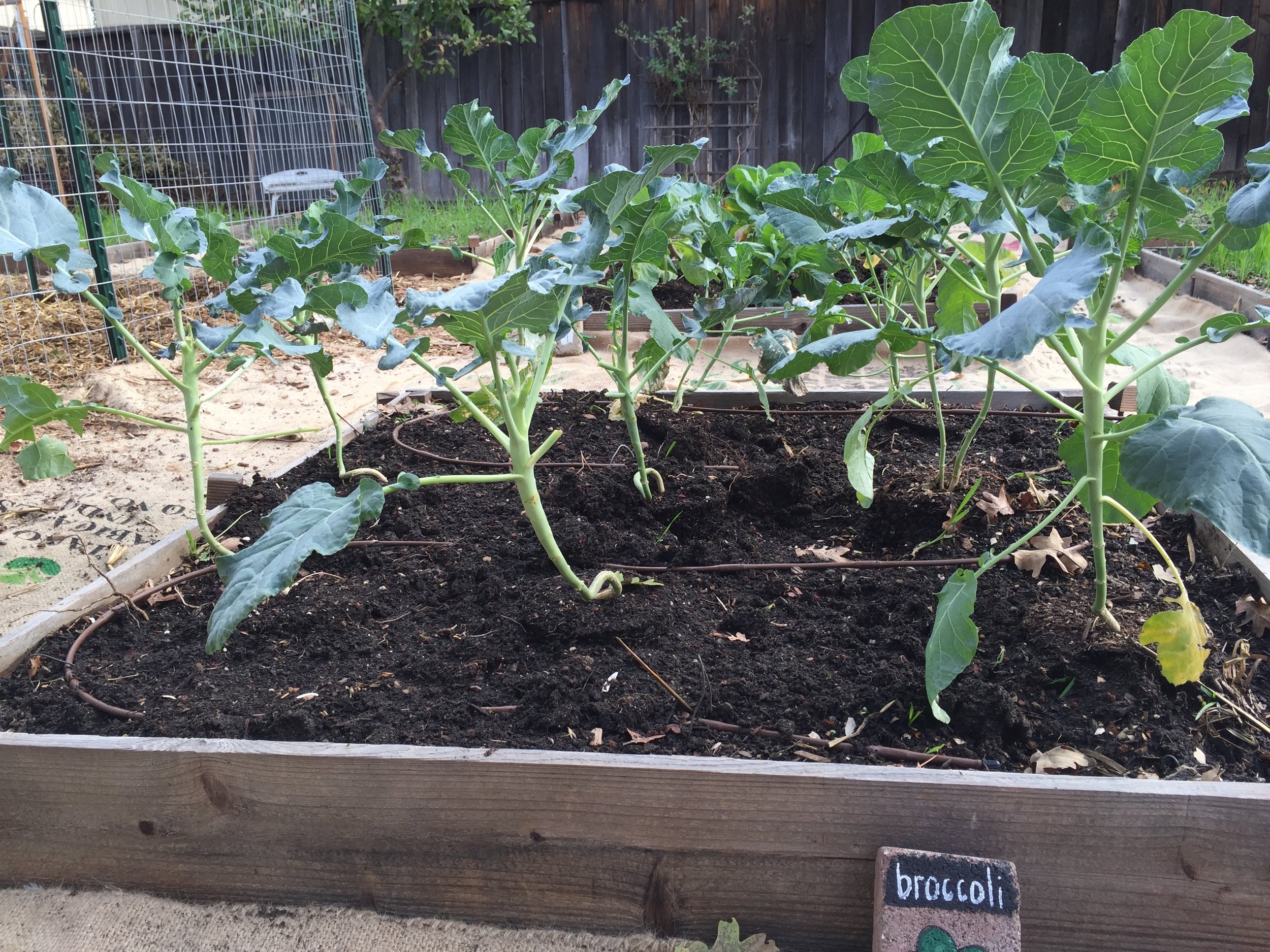
Broccoli, looking pretty leggy

Broccoli, looking pretty leggy

However some other things are doing just fine in pots. Beets, carrots, and greens - all looking well. I discovered some fat green caterpillars on my carrots the other day, and removed them all (seven in total) and gave them to the chickens. I forgot to take a picture. They were not swallowtail caterpillars - if they were, I probably would have relocated them to the fennel. They were green throughout and I can't figure out what they were. Any ideas? 

The shallots, garlic, and peas are all doing wonderfully, and I just ate my first peas this morning while out weeding. Delish. Spring peas are good but autumn peas are just as tasty! 

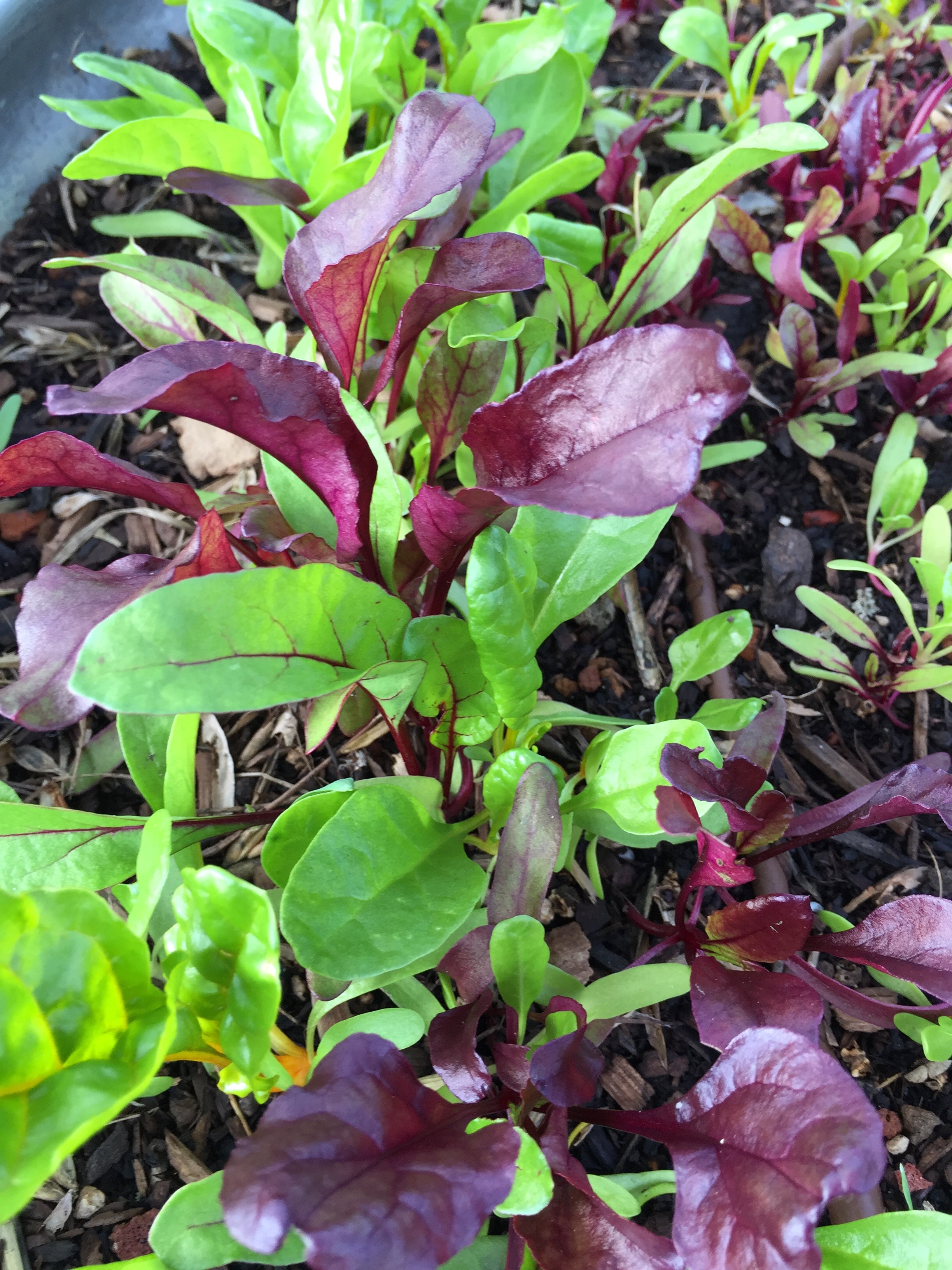
braising greens

braising greens

A final note about the wheat: I'm growing heirloom varieties, so yield should be about 30 pounds per 1000 sq feet. If I get 30 pounds, I'll be absolutely delighted. I expect more like 10. I planted three different kinds - Red Fife, Emmer, and Sonora White. The Sonora is a soft wheat and the others are hard wheats. Hard wheats generally have more protein (good for bread making) and soft wheats less protein (better for pastas and cakes). 

A final note about clover: As you most likely know, plants in the legume family (Fabaceae) will take nitrogen out of the air and fix it into nodules at its roots. In order to have that happen, there needs to be plenty of air down in the roots (lots of organic matter will provide good aggregation, NOT tilling), as that's where the nitrogen from the air comes from. The nodules are formed by a bacteria and the plant develops the nodules to protect the nitrogen-rich bacteria and keep it for its own use. When the plant produces fruit, it uses that nitrogen up. So if you want the plants to provide nitrogen for your soil, do not allow these plants to set fruit. For instance, you plant beans or peas, you eat the fruit of them, you've eaten the nitrogen that the roots collected, and that's fine! But if you cut them down before the plant fruits, that nitrogen, in nodules on the roots, will break down in the soil and enter the microbial cycle, being eaten and then pooped out etc, and will be available to the next crop you put in there. It's also helpful to put the green material that you cut down (the shoots and leaves) of the legume on top of the soil, to break down and provide nitrogen that way too.

If you grow peas next to broccoli, say, can the legume roots share nitrogen with the broccoli plant? Not really. The nitrogen is bound up in the plant until it is cut down. At that point, the nitrogen becomes available to anything else left nearby. Also, if there is a fungal association formed between the broccoli and pea roots, it's possible the nitrogen would be shared that way, but it's unlikely. So! You're only providing nitrogen to the environment AFTER the plant is cut down. Not during. During, the nitrogen is only available to the legume, for the most part. And if you let the plant form fruit, the nitrogen has been mostly used up (though putting green matter down in your beds will always allow for some nitrogen to get back in the soil; not mixing it in, mind, but just laying on top to decompose). 

I'd love to know what autumn/fall veg and fruits you all are growing, and how they are doing, regardless of climate. Please feel free to share in the comments!

Tags wheat, vegetable garden, insects, IPM, plant nutrition
Comment

Readying the Hive for Winter

November 7, 2017 Elizabeth Boegel
IMG_3706.jpg

It's important to open the hive and get a good last look before winter settles in. There might be a sunny warm afternoon in December or January to check on the bees before spring, but since that cannot be counted on, we chose this past weekend to really get in there and have a long session and clean everything up.

Our hive checks have been cursory at best in the last six to eight months, and those were mainly for keeping on top of varroa mite infestations. We noticed, early on in spring, that the bees had really built up a lot of comb around the bars and at the bottom of each curve of comb, attaching each bar to the floor of the hive. We weren't sure why they did this, but what it meant for us was that every time we tried to remove a bar to inspect it, the bar would tear, and we'd have a mess of comb and honey to clean up. This led to a lot more honey harvesting than we expected to do this year (it turned out to be fine because the bees had plenty). Still, bees get pissed off when you break their comb, and with good reason. What with my new allergy to stings (which brings with it a certain, well, gingerness) and Tom learning to take point on our hive inspections, plus a very large amount of bees this year (even after the swarm!), this meant that we just weren't as thorough as we should have been. 

So, in preparation for a good long inspection, Tom made a tool, kind of like a long bar with a 90 degree angle at the bottom, like the letter 'L.' In theory, this tool would allow us to detach the comb from underneath each bar without putting our clumsy, large hands deep down into the hive. We knew that we were going to be in there for a long time, and removing almost every comb, so we got the smoker going real good. November really is the ideal time for a leisurely look, because the bee population is down quite a bit from the summer highs; the drones have all been thrown out, and the queen has altered her laying pattern to fit the diminished daylight so there is less brood. In fact, she might be laying her last eggs of the season and won't start again until after the solstice. And we chose a nice sunny afternoon for it, which meant that a lot of the bees were out foraging, and we wouldn't disrupt the temperature of the hive too much. (Though I'm sure the bees would say differently, if they could.)

The bottom line is that everything looked good. There is plenty of honey for the bees for winter; we removed three full bars and three more that were half-full. We did this because it is important to reduce the physical size of the hive during the cold months. Less bees means less body heat. I've honestly been thinking that we probably should have removed even more, but I also want to err on the side of leaving the bees with plenty of food. The experts say 30 lbs and I'd estimate the bees have at least twice that. So they'll be well-fed this winter, and they can even get out and forage in the garden if the weather is sunny and above 50 degrees. (They are super busy right now, in fact, bringing in lots of nectar and a very pale, yellow pollen.)

Not everything was rosy. We did notice some problems. I saw one small hive beetle.

image credit: Wikipedia

image credit: Wikipedia

These guys can be a terrible menace to a weak hive. Our hive is strong, so it appears that the beetles haven't gained the upper hand, but the beetles are hard for the bees to attack and remove and their shells resist stings. One plus is that they must go back into the dirt to pupate, so I've ordered some beneficial nematodes to apply in the earth around the hive - those nematodes will feed on the larvae of the hive beetle. I bought these from Arbico Organics. I've never seen small hive beetles here before, and I'm hoping that this method will eradicate them before they become a nuisance.

Another thing we found was some evidence of wax moths. Nothing big, nothing terrible, but some of the webby stuff that is the sign that they've been there. 

image credit: Wikipedia

image credit: Wikipedia

A strong hive can fight these off too, and it looks like our bees have defended themselves well, but we cleaned up anything we found relating to wax moths and got rid of it. They are primarily a warm-weather problem, so I don't anticipate them overtaking the hive during winter.

I also added a prophylactic treatment for varroa mite, as I had seen a little bit of bee larvae on the landing board a few days ago (the bees often remove larvae that is compromised). There is no drone larvae at the moment, which is good, as that usually harbors the most varroa; but I want to eradicate any possibility as the hive goes into winter, so that they are still strong when it is cold. I don't want nosema, which is a fungal pathogen that causes dysentery in bees, which often appears when colonies are weakened. They don't need that when it's cold and wet.  I used Apiguard, which is thymol, which is made of the herb thyme. It's an organic treatment which kills mites on bees but not the bees. 

One thing that has NOT been a problem this year is ants. I've never seen any on or in the hive, so my diatomaceous earth around the hive legs has been effective.

Both Tom and I feel good about this hive cleanup and preparation for winter; the funky comb has been bothering us for months, and it feels great to have it dealt with. Tom has become really good at hive inspections - this is one of those things that you can only learn by doing, I think. 

And a good side benefit of it is that we have lots of honey to give away as teacher gifts this year, which is great.

One last interesting thing regarding bees - my friend in Orange County sent me this picture from her garage. I guess this was recently revealed when they were doing work. I advised her to call her local beekeeping association, which she did - and it turns out, most of the feral hives found in Southern CA are Africanized, or aggressive. So beekeepers don't want to keep them (understandably) and these colonies are often destroyed. As was this one. Very sad! It also makes me think that the aggressive bees will slowly be moving north and we'll have to deal with them more often here. I think, in many ways, aggressive bees probably survive better - studies seem to show they have less pest pressure - and that could be an answer for the total bee population going forward, but it would be very hard to manage aggressive bees in an urban situation! I'm sure we'll be hearing more about this as they become more common.


Tags bees, beekeeping, learning
2 Comments
← Newer Posts Older Posts →

Subscribe

Sign up to get email when new blog entries are made.

We respect your privacy. We're only going to use this for blog updates.

Thank you! Please check your email for a confirmation notice to complete the subscription process.

Powered by Squarespace