• About
  • Blog
  • Contact
  • Favorites
  • Archive
Menu

Poppy Corners Farm

Street Address
Walnut Creek, California
Phone Number
Walnut Creek, California

Your Custom Text Here

Poppy Corners Farm

  • About
  • Blog
  • Contact
  • Favorites
  • Archive

Washable, Reusable, Biodegradable Cleaning Cloths

September 7, 2017 Elizabeth Boegel
Swedish dish cloths

Swedish dish cloths

Over the summer, my twitter feed was inundated with news about how terrible kitchen sponges are. I follow a lot of cooking sites plus a lot of environmental sites, so I was getting some mixed messages. The cooking sites wanted me to use more sponges, and the environmental sites wanted me to use less sponges! So I had to figure all this out for myself. I hope I can simplify it for you, too.

First of all, the germ news. We all know how our kitchen sponges can hold on to a lot of bacteria; after all, that's why they smell bad after a while. I always thought that microwaving a wet sponge for a minute would kill all of that. Some other folks I know put their sponges in the dishwasher to clean, or boil them. But the latest news is that those methods actually can make the sponges worse! It seems that this is because the bacteria are resistant and rapidly re-colonize the sponge, making it even more germy than it was in the first place. The solution? Change your sponge more often. The recommendation was at least once a week, more often would be better.

Which seems sensible. Sponges are fairly inexpensive, so why not buy more and change more often?

Here's why not: Conventional sponges are simply terrible for the environment. They contain plastic, dyes, and synthetic disinfectants. When you throw them away, they go into the landfill and never decompose. There are some sponges that are made with recycled material, and those are better, but they still won't decompose like something natural would.

So this sent me on a hunt for alternative ways of cleaning my dishes. After a lot of searching, I think I have found two products that will really help us stay clean and germ-free, as well as helping the environment. 

First dish cloths. Pictured above are Swedish dish cloths, which are made of cellulose fibers, can be washed over and over again, and when they finally conk out, can be put in your compost bin, as the dyes and materials are biodegradable. Stock up and get a pile of them, use one for 1-2 days, throw it into your washing machine (or boil on the stove), and hang to dry (they cannot be put in a clothes dryer). The downside is that they are not cheap like sponges; however I think the fact that they are reusable for a very long time gives them the edge financially. I couldn't find any of these made Stateside, which is another drawback. I bought them directly from Tuliptree & Saga, which is a Scandinavian storefront, and ended up paying a little more in shipping. Skoy cloths can be obtained on Amazon. As you can see, you can find lots of fun designs, or just plain colors. The cloths are stiff upon arrival and after drying, but act just like a spongy cloth when wet. I have used them for a week now and like them very much. Yes, it takes a little more work to wash and dry them, but I think it's worth it to minimize our household impact on the environment.

Tom was on board with this totally (he is definitely more mindful of waste than I am), but his one request was to find a 'scrubby' sponge, something with some muscle, for pots with cooked-on food. After more research, I found these loofah sponges from Twist. These are really great, they dry fast, and can be composted as well. Since they cannot be washed, we'll be replacing these more often. I think next year I might grow my own loofah sponge gourds so that I can make our own supply. These seeds are on sale at Renee's right now!

Now, I am on a search for biodegradable cleaning wipes. I don't mind cleaning kitchen surfaces with one of these cloths and some environmentally-friendly cleaner (or my own Thieves Vinegar), but I get a little skeevy about cleaning the toilet with anything that I then reuse. Clorox makes a wipe that they claim is compostable, called Green Works, but the Environmental Working Group gave these a bad grade, apparently. If anyone has a suggestion for these, please let me know! 

Tags natural cleaning, composting
Comment

Malabar Spinach (or, hooray for summer greens!)

September 4, 2017 Elizabeth Boegel
IMG_5909.jpg

Perhaps you live in a part of the world where you can grow greens in the summer - lettuces, spinach, kale, and chard fill your plot. Here in our arid, zone 9b summer climate, greens are nearly impossible in the hot months; they either require cool soil temps to germinate, or they bolt immediately upon growing. Fall, winter, and spring are our main greens-growing time; in the summer we tend to make do without. 

Until now! I only recently came across Malabar spinach, and knew I had to try it. It's not really a spinach; it's Latin name is Basella alba 'Rubra.' But the leaves look like spinach, which is how it got it's common name (plus it's from the Southern Indian coastal Malabar region).  It's a tropical plant. It likes HOT weather. It likes lots of sun. And it likes humidity, which is one thing we don't naturally have here, so I have to keep it well-watered. 

I'm growing it in part shade (they'd prefer full sun), up a portion of fence that needed some adornment. I got the seeds from Baker Creek, but I've seen it available at lots of seed houses. They were slow to germinate, and spotty - I probably got about 60% germination rate. They were also very slow to start growing, but once the temperature hit the 90's, they really got going. And this past weekend we had over-100 degree temperatures, so they started taking off for real.

As you can see, these are vining plants, and they will get quite bushy and cover this fence, probably growing right over it into the neighbor's yard. They are very sensitive to frost, so I'm hoping the fence protects them and I can grow them as a perennial. If not, it's a lovely summer annual. It has attractive red stems and very shiny leaves, which are large and fleshy, almost succulent. It does taste remarkably like spinach and stands in very well in green salads. I have not cooked the greens yet, but apparently they do well in things like frittatas, which is where we would use them most. Every part of the above-ground plant is edible; the flowers are pink-tinged and pretty, and then they turn into very dark purple berries which are also edible, though very seedy. And that purple color in fruits is extremely dense in vitamins. 

IMG_5915.jpg

I am thrilled with this plant; thrilled to have summer greens to graze on as I make my way through my garden chores, and thrilled to give some fresh to the chickens each day. I'm excited to see what I can do with the berries. The only downside I can see is that it can be invasive in tropical climates, so if you live in the American Southeast,  you'd probably want to be careful growing this plant. 

For a stunning picture of a mature vine and some more facts on this versatile plant, check out this post from the Brooklyn Botanic Garden. And if you'd like some seeds, let me know, as I'm sure I'll have plenty to share!

Tags vegetable garden
4 Comments

September Planting List

September 2, 2017 Elizabeth Boegel
My mom's canning shelf, circa 1975; Gaithersburg, Maryland

My mom's canning shelf, circa 1975; Gaithersburg, Maryland

Screen Shot 2017-09-02 at 9.06.17 AM.png

Ok, "Steam"tember has arrived. It was 109 here yesterday, and is expected to be 112 here today. San Francisco is smashing heat records left and right; suffice it to say that this is a heat wave we didn't really expect. Or rather, I should say, we DO expect heat in September, but maybe not quite so extremely!!!

Anyway, what that means is an indoor day for us. I'll go out about three times and give the chickens a spritzing, and make sure the bees have water-filled bowls nearby; other than that, not much gardening activity is taking place. Luckily, I've done a lot of September's list already, and will continue to do it as the month goes on. Leeks, carrots, and beets have all been sown, the brassicas are all potted up and growing nicely, the kale, chard, and spinach will go in when I find room, and while I already tried to germinate peas in one place, they aren't taking, so I'll try them again somewhere else. But not while it's this dang hot!

I hope you're having better gardening weather on this Labor Day weekend, and can spend some quality time outdoors. Now, back to my iced tea and a binge-watch of The Handmaid's Tale on Hulu.


Tags planting list, vegetable garden
2 Comments

Homemade Sriracha

August 31, 2017 Elizabeth Boegel
IMG_5822.jpg

We've made all kinds of different hot sauces each year from our homegrown peppers, but this year I really wanted to try making Sriracha sauce, or Rooster sauce; the garlicky, spicy-sweet Thai chili sauce that we all love to put on our Asian dishes. After researching different methods, I decided to go with the recipe from this video, which features chef Jet Tila from Los Angeles. My batch turned out perfectly; it tastes and smells just like the stuff you buy from the store (maybe even better). So I thought I'd share the method here with you.

The most important ingredient, of course, is fresh chilies. I waited until I had the requisite amount ripe in my garden; you could just as easily go to your local farmers' market and buy someone out of their supply. You'll need quite a few of them, more red than green. I used a mix of jalapeños, Maule's Red Hot, Calabrese Piccante, and Thai peppers. Here is the recipe:

“¾ lb red jalapenos/whatever you’ve got
½ lb green jalapenos/whatever you’ve got
4 cloves garlic
¼ C white sugar
¼ C brown sugar
2 t salt
1 t xanthan gum
½ C distilled white vinegar

Chop peppers and garlic and add to food processor.
Add sugar and salt.
Process till chunky.

Decant into mason jar and cover with cheesecloth. Let sit on counter for 7 days. On the 3rd day, start stirring the mixture once a day.

After the week has passed, blend the mixture. Then strain by pushing through a sieve, or processing with a food mill. Put back into clean blender and add vinegar; blend. Then add xanthan gum, and blend until thick (just for a moment or two). Decant into decorative jars and refrigerate.”

By the way, I bought the xanthan gum on Amazon for not much money, and got a ton of it. It's a natural thickening agent, which most folks use for gluten-free baking. I can't imagine I'm going to use much of it, so if you are near me and decide to proceed with this project, let me know and I'll share some.

This is what it looks like after you've got the first six ingredients mixed up. You let this sit on your counter for a week, and as you can see, you need to cover it lightly with cheesecloth or a dishtowel, to allow for gas exchange. On the third day, you begin to stir it once a day (I used a chopstick). You'll start to smell the odor of fermentation pretty much right away, and the fumes from the chilies can also be quite strong. 

After a week, you'll blend the mixture.

IMG_5872.jpg

Here comes the most difficult part of the process: You'll need to push this mixture through a sieve, to strain out the seeds and large pepper solids. This takes a while. Keep at it. You want as much of the good stuff as possible. In retrospect, I think it would go easier using a food mill.

IMG_5873.jpg

I fed those seeds and chunky bits to my chickens and they loved 'em!

Then, rinse out your blender, and put the strained mixture back in. Add the vinegar and blend. Then add the xanthan gum and blend. You'll see it immediately thicken up. Then decant into a jar and put in the fridge!

Or, do as I did, and put it into decorative bottles to give as gifts. 

These jars are maybe 6-8 ounces? So the recipe doesn't make a huge amount, but far more than any family will eat in a year, I would imagine (unless you are a Sriracha addict).

A note on storage. I talked at length with a preserving expert and we wrestled this one out. We both think there is enough acid in this that you could water-bath can the mixture with no safety issues. However, canning it would change the color and also kill all the good fermentation bacteria you've got going on in there (though the vinegar kills some of it, too). Fermented foods are often kept in cellars for quite a long time without any problem; since I don't have a cellar here, I'll keep these in the fridge until I'm ready to give them away. Over time, the sauce should develop even more flavor and nutrition. 


Tags peppers, preserving, cooking
Comment

Food Waste

August 29, 2017 Elizabeth Boegel
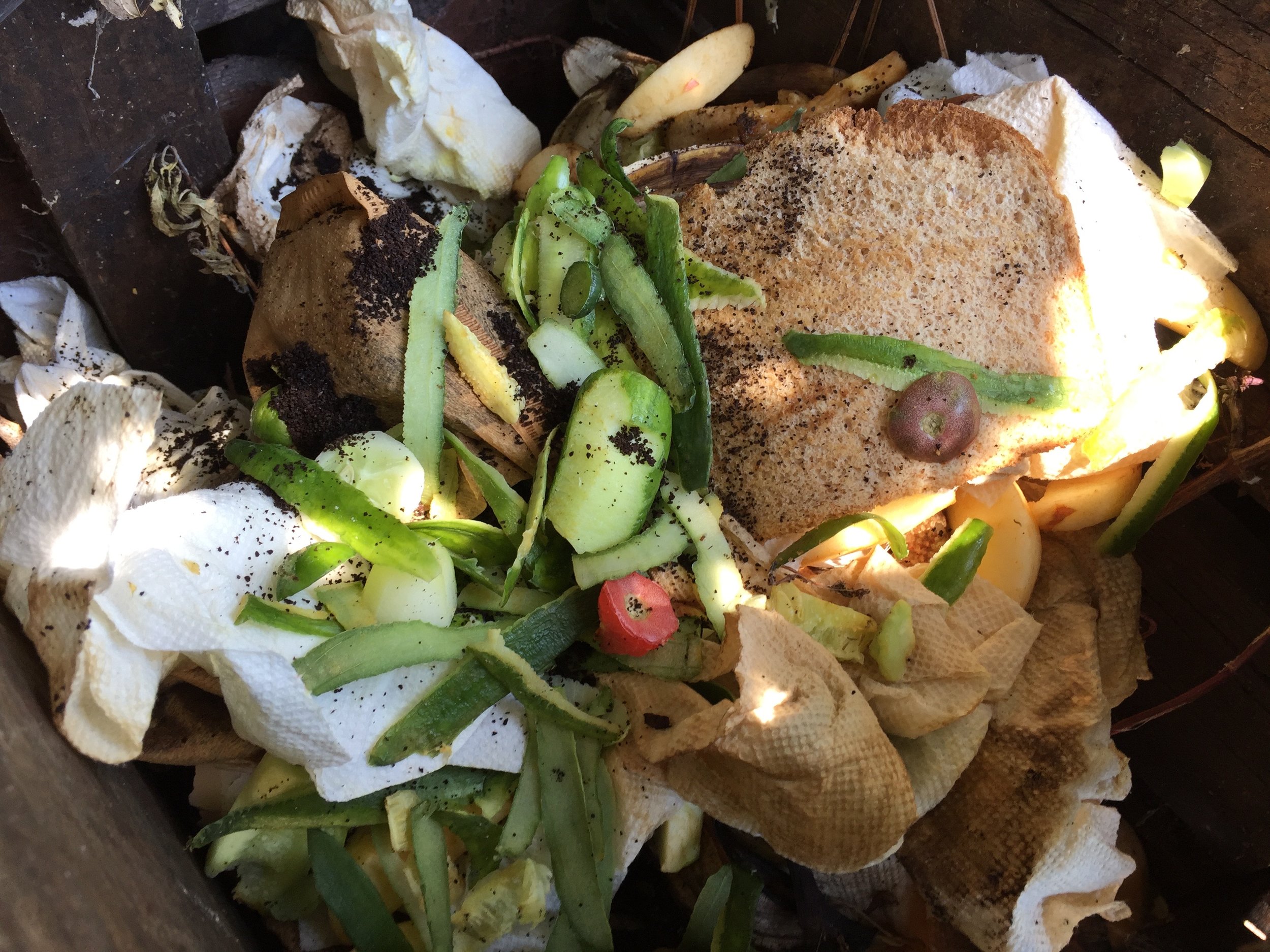
At the top of the worm compost bin: cucumber peelings, a heel of bread, coffee grounds and filters, paper towels, some apple bits that went bad, and tomato cores.

At the top of the worm compost bin: cucumber peelings, a heel of bread, coffee grounds and filters, paper towels, some apple bits that went bad, and tomato cores.

Recently, I viewed the trailer for the new film "Wasted: The Story of Food Waste" (you can view it HERE). It looks interesting, and I'll definitely see it when it becomes available; the featured chefs talk about how to use the parts of the ingredients that we would normally throw away, and make delicacies of them. A great thing for more restaurants and chefs to learn and put into practice, in my opinion.

It got me thinking about my own practices, and the food waste in my own kitchen. We make a lot of mistakes here at Poppy Corners, and we're constantly learning new things, but one thing we've got pretty well dialed in is how to avoid waste. Both Tom and I grew up with frugal, creative mothers, who could do a lot with less, so we learned early how to eat 'nose to tail' so to speak (even though our mothers probably wouldn't have cooked noses OR tails). As we've become more avid home cooks, we have developed systems to help us continue this frugality/no-waste idea. Here's a few suggestions, in the hopes that we all become better no-wasters.

1) Meal Plan/Shop Smart: I remember a time, back when we were first married, when Tom and I would come home exhausted from a day at work and a long commute and we'd look at each other and say, 'What are we going to eat?' and then someone would have to go out to the store and get something easy and fast, or go pick up take-out from a local restaurant. Once we had kids, we realized how unsustainable this practice was: Expensive, not very healthy, and it made everyone cranky and harried. It doesn't have to be that way. A little planning goes a long way. You can plan a whole week's worth of meals, which I did for years when we were under a tightly controlled budget, and it works successfully, though I actually found that for us, it wasn't ideal, as either some food would go bad before I could get to it, or we'd not be in the mood for what I had planned seven days ago. Then I went through a phase where I fancied myself a little like Julia Child in Paris, shopping every day. She would stop in at the fish monger, the cheesemonger, the boulangerie, the vegetable market. This is a delightful fantasy, and if you live in a place like this, more power to you. But our local farmers market takes place once a week; we don't have a butcher anymore let alone a fish monger; and what about things like toilet paper and napkins? Clearly a little planning was needed.

I finally settled on a every-other-day or every-three-days pattern that doesn't drive me crazy, provides everything we need, and still allows room for cravings or creativity. I keep two lists on the fridge at all times: One for Safeway, for things like dry goods or toiletries, and one for Whole Foods, for all the good cheese and grassfed meat and produce that we aren't growing at the current time. If a trip to the Farmer's Market happens on the weekend, or we take a day trip to a place with farms, then some things can be crossed off the Whole Foods list. 

I plan two to three dinners at a time. I'm always asking the family for ideas of things they want or are craving, but mostly they eat what I've planned. That means a heavy rotation of things I know everyone likes, such as pesto, or roasted chicken, or marinated flank steak, with one or two new things a week that we all vote on and decide if we'll have it again. I try to have fish at least once a week and a vegetarian meal at least once a week, but it's not a hard and fast rule. We also eat seasonally, which means lots of watermelon and corn and using the grill in summer, and lots of hearty greens and brassicas and braises in the oven in the winter. 

2) Make the right amount/Eat the leftovers: I'm lucky, because I have family members that will eat all the leftovers. In fact, they vie for them! Investing in good thermoses for the kids and good storage containers for Tom (who has a microwave at work) have really helped. Adam loves the leftovers more than the dinners I sometimes think, and Tom has a great desk lunch instead of a sad desk lunch of a soggy sandwich. However, if you don't have folks in the house who will eat leftovers, then make less of any given dish, or only as much as you will eat that night. Or consider a food swap - I have friends that belong to dinner groups, where someone makes dinner for several families on Monday, then someone else takes Tuesday, etc. Or if you're baking and you have extra, consider giving to an elderly couple in your neighborhood, or inviting the local kids to a cookie party.

3) Use as much of any ingredient as you can: Look for recipes that use up as much of a given ingredient as possible; for instance, a fish dish called Rollatini of Sole we had recently used the entire lemon rather than just the zest or the juice: the zest was used in the breadcrumb filling, the juice of one half was used in the sauce, and the other half was sliced and used as a base on which to place the fish as it baked, and then became a tasty part of the dish. (By the way, we used local fresh Petrale sole, and it was excellent. I highly recommend this dish!)  I tend to use a lot of stems when cooking with herbs, so they aren't wasted; some people even save tomato seeds and pulp to make tomato water, which is an excellent liquid with which to cook rice. Which brings me to...

4) Make broth: Any of those peelings or leafy tops that you don't eat can become a beautiful jar of broth. Nothing is easier! Fish bones become fume. Chicken bones and innards become chicken broth. Pork chop bones become pork broth. Beef rib bones become beef broth. Vegetable scraps can be added to any of these for deeper flavor, or can be used on their own to make vegetable broth. Just keep your bones/peelings in the freezer in a bag until you're ready to make broth, then put in a large pot, cover with water, add any seasonings you like (I never add any because I want a pure taste, but many people add all kinds of stuff. I do add a little apple cider vinegar to help leach the nutrients from the bones). You can put it on the stove top and let it simmer away, or you can put it on a low setting in the oven and let it go all day, or you can even put it on the low setting of your crockpot while you're at work. Strain out the bones and trimmings, cool in mason jars, label, and freeze. You'll have all the tasty liquid you need to make any kind of soup, rice, beans, grains, your own pho or any other Asian noodle dish, or you can drink it on its own when you are sick or need some extra nutrients. This is one of the most nutritious things you can do for yourself!

5) Maintain a compost bin/worm bin: Any bits of things you can't figure out a use for can be put in a compost bin. Eggshells, coffee grounds, used tea bags, that dried out mango, that moldy peach, even your nail clippings or the hair from your brush. Compost bins are the great equalizer. You don't need to do anything fancy, you can even just make a pile in your yard somewhere. One of my teachers throws all his fruit trimmings under his fruit trees, which he says looks ugly, but they compost in place and make even better fruit the next year. Just keep a bowl on your counter and add to it all day, then toss it on the pile at night. When you have extra leaves from your trees, add those too. If you have newspapers, add those. Paper towels, paper napkins, cardboard boxes, paper grocery bags, add those. Let it sit for a year. You don't even have to turn it or water it if you don't want to. Compost will happen even if you don't maintain it; it will just take more time. 

If you don't have outdoor space, consider an indoor worm bin or a city composting service. Or perhaps you have a local school who collects scraps for their garden compost.

6) Keep chickens/hogs: I used to often stay at a place in Mendocino with cabins and outhouses, a very rustic kind of place. They requested that any food scraps you had be fed to their pig, who had his own corral in the middle of the garden. The list of items you could feed the pig were astounding, and it was always fun to take your bucket up to the pig and watch it all get inhaled. That pig was butchered at the end of the year to provide food for the staff, and then they'd start again with a new pig. 

I don't have enough yard space to keep a pig; my neighbors are awfully tolerant of my quirks, but I think they might draw the line at hogs! Chickens are another matter. They don't take up a lot of space, they don't smell, and best of all, they are efficient composters who can turn food waste into usable food, in the form of eggs. Our chickens will eat nearly anything. That tablespoon of buttermilk left in the carton. The head and tail from the rainbow trout that Adam caught and we grilled for supper. The ratty ends of the lettuce. The tomatoes that were half eaten by rats in the yard. The partial bowl of oatmeal that someone didn't want.  The only thing I don't give them is garlic or onions, because apparently it can change the taste of their eggs; otherwise, they are the perfect receptacle for any food scrap we generate. Not only that, when they eat our scraps, they eat less store-bought feed, which means their food bill is far cheaper. 

Food waste is not a forgone conclusion in our home kitchens. We can find crafty ways to use every bit of our purchases. And I'm also speaking as a grower, not just a consumer. Nothing is as precious is the produce that you nurtured for months; you certainly don't want to waste any of it! That fosters a true respect for the product. I think if we all treat our food with that kind of respect (animals especially), we'll all feel compelled to waste less of it.

P/S Two cookbooks that have really helped me to mitigate food waste (at least in regards to cooking a whole product) are: Batch, and The Nourished Kitchen.


Tags learning, compost, cooking, preserving
Comment
← Newer Posts Older Posts →

Subscribe

Sign up to get email when new blog entries are made.

We respect your privacy. We're only going to use this for blog updates.

Thank you! Please check your email for a confirmation notice to complete the subscription process.

Powered by Squarespace