• About
  • Blog
  • Contact
  • Favorites
  • Archive
Menu

Poppy Corners Farm

Street Address
Walnut Creek, California
Phone Number
Walnut Creek, California

Your Custom Text Here

Poppy Corners Farm

  • About
  • Blog
  • Contact
  • Favorites
  • Archive

Roasted Tomato Sauce for the Freezer

July 12, 2017 Elizabeth Boegel

We are harvesting many tomatoes a day. Several get eaten for meals, of course (my latest favorite is scrambled eggs with tomato, shallots, garlic, and basil, served with a slice of my sourdough spread with burrata cheese), but when I get a small bunch that need to be used right away, and it's not enough for a big canning project, I make a roasted sauce for the freezer. You could also pressure-can this sauce, but you can't water-bath can, as the acid is likely not high enough for that. All you need are your tomatoes, some fresh basil, garlic, olive oil, and coarse sea salt (or kosher). 

Preheat your oven to 400 degrees. You'll spread the chopped tomatoes on baking sheets, adding as much chopped garlic and basil as you like. Then lash everything with a good glug of olive oil and a sprinkling of salt. Roast for 30-40 minutes, moving your sheets around halfway, until the tomatoes have softened and everything smells heavenly. Leave to cool for a bit, then load up your containers for the freezer. Make sure to label them with the date!

This makes a great lunch sometime in the dead of winter, when you're craving some summer flavors. If you're not growing your own tomatoes, there's nothing to stop you going to your local farmers market, and choosing a flat of delicious, multi-colored, delightfully misshapen, heirloom tomatoes from your local farmer. Eat some fresh, and make sauce for the freezer. Do this every weekend, and your cold season will be made just a little bit warmer. 

I'm still picking our tomatoes just before ripe and keeping them on the piano to ripen further.

With all the creatures we have visiting our garden and night and taking nibbles, this is the only way I am assured a supply! We have so many different kinds and colors, that we have to check for ripeness by feel rather than by color. When they are soft, they are ready to eat. Soon, I'll have enough all at once to do a big batch of crushed tomatoes for the canner, or possibly tomato paste, depending on the variety. Tomato season is exciting!

Tags cooking, tomatoes, preserving
2 Comments

Fire and Water

July 11, 2017 Elizabeth Boegel
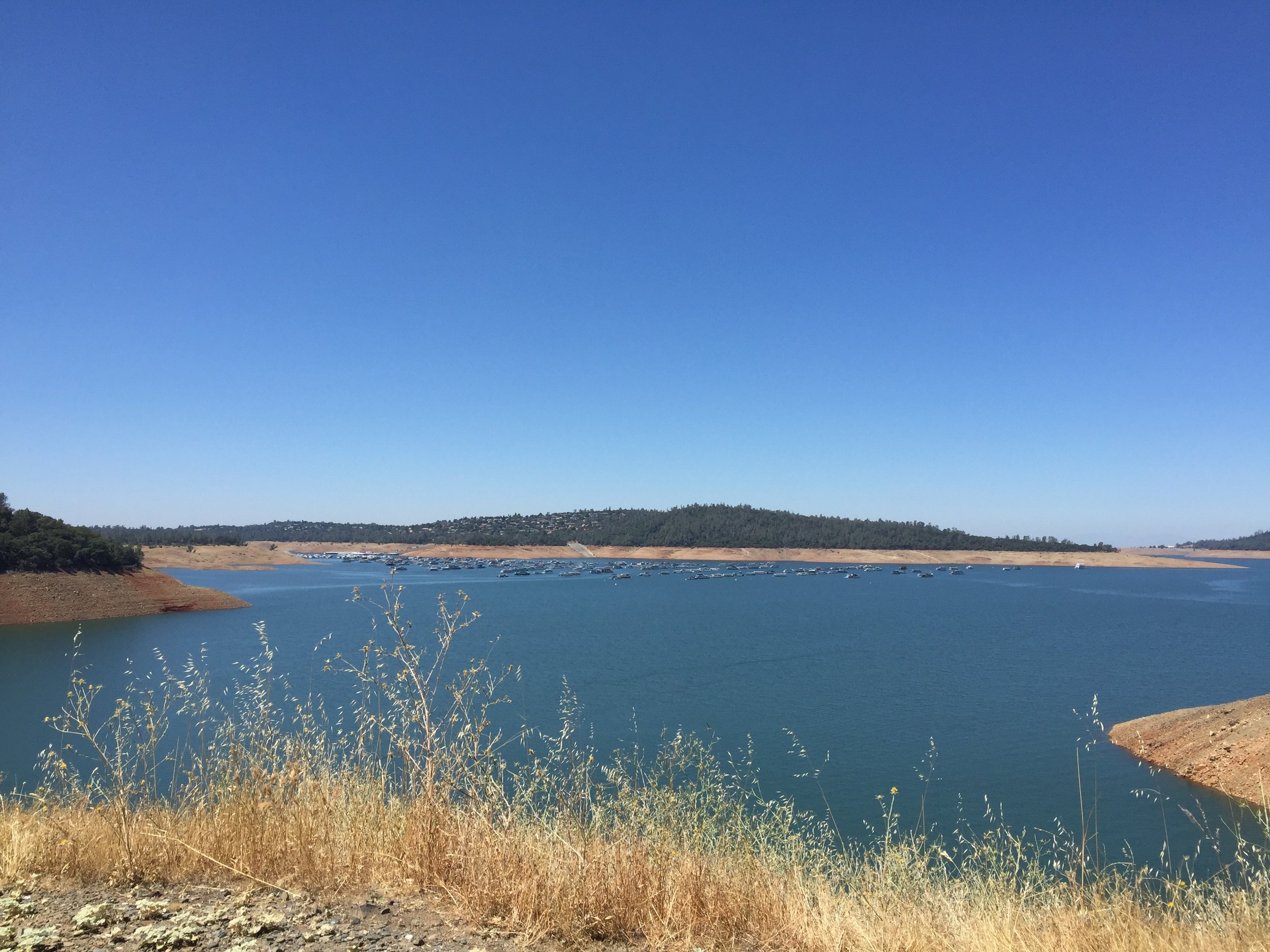
Lake Oroville

Lake Oroville

Yesterday, I drove Kate up to Oroville so she could attend camp at Okizu, which is located north of the dam in Berry Creek. 

A quick word about Okizu, for you new readers or folks who don't know us well. Okizu is a camp for children with cancer and their immediate families. We started attending family camp after Adam was diagnosed with Acute Lymphoblastic Leukemia at age 2, in 2003. When the kids turned eight, they each started spending a week up there in the summer time, Adam at 'Oncology' camp and Kate at 'Sibs' camp. We also still attend a family weekend camp every year.

All of this is completely free for us; it is a wonderful service that allows Adam to connect with other kids who have been through what he has been through, and Kate to spend some time reflecting on what it's like to be the sibling of a child with a life-threatening disease. As a family, each year we get a long weekend to remember that time when he was young (Adam had chemo for three and a half years), and offer support to parents who are new to the diagnosis. We also have the chance to honor those who have lost their lives and mourn with their families. 

Okizu is located in a beautiful valley, under Bald Rock, in Berry Creek. Berry Creek hosts a Grange Hall and a church, but not much else, and the camp property is vast and encompasses a ropes course, a zip line, two lakes (one for swimming and boating, and one for fishing), an archery course, an arts and crafts pavilion, a dining lodge with a games basement, a huge hill and meadow for frisbee golf, a doctors cottage (there is always a doctor and nurse on premises, many of the children who come are still undergoing treatment), and four large sections of cabins and bathrooms for the campers. It's a wonderful place, and our kids often talk about Okizu being like their second home. They look forward to their time there every summer, and expect to serve as counselors when they age out of the camper program.

Anyway, there is a bus that takes kids there, but instead I drive the kids up, as I enjoy the trip. I like connecting with the counselors and directors, taking in the gorgeous scenery near camp, soaking in the farmland north of Marysville, and perhaps most of all, measuring Lake Oroville with a critical eye each year. The fullness of the dam reflects the health of our water supply here in Northern CA. Many, many people get their drinking water from Lake Oroville, which is a man-made basin and dam. It flows out to the Feather River, which is the principal tributary of the Sacramento River, which flows all the way down into our delta which meets our San Francisco Bay up near the city of Antioch. It's a huge and immensely important watershed.

As you probably know, we had so much rain last winter, such epic amounts, that the dam's spillway was engaged, which had not been tested since the dam was built 50 years ago. The spillway eventually crumbled and failed, which caused the experts to activate an emergency spillway, which also turned out to be inadequate. Many thousands of people living in Oroville were evacuated, under threat of a breach. It was a very tense time for that community, and for all of us in Northern CA watching helplessly. The rain, which we so desperately needed, after having been in severe drought for five years, was now so abundant that it was causing a different kind of crisis.

Eventually, the rain ceased, folks were able to go back home, and repairs ensued immediately on the dam, as everyone involved was concerned about the eventual snowmelt in the Sierra (which is underway now, though there were still skiers at Squaw Valley on July 4; Tioga Pass in Yosemite was just recently opened for thru-traffic; we got a LOT of snow). Oroville, a town perhaps more economically downtrodden than many in CA, breathed a sigh of relief. The city relies on vacation visitors to the lake for much of its income. 

So it was with sadness that we heard the news that the Wall Fire was burning across vast acreage near Oroville. More folks had been evacuated. Our hearts went out to the people of Oroville - hadn't they had enough to deal with this year already? The night before Kate was to go to camp, we were told that it would likely be cancelled: The camp itself was not in any danger, but the road leading up the mountain had been closed to allow the fire fighters and trucks clear access to the fire. 

We got a call later that night that camp was on! The director had convinced the CHP to let campers through and up to camp. Kate was relieved, I was relieved. We left Monday morning early and had a non-eventful drive up. The sky above Yuba City was quite hazy with smoke, and we could smell it, but we could not see the fire. Oroville looked like business as usual. But we were stopped on the road leading up to the dam and told to turn back. I explained where we were headed, and that we were told we could go through, but the officer made us turn around. After a few calls to the camp office, we tried again, where the same officer apologized and let us go through.

So Kate's and several hundred other kids' week at camp was saved. I stopped and ate my sandwich on the way back by the lake, where I took these pictures. The lake does look fuller than it has in many years, but it was all the way up to the underside of this bridge, in February:

It's hard to imagine it. 

So I got to thinking a lot about our winter, and how everyone expected (or at least us laypeople) that our wildfire situation would be much less this summer. But the truth is, we have more fires burning earlier in the season than we have ever had. How can this be, when the earth had so much saturation just a few months ago?

I found this tidbit in the LA Times: "Didn’t our recent heavy winter rains make trees and brush less flammable? Yes, up to a point. Regardless of rainfall, however, the fire hazard in a specific region is defined by its fire history and the effect it has had on the landscape. That’s because fires preferentially burn old chaparral and conifers. Hence, the oldest stands of trees are always the next in line to burn."

Interesting! I'm no expert, but here's what I think another important culprit is: All that rain allowed a LOT of vegetation to grow. We hadn't had that much growth in years.  And while it remained green as long as the rains continued, as soon as they stopped, they dried up like they always do. That left HUGE stands of brown vegetation everywhere. This is just simply tinder. 

So I think we're in for a very bad fire season indeed. 

It doesn't help much that folks have been told that 'the drought is over.' Just the other night, Tom and I were taking a walk up a nearby street, when we noticed sprinklers in a yard leaking so badly that it was causing a river of runoff, just wasted water running down the street. As we were discussing that we should let the homeowners know they had a leak, or a problem, we heard them on their front porch saying hello. When we pointed out that something was amiss, the owner said, "oh, we know. It always does that. I can't control it."

Tom and I just walked away, and that interchange kept us thinking hard for another mile or so. Folks can't possibly still be ignorant of the importance of saving water in our desert climate. Yes, we're told all the time that the drought is over, does that make people feel safe enough to waste wantonly? Did this gentleman have a well, like many folks in our neighborhood, and therefore since he wasn't paying for the waste, it wasn't a concern? All the houses on our street with wells had them dry up last summer, which had never happened before. The lack of ground water affects all of us. Owning a well does not give anyone a 'pass' from conserving. 

Whether or not this water came from a well, we could only come to one conclusion, and that is that the homeowner was willfully wasting water and what's more, couldn't be concerned to correct it. And this, we find incredible and frankly reprehensible. 

Just to add insult to injury, the yard in question had nothing in the way of an ecosystem. There was no food garden, no wildlife garden, not even a useless green lawn. This yard had a few stunted bushes and swathes of bare dirt. What was there to nurture with these leaky overhead sprinklers???

The lack of water is not a problem that will ever go away here. It is something that we all have to be aware of, and we have to work together to prevent its loss. How much of our water supply is going to be used this year for fighting wildfires and protecting homes? How much of our water supply needs to go to growing the nation's food? What are we going to spend our water on? Just because we had a great winter does not mean we can be wasteful now. Or ever. Oroville is evidence of that. 

Tags rant, learning, water
Comment

Weekly Walkthrough: Nibbles

July 9, 2017 Elizabeth Boegel

Something is nibbling on the tomatoes.... what, we're not sure.

Plus tying up peppers, cucumbers, seeding fall veg, watching the bees, a little of this and a little of that.

Cheers, and thanks for watching.

Oh, and probably no new videos after this, until mid-August. Just too much going on the next few weekends! I'll be posting on the blog, though.

Tags videos, tomatoes, peppers, cucumbers, bees, bee plants, seed starting
Comment

One of our Favorite, Easy Summer Meals

July 6, 2017 Elizabeth Boegel

It's hot, and turning on the oven seems counter-intuitive. The days are long, and busy with activity. By 7 pm, making dinner seems like a chore. But going for take-out is not the solution, as it often requires more energy than cooking (figuring out what to get, getting in the car, driving in traffic, etc), and certainly take-out is not as healthy as a home-cooked meal. So I require easy, healthful meals that can be made quickly and easily. I find a shift of focus is necessary. 'SIMPLE' is my keyword. I rely on my summer produce to get us through our hot weather meals. Nothing is simpler than boiling a pot of pasta, and while that cooks, sautéing a simple sauce of olive oil, fresh tomatoes, basil, and garlic. Or, grill a piece of meat, add a side of sautéed green beans or a caprese salad, and you're done. 

Also helpful is assembling a meal early in the morning and letting it sit in the fridge all day, until the grill can be turned on in the evening. That can be a pizza dough, resting until you can top it with fresh pesto and grill it over high heat on your pizza stone. Or it can be a marinated meat, like today's meal. 

Chicken souvlaki in pita, with tzatziki and chopped tomatoes, is one of those perfect summer suppers. It uses lots of produce from the garden (cucumbers, garlic, tomatoes, oregano, Romaine, lemon juice that you've frozen from your winter lemons), and couldn't be simpler to assemble. Even picky eaters like grilled chicken and soft bread, and those who like more flavor can slather on the tzatziki. Make plenty of extra chicken and have a salad with the leftovers the next day. Extra tzatziki can be a lovely dip for plain veg or a salad dressing. Keep leftover pita in the freezer and defrost as needed.

For the chicken souvlaki, you'll need boneless breasts or thighs, whatever you prefer. I always make at least 6 breasts so we'll have lunches for a day or so afterward. In the morning, place them in a marinade - a combination of lemon juice, olive oil, and oregano. If you have some leftover white wine, add that. Make enough marinade to cover the chicken and leave in the fridge until you're ready to grill it. You can make homemade pita and it's worth it, but that changes the meal from simple to complicated. So just buy the freshest, best pita or flatbread you can find. 

After getting the chicken in the marinade, make the tzatziki. You'll need 1-1/2 cups plain whole-milk Greek yogurt, 3 Tbsps lemon juice, 3 cloves of garlic, minced, a sprinkling of coarse sea salt or kosher salt, and about a cup of chopped cucumber. Peel the cucumber and scoop out the seeds before adding (my chickens adore them!). If you have a commercial cucumber that seems waterlogged, you can salt it and let it sit for 10 minutes, then rinse and dry before adding to the yogurt. But with homegrown, I find that this is an unnecessary step. Mix all the ingredients together, cover with plastic wrap, and let sit in the fridge until dinner time.

When you want to eat, grill the chicken, and after letting it rest ten minutes, slice it. Chop some tomatoes and extra cucumber for those who want it, and wash and tear the lettuce if using. Traditional souvlaki includes red onion, so you can use that if you like. Let everyone assemble their own sandwich in the way they like it best. Mine is often so stuffed that I have to eat it with a fork and knife.

Enjoy!

Tags cooking, summer meals, cucumbers, tomatoes
2 Comments

Growing Potatoes!

July 5, 2017 Elizabeth Boegel

I've had a request from a reader to discuss my method of growing potatoes. I've grown every kind of potato there is, it seems, and in every different way I can. Over the last few years I've definitely found my favorites, and I'm happy to share them with you!

First of all, you don't need to buy seed potatoes from a seed house, unless you are wanting a specific variety that you can't get at your local market. As long as you buy organic potatoes, you can wait until those go soft and sprout, and then plant them. Conventional potatoes are sprayed to prevent them from sprouting, so buy only organic for this purpose. (Heck, for any purpose. Potatoes regularly make the Dirty Dozen list for high-chemical residues.) My local Whole Foods carries organic Russet, Yukon Gold, and both small red and fingerling potatoes, sometimes even blue. Any of these will work. Like I said, if you want something more specific, you'll have to order from a seed house. That's fun too, but I like using up potatoes that have gone soft in my vegetable bowl.

Once you have your sprouted potatoes, you can either cut them, leaving a couple of eyes on each piece, or leave them whole. Frankly, I don't bother with the cutting. If you cut, then you have to wait several days to let them dry and harden, and I honestly usually just want to get them in the ground. Planting them whole is fine, though if you have unlimited space, it's more efficient, and you'll get more yield, if you cut them.

I've grown potatoes in every season. In the hot summer months, they seem to prefer dappled shade in my zone 9b garden (very hot and dry, and often windy), or morning sun only. The full sun just burns them up. They will grow through our colder months (it's mild, here) in full sun, but I don't get a harvest until spring. Mainly it seems I am harvesting potatoes either in the spring or the fall. Potatoes regularly come up voluntarily in every section of my garden, as I've grown them in all different places, and clearly missed some at harvest-time. Sometimes I pull them out when they sprout, for instance if they are coming up in tomato beds, because I don't want any diseases spreading between those two plants in the same nightshade family. 

My first potato experiment was growing them in towers. I had read that if you have a limited amount of growing space, this is a good way to still have potatoes. Pretty much anyone can find room for a 2x2 basket of some sort, with an open bottom. You simply lay the mesh cylinder on the dirt, then place the potatoes at the bottom. Cover them with dirt. Line the sides with newspapers so that the dirt doesn't fall out. Wait until the plants have grown about a foot, and then add more dirt up to the bottom of the leaves. As they grow, keep adding more dirt until you reach the top of the cylinder. The potato plant will shoot out the top and then topple over a bit. That's fine. 

I got a great yield from this method. The potatoes grew along the stem of the plant but also down deep into the dirt below, so there were potatoes in the cylinder and below the cylinder. I pried apart one side early on, and harvested new potatoes as soon as I saw blooms, and then waited to harvest the rest of them when the plant died. It was textbook.

A word here about potato blossoms. I have gotten a potato harvest even if I haven't seen any blooms. I can't explain that. I don't know why. It seems I am not the only one to question this; when I search for answers, I do find that not all potato varieties need to flower to produce fruit. In fact, some flower some years and not other years. It seems there is a great deal of leeway when it comes to flowering. So don't rely on the flowers to tell you whether or not there are potatoes below - you should be able to pull back your mulch (whether it be dirt or straw or leaves) and see what you've got. In any case, when the vines die back, it's time to dig out the harvest.

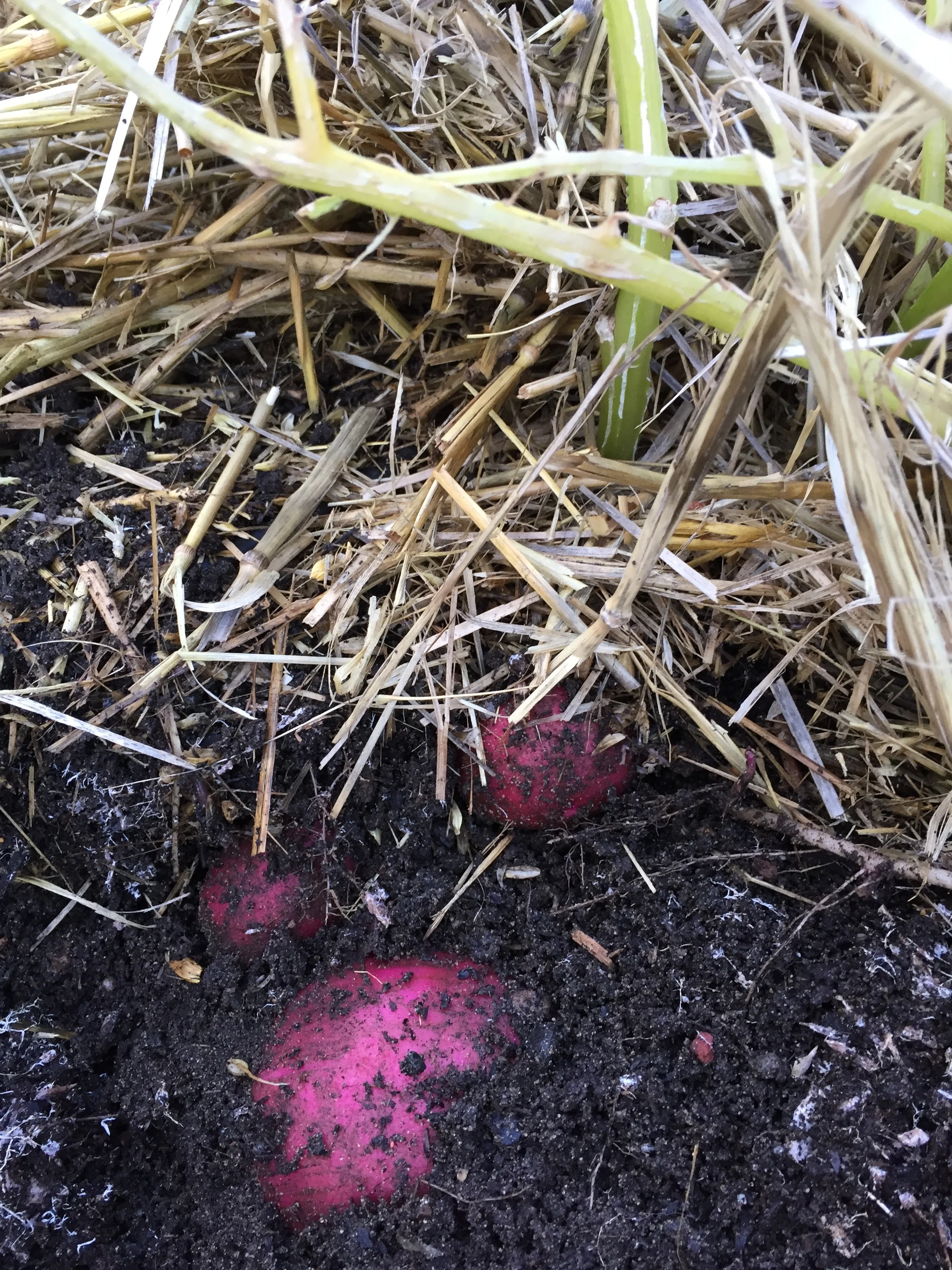
I've also grown potatoes in rows, using straw as my hilling material. There's a couple of reasons to hill potatoes. One, covering up the developing tubers keeps them protected; potatoes exposed to light can turn green and poisonous. Two, hilling keeps the developing roots cool and covered. Three, hilling helps drain water to the sides so that the potatoes get what they need but don't sit in puddles. The good news is, you can use pretty much anything to hill your potatoes. Dirt is probably best, but dirt is sometimes in short supply (like in my raised beds, which have a finite amount of soil). Ruth Stout was the person who first wrote about hilling potatoes with straw. She believed in 'no work' gardening, and she advocated tossing your potatoes directly onto dirt and covering them with a layer of spoiled old hay. I find that I like my potatoes to grow a bit of green first, so they don't have to work their way through a matted straw flake, then I toss the straw on top and work it towards the sides of the plant. It works great. A lot cheaper than soil, too.

I get better yields when I plant in rows, but only by a little. It does take up a lot of space, so you'll have to decide space vs. yield, for your needs. I think you could probably make a tower with straw instead of dirt, as well.

Which I tried last year, and I think it worked ok, but the problem is that I planted the potatoes in 10 gallon pots. I don't think the potatoes had a lot of room to spread out and grow properly, like they did in the open-bottomed mesh cylinder. If you search 'growing potatoes in containers,' you'll get all kinds of folks raving about how well it works for them, whether in pots or grow bags. Frankly, it didn't work well at all for me. The plants looked great, but the yield was the smallest by far. I was very disappointed.

Nutritionally, russets have more to offer than the gold potatoes; fingerlings are better than the reds, surprisingly, and the blue potatoes have some interesting extra nutrients that the others don't have. Make sure you eat all the skins! All potatoes are energy-rich, meaning they are fairly high in calories, and can be a calorie-staple crop for those who can store them properly. Around here, it's nearly impossible to do that, so I only grow as many as we can eat within a month. Potatoes prefer dark, cool, ventilated, humid conditions - like a root cellar. I don't know anyone that has a root cellar in CA (and if you do, can I rent a shelf???), so I spread them out into a single layer, then dry them in a shady place for a day or two. If it's winter and it's cool, I can keep them in a bin in the house, but again, not for terribly long. If it's summer, I put them in a paper bag in the garage refrigerator, with a bowl of water nearby for humidity. It's not perfect. That's why it's a good thing to grab a few every few days as they are growing, rather than waiting until the end for a large harvest.

As for pests, we do get the potato beetle here. When I find them on the plants, I collect them and squish them. I don't find that they do a huge amount of damage. Deer like the green leaves and will eat them to the nubs if they can reach them. Other than that, I don't notice many potato predators. (Though we are starting to see signs of voles around here - I'm working on a post on that - they could do some serious damage; as could gophers, which we don't usually see in our yard, thank heavens.)

My dad often told me that potatoes were one of his favorite things to grow in his extensive garden, it was like a 'treasure hunt' digging them up. I agree. They're fun to look for in the dirt, they have beautiful leaves and flowers, and they provide a tasty meal. I'd say put some in the ground ASAP and by October, you could have a substantial crop!


Tags vegetable garden, potatoes, how to
2 Comments
← Newer Posts Older Posts →

Subscribe

Sign up to get email when new blog entries are made.

We respect your privacy. We're only going to use this for blog updates.

Thank you! Please check your email for a confirmation notice to complete the subscription process.

Powered by Squarespace