A Frustrating Development

We had a great morning, getting so much done in the garden, and we were videotaping every moment for you. It felt so good to get things accomplished. The garden and this blog have taken a back seat lately; May is just a really busy month for us, and especially so this year. It's unfortunate that the garden needs to most attention during May, because it's the last priority. So today it felt wonderful to get caught up.

Then, we opened up the hive to add some bars - we have noticed that there is a large crowd of bees outside on the landing board, which is due somewhat to the hot weather, but also due to overcrowding. I had noticed during the day that every time I went by the hive, the bees were somewhat aggressive, buzzing my face until I left the vicinity. They don't do that unless something is wrong. I figured it was due to lack of space, and I was glad I had three bars ready to add, to give them more room. We figured we could do a quick in-and-out, just adding the new bars to the back. But when we opened the hive, we found a bit of chaos - all the bars were full of comb, and the bees were somehow spilling out to the back through a crack in the follow board. That's a board we have at the back of the hive - it's solid, not just a bar - and it's there to keep the bees from going out into the empty spaces in the hive. This way we can keep the hive smaller in winter, when it's cold and there are less bees, and they can stay closer together for warmth. This time of year, we gradually add more bars and therefore more space. Somehow the follow board was tweaked enough so that there was a crack, and the bees were spilling out. Many had died in a spider web that is in the very back corner of the hive.

At the same time we were seeing this mess, the bees were aggressively coming out and buzzing us. We had just decided to leave it open and go start the smoker, and properly get things in order, when a bee landed on my right index finger and stung me. No big deal, we each usually get stung once a year. I walked away from the hive (because another bee was buzzing my face) and scraped off the bee and the stinger. I went over to get the smoker lit and we did that very quickly indeed and went back to the hive to start creating order. As we were doing that, I started to feel very hot, my face was beet-red and my head was pounding. I thought I might pass out. We kept on going, but finally I told Tom I had to go inside and figure out what was going on.

A little history. Last August was the most recent time I was stung. It was on my left ring finger knuckle. My hand swelled up out of all proportion to the sting. I couldn't move my hand properly for four days. My family was out of town in Maine, and I was alone at home. I was ok, but besides the extreme swelling, I was having another reaction: Intense pain in the opposite armpit. 

After two weeks, the swelling was better, but still recurring every few days, like a new swelling. And the armpit pain was persistent. I figured it was a lymph node reaction. My uncle, a doctor, was in town during this time. He suggested that I was slowly becoming allergic to bee stings over time, and that I should be very careful in the future if I was ever stung again. I did a lot of research but found very little information regarding lymph node reactions or about folks becoming more sensitive to bee stings over time. So I sort of forgot about it all, though my knuckle on that finger has never been the same and there are some rings I cannot wear.

All of that was in the back of my head today. I started to feel my feet swelling in my shoes, so I quickly took those off. I was completely overheated, so I decided to take a cold shower to try to cool off. In the shower, I started to itch intensely - my feet and my hands were simply terrible, so itchy, and also my head and pelvis. Then my lips started to tingle and swell up. My heart was beating so fast and then I felt my throat start to ache and swell. At that point, I got out of the shower, pulled on some clothes (clumsily, as my right hand was now a ballon), and Tom drove me to the emergency room. Right before we left I took two Benadryl. 

When we got to the hospital I thought I was going to jump out of my skin. I couldn't be still and everything was insanely itchy. My throat and lips felt much worse, and my heart rate and blood pressure were very high. They took me in immediately. 

Not long after that, I started to feel the Benadryl kick in. That helped calm me down, and then they gave me a high dose of Prednisone, which helped with the itching. My breathing was always fine, I never had trouble there, and after some time the throat thing went away. My heart rate and blood pressure came down a bit and after a couple of hours I was able to leave. However, I have to take Prednisone for the next three days, and Benadryl as needed. Also, they issued me two epi-pens. I trained on how to use them during my work with medically and mentally challenged kids, but no one in our family has ever needed one. Here's where Kaiser is great: The pens cost us a $10 copay. That is amazing and we are so grateful to have good health insurance. 

We have now been home for two hours, and something that started happening before we left the ER was excruciating pain in my left armpit. The 'ouch' in my right hand, due to the actual sting and the fact that I am very swollen (the swelling is now moving up to my wrist, so typing has been pretty hard!), is uncomfortable, but it's nothing compared to the intense pain in the armpit. It's so strange. It's the opposite arm, which is exactly what happened last time. I'm still trying to find any information I can about this kind of reaction, but coming up pretty empty-handed. It must be a rare thing.

As for the fact that my reaction has gotten more sensitive over time, it seems to be sort of half and half with beekeepers; some get less sensitive over time, and some more. I'm obviously in the latter category.

I am seriously frustrated, because from now on I have to be very careful around the bees. Next time I get stung, it's epi-pen time, no question - if I'm worse every time, next time it could be my breathing that takes a dive. I'm going to have to wear a hood and long sleeves and gloves, which I loathe. I'm going to have to let Tom do most of the hive checks with me looking on manning the smoker. I've just gotten to a place where I feel like I know what I'm doing, after three or so years, and now I have to back off. Ugh.

But, I'm very lucky, and I know that. And there is no question of us keeping the bees, neither one of us is willing to get rid of them. Maybe in the future, if it's necessary. We found one thing very funny today: The ER doctor just really didn't know how to react to the fact that beekeeping is (for us) a hobby. He assumed it was my profession, otherwise why do it? It was clear he thought we were nuts. He spoke to us a little slowly and a little carefully, like we were just a bit mental. Tom and I had a good giggle about that.

If anyone has any information about this sort of thing, I'd love to hear it - please share in the comments.

Now, I'm going to go take some more Benadryl and go to bed. :)
Responsible chicken keeping

No video this weekend. I'm going to write about an enormous learning experience we had Saturday, but it might be hard for some to read. That's totally understandable, because it was hard to for us to go through, too. But in the interest of transparency and furthering knowledge, I am going to share this. The pictures will be unrelated.

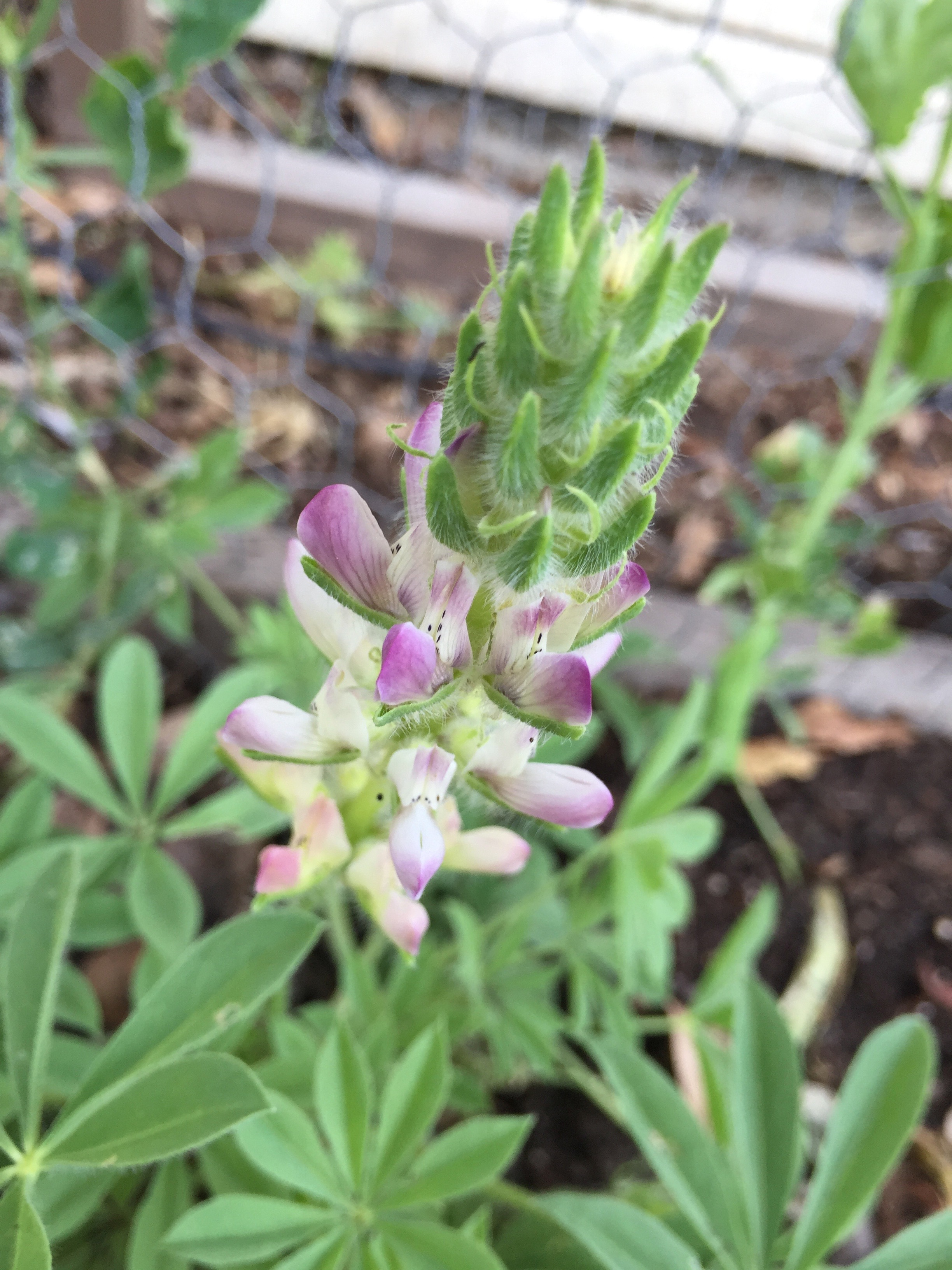
Pink Lupine, a Gallery hybrid

Pink Lupine, a Gallery hybrid

As you all know, we've been having trouble with the process of integrating two new chickens in to the existing flock. We followed the correct protocol, separating the chickens using a cage within the coop for a week, then putting the new chickens in with the old chickens in the hen house at night. All of that went according to plan. But when the two groups were finally together during the day, chaos ensued. The new hens were bullied incessantly by one chicken in particular, an Easter Egger that we had named Tonks. Tonks would lie in wait for one of the new chickens, then spring out at them and viciously attack, holding them down with her sharp toenails and pecking with her sharp beak, drawing blood from necks, heads, and combs. The new chickens had taken to spending their days in the hen house, enclosed by four walls, afraid to come down to eat and drink. I gave them their own food and water, but once I did that, they never tried again to emerge. In desperation, we tried several things: One day we let Tonks free range by herself, hoping she'd then be classified 'the outsider' and be knocked down a peg. That didn't work. She immediately went back to terrorizing Goose and Scrappy, the new hens. Then we let ALL the chickens out to free range, which sort of worked. They had enough space that no one seemed to interested in bullying anyone else, though Tonks still kept Goose and Scrappy from the food and water. The main problem with the free ranging was that the chickens decimated several plantings, ripping up (with their scratching) several dozen seedlings I had transplanted, and pecking the broccoli patch into oblivion. When I saw them going for the tomatoes, I got very worried. So back into the coop they went. And back up into the dark hen house went Goose and Scrappy. The one benefit we got from that free-ranging experiment was that Ginny was enclosed back into the fold. No one picks on her anymore and she is happy being with her mates.

Heracleum maximum, or Common Cow Parsnip

Heracleum maximum, or Common Cow Parsnip

I spent a significant amount of time watching the behavior of the chickens. Most of the other older hens left the new ones alone, until Tonks went after them. Then there would be a pile-on. It was sort of like Tonks was inciting gang violence. It was very interesting to watch, although also very uncomfortable. 

Now, I knew that chickens could be mean. I knew that there would be a pecking order. I knew there might be some fighting. But I didn't expect this deadly, focused kind of attacking. It seemed different than mere pecking order stuff. Tonks wasn't a BAD chicken, she was just doing what chickens do. None of my interventions seemed to stop her from attacking the new guys. I was, frankly, in a state of constant worry. I was afraid that Tonks was going to kill Goose and Scrappy. And Goose and Scrappy were our egg-laying future; these old guys were popping out an egg every four days, if that. We hadn't seen an egg from Tonks in a long time. In terms of value, the new chickens were far, far above any of the old. We didn't want them to be killed; they were an investment for us. 

Centaurea cyanus, or Cornflower (or Bachelor's Button)

Centaurea cyanus, or Cornflower (or Bachelor's Button)

Much of our time was being spent managing the hens, trying to keep the new ones alive and comfortable. I began to resent the older hens, wondering what they were giving us besides shit and worry. I would wake up at 5 in the morning, listening for fighting. I would go out after dark to make sure no one was attacking the new hens while they were trying to roost (which happened a lot). On Saturday morning, exhausted and exasperated, I watched Tonks fly out of nowhere to attack Goose up in the hen house. I marched in and grabbed Tonks. I asked Tom to find the old cat carrier in the garage, and I put Tonks in it, under the peach tree. I left her there and went and got a cup of coffee. When I came back, the coop was a different place. Quiet. Peaceful. The new hens scratching around near the old hens. Not a peep from anyone.

Arbequina olive tree blossoms 

Arbequina olive tree blossoms 

I went about my morning and my chores for several hours, watching the coop out of the corner of my eye. Tom and I had enlarged the space, making a sort of fence around the coop, encompassing the compost bins and some low shrubs; the chickens were all enjoying the space and scratching around for bugs. No fighting. No running away. Just calm as calm could be. And that's when I knew that Tonks was the problem chicken.

That meant we, and the other six hens, would be better off without her.

That meant we needed to figure out what to do with her.

That meant that Tom and I sat down together for several hours, talking over every angle and every possibility. 

We have several friends with established flocks; we knew none of them would want an aggressive chicken that rarely lays. It's one thing to go through the integration process with new, young hens that will provide you with eggs daily - it would be quite another to go through that process, for a chicken that may or may not be able to integrate and would only get older and less likely to lay. It also might not be the best thing for Tonks - imagine being taken away from the home you know and put into an entirely new flock, by yourself. She'd then be the victim of the kind of bullying that she had been meting out in our flock. Justice, perhaps? Maybe, or maybe just cruel to put her through that. 

We checked with folks we knew who had once owned chickens but didn't any longer, but those folks didn't want her either. A hen who is not laying is often merely a food-eating (and therefore money-eating) machine. Tonks wasn't used to being handled, she wasn't going to be some kind of cuddly pet for a toddler.

There are many people who will take an old chicken off your hands to butcher and eat. This is something that happens all the time, everywhere. It's a free source of food for these folks. And before you curl your lip at that behavior, let me ask you: When was the last time you ate chicken for dinner? For us, it was Friday night. A couple of nights before that, we ate pig. A couple of nights before that, we ate cow. The Boegel family cannot throw stones. We are meat eaters. How much do we pay for organic, humanely raised chicken? There is a farm twenty miles from us that is charging $30 a chicken, 3-4 pounds, young, free-ranged on their pasture. 

Bridal Wreath Spirea

Bridal Wreath Spirea

This sent us into a rabbit hole that was hard to navigate. When we originally got chickens, we knew that this day would come, when we would have to be responsible about the end of their lives, too. But we put off thinking about it, because that day seemed far away and it was easier not to ponder it. These chickens are not pets. The only reason they have names is because we need to be able to talk about them and identify them in some way. I confess that Ginny has become sort of a pet, because we got close for the two months she was free ranging in the garden, away from the other birds, and I began caring for her in a more immediate way. But I still don't feel about her the way I feel about my cat, or the way I felt about my dog Joe. THOSE are pets. The chickens are here to provide food.

So we were clear on that. We had no emotion either way for Tonks, no kind of attachment. I had stopped being angry at her and was more sympathetic to her situation, but the fact of the matter was that we could not have her in our flock. No one else wanted to take her. We are meat eaters. She was our property, bought and paid for. She had provided a service for us, one we were grateful for. She had a happy life, with all her needs met, and most of her desires met too; fresh greens from the garden every day, slugs brought in by hand from her keeper. Plenty of room to grow and stretch and hop and fly. Buddies to dust-bathe with. A comfortable roost at night, not too hot and not too cold. Unlimited food and water. A pretty darn good life, for a laying hen. Tonks was healthy and clean. Not laying, but not sick. A sick chicken would be easier to kill; we could call it compassionate. Killing a healthy bird? When her only faults were that she was getting old, and getting mean? That's hard to come to grips with.

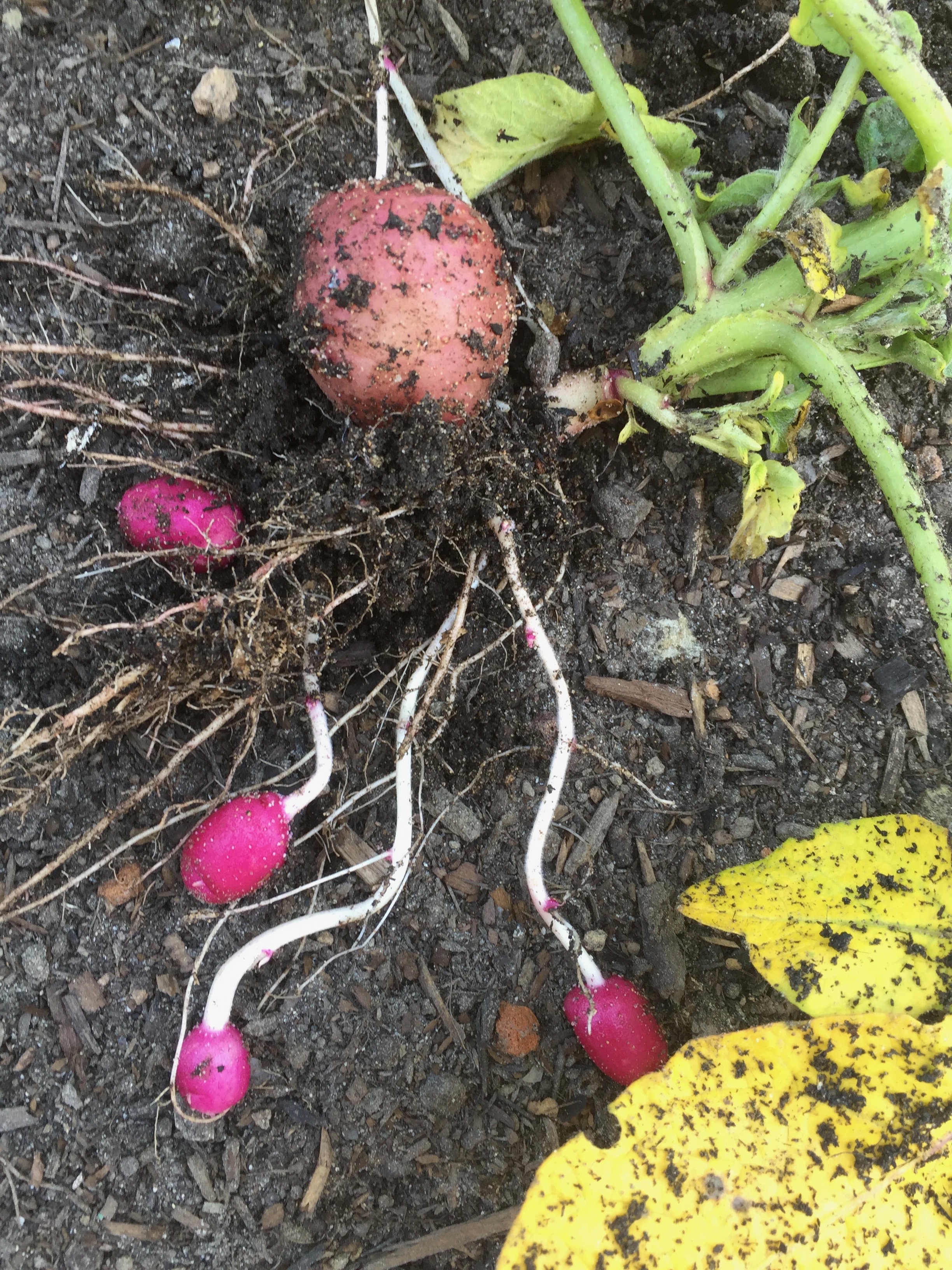
A potato I dug up out of one of our beds. You can see the seed potato, the green leaves it sends up, and the new potatoes developing on the ends of the roots.

A potato I dug up out of one of our beds. You can see the seed potato, the green leaves it sends up, and the new potatoes developing on the ends of the roots.

If Tonks was a pet, we'd find a vet that treats chickens and have them euthanize her, at great expense. But Tonks was NOT a pet. Tonks was a provider of food. Her job was to lay eggs and get along with everyone else. If she had been a friendly chicken that didn't lay, we would consider keeping her just for her manure. (Expensive manure, but Ginny is basically in that position right now.) 

The conversation then veered toward what sort of people Tom and I are. We've never hunted, and this whole debate would likely seem silly to someone who does. We've never killed anything larger than a spider before (well, that's not true, I used to trap and poison rats, but I don't anymore.) The place we are, in our lives, is a place where we can buy our food at the grocery store. We are not starving, we are not broke, thank God. We can go buy our chicken at the store like most of the people we know. We did not grow up with farm animals, we've never witnessed farmers killing and eating their animals. We are sheltered people. We have never known hunger. We have never known need. We have never done anything other than buy our meat wrapped in plastic. Even when we buy from farms, we buy the animal already dead.

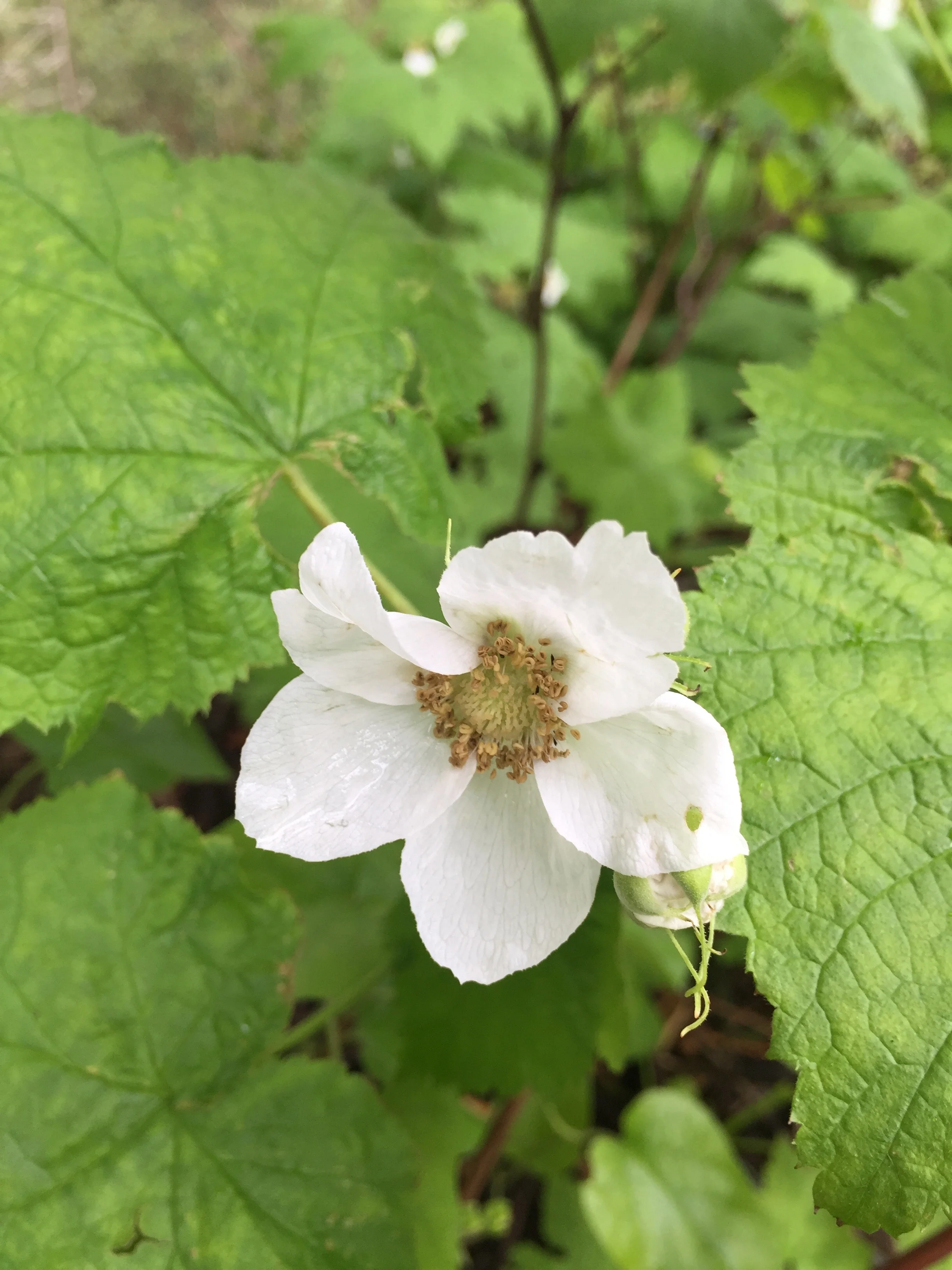
Rubus parviflorus, or Thimbleberry

Rubus parviflorus, or Thimbleberry

What does it mean to be a responsible livestock owner? When you google that question, you get all sorts of information about fencing. Page after page of guidelines on keeping your animals contained. No moral discussions about life and death. Real farmers would probably scoff at our dilemma. Or maybe not: I'm sure they are serious and sober about taking life. I'm sure they'd feel our struggle was a worthy one, that feeling 'easy' about it is something no one should feel. At least that's what I think. I think a decision like this should come with some serious moral wrestling. So wrestle we did, until we came to the decision that the responsible thing for us to do was kill Tonks quickly and humanely, ourselves; then to clean her and use her as food for our family.

After hours of talking together, thinking privately, then talking some more, then thinking some more, it was surprising that once we had made the decision, things moved quickly. We had all the supplies we needed, and had already researched the logistical particulars. Tonks was calm and quiet, her death was swift, and cleaning her body was a clinically interesting project. There was blood but little mess, there was no smell at all, we were able to complete everything very quickly, and we now have a bird in the freezer. We will use it for broth, which goes in to many of the other things we eat. 

California Monkey Flower, or Mimulus - I think this is Santa Susana

California Monkey Flower, or Mimulus - I think this is Santa Susana

Now that Tonks is gone, the flock is completely different. Everyone is working together. Once in a while there is a little squawk when someone is being kept in line, but mostly there is silence. I could swear I hear Hermione (the black and white barred rock hen) purring sometimes. The chickens all hang out together. No one is separated. No one is being kept from food and water. In short, there is no drama.

This whole event was a learning experience from start to finish, and I don't just mean the kind of learning where you gain a new skill, though certainly there is that too. We also learned a lot about ourselves as people and as animal owners. I keep thinking about the beekeepers who regularly re-queen their hives anytime the colony shows the least sign of aggression (kill the old queen, and install a new one, or allow the colony to make a new one).  It is almost de rigueur. There is certainly a difference between killing an insect and killing a chicken, but in this case the situation was similar. I won't be cavalier about this event, and could never be, but it would also be false to say that we are not glad that we have figured this out, and proud of ourselves for accomplishing a hard thing. If we are going to continue to keep chickens, it is important that we face the end of the story, too.