• About
  • Blog
  • Contact
  • Favorites
  • Archive
Menu

Poppy Corners Farm

Street Address
Walnut Creek, California
Phone Number
Walnut Creek, California

Your Custom Text Here

Poppy Corners Farm

  • About
  • Blog
  • Contact
  • Favorites
  • Archive

All the Sounds of the Earth are Like Music

February 14, 2017 Elizabeth Boegel
Swiss Chard in the morning sun

Swiss Chard in the morning sun

Mornings as beautiful as this one have me singing that old song from the musical Oklahoma. Instead of a 'bright golden haze on the meadow,' I have a bright green haze in the vegetable beds. Not as poetic. But definitely exciting. After weeks of rain (and more on the way), a sunny day feels like a blessing. The established seedlings are spreading out and sunbathing, and the germinating seeds just seem to pop out of the ground. Carrots! Lettuce! Peas! all making a break for it in this brief sunlit window of time. 

A shelling pea blossom, somehow pink. 

A shelling pea blossom, somehow pink. 

Tom measured the temperature in the greenhouse Sunday - it was 88. On clear nights it's still in the low 40's here, but drunk on sun and 65 degree days, I've removed all the row covers, figuring spring is on the way. Tomorrow the rain returns (and stays for at least a week), which means the nighttime temps will warm up, so everything should be safe. I'm going to transplant more brassicas and sweet peas today, if I get a moment. Homework for my classes is taking far more time than I expected, and I absolutely MUST get a walk in today while it's nice.

Blueberry blossoms

Blueberry blossoms

There's a dark shadow over everything, however, as we are thinking about the folks in Oroville, Marysville, and Yuba City (150-ish miles north of here) who had to be evacuated Sunday night due to a possible dam breach. Oroville is the highest dam in the United States, contains the second largest volume of water in California, and provides much of the drinking water for central and southern parts of the state. It was built almost fifty years ago and has never overflowed, but it did this past weekend when the emergency spillway was activated. The erosion in the main spillway and now in the emergency spillway is vast; crews are working hard to shore it all up before the next wave of rain comes in. This dam also collects meltwater from the Sierra, so there are months of worries ahead. 

in the greenhouse

in the greenhouse

We notice the effects of too much water everywhere here. The roads are eroding, there are sinkholes in many well-traveled places, mudslides blocking major freeways, frequent flooding over commuter routes. Kate and I traveled to Sacramento this weekend for a theater competition (perhaps another reason that show tunes are in my head), and the entire farming community around Sacramento is under water. Fields are lakes. Trees are half-submerged; homes are flooded. The Sacramento river is at the limit. Flocks of migrating birds are everywhere: The sky is filled with clouds of ducks and geese, while the rivers and field/lakes are full of herons and egrets. It was something to see and made my driving very distracted. 

I'itoi onions

I'itoi onions

So we all appreciate these dry days very much and try to get outside and turn our faces to the sun, desperate for vitamin D.

I may not make it to March before starting tomato and pepper seeds, I just can hardly stand to wait. Meanwhile I'm making do with watching my celery seeds sprout. (Not entirely satisfying.) What seeds are you starting indoors in your climate these days?

Tags vegetable garden, fruit garden
Comment

Common Garden Weeds (and how to get rid of them)

February 9, 2017 Elizabeth Boegel
Image credit: Shutterstock

Image credit: Shutterstock

If you live in the West, you've been living in a very wet place indeed, and one thing we can count on during our rainy winters is WEEDS. (Apologies to those of you in other states; I know there's been cold, snowy weather going on where you are, but eventually your wet spring will come, and then you'll have weeds, too.) Even in my garden, which is heavily mulched and full of organic matter, I still get weeds. Most often they are not weeds at all, just seedlings of trees or bushes that have germinated below the canopy. Those are easily pulled, though certainly it is not a fun job. But I don't really consider those weeds. To me, weeds are something blown in on the wind, or 'placed' there by birds, something I didn't intend to have in my garden. So, for instance, my pepper tree releases thousands of seeds each year, and many of those germinate and start baby trees. Those are not weeds, because I placed that tree there knowing that I'd have seeds to deal with. (Or at least one would hope I planned that far ahead, and chose the tree with that knowledge; certainly that's the way I'd do things now, but I'm not at all sure I did things that way at the time I planted the pepper tree.) But lately I've noticed a lot of Veronica persica (Persian or Bird's Eye Speedwell) in my pollinator beds. This is a plant I didn't intend to be in my garden, and even though, as weeds go, it's not a heinous one, it's something I will take steps to control. 

Speedwell

Speedwell

Veronica persica is a pretty little thing, with small, hairy, heart-shaped leaves, and sweet tiny purple flowers. It's a weed that likes disturbed places, gardens, turf, orchards, vineyards, and roadsides. I disturbed the soil in this particular area by pulling out some annuals, and that, plus wet, overcast conditions, caused this weed to move right in. I don't use herbicides, but this one is resistant anyway, so don't bother with that (and honestly, you never need to resort to that). You need to remove the plants before they set seed, but of course removing the plants means you're disturbing the soil even more. These plants don't do well in sun, so likely they'll disappear once we have long, hot, dry days. Mulching these (with a little cardboard underneath) would take care of the problem, but this in my pollinator gardens, where I'm also trying to germinate annual wildflowers. Likely those will crowd this little guy out, so for now, I'll just cut off the tops and make sure they don't set seed.

Dandelion

Dandelion

Here's one we're all familiar with, the good old dandelion, or Taraxacum officinale. I remember my dad going out with his special dandelion weeder on Saturday mornings when I was a kid in Maryland, trying to pry these things out of his well-tended lawn. Dandelions are special because their roots can grow new shoots. This is unusual. So if you cut off only the top of a dandelion, its root can send up new growth in the form of a shoot. Most plants can't do this (unless it's the type of plant that spreads by rhizomes underground). If you've ever tried to get one of these out of the ground, you'll know that it has a long taproot which makes it difficult to remove; and if you don't get the entire root, that darned thing will send up a new shoot. Personally I rather like dandelions; the flowers are a boon to pollinators, and I have no precious lawn to ruin. However I do not let them set seed in my garden. Still, there's plenty of dandelion seeds in the neighborhood that blow right in. 

Mallow

Mallow

Here's another weed with a long taproot - common mallow, or Malva neglecta. Folks around here call it cheeseweed, because the seed pods look like little wheels of cheese. This plant is entirely edible, but it doesn't taste like much of anything to me. However the greens are highly nutritious, so it doesn't hurt to throw it in a frying pan with some kale or chard. Mallow is ubiquitous in my neighborhood, colonizing neglected yards and hell strips. It shows up in my garden sometimes, in back corners where I haven't been in a while. It's best to pull this guy when small and young; the taproot develops considerably as it gets older and it is extremely hard to pull out at that point.

Mustard

Mustard

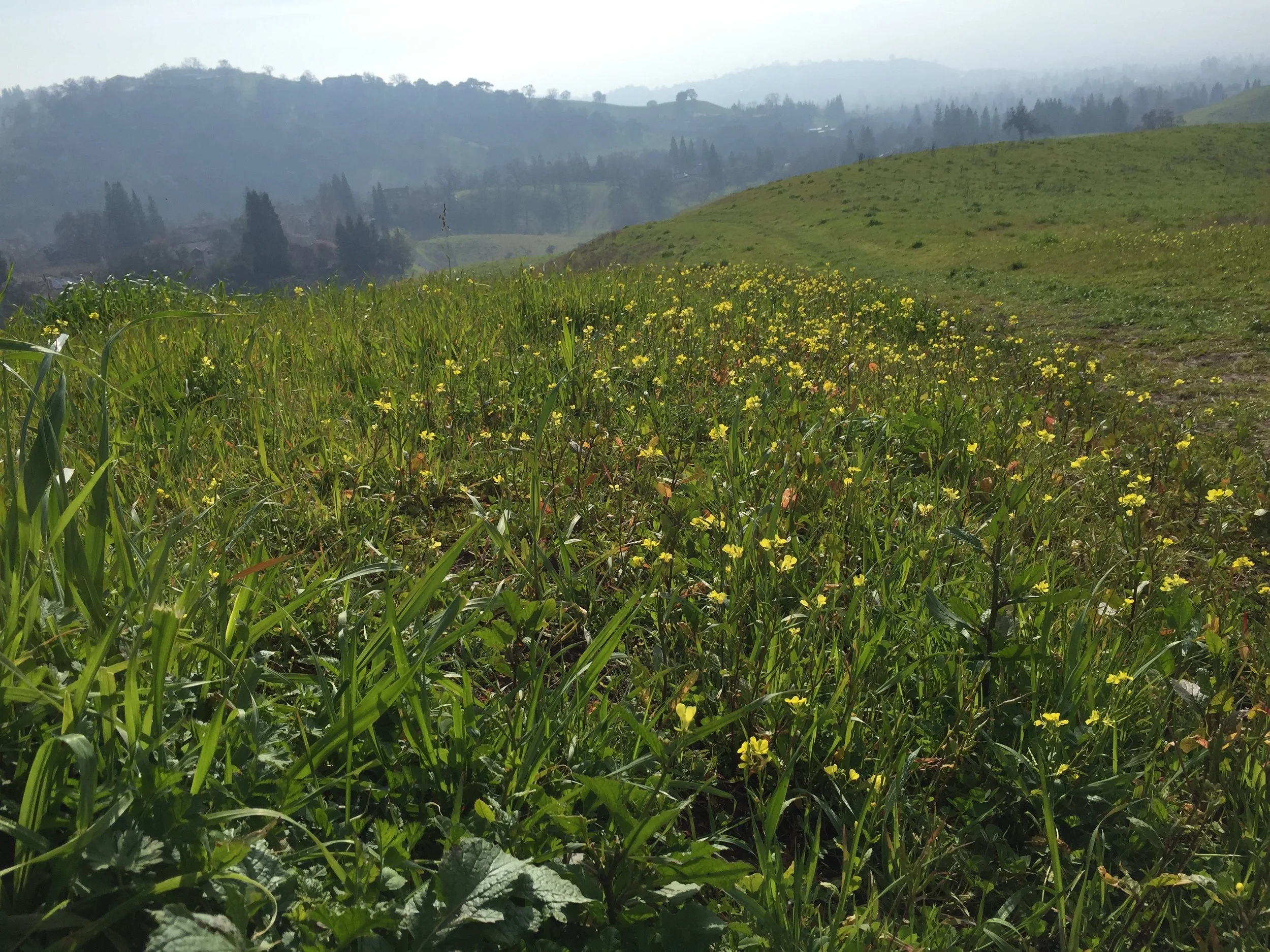
Many weeds are edible, and here's one I collect frequently when hiking to add to salads and omelets, though only when the leaves are young and before flowers appear. The thing you taste in all Brassica species (broccoli, cauliflower, cabbage, kale, Brussels sprouts, mustard etc) is called 'myrosin.' As the plants get older, the myrosin gets stronger, and it's often distasteful at high levels. But when the mustard leaves are young, they have a pleasant spiciness that can really wake up a plate of greens. Many people grow them for that reason, and they are a fancy-restaurant specialty. Around here, they are invasive. There might be 60 different varieties of mustard plants (all in the family Brassicacaea) growing in the hills in California, and they make a beautiful yellow haze this time of year when they bloom. But make no mistake, it's dangerous to let these guys go to seed in your garden. They will take over. 

Common Groundsel

Common Groundsel

And speaking of taking over, this is a weed I see next to every sidewalk in my neighborhood, in huge quantities. This is Senecio vulgaris, or common groundsel, or Old-Man-of-Spring. As you can see from this picture, the seeds are incredibly abundant. This weed grows everywhere humans are, next to roadsides and freeways, in nurseries, gardens, vineyards, and orchards. It does have a taproot, but you don't have to remove the entire thing. This is one weed that benefits from shallow tilling. You can also mulch it. It likes wet and cool, so it cannot live in hot and dry. Apparently there is some promising research on a fungal control for this guy, but meanwhile, do not let it set seed. Get it out of your garden. 

Bittercress

Bittercress

How about this pretty little weed? This picture was taken in front of my next-door-neighbor's fence. Bittercress, or Cardamine oligosperma, flourishes in that location every year, and I work hard not to let it cross the 'line' and come into my garden. Bittercress is also a Brassica, so it is edible, but it's so tiny that you'd need a lot of it to make it worthwhile (come on over, I'm sure my neighbor won't mind if you forage her front fence, and you'd be doing me a big favor). This little plant grows in nearly every plant community we have in California, and it's wicked: It is also called 'pop seed' because the seeds pop out of the pod and fly everywhere if you so much as graze it with your shoe. Do not let this plant get to that point. Hand pull it before it flowers or sets seed. Again, it prefers wet conditions, so it will die out in the summer here. But the seed can live in the soil forever and anytime you disturb it, up it will grow.

Herb Robert

Herb Robert

This is a pretty weed too, called Herb Robert or Geranium robertianum. This developed from an escaped cultivar at some point, which makes it sound very exciting and might convince you that you should keep it around. The experts say it's not invasive, but it's another weed I see everywhere humans are. It is attractive, but it's sneaky. I say get rid of it. I find it in my vegetable beds where it hides cunningly until it grows to gigantic proportions. This weed is easily hand-pulled which makes it somewhat ok in my book.

Petty Spurge

Petty Spurge

Finally, we have Euphorbia peplus, or petty spurge. Gosh I see this one on the margins of gardens everywhere, and I'll bet you do too. It's mildly toxic and can cause a rash, so use gloves when removing this plant. And remove it you should, the entire thing, including the root. It also prefers moist shade, like a lot of the weeds coming up right now. This plant often comes into our gardens through nursery stock, so check the plants you buy carefully before putting them in the ground.

This is by no means a complete list. I haven't mentioned purslane, or oxalis, or many of the most common weeds found in gardens. These are just a few I am noticing right now. In many ways, this is the best time of year to remove weeds, because they come out of the wet soil easily. But a note of caution: So many of these weeds like both disturbed and compacted soil. Walking near the plants or on them will cause our sodden earth to compact terribly and the weeds will proliferate even more. Be careful when walking around your beds. Use the paths, or if that's not possible, take a board out with you to step on, to diffuse your weight. If possible use long tools to help you, so you don't need to step in the beds. If you can cover the weeds with cardboard and mulch, that will not only prevent compaction and block photosynthesis, it will also improve your soil and acidify it so that weeds will not enjoy living there. Remember, lots of organic matter is key to improving your soil and making it inhospitable to weeds. Disturb the ground as little as possible. Be vigilant about removing flowers and seed heads. Over time, this will overcome even the most difficult weed. I've witnessed this as my battle with bindweed seems to be finally over, after many years of eagle-eye weeding. Keep at it and you will succeed! 

Tags weeds, wildflowers
Comment

Catching Up

February 7, 2017 Elizabeth Boegel

The computer is back! Something went wrong with our monitor and it needed a new part. I was surprised how much I missed having a desktop around - guess I've become dependent, despite the computer in my pocket. I also missed making our weekly video. I can't do one this weekend either, but next week hopefully I'll be back to routine.

Meanwhile: Rain. And more rain. As you can see in the above photo, our back patio is mostly under water, the row covers are sodden and bedraggled (at least the beds can be open to the weather, as it's been in the 50's at night and low 60's during the day), and though everything is green, there are signs that it's just been too much water for the earth to handle. The creeks around us are flooded, trees are down everywhere, our street is literally a river, and I cannot believe the amount of water in the foothills. Our house is mostly dry but I've discovered a couple new roof leaks in the garage and the corners are full of water. We haven't had this kind of rain in twenty years, and I'm guessing we won't again for another twenty. Oh, how I wish I had put in several five-thousand gallon tanks this summer. Opportunity missed.

We've got empty fire rings waiting to be filled with soil, which I won't order until I'm sure the rain is mostly over, or at least until we have a dry weekend where I can wheelbarrow it all from the driveway to the beds. I'm also noticing that there are patches in the wood chips that need replenishing (they've been washed away or decomposed), so I suppose we'll have to get a pile of those delivered as well. Our spring will be very busy.

I did manage to transplant some broccoli, cabbage, and cauliflower from the greenhouse into the beds, but it looks a bit peaked in this latest rain. The kale, chard, braising greens, spinach, radishes, turnips, garlic, and onions are all doing just fine, and the new sowing of peas is just starting to emerge. I'm glad I got annual native wildflower seed down in the pollinator beds before this latest deluge, I'm sure they'll pop up quite happily in this weather. At some point the sun WILL come out, and I'll be sure to make my way into the hills and open spaces to see the flower show that will surely be incredible this year.

School is kind of kicking my butt. Well not school per se, I am enjoying my classes a lot and learning so much every day, but the homework has been more time-consuming than I expected. I am often stuck working at the kitchen table for hours, on the days when I am home. I'm trying to cram a whole new language into my brain. I wake up at night after nightmares about nomenclature or vascular bundles. At school I take pictures of every example, every sample we look at in lab. When I take a break from homework to walk in the rain, I find myself ID-ing every weed in every sidewalk crack. My 49-year-old brain is racing to absorb everything and regurgitate it on command, and it hasn't had to do that in quite a while. I suppose it's good for me, kind of like how doing crossword puzzles or sudoku is supposed to be good for aging brains. The only difference is that a professor isn't waiting to hear how you did on your crossword puzzle.

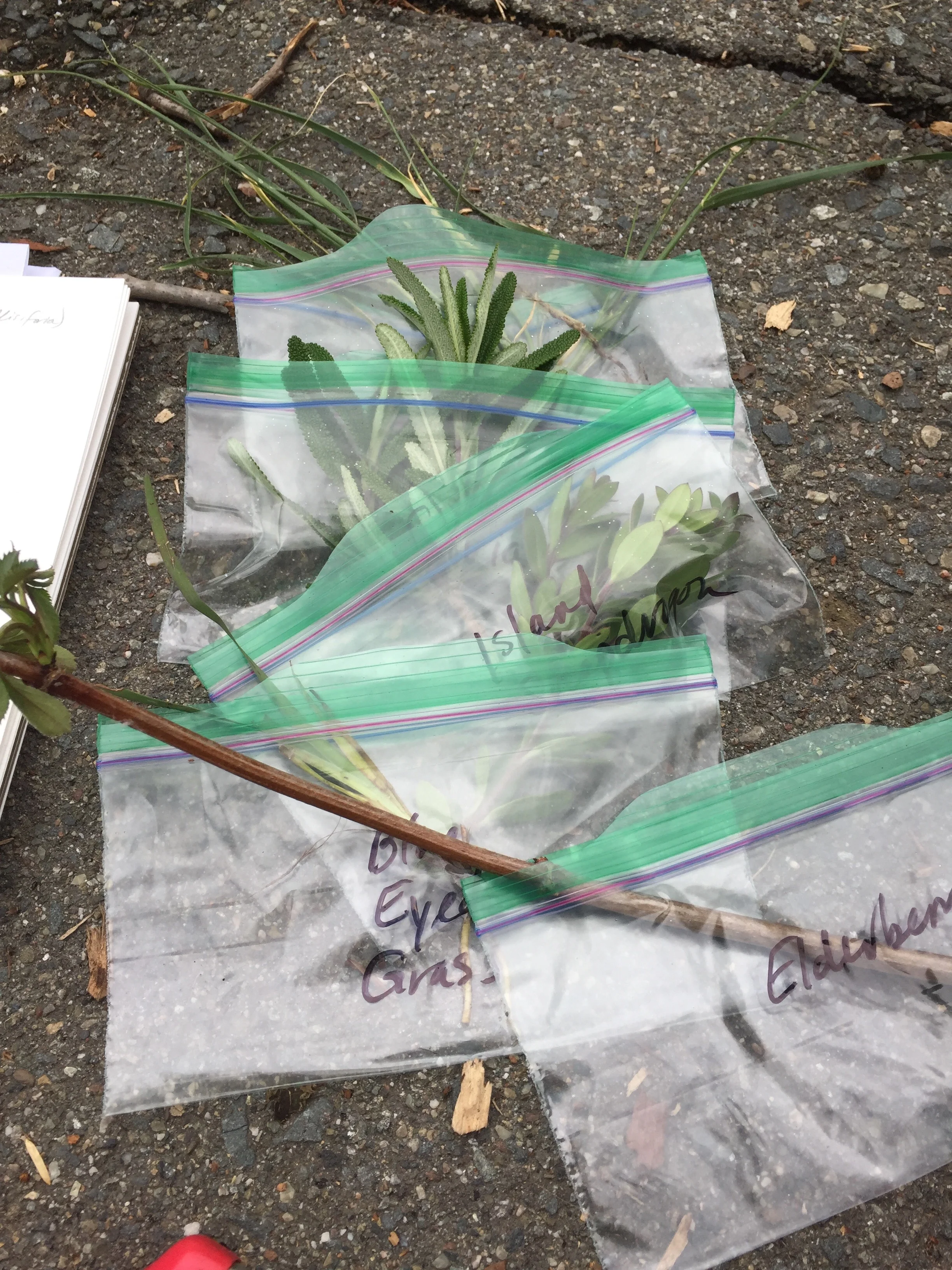
Sometime last Fall, I signed up for a native plant propagation class that took place this past Saturday in a wonderful garden near me. I was reluctant to attend as my head was already stuffed full with regular school stuff, but I forced myself out into the wet day and I'm so glad I did. The class took place at Judy Adler's house and some nearby gardens that she has established, on public school property (with the school's permission). Judy has it all dialed in - low water-use landscapes, native plants that are also food sources for local wildlife, environmental education for children in the area, and a vast knowledge of plants that grow well in our area and climate. I learned so much, and came home with many cuttings to propagate in my own garden, but what I enjoyed the most was being with Judy, trying to soak up her enthusiasm for this world and all nature in it. She is a vibrant, active, fascinating teacher and I would highly recommend taking a class with her. 

As for seed starting, I've only got one tray inside under the lights; I'm dying to start tomatoes and peppers, but it's just too early, and who knows how much more water will fall from the sky. So I am holding myself back. I've got celery starting, and Iceland Poppies, and Chocolate Lace Flower. In the greenhouse are more brassicas, growing larger before being transplanted, and the sweet peas which are getting a very slow start. At least we are getting some fresh greens from the garden a couple of times a week, as well as spring onions anytime we want them. Everything is yearning for sunshine. I might put myself under the grow lights. Maybe that will help me learn my schoolwork faster. 

Tags vegetable garden, flower garden, learning, natives, seed starting
Comment

90% Luck

February 2, 2017 Elizabeth Boegel
Wild mustard (Brassica) in the hills near my house

Wild mustard (Brassica) in the hills near my house

As you know, I'm taking college classes in landscape horticulture. One of my courses is in identifying and designing with California native plants. I love native plants; I would say that my current gardening obsession actually started with them many years ago. I've been to more native garden tours than I can count, read more books on the subject than I can list here, and have done extensive research and taken workshops on these plants. And yet: In just two weeks at Merritt, I've learned more than the last 10 years figuring it out on my own. One thing has become crystal clear to me, and that is that any success I've had with natives has been 90% luck. Because I've done a lot of things wrong.

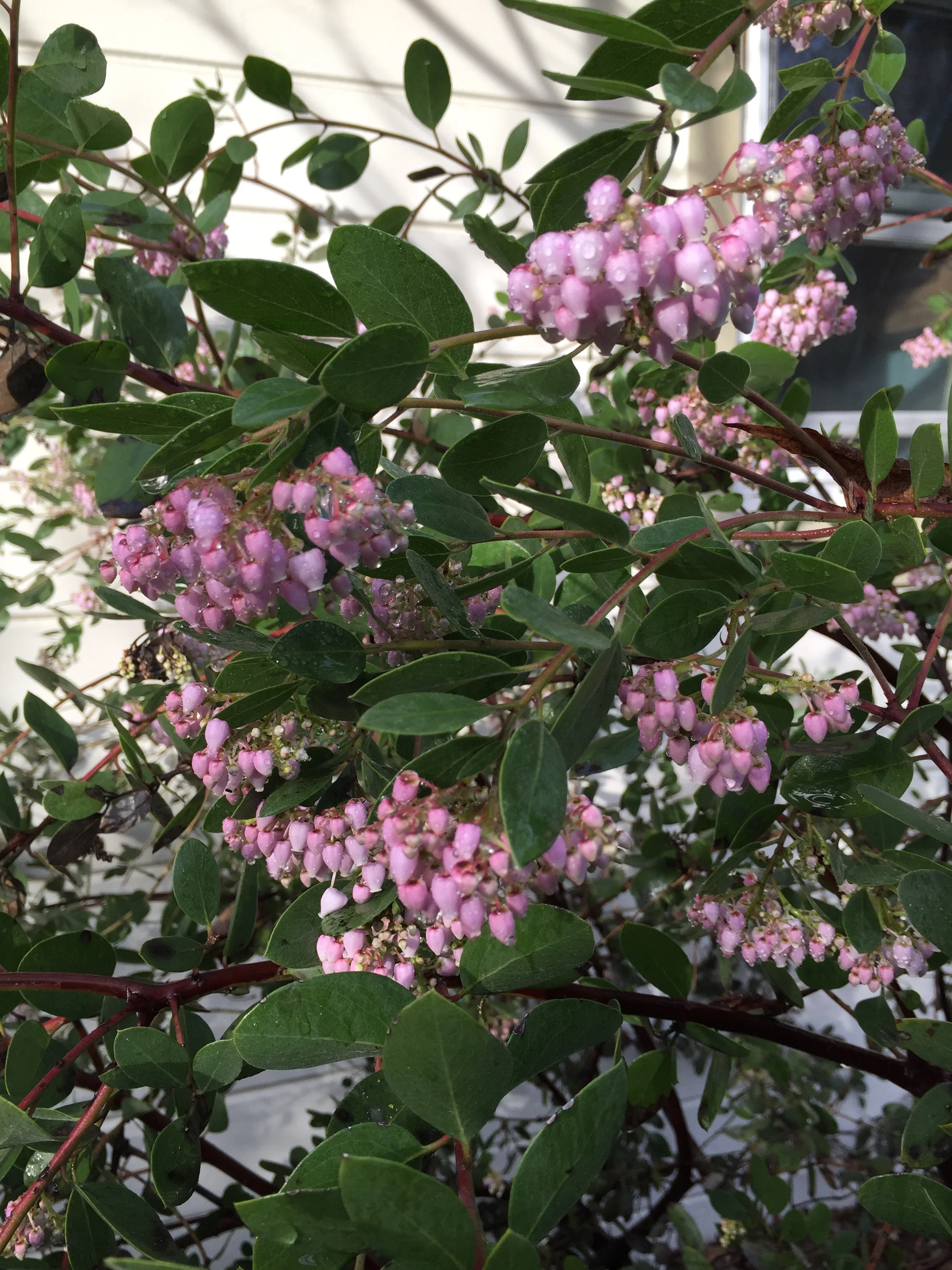
Arctostaphylos densiflora 'Howard McMinn' in my garden

Arctostaphylos densiflora 'Howard McMinn' in my garden

Yesterday we studied manzanitas (Family: Ericaceae; Genus: Arctostaphylos). I have several of these plants in my garden, for several reasons: They have beautifully colored branches, often deep red; they have wonderful blossoms that native bees and hummingbirds really like; they produce berries, some edible by humans, all edible by birds; and they require very little water. To that end I have sited them in my garden in places that receive zero irrigation. And that is correct, I have done at least that right. But manzanitas (most often, not always) naturally occur in very lean soil, on slopes and ridges, or bluffs and coastal scrub, far away from nutritive clay. I have clay soil in my garden, which has been amended with compost and lots of other organic matter. This means my soil is very rich. Clay soil is not only dense physically (lacking oxygen when wet), it is also highly charged and nutritious; just what manzanitas do NOT like. If I had planted them correctly, I would have added a lot of sand to the soil, piled up a little berm so that water runs off, maybe topped it off with rocks or gravel, not wood mulch. Arctostaphylos gets its nutrition not from soil, but from mycorrhizae, fungus that grows in association with its roots and transfers food that it mines from the surrounding minerals. I don't remember planting my manzanitas (it was a long time ago!) but I do know my usual methods, and I assume that I planted them in extra compost to 'give them a good start.' I didn't know any better.

Despite my wrong method of planting these manzanitas, they have thrived and bloomed every year, and are large and happy. I can't explain this. All I can say is that once I planted them, I left them completely alone. No water, no fussing; an occasional very slight haircut just to keep them manageable, but nothing extreme.  And that seems to be what Arctostaphylos likes with regards to maintenance - abandonment, basically. My teacher says that's actually the goal with native plantings. Total abandonment. If you can't do that, you've put the wrong plant in the wrong place. 

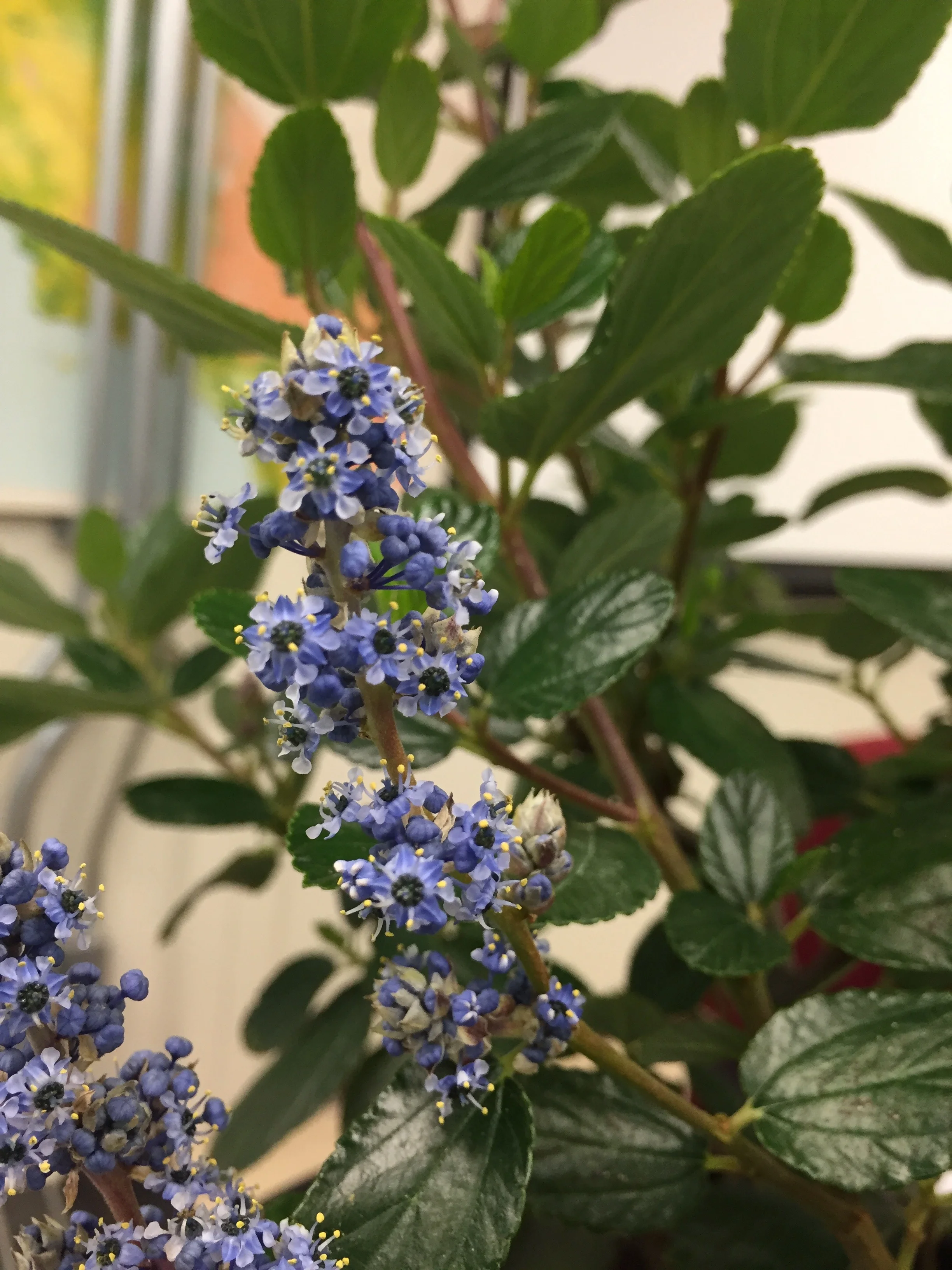
Ceanothus arboreus 'Cliff Schmidt' in class yesterday

Ceanothus arboreus 'Cliff Schmidt' in class yesterday

We also studied ceanothus (Family: Rhamnaceae; Genus: Ceanothus), which I have in my garden as well, mostly for the bees but also because they are beautiful. Most of these genera also prefer lean soils; coastal sage scrub or chaparral communities. Again, they survive in my garden, likely for the same reason the manzanitas do - I plant them in dry areas and leave them alone. However I have lost a few ceanothus, and I think it's because those were in areas that received irrigation. I also pruned one of them very heavily to keep it out of a path, and eventually it bit the dust. Though it's true ceanothus are naturally shorter-lived than manzanita, because they are nitrogen-fixers; like legumes, they pull nitrogen out of the air and put it into nodules at their roots. All nitrogen-fixers live brief lives, I suppose because they are working so hard while they are alive. Many ceanothus prefer coastal conditions, but quite a few like it hotter and drier, and I guess I lucked out by choosing those varieties. 

I'm sharing all this because I know many of my readers are also lovers of California native plants, and like to make space for them in home gardens (which is a noble pursuit). Here's what I recommend you do (and what I'll be doing as I plant in future): Take a lot of time to research the plants before buying them. Most nurseries give cursory information about planting at best. For native plants, there are a few good resources that will help you determine the best placement for a plant (and perhaps whether even to buy it at all). These resources are: Las Pilitas Nursery, San Marcos Growers, California Flora Nursery, Native Sons Nursery, the CalFlora website, and the Jepson Herbarium website from UC Berkeley. These websites will help you understand what the ideal planting conditions are BEFORE you plant.

A word about plant communities: I've known about them for many years, but I can't say I have planted according to them, to my garden's detriment. Let's take my yard as an example. It is flat, it is comprised of clay soil, it gets extreme temperatures (over 100 many days of the summer, below freezing many days in winter), it is extremely dry for most of the year (if not irrigated), and is surrounded by streets and concrete. It has had an inordinate amount of organic matter mixed in as well as been covered by wood chips. Some of it is shaded by very large, mature trees, and there is a lot of leaf litter. Some of it gets no shade at all. There are microclimates within its boundaries; some areas stay wetter and cooler longer, some are ovens with hot, trapped air (by the way, the ceanothus and manzanitas are located in the oven sections, that probably helps them). I have to be brutally honest about the basic conditions of my yard in order to have planting success. There is no sense in having a coastal or island plant in my garden. It will not survive. 

Frangula californica 'Leatherleaf' coffeeberry in my garden, probably in the wrong spot

Frangula californica 'Leatherleaf' coffeeberry in my garden, probably in the wrong spot

One of my goals for this year is to revisit the areas that are regularly irrigated and decide if there are some plants in those areas that would prefer to be moved. 

Lastly, I want to let you know that there will be no Weekly Walkthrough video for the next two weeks. This weekend, our computer will be in the shop, as it needs a new part. Next weekend, Kate and I will be in Sacramento at a theater competition. 

Here's hoping for more planting successes in the garden this coming year, for all of us!

Tags natives, flower garden
Comment

February To-Do List (for Zone 9)

January 31, 2017 Elizabeth Boegel

Here is your handy-dandy printable for February. We're still having some pretty cold temps at night, though it is supposed to warm up nicely as the week progresses - into the 40's at night rather than the 30's. I think it's safe to start some of these things in your outdoor garden beds, especially if they are under cover. If not, you might want to wait a week and see how things shape up. Remember, our last average frost date is February 15. We may still get some cold nights, as late as mid-March. Maybe save back some seed to plant then, just in case.

Planing List Image.png

Hedging your bets is always a good idea, at least in the garden.

The tule fog has settled here today, a rare occurrence this far from the interior Bay. It makes everything look very mysterious. I'm hoping to get one last hike in before the rain begins again tomorrow. The reason I don't go hiking in the hills when it's wet is because we have very heavy clay soils here, and when it rains, it becomes a particularly sodden muck that can suck the shoes right off your feet. I do have muck boots, but they don't have enough support for hiking. Someday maybe I'll get a pair of real hiking boots. But I'm still not sure I'd enjoy slogging through mud. Unlike the little boy we saw on Sunday, in a mud puddle on the trail. He was covered head to toe and having the time of his life. 

Tags seed starting, vegetable garden, herb garden, fruit garden, raised beds
Comment
← Newer Posts Older Posts →

Subscribe

Sign up to get email when new blog entries are made.

We respect your privacy. We're only going to use this for blog updates.

Thank you! Please check your email for a confirmation notice to complete the subscription process.

Powered by Squarespace