Little Free Library

Our school district has a program called ROPES, which stands for Rite of Passage Experience. This is an outside-of-school project, chosen by the student, in order to try something they wouldn't have time to learn in school. Students are allowed to participate in 5th, 7th, and 8th grades. Adam has participated twice before: In 5th grade, he designed and built Adirondack chairs for Camp Okizu, under the tutelage of my dad, who is a woodworker; and in 7th grade, he decided to tackle the school lunch program, which was an ambitious project (I blogged about it here, scroll down to the end of the post). Kate participated in 5th grade; she wanted to know where chocolate comes from and how it is made. That was a fun project for all of us!

This year, Kate is in 7th and Adam is in 8th grade, so they're both eligible, and seeing as it's the only year they can do a project together, they took advantage of that. They decided to build a Little Free Library.

Do you know about this movement? LTL's are popping up all over the country, and indeed, the world. We thought it would be excellent to have one in our neighborhood, which is full of kids and adults who love to read. 

Adam and Kate have been working on this since the beginning of March, when they designed the library (with a lot of help from my dad) using Sketch Up. Dad had some Ponderosa Pine boards that he donated to the cause, and with his help, over the past month, the kids have slowly built their library box. They had to give consideration to where it would go, how folks would access the books, how to keep the books safe and dry, etc. 

Well, the library is mostly finished. Today they painted it and wrote their report. They still have to prepare a presentation to give in front of District representatives (that will be April 19), and once that presentation is finished (they need to take the box in as the visual part of the report), we'll install it in our parking strip garden, right next to the sidewalk. It'll need posts and cement, but we'll cross that bridge when we come to it.

Open the latch, and borrow a book!

Open the latch, and borrow a book!

We had to register it with the Little Free Library association and they'll send us a sign to attach to it, so it'll look very official. Then it will go on the world map so folks can find it. We've got a whole load of books ready to go in, but it'll be fun to see what people choose to take and what books we get in return. And oh yes, you letterboxing folks, I'll be putting in a box to find, as well! We expect the library to be installed and ready for business by the middle of May.

Fruit Trees

Walking around the garden last night, Tom and I noticed a lot happening in our fruit trees - mostly good things, but some not so good. For instance, the peach tree has peach leaf curl. 

We've dealt with this before. PLC is a fungus and it can substantially affect fruit production. The cure for this is a copper spray, which we have done sporadically in years past (it is applied when the tree has lost it's leaves in fall). I haven't for at least three years, and we're paying for it now. However, so far, it hasn't affected our fruit set.

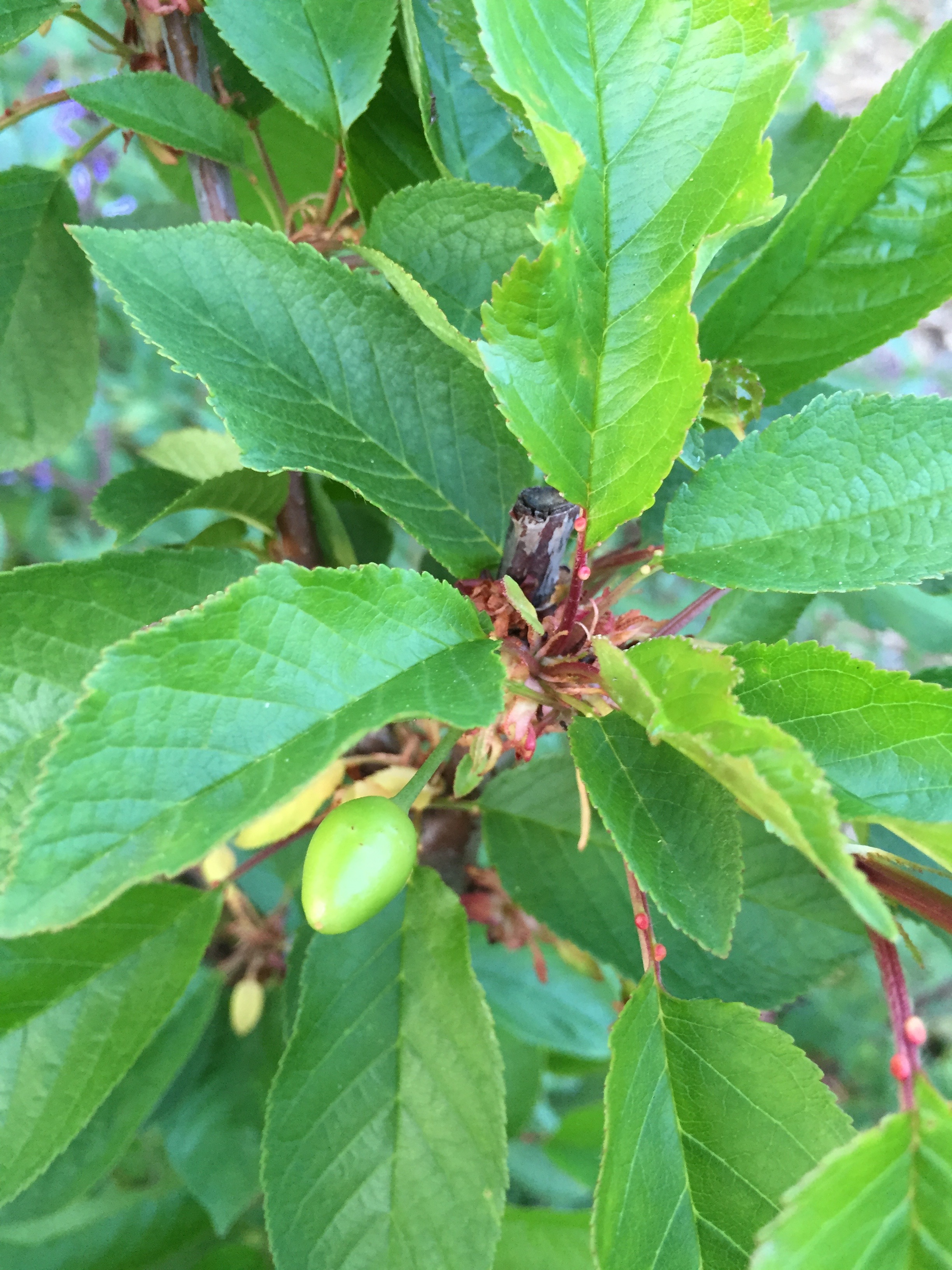
Something really good has happened in the cherry tree section. I planted two cherry trees last year, of two different varieties, because most cherry trees need a partner to pollinate them in order to set fruit. Our second cherry tree died over the summer, so we were left with only one. It blossomed normally, if lightly, and I thought that would be all we'd get out of that tree. But looky here -

Yep, cherries. I'm gobsmacked. And happy.

The olive trees that I have in front of the chicken coop, in containers, are blooming.

And there are already tiny apples on the apple tree.

The resurrected quince hasn't bloomed yet, the fig is getting very leafy but no fruit as of yet, the plum has a dozen small fruits on it, and the new Asian pear is putting out its new leaves. 

As for fruit vines, the blueberries and huckleberries have bloomed and are setting berries, the strawberries are blooming and there are many green fruits too, and the raspberry and thornless blackberry bushes are growing new leaves. It's all very encouraging.

I'm on spring break this week, which means lots of time in the garden. I bought a few more herb starts for the new herb garden, as well as five new native plants for the woodland garden (what can I say, there were holes that needed filling). One of them is a Western Spicebush which I have always wanted, so I'm pretty happy.

I noticed that we have a significant aphid population in the California Honeysuckle, but then I noticed this guy nearby, and I started to feel better. Nature often provides.


 The peas are the current star of the vegetable garden and we're having them with dinner several times a week. Sauteed very lightly in butter, there is really nothing tastier.


Tomatoes

Maybe I am a tomato dunce.

I am not being dramatic.  Because I killed half the tomatoes I transplanted last weekend.

Both Cherokee Purples, dead. Half of my paste tomatoes, dead. And the list goes on. I also killed two peppers and I didn't even transplant those.

I have no idea what I did wrong. Half of the tomatoes survived and are doing well. It must be something with the way I handled them? Or did I not plant them deeply enough? Not give enough water? Oh, screw.

So today I decided to supplement my supply with a few purchased seedlings from the Contra Costa Master Gardeners. They always have a huge selection to choose from, and while I was there, I picked up a pepper that you grow specifically for drying. Our drying experiments never worked well last year, and apparently it's because you need a specific pepper - who knew???

So, now I've got four cherry tomatoes, five slicing tomatoes, and six paste tomatoes, all in half-gallon containers, out in the sunshine (76 today and heading towards the mid-80's later in the week), and man did I water them in well. 

Cherry: Mexico Midget, Yellow Pear, and two Black Cherries (all survivors of my killing spree).

Slicing: Nebraska Wedding, Black Krim, Brandywine (survivors), plus two I got today - Mortgage Lifter, and Cherokee Purple. 

Paste: Opalka, Federle, Amish Paste (thank goodness one of each of these survived, I knew there was a reason I planted two of everything), and three from the sale - La Roma III (the only determinate variety I have), Rocky, and Pompeii.

I heard a bit of a tomato talk while I was standing in line to pay; one of the Master Gardeners was talking about how they plant tomatoes in 'Our Garden' (their demonstration site). She said they water their tomatoes on drip (like us) four times a week for 40 minutes at a time. This is easily half again as much as we watered last summer. So we'll be adjusting our drip system to match what the MG's do.

She also said our soil is still too cold to put tomatoes in the ground - this is what I thought - so I'll be waiting several weeks. Not like last year!!!

I transplanted the peppers today too. I have the one I bought for drying from the sale - Picante Calabrese - and the ones that survived here- Jalepeno, Maule's Red Hot, Jimmy Nardello, Chocolate Bell, Bull Nose Bell, and Sheepnose Pimento. 

Because of this amount of tomatoes and peppers, and seeing how things are coming in the winter garden, I revised my whole plan for the summer garden. 


Speaking of the winter garden, both garlic and shallots are starting to look like they might be ready for harvest earlier than I expected. Last year we harvested garlic on April 24 and shallots on June 13. So I must be wrong and they must need more time. The fingerling potatoes are looking good but haven't bloomed yet, so I don't want to take those out anytime soon. The carrots and beets are being harvested now, and there are still turnips though we have eaten all the turnips we want to for a long, long time. Maybe we'll pickle some. Broccoli is going to seed, the cabbage never 'headed' and is being used to feed the chickens; we are harvesting peas daily along with spinach, kale, and chard. The braising greens have gone to seed and are providing flowers for the bees and food for the chickens as well.

Flowers are blooming everywhere. Here is a small sampling.

 a bumblebee on Coral Bells (Huechera)

 a bumblebee on Coral Bells (Huechera)

Douglas Iris

Douglas Iris

Hummingbird Sage

Hummingbird Sage

Scabiosa, or Pincushion flower

Scabiosa, or Pincushion flower

Chinese Houses

Chinese Houses

I can't remember - old-fashioned phlox? Not sure. Charming though.

I can't remember - old-fashioned phlox? Not sure. Charming though.

More Ceanothus

More Ceanothus

Brilliant Poppies

Brilliant Poppies

Galliardia, or Blanket Flower, about to bloom

Galliardia, or Blanket Flower, about to bloom

It's fun to walk around and see things popping up. Like this -

Plums!

Plums!

or this -

Blueberries

Blueberries

What's happening in your garden this weekend?


Happy Easter!

We're having a glorious summer-like Saturday here at Poppy Corners.

Huckleberry flowers

Huckleberry flowers

To all you Mid-westerners and East-coasters, I'm so sorry - but it's in the high 70's here today. I'm actually a little bit sunburnt after working in the garden today. 
June-bearing Strawberries

June-bearing Strawberries

I decided to pot up the tomatoes one more time. They've been growing in the cowpots very nicely, and while I like the fact that the cowpots are made out of manure, they tend to let the seedlings dry out quite a bit, which I don't like. Also, I'm not planning to plant these seedlings in the ground until very late April or very early May, to avoid the problem I had last year - an unexpected cold wet week in April. 

Carrots with Cilantro

Carrots with Cilantro

I bought some black plastic half gallon pots and more potting soil and moved all the tomatoes into them. I also gave them a diluted liquid fish feeding. 

You can see how dry the peppers look in those cowpots.

You can see how dry the peppers look in those cowpots.

I have one raised bed standing fallow because my Cauliflower and Brussels Sprouts crops failed (possibly due to Joe the dog, digging). So I put the pots there, and put a row cover in place. I'll leave the pots outside overnight, but cover the bed with row cover, which should protect the seedlings and keep the space underneath a few degrees warmer than outside. Now I just have to remember to cover it at night and uncover during the day. 

Harlequin flower

Harlequin flower

I've left the peppers in their cowpots for now, they are still very small, but I will also leave them out under the row cover. 

Fingerling Potatoes

Fingerling Potatoes

Tom's been working on getting drip access into the new raised beds, and I've been sowing more wildflower seeds and doing a a lot of weeding in the pollinator beds. 

a native bee on Salvia

a native bee on Salvia

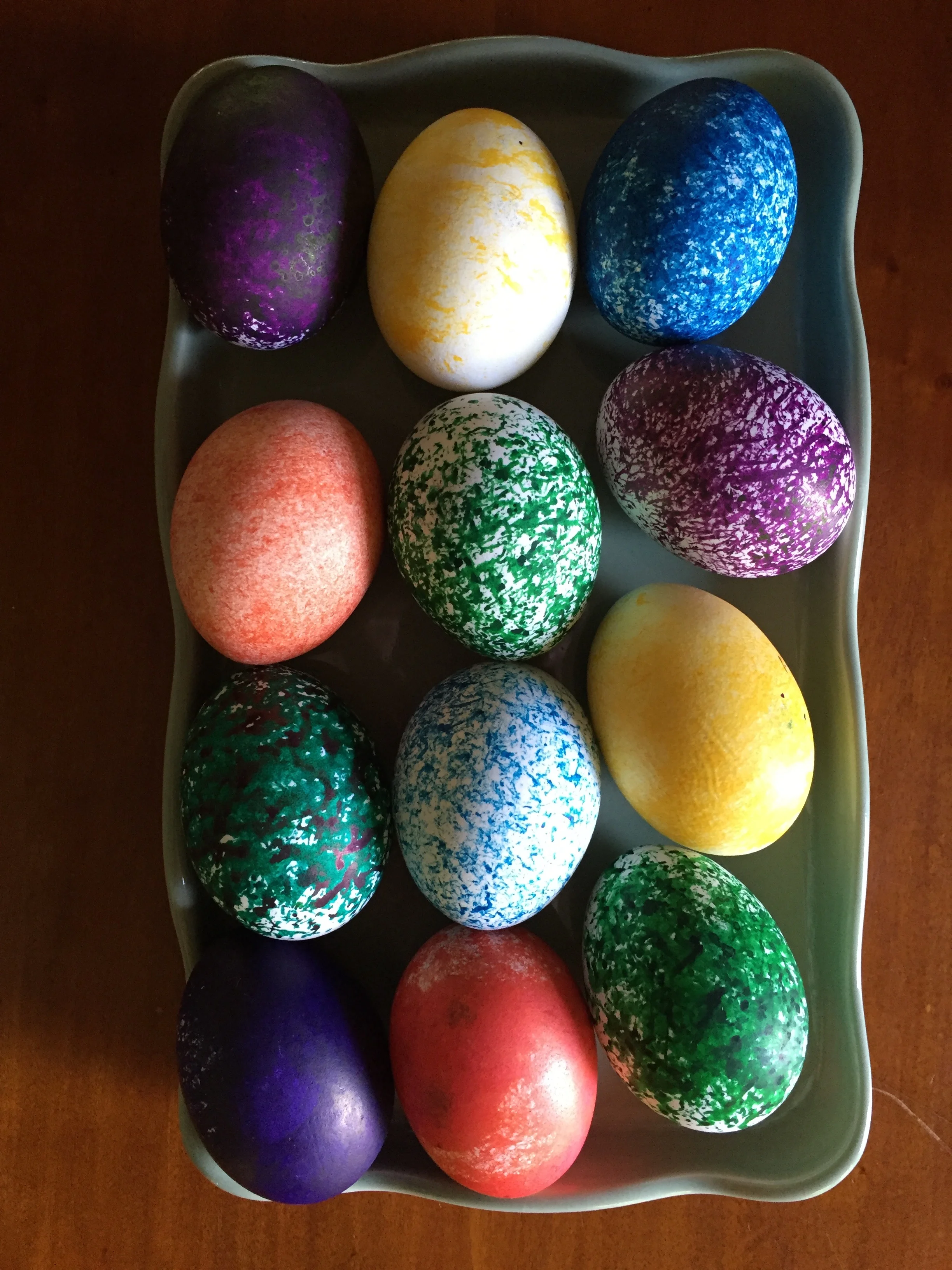
Today was also my annual egg-dying experiment. The last few years, I've been trying out natural dyes. This year, I wanted to try out a new way of coloring the eggs using commercial dye. I saw this in some magazine months ago.

I filled some old recycled containers with different grains - rice, quinoa, popcorn, and grits. Then I added some dye.

I shook the boiled eggs (just white ones from the store, I didn't want to waste eggs from our own chickens) in the dyed grains, and this is how they turned out.

I like them but I don't love them. Next year I'll try something different!

Tom and I had a fun cooking class this past Wednesday with Epicurean Exchange, it was a gift from my mom. This class was all about French Desserts; we made Creme Anglaise, Chocolate Mousse, Chocolate Souffle, Crepes Suzette, a lemon tart with a short crust, and some ice cream. We enjoyed it very much and I came home with three dozen eggshells for my tomato planting in May - that's how many eggs we went through in the class!

Chef Charlie

Chef Charlie

I hope you're all having a wonderful Easter weekend. Maybe some of you are even on Spring Break, in which case, enjoy!

Mock Orange

Mock Orange

Satisfaction

Sometimes I think all of this homesteading/sustainable stuff is just a little too precious for words. I mean, I just read a review for a restaurant that recently opened in San Francisco that is extremely farm-to-table, and some of it is just so over the top. I mean, using a perennial wheatgrass that is specifically known for its carbon-capturing capabilities for the bread? And I thought grinding my own wheat was crunchy.

And I'm too old to be a hipster. None of the stuff I'm doing is in the name of 'cool.'

But there are times, even whole days, when I derive such an immense sense of satisfaction from doing things this way, I just kind of want to burst with the 'rightness' of it. Today has been one such day. 

Tom's brother is here for the day, and it's so fun. He helped Tom put up the hop vine trellis (which involved ladders! yikes, you never know what you'll be asked to do around here) and now they are brewing beer. I knew we'd want to have good meals for him, something from the garden and something from the larder.

Choosing something for dinner was easy, with the new smoker - put a piece of meat on for the day, make some baked beans, and later, biscuits, and we're done. But I wasn't sure about lunch...

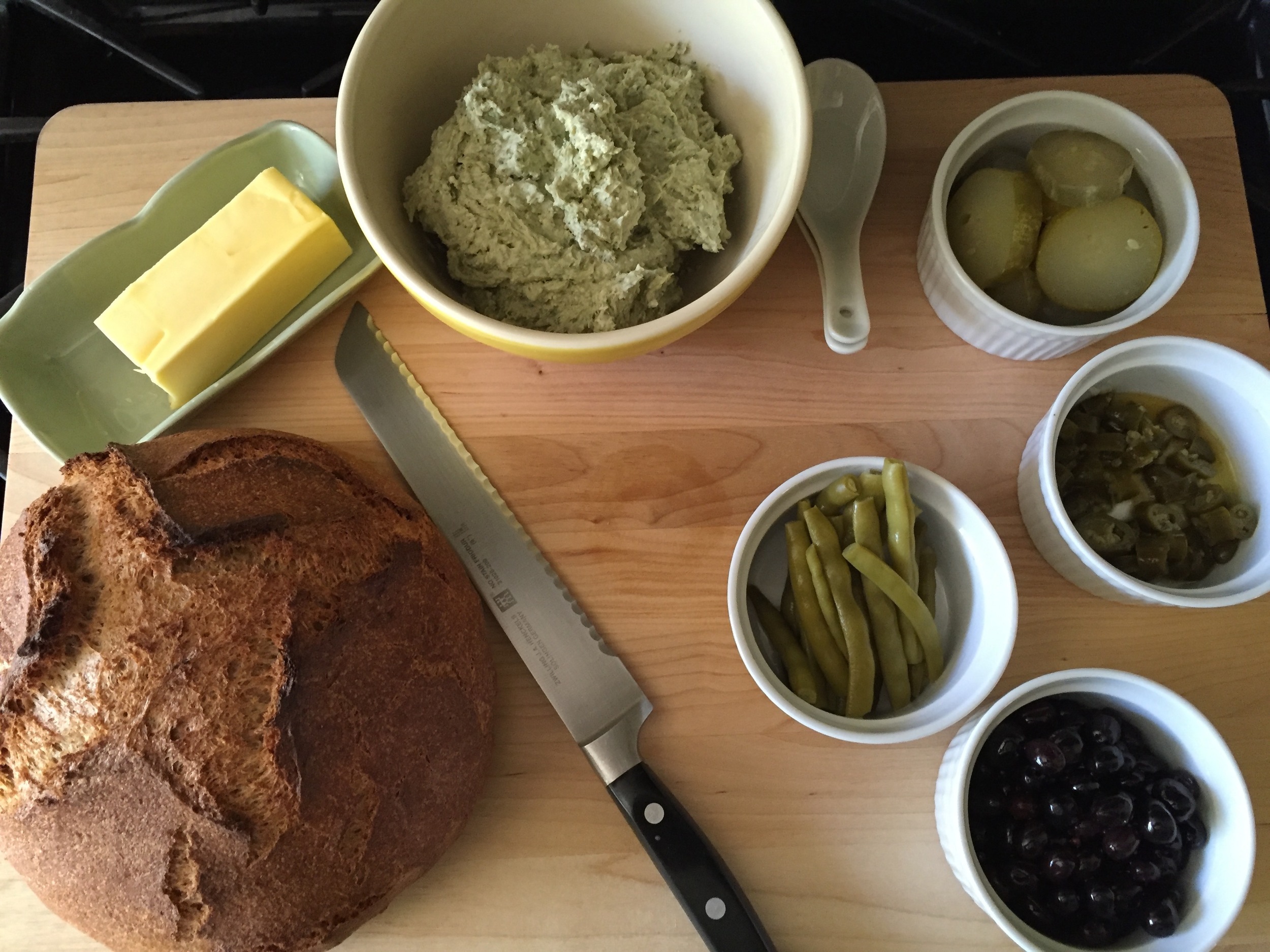
Today was bread-baking day, so I already had fresh bread. I had some ricotta left over from the other day - I had made fresh ricotta to go on homemade pizza dough. I also had a couple of tablespoons of pesto left over, which I froze last summer and have been taking out of the freezer when needed (like for pizza). I went out to the old herb garden and cut some chives, marjoram, and oregano. I opened up the last jar of pickled garlic from last summer. I put the ricotta, some olive oil, the pesto, the herbs, and a couple of cloves of garlic in the food processor and blended it all up with some salt and pepper. This gave us an herby cheese spread for the bread. 

I sent Tom to the store for prosciutto, and went out in to the garden for carrots, turnips, broccoli, beets, peas, and asparagus. I made a vegetable plate with these items from the garden.

I got out the last jar of pickles, a jar of dilly beans, and the olives and pickled jalepenos from the fridge. All together, these items made such a nice lunch, with a mandarin orange to top it off. And it was just so darn satisfying to have all these items on hand to make a lovely, homemade lunch. 

It's been a while since lunch, so soon we'll have an afternoon snack with our coffee - angel food cake and blueberry compote. I had a ton of egg whites left over from projects earlier in the week, so angel food was a great way to use them up. How fabulous to have our own delicious, nutritious, home-grown eggs to use in all these wonderful dishes. How amazing to have all these vegetables in the garden, just ready to eat. How terrific that I thought to put up all these items last summer, so they'd be on the shelf when I needed them. How lovely to have fruit from our own fruit trees, vines, and bushes. It's all just so darn satisfying, I can't think of any other word for it. It has nothing to do with the environment (although it helps there, too) or the water shortage (though it helps there, too), or make us look cooler, but it sure does feel (and taste) pretty good.