Ginger Beer and Honey Wine

You may remember that on Sunday, I started a 'ginger bug' with the intention of making both mead and ginger ale. I've been feeding the bug every day since; this morning it was bubbly and fizzy and ready for use. So I moved on to step two of both projects. First, I strained the bug. It smelled faintly alcoholic! But also really delicious and gingery.

For the Ginger Beer, I heated 2 quarts of water with 3/4 cup sugar, a cinnamon stick, and a three-inch chunk of ginger, sliced thin. Once the sugar had dissolved, I let the mixture steep for 15 minutes. Then I strained it and added 1/3 cup lemon juice. I waited for the liquid to reach a temperature of less than 100 degrees, then added in 1/4 cup of the bug. Then the mixture went into four 17-ounce bottles, which will sit on the counter until Sunday, hopefully getting very fizzy.

Fermentation will provide the carbonation

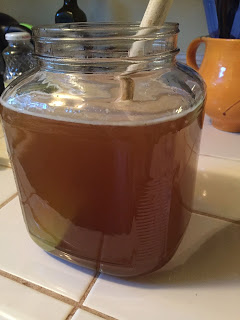
For the Honey Wine, I dissolved three cups of honey (about half of my own already-fermented honey, and half store-bought) in 3 quarts of warm filtered water, in a large gallon jar. After it cooled down to under 100 degrees, I added a cup of the bug. That's been covered with a clean dishcloth and it will sit until Sunday as well, but I need to stir it twice a day.

Isn't it a pretty color?
I'll proceed with Step 3 of both of these projects on Sunday, and let you know how it's going! So far everything smells and looks very tasty.

*note: I didn't come up with these recipes. The Ginger Bug and Ale are from Living Homegrown, and the Honey Wine is from A Life Unprocessed.

Rain!


Pyracantha berries in the rain
Overnight, Mother Nature smiled on us and opened up her skies. We woke several times to the sound of rain drumming on the roof. It rained steadily through the morning, a real drenching, none of this 'misty' crap that sometimes passes for rain around here. I needed an umbrella and my boots for walking the dog; the 'river' outside our house was there again, however briefly. The earth sighed with relief and soaked it all up.

Erigeron glaucus 'Wayne Roderick'
We had a nice couple of hours to dry out, and now the thunderstorms have started. It's all terribly exciting and fun.

Just before the storm
The chickens don't know what to make of this (ba-gawk!), and Joe the dog is pacing nervously around the house. The cat is sleepily stretched on the sofa. The kids and I are cozy and warm. Lasagna will be in the oven soon, and  Adam just said "I like afternoons like this." I'm feeling comfortably smug because I got the South Garden planted yesterday, just in time (kale, chard, greens, broccoli, cabbage, peas, kohlrabi, spinach, fava beans). I guess I'll need to get the North Garden planted ASAP (garlic, shallots, beets, turnips, Brussels Sprouts, cauliflower, carrots, potatoes, fava beans), though the outlook for the rest of the week is dry.

Rain feels like a blessing.

"You care for the land and water it;
you enrich it abundantly.
The streams... are filled with water
to provide people with grain...
You drench its furrows and level its ridges;
you soften it with showers and bless its crops...
The grasslands of the wilderness overflow;
the hills are clothed with gladness...
They shout for joy and sing!"
                             Psalm 65-ish

Fermented Honey

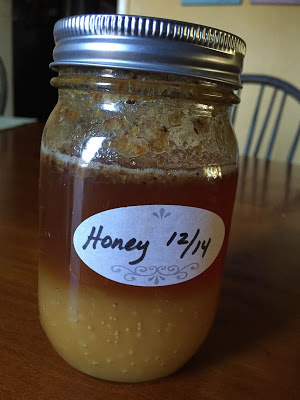
Yesterday, I took out our very last jar of honey from the December 2014 harvest. It's been sitting in our cupboard since then, and this particular sample is full of the dregs of the harvest - the bottom of the barrel, literally. It's full of propolis, pollen, and little bits of wax. Over the year, it has separated into two distinct layers. I've been using the other jars of honey, so haven't needed to get in to this one. However I wanted honey on a bagel and so it was time to crack this jar open.

When I opened it, a miasma came up out of the jar - a distinctly boozy odor. My honey had fermented.

You can see the layers, and actually bubbles in the bottom are quite clear.
I used it on my bagel anyway. Pleasantly alcoholic. Probably really good for the gut.

But, no one else in the house will enjoy it, so I've been researching ways to use it up. You can bake it into a sort of cracker, or make a drink a bit like kombucha, but of course the classic way to ferment honey is to make it in to mead. Since my honey has already turned, I figure the mead will be even easier to make, but most of the recipes I found required pounds of honey, and this jar probably has a cup and a half in it.

I finally found a recipe at A Life Unprocessed that uses three cups of honey, so I can supplement with some store-bought honey and together, should make a gallon of wine. This recipe also calls for using a 'ginger bug' which I had been reading about over at Living Homegrown, as that author uses it to make homemade ginger beer, and that sounds yummy. So I decided to mix up a ginger bug.

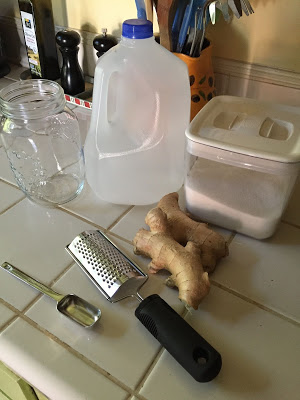
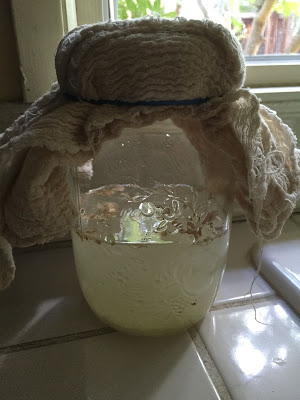
It's pretty simple - stir together ginger, sugar, and water. You let it sit for 3-5 days. Then you can make your wine.


The finished bug
Grate a tablespoon of ginger, with the peel, and add it with a tablespoon of sugar to a jar. Add two cups of filtered water (apparently chlorine from tap water can inhibit the ferment) and stir. Cover with cheesecloth, rubber band it, and let it sit. Every day, add another tablespoon of ginger and sugar. In 3-5 days, it should be ready.

Luckily our beer brewing equipment can help us with this project. I'll let you know how it goes.

Edit: Forgot to say that raw, unfiltered honey can ferment over time if kept in a warm location. The reason is that since it is unfiltered and untreated, there is a lot of surface area for yeast to grow. If you're going to store honey for a long period of time, it's best to keep it in the fridge and warm it as you need it. I've eaten raw, unfiltered honey from local hives all my life and never knew this!

Grass and Water

There's a park up the street that I drive by all the time, in fact my children played there a lot when they were little, and I still walk the dog there sometimes. It's a city park with a playground, tennis courts, ball fields, and walking paths. When it became clear that the drought was serious, the city stopped watering most of this park. The extensive green fields became brown and dusty. Lately I've noticed that there's been some work mulching some areas (giving up the idea of grass completely) and I was so excited about that. I mean, I know the ball fields need grass, and that's ok - loads of soccer and baseball teams rely on this park, and some green fields are necessary - they've continued watering these sporadically. But I was glad to see that the city seemed to be rethinking their stance on 'grass everywhere.' However they left one very large swath of land alone, it's not a ball field, and it serves no purpose as far as I can see. Dry and dusty it has remained.

Until now. In the last week or so, I've noticed that it's getting greener and greener. First the green creeped up in the edges, and now the center is turning green too. Since we've had absolutely zero precipitation, that means the city has turned those sprinklers back on, in anticipation of El Nino materializing.

This worries me.

We've been hearing hype, and I mean major hype, about El Nino, and how wet it's going to be this winter. And if it is, hooray. I couldn't be happier. But last week we were looking forward to a big forecasted storm that never came, and we had rain in the forecast for this coming Sunday and Monday and now that has changed as well. And I'm worried that all the rainstorms are going to do the same thing the whole winter - just quietly pass us by.

And if the city is loosening up their restrictions on how much they are watering public parks, doesn't it mean that homeowners are also loosening up and watering more frequently?

Meanwhile I have neighbors that never changed their habits at all - they've been watering their grass all summer long using well water. I don't know if any of them read this blog, but if they do, I'd like them to reconsider this practice. Just because you aren't using city water doesn't mean you're not using a huge amount of a precious resource.

And then there are those who have let their grass die (admirably) but seem to have no plan to actually change anything - they're just waiting for the rains to come back and then they'll have a lawn again. This is almost as unhelpful to the environment as the reckless use of well water.

So let's talk about grass for a minute, because I really think we need to change how we feel about grass, at least in the West where drought is pretty much going to be a permanent fixture, El Nino or no.

I want to make it clear that I totally understand the love for grass. As a kid on the East coast, I spent numerous hours lying on the grass in our yard, staring up at the trees, or reading a book. I loved running barefoot through it, looking for fireflies. My dad spent a great deal of time making sure it looked nice. I'm sure chemicals were involved. He had to mow and weed it each week and I'll bet that was a chore he could have done without, but it looked nice and we used that lawn constantly (there were no devices calling us to go indoors, so most of our free time was spent outdoors).

I also loved having some grass when my own kids were little. I liked being able to put a little kiddie pool out in the middle of the green expanse and lay out a few towels. They could run around barefoot and splash in the pool. Sprinklers, too - who doesn't love running through sprinklers? This is a rite of passage for a kid. Grass is a good place to play catch, croquet, frisbee. One of the best parts about it is that you don't need shoes.

Ecologically, grass is good for basically one thing, and that's covering bare ground. I'm sure it does the whole carbon-oxygen conversion thing, and it keeps a few creatures on the micro level happy. If it's kept up, it looks nice. I watch a show on PBS called "P. Allen Smith" and he gardens in the deep South, and his garden pathways are all turf, and I have to say it looks so lovely. Whenever I go to other states, or to to England, I'm always amazed and delighted about how green it is. A huge lawn is often a symbol of richness and wealth, it's expansive and welcoming.

The downside, even if you do get plenty of rain, is the upkeep - chemicals, fertilizers, regular mowing, de-thatching, aerating, re-seeding. That all takes a certain amount of money and time. Around here, hired gardeners are as common as housecleaners, and it seems pretty normal that no one can take care of their own garden or house by themselves (there's a rant in me about that, too - another time). And, if you don't get plenty of rain, or even adequate rain (because grass needs a lot of rain to stay looking good), you have to use another input in the form of city water.

So let's compare, say, a front yard of turf and a front yard of native plants. For simplicity's sake, let's call this a Western yard, because that's where I live and that's where the drought is at the moment (though other parts of the country do experience drought as well).

GRASS:

Pros:
          Beautiful - in a 'one-note' sort of way
          Supports small amount of underground biology (although chemicals will reduce
                 this population)
          Prevents erosion
          Provides oxygen
          Provides play surface

Cons:
          Requires regular maintenence in the form of mowing, weeding, aerating, de-thatching,
                re-seeding
          Requires chemical inputs in the form of herbicides, pesticides, fertilizer
          Requires a good deal of water, which can be expensive
          In drought, must let go brown, or spend even more money to water it; once grass
                dies, it'll need to be re-seeded or sodded at great expense
          A monoculture; no diversity

NATIVE PLANTS:

Pros:
          Beautiful AND colorful
          Supports huge amount of wildlife, both under-and above-ground, as it provides
                   food and habitat for many insects and animals, plus a safe soil for the
                   development of a robust microbiome and network of mycelium
          Prevents erosion
          Provides oxygen
          Takes far less water to grow and maintain, and in many cases, no extra water at all
          Actually improves the soil
          Does not need chemical inputs, as plants are perfectly situated to their environment
          Native grasses can be used for a play surface
          Provides ecological diversity

Cons:
          Needs a little extra water at planting time to establish
          Depending on plant, may go 'summer-dormant,' so more planning might be needed
                  to 'fill in the gaps'


I think the benefit of removing grass and putting in native plantings is more than clear.

Or, how about putting in an organic vegetable garden, which still takes less water than lawn and provides you with food the whole year, while also improving the soil and creating food and habitat for insects and birds? Sure, it's a bit of work on the front end, but the benefits are so much greater!

When you compare what you get out of it, and what the environment gets out of it, why WOULDN'T you remove your grass? If you were told you could put your money into some account that would benefit you greatly, while also benefitting everything around you, with near zero risk, you would RUN to invest.

It's just common sense.

So why isn't everyone seeing this the way I do? Am I missing something? This all makes me think we have a failure of imagination in this country, or a misplacement of values. Maybe lawn has a symbolism I'm not aware of. Maybe it's just the 'default.' Whatever it is, I think it's time to re-think it. Some of the most beautiful gardens I've ever seen have been composed of native plants interspersed with Mediterranean drought-tolerant plants, with birds, butterflies, and bees swooping through, a song in the air constantly, and not a blade of grass in sight. If even one neighbor on every block changed from lawn to this new kind of garden, the world would be a much healthier place. If one neighbor on every block changed from lawn to a vegetable garden, none of us would ever have to buy our produce at a store again.

Reviewing the Summer's Plant Choices

As I put the very last batch of tomatoes into the oven for roasting today (they'll go in the freezer rather than be canned), I thought about the varieties that I grew this summer. Afterward, I made some notes about it, so that I can make different choices next year.  As I've written before, it's hard to know how much the drought and sandy soil affected our garden; however there are intrinsic things about each vegetable that I think came through, regardless of our issues.

Tomatoes:

Paste: I chose 'Amish' and 'Baylor.'. The 'Amish' variety did a better job, but neither of these was stellar. I'll look for other choices next year, though I might give 'Amish' another try. They were large and meaty. I did manage to make 8 half-pints of tomato paste from these tomatoes and had plenty more for fresh eating, just not as many as I wanted. And they looked diseased from the start, which isn't necessarily the fault of the variety, but rather either the fault of the seedling, or perhaps my soil.

Cherry: We chose 'Black Cherry,' 'Yellow Pear,' 'Dr. Carolyn,' and 'Isis Candy.' The 'Yellow Pear' definitely wins the prize for best producer, and the tomatoes were sweet and delicious. I liked the 'Black Cherry' for it's dark color (better nutrition), but it was a feeble producer in my garden. 'Dr. Carolyn' was a light yellow tomato that I didn't like as much as the 'Yellow Pear,' and 'Isis Candy' was a dark orange variety that was fine, but I would have preferred a dark red variety. I'll do the 'Yellow Pear' again for sure.

Slicing: I chose four, but only remember the names of three of them: 'Bloody Butcher,' 'Cherokee Purple,' and 'Italian Heirloom.' 'Bloody Butcher' was the earliest producer, but the tomatoes were quite small - again, maybe the fault of the drought and our poor water conditions. 'Cherokee Purple' was a gorgeous tomato, thick and indeed a reddish purple, with many ovaries, a classic heirloom. I'll grow this one again for sure. The other two I bought were completely nondescript, barely producing and unmemorable.

Corn:

We grew one variety, 'Luscious Bicolor.' It was simply ok. The ears were quite small, and while they tasted good, there just wasn't enough of it. I'll try a different kind next year, probably a yellow variety, for better nutrition.

Pole Beans:

We grew 'Blue Lake' and 'Rich Purple Pod.' Neither were our favorite. Both were better when picked quite small, as they got very stringy and leathery when even medium sized. The purple ones were beautiful, though. I'll choose different varieties next year.

Winter Squash:

I grew 'Delicata' and 'Climbing Honey Nut (butternut).' Both were wonderful - good growers and producers. The 'Delicata' is delicious for fresh eating as it ripens, and this variety of butternut was small, which makes it easy to peel and roast, and store in the warm garage fridge. I'll grow both of these again. A note, however - the butternut didn't really climb - it sprawled, as all squashes seem to do.

Sweet Peppers:

All four of these varieties were prolific producers, however many of them did not change into the rich colors that were promised, even over a very long season. We had millions of 'Jimmy Nardello,' which are a small, thin, red variety. They were delicious but hard to seed due to their thinness. 'Marconi Red' were wonderful long red peppers but many of them never turned red, so we ate them green. 'Sweet Sunrise' was the only pepper I grew that had a 'bulb' shape, which I liked a lot, but only two of the many we harvested were orange. 'Olympus' was nondescript and I won't grow it again. I'd like to grow more 'bulb' shaped peppers that have an early harvest date; we might get some better coloring that way. Plus the bulb shape seem easier to cut and seed.

Hot Peppers:

These were the undisputed star of our garden this year, producing like crazy, so much so that we couldn't keep up. Right now there are at least 20 jars of canned hot sauce on the canning shelf, as well as 10 jars of pickled jalepenos. We also have jars upon jars of roasted peppers in the freezer for wintertime salsa. Next year I think we'll stick to 'Jalafuego Jalepeno' - delicious - and 'Serrano Hot Rod.' The 'Ancho Poblano' didn't produce nearly as much as the others, and they were quite a bit smaller than we would have liked. 'Padron' was fun, but not as well-liked as the others.

Sweet Potatoes:

I made my own slips from the Japanese sweet potatoes sold at Whole Foods. The vines were glorious, but the harvest meager. I'd like to try a different variety next year, something with more of a deep orange color, plus something that might be able to be started earlier, as this is a very long-season crop.

Watermelon:

We chose 'Moon and Stars,' and it was a beautiful variety with speckled leaves and fruit. Unfortunately it was also incredibly speckled inside - very very seedy - though delicious. We'll try a less-seedy kind next summer.

Cantaloupe:

We grew 'Melone Regato Degli' and it was a beautiful, small, not-too-sweet fruit. I might try this again, or try a larger variety.

Carrots:

I grew 'Starica' and 'Jeannette' - both were wonderful and tasty. Succession planting and plenty of space is the key to a long season of delicious large carrots.

Basil:

'Genovese' was a star producer for us and kept us (and the neighbors) in bushes of basil all summer long. I'll definitely grow this again.

Collards:

I've always grown 'Green Flash' in the summer, and they do well here. This year we had a lot of aphids and cabbage white butterflies, which did a lot of damage. I like having some sort of green in the hot months, and collards are the only ones that don't bolt in the heat of summer. I'll try again.

Potatoes:

I grew 'Yukon Gold' and we had a very nice crop, though not as big as I had hoped. This winter I will grow them in rows rather than in towers, and we'll see how they do. (I'm also growing two different varieties.)

Romaine:

I grew pelleted 'Green Towers' this summer, and it was a stellar producer up until mid-July. I'll definitely grow this again. Nice large, crisp heads - perfect for Caesar salad.

Cucumbers:

While we were able to make many, many jars of pickles, our cucumbers weren't the best for fresh eating. I grew 'Endeavor' pickling and 'Straight Eight' slicing. I'll try different varieties next year.  I do think the drought made them taste a bit more bitter than usual.

Cilantro:

I used Seed Savers organic seed this year, and it was wonderful. However I always forget to sow it later in the season rather than at the beginning.

Peas:

I grow peas in both the winter and summer here, and they do ok until about late July. I used 'Sabre' this time around, they were ok, but not fabulous.

Strawberries, Blueberries, Raspberries, Blackberries:

I have many different varieties, all from Stark Bros. They all have performed marvelously. The trick is to order a type that will do well in your climate. There are limited berries that I can grow in our Zone 9. Even so, it's a little hot for these guys, and I get a smaller yield then someone in cooler temps.

And, we had two artichokes from our one plant (with many more blooming), lots and lots of late season spears in the asparagus patch (next year we can actually eat them!), and countless springs of herbs from the perennial herb garden. Our peach and apple bore well this year, though the peach needs more chill hours (hoping for that this winter), and we'll see how the new plum and cherry trees do. The quince, which I tried to murder, has returned. So I'll have to figure out what to do with those guys next spring.

We'll likely start planting winter crops in two weeks.
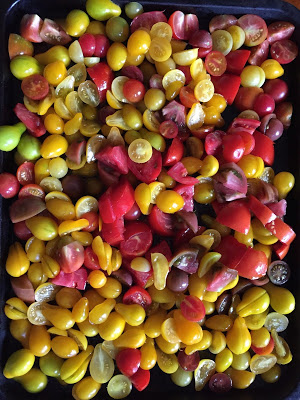
Tomatoes ready to go in to the oven for roasting