Chicken Tractor

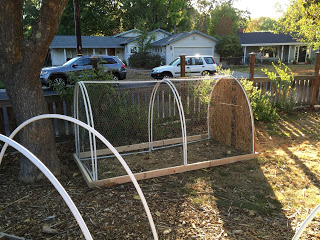
Early this morning, I wrangled Kate out of the house to help me take the chickens to the 'tractor.' This was not as straightforward as it sounds. While Tom and I had worked on two designs of 'tractor' before settling on one, we had never figured out how to get the chickens from the coop to the tractor. This turned out to be a wee problem.

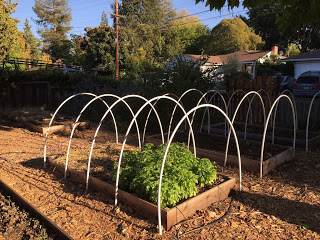
Why didn't we make a wheeled tractor, you might be asking? One that could be wheeled up to the door of the coop, fit neatly there, and the chickens could just walk on in, just like in all those YouTube videos? Well, we have raised beds right in front of the coop door, so there's not enough room to fit a nine-foot-long tractor there, so we couldn't go that route. And the tractor needed to be that long, in case we wanted to put it over one of our 4x8 raised beds for the chickens to clean up. So we went ahead with our plan, never figuring out the all-important travel bit.

I guess I figured I'd just get a bin, put some scratch in it, put it on its side in front of the coop door, and the chickens would stroll in.

I figured wrong.

You've got to understand, these are chickens who are scared of everything. I don't know if it's because I got them as 'coop-ready' chicks, meaning they were older and had already gotten set in their ways, or if they're just slightly demented. Maybe if you raise chicks from the time they hatch, they 'imprint' on you in some way and think you're awesome. My chickens definitely don't think I'm awesome. They get that I'm bringing them food, but they still don't come anywhere near me. They screech and squawk if I try to catch them. But it's not just me, they're afraid of everyone and everything. These are chickens who, when I hung a suet cake from the ceiling of their coop on a string just to give them some entertainment, huddled in a corner, far far away from the suet cake, literally all day - until I took it away, when they resumed normal activity, including laying eggs. I've always just fondly said, 'Well they're birds for heaven's sake. Of course they're skittish!'

So I don't know what I was thinking. But I blithely put the bin, as planned, in front of the coop door.

The chickens rushed to the furthest corner, trembling.

So I said 'screw it' and instead, terrorized them even more by coming in and grabbing them individually, then handing them to Kate to transport to the other side of the garden and the tractor.

Finally we got them all in, along with bowls of food and water, and a rubbermaid bin I filled with hay and put on its side, for nesting.

I felt quite accomplished. The chicken scene looked, well, idyllic.


The grass is pretty dead now, but there are bits of green weeds, and, I supposed, plenty of bugs for the chickens to eat, so heaven, right? They pecked around happily for about 10 minutes. I beamed. I thought, "This is the way it's supposed to be! I'm finally 'pasturing' my chickens!" All the guilt I've been feeling about keeping them (literally) cooped up, in order to save my plants, vanished. I'd found a way! A way to keep my garden safe, while letting the chickens roam free!

I felt happy for about a half hour. Then something happened. The chickens started looking stressed. They turned over the food and water. They pulled all the hay out of the bin, not showing any signs of actually wanting to go in it. They jumped on top of it and pooped. They ran back and forth, back and forth, crowing worriedly. They banged their beaks on the door. I kept scattering scratch around, hoping to distract them from their distress. It only worked briefly. Poor Tonks, our one very hen-pecked chicken, got even more pecked - there was no escape from Hermione, the Barred Rock, and Hermione was particularly vicious. Finally I pulled Tonks out around two o'clock and took her back to the big coop and run. She promptly went to the nesting boxes and laid an egg (and probably enjoyed the alone time). Then the barred rock and the two reds started pecking the remaining easter egger, which pissed me off. "Look, chickens," I wanted to holler, "you're having a field trip! Scratch! Dig! Dustbath! Eat! Go in the box and lay an egg! Explore your world!" But no, they were just too worried.

So clearly they had to go back to the big coop. But I discovered I had no way to get them out of the tractor. Tonks had been huddled in a corner, getting pecked, so she was easy to grab. But the door was chicken sized, not human sized, so once I leaned through, the other four ran to the other side of the tractor. When I opened up that whole side to get to them, they tried run past me and escape. I didn't know what to do.

Tom rigged up a sort of mini-coop on top of our old, little red tractor, with a ramp going up. He took it over to the tractor and opened the door, hoping the chickens would just climb on in. "Ha ha," they cackled crazily. And then there was utter chaos. Chickens escaped, heading for the road. Kate was in tears, figuring they'd all die. Tom and I chased chickens around the garden, trampling plants all along the way. The squawking was tremendous. All we needed was a soundtrack, like banjo music or something, to complete this picture. God knows what our neighbors were thinking.

We finally got everyone back to the coop, where egg-laying commenced with a right good will, several hours past the usual time, and where contented scratching and pecking is now going on. We took apart the tractor and stored the pieces in the garage. We won't be trying that again, any time soon.

Thinking about our Soil

I've been thinking a lot about the garden and how it performed this year. I was disappointed overall. There are three possible reasons for our lackluster harvest:

1) The drought. California is in it's 4th year of severe drought, and because we were told to reduce our overall water bill by 25%, we couldn't water as often or as long as we would normally.

2) Our drip system. We replaced our overhead sprinklers with a drip system, which definitely reduced our water bill, and in theory should water everything even better than the overheads, putting the water where it's most needed (at the roots) and keeping the foliage dry. In reality, we were unsure how often or how long to run them, and probably starved our plants for water.

3) The soil. This year I ordered "Local Hero Veggie Mix" from American Soil in Richmond. It's described as containing "Sandy Loam, Greenwaste Compost, Rice Hulls, Chicken Manure, Grape Compost, and Cocoa Bean Hulls." When we took delivery of the soil, I did think it was quite sandy. And I think, generally, it was fine for amending our current beds. But we had seven new beds to fill, and I filled it with this soil, rather than mixing it in to our regular clay soil.

Now it also says on the American Soil website that this soil is perfect for filling beds, but I do think that the combination of this sandy soil, plus very little water, made it harder for the plants to do as well as they might've. Then on top of that I added well-rotted horse manure which by nature is quite dry. So basically I think it's a combination of all three things listed above which contributed to a smaller harvest.

Now, we've had a good harvest overall. We've had plenty of everything, and even extra to preserve by canning and pickling. But considering the amount we planted, we should have had far more poundage. I'm thinking of the tomatoes especially. We had four plants each of slicing, cherry, and paste tomatoes. We should have had an abundant harvest, massive, filling-the-canning-shelf huge. We were able to put up four quarts of crushed tomatoes and 8 half-pints of tomato paste, but that's meager. We did eat quite a lot of them fresh, and I'm glad we had enough to provide a small caprese salad each day for the last several months, and a pomodoro sauce every so often. Still - not enough to fulfill our sauce and braising dreams for winter.

How to correct these problems? First of all, we wish until it hurts for an El Nino year. It's looking promising, but you'll forgive us all for being dubious (we've been fooled before). Rain would help our personal situation quite a bit, and a few good months of daily rain just might get the entire state out of this drought. (This reminds me to clean the rain gutters and make sure the rain barrels are set up properly. Too bad we don't have a cistern.) As for the soil itself, I wish I had enough home-made compost to put an inch on every one of my 13 raised beds. I just don't. In my small compost bin (the one I call the 'worm bin' because it's too small to heat up very much, and I buy worms to add to it every year) I can get a couple of five-gallon bucketfuls every couple of months. But that's not enough for our growing footage.While I have two other large compost bins (which are positively full to the brim at the moment of material), it just doesn't seem to break down very quickly, and that's probably due to the fact that I can't spare the water to keep them wet. Perhaps they will decompose more quickly once it starts raining. I don't lack for either green or brown matter here and I'm again finding it hard to find a place to put it all.  I'm getting more and more wary of buying compost, even from reputable places like American Soil, because I don't really know how it was made or from what.

So I'm not sure what I'll do, moving forward. I might buy some bagged soil mix from a local nursery - they have a kind that I really like that is full of good stuff. A large bag is $10 each, though, and one  bag is not enough for each bed. I have been putting a buckwheat cover crop in each bed as I clear it, which I then cut down to use as green manure. That gets covered with soiled hay from the chicken coop which I will leave to use as mulch through the winter crop. Hopefully all that organic matter will help. I also plan to seed fava beans in every bed along with the usual winter veg. That will at least add nitrogen as it's growing, and then in late winter/early spring the flowers will provide forage for the bees, and then food for us.

Speaking of food, this coming weekend I plan on harvesting the butternut squash that is now on the vine and curing it, before storing it in our 'warm' refrigerator in the garage (my parent's old fridge, which is in our garage now, and is on it's warmest setting, which is still probably just under 50 degrees). We've eaten some that I harvested a while back, and they're delicious - these are tiny butternuts, the size of my hand. Their color is a deep, brilliant orange, which just advertises how much nutrition they provide. Roasted in olive oil and sprinkled with plenty of kosher salt, they make an excellent side dish or even snack. I'm excited to eat more of them.

Which reminds me to tell you that I've also been thinking a lot about what colors I am eating every day. After reading "Eating on the Wild Side" by Jo Robinson, I reevaluate nearly everything I eat. And actually, I'm doing pretty well, though I've changed my habits in some ways per her advice, especially in how I store fruits and vegetables (you should see the three-column chart I've posted on the refrigerator. I'm only a tiny bit Type A). It's fun to try to eat something from each color of the rainbow each day (though many days there's no way I can get them all in). I realize it's probably easier to do this in California than it is in, say, Toronto.

Cuphea, Chicken Tractor, Hive Check

Today I went to a nursery in Richmond, Annie's Annuals, a wonderful place where all the plants are raised from their own seeds and cuttings. Everything is neonicotinoid free, often heirloom, often native, and always grown in 4-inch pots. I don't go often because I have very little control when it comes to buying plants, and I could easily spend our mortgage money at Annie's.  However, today I went with a plan, and I stuck to it fairly closely. I checked online to see what they had available, then I made a list of things I wanted to try. I got most of those things, and only a couple things I didn't plan for.


Two flats of lovely flowers.

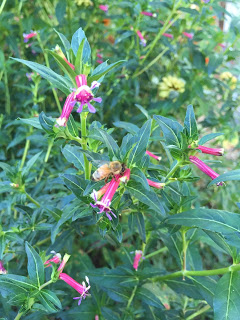
The absolute best part of this adventure, however, was that I discovered the name of the plant! The plant in my garden that was nameless, the one that all the bees are simply mad for?


My friend found it at the nursery today. It's Cuphea! (pronounced koo-fee-ah.) I bought more of the same kind that I have ('starfire pink'), plus another one called ''minnie mouse'' because it has two brown dots that look like ears.

When I remarked to a nursery employee that the honeybees love this plant, he said I should also try Hebe speciosa as he noticed the bees always covering that in their demonstration gardens. So I brought one home, along with milkweed, salvia, ceonothus, papavers, monkey flower, and various other items. Oh, and some woodland strawberries for the pallet planter on my front porch.

Of course now I have to plant all these, and I didn't get to it this afternoon, because I stuck to my plan of clearing out everything but the basil in the South Garden, and replacing it with a cover crop.

That's the basil, looking forlorn next to a lot of bare beds
I figure the basil is its own cover crop, if I let it flower it will also be forage for the bees.

And speaking of the bees, we did a hive check today. Ready for this??? Not one sign of varroa or wax moths. Nothing. Nada. The bees were working hard, especially in a privet that just bloomed (the only one left in our yard) as well as the pollinator gardens, and everything in the hive looked just right. I removed the strip of formic acid and determined that we should check the hive every week until it gets cold and rainy. For right now, unbelievably, it looks like we are over the hump.

PHEW.

Tom spent the afternoon putting together a newly designed chicken 'tractor.' It looks awesome.


It comes apart in five sections for easy moving, it has an actual door at one end, and it also fits over the raised beds in case I want the chickens to clean up in them as well. We won't be able to try it out till next weekend, because we want to be home when they are in the tractor. It's definitely not predator-safe, but we figure if we're around and working in the yard, they'll be fine. A bowl of water and another of food, plus some sort of nesting box, and we should be good to go with Project Dead-Grass-Removal.

So, a mostly productive weekend. Hope you got some time outside, as well!


Pumpkins, gourds, other interesting finds

I've had absolutely no time in the garden, so tonight when I came home from a day in San Francisco with Adam, the first thing I did was go harvest the pumpkins and gourds before sunset. Our haul is meager. The terrible powdery mildew problem really put a cramp on the pumpkin beds. The large pumpkins didn't fruit at all, and I harvested only one medium-sized pumpkin. However I have about 12 mini pumpkins and four gourds. Enough to decorate the house with. Not nearly enough to use for carving or pie. Bummer.


I guess I should be grateful to have any at all!

Regardless of the fast pace of my days, the dog still has to be walked, and I suppose that's another thing to be grateful for, because I get to slow down enough at those moments to look around me and absorb what's happening in nature. This week I collected some Osage oranges from our nearest open space.


Osage orange trees are in the Mulberry Family, and can be invasive in areas which were over-grazed or in abandoned agricultural areas (this particular open space used to be cattle pasture, plus it's an old walnut orchard). The fruit is not edible and it has a strange scent. An old wives tale is that you can use the fruit as an insect repellent, but as far as I can tell from my research, that's probably not true. Insects and birds don't seem to eat them, and there seems to be no apparent use for these strange balls. However, I think they look very autumnal and a bit 'brain-y' and are perfect for Halloween decorating.

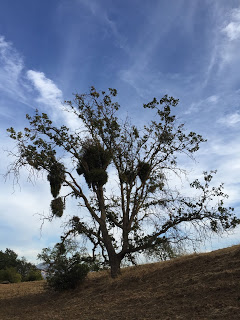
On another walk in a local open space, I noticed the oak trees festooned with mistletoe.


Mistletoe is invasive and can kill the tree, albeit very slowly. Our old Cub Scout troop used to go collect it out of the trees and then sell it at Christmastime. Most of the mistletoe I see is far too high to obtain, or I would try to get a little some of it myself. I'll keep looking for a lower infestation, as we get closer to the holidays.

On yet another walk I came across this:


Alas, I did not have time to relax in this hammock. Also, I was just a tiny bit skeeved out. Maybe I'm not as adventurous as I thought I was.

But, I don't have to go as far as the open space to find treasure. Some of it is right here in our yard. Such as this orb weaver web in our pepper tree, at sunset.


I'm gone again for most of the day tomorrow, but I'm hoping to have time to rip out the pumpkin vines and add a buckwheat cover crop, as well as harvest all the butternut and delicata squash and rip those vines out as well. I would like to remove our paste tomato vines as they are looking really horrible now (though they still have some fruit on them) and possibly try to dig up a section of the sweet potato vines and see what's happening under there. I also need to harvest the last of the cantaloupe and rip out those vines as well.

We also need to check on the honeybees and see how they are faring with the varroa and wax moths.

We've scrapped the enormous chicken tractor and are thinking about a sleeker design. More to come. We need to get that grass ripped up (eaten, scratched up, dug in by chickens) before the rains come, or it'll just pop right back up again. And I have big plans for that area. I'm reading a great book called "Eating on the Wild Side" by Jo Robinson and she gives great ideas for extra-nutritious plants to grow. Blood oranges, anyone?

Hard Decision regarding the Hive

Our honeybee hive is as strong as we've ever seen it. In a severe drought year, with all the beekeepers we know having to feed their bees, ours are bringing in nectar and pollen daily. Our forethought and planning with the pollinator gardens have really paid off in a big way. Looking through the hive today, we noticed many bars completely full of capped honey, with more bars full of ripening nectar. There's not much brood, which is expected this time of year, but the hive seems well-set for the winter months.

All this was very pleasing, and we would have been entirely happy with our inspection, had we not noticed this.


It's hard to see, but the arrow is pointing to a varroa mite on the back of this bee. It's a red shiny dot. My hive tool is pointing to it from the other side.

We noticed 3-4 mites on as many bees - they're not overrun, by any means, but will be soon if left untreated.

And in a not-unexpected twist, we noticed four wax moth larvae crawling on the floor of the hive. I promptly severed them in two with my trusty hive tool, but I left the hive inspection feeling very depressed and unsettled.

We lost our hive last year to varroa - it was in late November and we didn't notice until the entire hive was dead.

We've never had wax moths before, we only noticed them for the first time about a month ago, but the really special thing about them is that they destroy the honey and the wax, so even if our hive dies from varroa, if the moth larvae get to it before we do, we won't even be able to harvest the ample honey crop.

I called my beekeeping mentor immediately (that's my dad :) ) and we talked about the fact that he had just bought some formic acid strips from the beekeeping store for just this purpose. He invited me over to look in his hives and see if I saw mites there.

So I did. But first I researched formic acid. As you know, I've been struggling with the question of whether or not to chemically treat my bees. Most beekeepers do, regularly. I feel strongly that the bees (not just my bees, but bees in general) need to evolve past this, and in order to do that, we just need to leave them alone. And until I saw mites on my bees today, I was sure that I would never treat  them.

Then I thought about the fact that my bees did not come from a wild swarm, but from a breeder, who definitely treats his bees. My queen has been treated before. She grew up being treated and having that help. Her genetic line is used to being treated. She has never developed the ability to resist mites. She isn't likely going to start now. My bees will die, if left untreated.

This pisses me off, because having to get a new colony is not only heartbreaking, it's a pain. It's expensive, and they always come in mid-April when the first nectar flow is already finished here in Northern California - they miss the native wildflower bloom. And then I have to feed them for weeks while they build their comb (since I have a top bar hive, they build their entire comb). And just when they get to a strong and healthy place, varroa descends. And it will descend every year, this is just a fact of life now.

Then I thought about the wax moths. Formic acid has been shown to kill wax moth eggs and larvae as well as varroa mites. My mind started to change.

So when I inspected Dad's hives with him, and we found varroa in one of them, and he didn't hesitate to put a strip of formic acid on top of the bars of his hive, I found myself taking the other strip home. And then I opened up my hive and placed it inside.


It doesn't smell great. I'm sure the bees won't like it. Some will probably die. The queen might even die. But if I don't do this, the colony will surely die. So I'm going with the better odds.

I'll keep you updated, friends. Formic acid is considered an 'organic' treatment, but it's certainly not the kind of organic I'm used to here at Poppy Corners. I'm not entirely happy, but I feel confident that I'm giving my bees a shot at survival.