Mantids

Today, I saw two Praying Mantids in the garden.

One on the Tithonia....

... and one on the Strawberries.
These look like two different species to me, or maybe a male and a female of the same species. I did some research and there are many different kinds, most of them non-native. But I couldn't determine which these were. I learned that they eat the bad bugs, yes, but they also eat the good bugs, like my honeybees! and butterflies. They do not discriminate, making them not-so-great for targeted biological pest control. However I still like to have them in the garden and since I have between 20-40 thousand honeybees, I suppose they can take one or two. Autumn is mating time for the mantids, so that must be why I'm seeing them now.

I also picked our first two figs, yum.

'Panache' fig
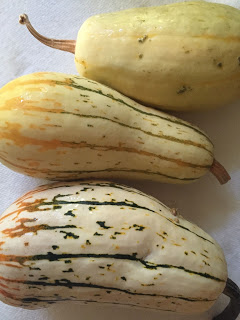
And I picked a bunch of Delicata squash. I guess they'll join the potatoes in our bedroom, the coolest room of the house. I can't do much about providing high humidity, though.


It won't be long before Butternut squash and sweet potatoes join the stash.

I forgot to show you a gift I was given last week at our Ceilidh. My friend Leslie ("Stitches," as she is known at camp) made my hen-pecked chicken an apron. Isn't it cute?


You snap it under the wings and it lays snug on the back, to prevent the other chickens from pecking the bird. Unfortunately, I've had no luck getting it on Tonks, despite several tries. The chickens (all except Molly) really don't like being handled and think I'm pretty scary. This bothers me a little because soon we are planning to make a sort of chicken tractor to place in the garden in different spots so the hens can have field trips and eat bugs etc. But how are we going to get them into the tractor? Hm. Thinking we'll have to build some sort of carrier, too, and bribe them with greens to get them inside. Oy. Oh well, that's a project for another weekend. Thank you Leslie! I'll keep trying to get the apron on.

Speaking of the Ceilidh, I keep forgetting to remark how fun it was. We had homemade pizza on the grill with a sauce from the garden and Tom's homemade cheese; our guests brought a lot of yummy side dishes, and Mom and Dad brought the crank ice-cream maker and everyone took a turn making our dessert. It was fun to be with neighbors and friends on a hot summer night.

And hot it will continue this week, with temperatures well over a hundred predicted for the next four days, sigh. It's hard to remember that 'winter is coming!' (Thanks, G.O.T.)

A Weekend (mostly) in the Kitchen

Tom and I spent most of the weekend working through the produce available in the garden. We eat something fresh every day (often more than once), but we have more than we can eat and we don't want it to go to waste. Frankly I wish we had more tomatoes to preserve, but meanwhile I'm preserving all the extras I have. Today I made a couple of quarts of crushed tomatoes. This is a messy job, and rather than just showing you the beautiful result, I wanted you to see the spattered counters, the many pots on the stove, in short not just the product but the process.

most of my drought-starved tomatoes are tiny,
which makes for a lot of fiddly cutting. Note that I
have to use a pasta fork as a slotted spoon, because
I broke my slotted spoon.

blanched tomatoes, waiting in ice to be peeled
a juice-splattered counter; one bowl of peelings and seeds
for the chickens, one bowl of tomato 'meat'

canning uses a lot of pots and a lot of water; we save it all
and take it out to the yard and water potted plants
The end product is indeed beautiful
I also took down the hot peppers that the kids and I strung about a month ago. They've been hanging on the canning shelf ever since; some of the serranos turned red, some of the padrons turned orange, and everything is drier - however not everything is dry enough, and when I put it in the blender, I don't want to make a paste, I want to make pepper flakes. So I spread it all out to dry on a towel outside, and that should take care of any lingering moisture.


Pretty, aren't they?

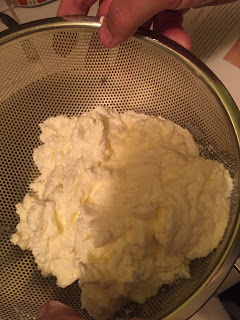
Tom worked on making homemade cultured butter. Last night he warmed cream on the stove, added mesophilic culture, then let it sit on the counter overnight. This morning it was the consistency of yogurt and he put it in the fridge.

At night after it was in the fridge all day

Tonight he churned the cream in our food processor. It was fun to watch it go from thick cream to butter + buttermilk.


This buttermilk will be used for pancakes tomorrow morning.

Tom also pickled jalepenos....


... a process which made us sneeze and cough, no matter where we were in the house, for a couple of hours.

I picked yet another huge batch of basil, put some in the chicken's nesting boxes, and made the rest into pesto. We have more pesto than we'll ever eat (I think) in the freezer.


There's still plenty of basil in the garden, which I think I will now let bloom for the bees. We have basil in several places so there's enough for random tomato dishes (we use a lot of fresh basil in tomato salads and sauce).

Speaking of flowering, the buckwheat cover crop I put in a few weeks ago is starting to bud.


And we're starting to get mini-pumpkins forming!


Although remember when I sprayed a vinegar solution on the leaves to kill the powdery mildew? Well, I killed the mildew. I also killed the leaves.
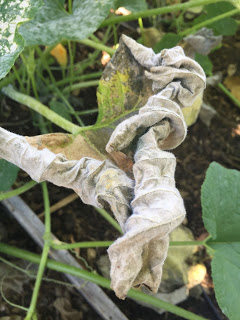
oops.
The cantaloupes look closer to harvest...


And some of the sunflowers are finally opening.
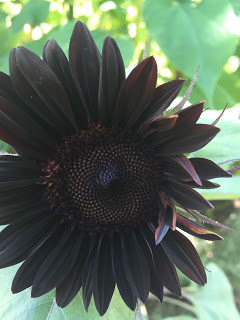
Chocolate Cherry Sunflower
Since we've got the day free tomorrow, I've got lots of projects lined up. I need to rake the chicken coop, turn the compost, cut the water sprouts off the apple tree, pull out the watermelon vines and sow buckwheat in that bed, and harvest green beans (an every-other-day chore). Oh yes and look for cucumbers hiding under leaves. And maybe trim up some unwieldy plants. Glorious!
My Favorite Pollinator Flowers for Late Summer/Early Autumn

These are the plants in my garden that are simply covered with pollinators right now. Most of these flowers have been blooming for a month, or even longer, and will continue to bloom well in to the Fall. My bees are going crazy in these flowers, but many of these also attract butterflies. In Northern California, very little blooms at this time of year - often this is our driest period, even in a non-drought year. So not only do these flowers make our yard look beautiful at a time when not much else is blooming, they also feed the insects, which is a powerful argument on its own for planting these. I've put them in no particular order. Some are part-shade, but most are in full sun. They do get supplemental water from us, but very little. Our temperatures range from mid-50's at night to over 100 during the day, so they also do well in extreme temperature swings. Again, it is quite dry.

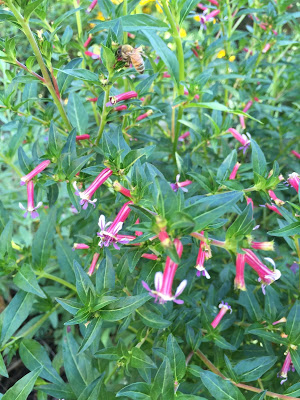
This is the one flower I can't identify for you. I didn't keep the tag,
and I can't figure out if it's a fuchsia, salvia, or agastache. It's covered
with bees each day, and if I ever find it again, I'm buying out the supply.

California Aster (Symphotrichum chilense). Drought-tolerant.

California Sunflower (Helianthus californicus). Drought-tolerant.

Herbs of all kinds. At the moment, I have thyme, sage,
marjoram, oregano, and these chives blooming.

Coneflower of all kinds (Echinacea). I have found these
hard to grow from seed and have had to buy starts

Cosmos of all kinds - this is 'sonata' - easy to grow from seed

Saltmarsh Fleabane (Pluchea odorata) - more for butterflies than bees.
Drought-tolerant.

California fuschia (Epilobium canum) - I grow this from starts,
but it spreads freely. Drought-tolerant.

Galliardia of any kind - I've had trouble with seed and use starts
(also called Blanketflower)

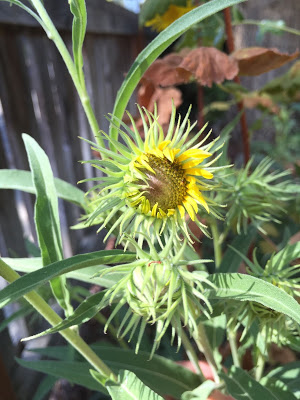
Hairy Gumplant (Grindelia hirsutula) - this has taken over
our woodland garden and the bees are nuts for it. I got starts
at the Watershed Nursery in Richmond along with many of
the plants on this list. Drought-tolerant.

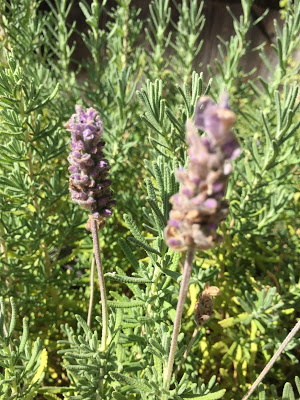
Lavender of all kinds - this is French lavender (Lavandula dentate).
Drought-tolerant.

Salvia 'purple majesty' - this one is also a magnet for Carpenter bees.
Drought-tolerant. Dies back completely at frost but returns in Spring.

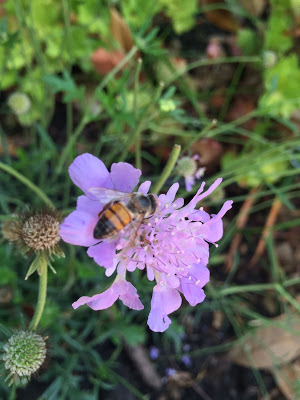
Scabiosa of any kind (or Pincushion flower)

Bluebeard Spirea (Caryopteris x clandonesnsis) - this
is not a true spirea, apparently, but this blooms for months
and really attracts the honeybees. Drought-tolerant.

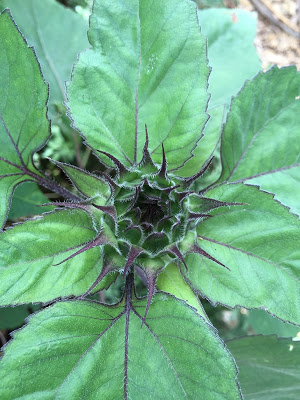
Sunflowers of any kind. I think this one, just about to open,
is particularly beautiful!

Tithonia 'Torch'  - I've already sung the praises of this
flower many times - attracts every pollinator, from
native bees to honey bees to butterflies to hummingbirds.
Easy to grow from seed.

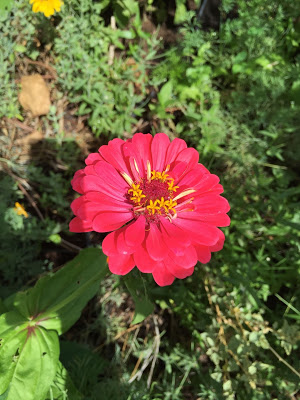
Zinnias of any kind - all are attractive to pollinators and
easy to grow from seed.

Gaura - this one is 'whirling butterflies' - it's in a neighbor's
yard and is simply covered with our honeybees every morning.
Drought-tolerant. Will die back in Winter but re-appear in Spring.
EDIT: Just a note that 'drought-tolerant' doesn't mean NO water. Some things will do ok with no water at all in the summer, such as Manzanita, Toyon, or Ceonothus. But those are Spring-blooming, after the winter rains. Most DT plants need water to get established, then less water than conventional flowers. We tend to plant most of our native, DT plants in Autumn, before the winter rains come. That gives them plenty of water to start.

Don't forget that honeybees (and native bees too) love the Autumn vegetables in the garden, particularly squash and melon blossoms, so feel free to plant those, too!

Digging Potatoes

Today I dug up the potato harvest. I've been 'stealing' new potatoes from deep underground for about a month now, so we've already eaten several pounds. I still expected to get quite a few today, and I was not disappointed.

The potato vines had all died and withered, which meant the potatoes were ready to be dug out.


I grew the potatoes in towers. Last April, I put the potato seed chunks on top of the raised bed, surrounded them with a wide basket made of hardware mesh, lined the basket with newspaper, then covered the chunks with more compost. As the potatoes grew, I added more dirt and more newspaper, until finally the entire basket was full, with the potato vines growing lustily out of the top.

I made two of these towers. One was quite wide, with potato seed from Seed Savers Exchange. The other basket was more narrow, with seed from Renee's. Both were Yukon Gold. And the wide basket did MUCH better than the narrow. So I'm not sure if it was the quality of the seed or the width of the basket.

This winter I intend to grow fingerlings and red potatoes in regular mounds rather than a tower, with hay as my 'hilling' material rather than pure soil. So we'll see how those do.

Meanwhile, it was fun to remove the wire basket and the newspaper, and find all the potatoes down below. The dirt is gorgeous and smells wonderful, so this was a pleasant (though sweaty and dirty) task.


I had a pretty good yield, maybe a bushel? Considering how many we've already harvested, I'm pleased.

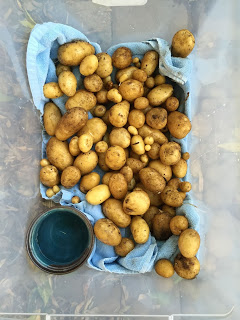
Now the question is how to cure them. I rinsed them and put them in a box with a dish of water, one towel nestling them at the bottom, and one towel over the top to keep the humidity in. I'll leave them like this for a week or so. (That is, if we don't get greedy and eat them first.) I took out a few for dinner and gave a few to my dad, but I still have quite a few left to cure.


This is the first year we've been able to have a harvest of potatoes, as the deer always ate the foliage before, and killed them.

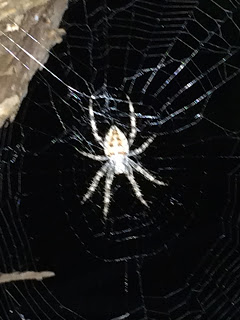
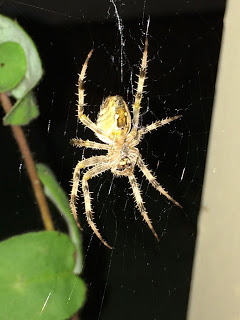
One last thing: As I was removing the spent potato vines and shoving them into a container to take to the compost bin, I found this little lady.


The picture quality is bad, but I was in a hurry to get her red belly markings before she flipped over. Yikes! Glad I was wearing gloves. I know we have Black Widows in the yard, but I've never seen them in the produce before.