Pickled Garlic

As you might remember, we harvested a huge amount of garlic this past April, then braided it in May and hung it on the canning shelf. Then along about June I decided to freeze some of the garlic in oil. (Never store garlic in oil in the fridge - it is a perfect recipe for botulism.) Since then, we've been cutting the heads off the braids whenever we need it for cooking or canning, which has turned out to be quite often. I'm surprised at how much garlic we go through - we only had about 10 heads left on two braids. We're going to have to dedicate an entire 4x8 bed to it this winter, I think, rather than just a 4x4. Anyway, as I was cutting in to a bulb this weekend, I noticed that some of the cloves had gone brown and mushy, and I realized that the garlic would no longer be stable hanging on our canning shelf.

I found a recipe for pickled garlic on the Growing a Greener World website. I originally didn't want to pickle garlic, thinking that it would taste like pickles, not garlic. But Theresa Loe, the author of this recipe, assures us that using the pickled garlic is very close to using fresh, and we can rinse off the cloves before we slice them, even. That convinced me to go ahead and give it a shot. So today I pickled and canned garlic.

It was straightforward, but fussy. Peeling a pound of garlic is no joke. Luckily that trick I showed you before, and which is also in the recipe, works great. It just takes a while. And then I screwed up and heated up pint jars instead of half-pint jars, well, let's just say this project took most of the day. I also had to go over to my folks house and get their braid of garlic that I gave them in May, because if my garlic is going bad, so is theirs. Anyway, it's done now, and I can tell you that I'm pretty sick of the smell of garlic, but I'm very glad the harvest is not wasted. As it was, I had to throw out about a quarter of the garlic, due to mushy brownness.

This recipe used about 20 heads of garlic.

All my supplies

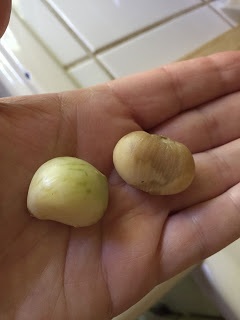
Good clove on left, bad on right

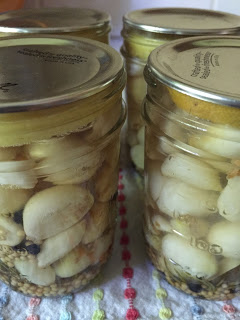
4 half-pints to add to the canning shelf

The Value of Connection

I'm losing friends left and right these days. Friends I've had since I was a kid - friends who knew me in my awkward teenage years - friends who saw me struggle in college. I can't seem to keep authentic connections going with any of them, and to me, it seems clear that it is due to social media.

Why write or call one person to connect, when you can update 300 people all at the same time?

It's efficient, I agree. It saves time. One picture can tell everyone what you're up to, what the news is. There's no need to write an email or pick up the phone, your job is done. And you don't need to ask anyone else how they are, either - it's all there on social media for you to peruse at your leisure. That is, if you have any leisure. A common refrain I hear from practically everyone these days is that they are just 'too busy.'

I've just been told quite clearly, for the second time now (I guess I didn't really believe it the first time), by a dear friend that I've known since Kindergarten (I'm 47 years old, so that means we've been friends for 42 years), that Facebook is a higher priority than me. That all she has time for is updating there, and on Instagram, and on Twitter.  So I'm waaaaay down on the list. She is 'too busy' to even respond to my emails. Instead she chooses to spend her time on social media.

I used to be on Facebook, but left several years ago when I realized that it was inauthentic. I knew I'd need to work harder to connect, and I vowed to do that. I've been trying, maybe not hard enough. It's hard to have one-sided relationships. Hard to put stuff out there, and not get any response, or just cursory ones.  I've never used Instagram, but I am on Twitter. I don't do much there except promote this blog, and I don't even really need to do that - very few of my readers come to the blog from Twitter. Sometimes I get recipes or gardening ideas there - but I can get that elsewhere.

It's hard to see it when you're in it, but quite clear when you're out of it - social media isn't about real connections. It's about advertising your life, one picture or 140 characters at a time. It's "hey, look at me, here I am" rather than "hi, how are YOU?" It doesn't promote conversation. The 'sharing' isn't real sharing. I realize that as a blog writer, I'm often also saying "hey, look at me." But I don't use my blog as a way of connecting with my friends. I use it to connect with new folks, and to put information out there that might be useful, and to be a part of the larger conversation about homesteading. I would never say to my friends, 'we don't need to talk, because you can get all your information about me from my blog.'

I'm an introvert, social situations are hard for me, it takes a lot for me to get 'out there' and be part of a social world. And yet I miss friends. I miss hanging out, having drinks (I don't even drink!), sharing life, laughing. I miss real connections.

To that end, I am putting my money where my mouth is and taking action on two fronts. One, I have deleted my Twitter account. If you need to reach me, and you don't have my private info, put a comment on this blog - I'd love to hear from each one of you. Two, Tom and I are instituting the Poppy Corners Ceilidh (pronounced Kay-lee) on the last Sunday of every month. It'll be a sort of open house - we'll plan to be here between 5-9 and we'll have a big pot of food to share and some lemonade. Anyone is welcome to drop in - bring a side dish or drinks to share, bring an instrument, bring a football - we'll eat and play music and throw a frisbee around and just connect. Our first Ceilidh will be on August 30. If you're in town, and you've got an hour or two, come on over. I can't promise anything particularly clean or organized. There'll probably be paper plates. I don't want the pressure of trying to 'entertain.' I just want to hang with my friends, family, and neighbors.

We're all busy. We've all got tons of things to do. But I want to carve out a time, once a month, to just be with people. I hope you'll join us.

Nature, nature, nature!

I know I've blogged about this before, but I am simply amazed at the way this flower, Tithonia (or Mexican Sunflower), is attracting wildlife constantly. I wish I'd discovered it sooner. The bees love it, the monarch and gulf fritillary butterflies love it, and I rarely see a bloom without some sort of pollinator on it. I highly recommend getting your hands on some seed and growing it next summer! I got mine from Renee's Garden, and I just scattered the seeds in my garden with a bit of compost, and they've done great. No need to start seeds inside. The leaves are like velvet, but look like sunflower leaves. Another plus - the goldfinches don't eat the leaves of this like they do sunflowers. And I do believe I've mentioned, but I'll do it again - I NEVER used to get monarchs in the yard, no matter what I've grown. This is the first time I have them every day, in abundance.


Speaking of pollinators, I know I've written about galls and gall wasps before, but I'm noticing something interesting on my hikes. The Blue Oak trees are simply covered in galls.


From far away, the trees look like Cotoneaster or Pyracantha in December. I've never seen so many of this kind of gall. From what I understand, insects have cycles just like anything else, and some years are banner years for gall wasps. This certainly seems to be the case this year.

I also found a new kind of gall (for me) on a different kind of oak, on my walk this afternoon.


Fascinating!

We've had lots of adventures this week, the highlight being a visit to  Brannan Island State Recreation Area. We saw Egrets and Great Blue Herons and heard lots of bullfrogs. The day started off cloudy but that didn't stop us from getting in the river.
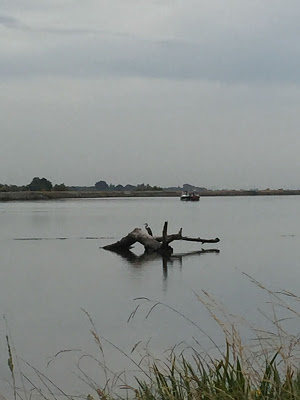
Can you see the heron?


I don't know about you, but I'm constantly looking for places that get us away from our various screens. I think it's getting more and more important for us to put down the devices and look up once in a while. No one ever looks at one another anymore - on the train, in the coffee shops, waiting in lines, at the doctor - everyone's looking down all the time. I encourage you to start becoming aware of how much that happens. Once you begin to notice it, it's really quite striking. Does no one simply 'think' anymore? Daydream? Look off into space? Read a book? Look out the window? Honestly. I find it quite disconcerting. And I like my devices, don't get me wrong! I'm very guilty of abusing them. That's why I try very hard to get away once in awhile. And good grief, if you live in California, there's plenty of opportunities to get outside and explore. There are thousands of State Parks, all very affordable (usually just a day-use fee for parking), and all very interesting. And I'm always amazed at what the kids come up with when they are out with friends in nature, without planned entertainment. This time it involved games that included flying mud, swimming competitions, and watching floating vegetation go by and trying to guess how fast the current was running.

This reminds me of a show we used to watch when the kids were little on PBS, called Peep and the Big Wide World. It's a great little cartoon about a chick who finds a robin and a duckling for friends. It's quite funny (we still quote it to this day), but in between the cartoons they show real kids doing real science experiments - something like watching water run down your driveway and making it go different ways using rocks or leaves, or raiding the recycle bin for building materials. It gave my kids (and me too!) lots of ideas of how to play in nature, using free things or repurposed things. It also taught us that every little thing outside can be interesting, even something as simple as a shadow. If you've got little ones, I urge you to check it out.

I've said it before and I'll say it again, cultivate curiosity about your world. Why is there a rainbow around the sun today? Why is that tree growing sideways? How does a walnut tree make walnuts if it doesn't bloom? Why is that ground squirrel hollering? And on and on and on. It's priceless. The devices will always be there later.

I spent the morning inside today, however - I made more salsa. I used a different recipe that used lime and lemon juice rather than vinegar for its acid, which seems right in salsa. Anyway it's a labor of love - chopping every little shallot and garlic clove, picking and chopping peppers, blanching tomatoes to remove the skin - it all takes a while. But we have 8 more pints of salsa on the canning shelf, every ingredient (except the citrus juice and salt) from our garden.


The cucumbers are going mad, I'm hoping Tom will make more relish tomorrow.

Tomato Issues

As I've mentioned before,  I am harvesting tomatoes every day (at least 10 pounds of cherry tomatoes, and 15 pounds of slicing and paste, just today), but I didn't want the season to go by without recording the fact that we are having serious tomato issues, stuff I've never had before. I haven't been growing tomatoes long enough to know what the different diseases are, but the paste tomatoes starting looking funny as early as June, and now everything looks weird, and it's getting worse all the time. Our May was cooler than normal; our June was hotter than average, and July has been up and down, with temps as high as 108 (last week) and as low as mid-50s at night (last night). We also started with the drip system this spring, and I mulched with straw for the first time. Plus, we're in a terrible drought, and we don't really know how much to water and how often. So a lot of variables.

I know I have blossom end rot, which could be too much water or not enough water. Betting on the fact that we weren't getting enough, I upped our watering slightly, and the blossom end rot has gotten better - but now I have tomatoes that are splitting from the change in water - meaning their insides are growing faster than their outsides. On top of that, some of the tomatoes have random holes. I haven't found any bugs or worms.

Blossom End Rot

Splitting along the side

Splitting along the top

Random Hole
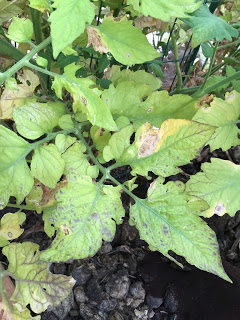
The fruit with blossom end rot goes to the chickens (and they've gotten a lot, sigh). The fruit with splits or holes still gets used; I just cut away anything bad, and they taste fine. But what really worries me, and has the whole season, is the leaves. In June the leaves on the paste tomatoes started forming a sort of wilt, like a shepherd's crook. That hasn't ever gone away, though we removed the straw mulch (thinking it might have been contaminated with herbicides). Lower leaves on all tomatoes started turning yellow, and now I have whole sections of dead leaves. I added Epsom Salts both in the soil and as a foliar spray, but it didn't seem to change anything. Some leaves have spots, some are curled. For a while I thought it was some sort of fungus, then I thought verticillium. I just don't know.


My working theory is still verticillium, because the squash and peppers have a similar wilt, though not nearly as bad.

delicata squash

'sunrise' sweet pepper
If any of you experienced gardeners would like to weigh in, I'd be happy to hear your thoughts on all of this.

Meanwhile I gave away quite a lot of cherry tomatoes today; we had too many to eat, and other than freezing, there's not a lot of ways to preserve them. The neighbors always seem happy to get some. I'll hang on to the larger fruit until Friday and make a few quarts of crushed tomatoes.


Hive Check

I thought you might like to know how my hive check went today.

Early this morning, I opened the lid of the hive. I didn't take out any bars. (This is exactly what I did yesterday, not wanting to bug them so soon after getting in there Saturday.) When I lifted the lid, the first thing I noticed was ants. Maybe 10-12 ants strolling around, robbing the hive. This pissed me off, big time.

I literally piled heaps of diatomaceous earth around the legs of the hive. This will do a couple things, I hope: Interrupt the ant's travel patterns, and desiccate the ones who go through it regardless. If nothing else, it will deter new ants from climbing in to the hive. A strong hive should be able to survive an attack of ants, but my hive is already reeling from the wax moth attempt, so I thought I'd better help out as much as possible.

This may have been overkill.
I immediately vowed to come back this afternoon and truly open the hive and take out all the bars. (Afternoon is the best time to open a hive, when it's warm, and most of the bees are out foraging.)

I've just come in from doing that, and I'm happy to say I saw absolutely no evidence of wax moths. Or ants. Hallelujah!!!! I am so incredibly relieved. The bees are working normally, there is brood, honey, nectar, and pollen, there is new comb being built. I did not see the queen, and I only saw one drone (it's getting close to drone overthrow time anyway, so this doesn't worry me).

One thing that I did notice, and it's not good or bad, just interesting, is that there are three fairly well-developed queen cups being maintained. Queen cups are larger cells built to raise a new queen. Sometimes the bees make these 'just in case.' Sometimes they make them because they are unhappy with the queen, and want to re-queen the colony. There is some debate about what the purpose is depending on where the cup is built on the comb. All three of the ones I saw today were in the middle of the comb, rather than the bottom. However! The comb is built a little funny because that's how this colony built it at first, in two swags rather than one, sort of attached in the middle.


Here you can see the two swags meeting in the middle, with the queen cup being built between them. Next to the queen cup is actually some drone larvae, you can tell because of the puffy tops (which kind of surprises me; it's a little late in the season to raise drones, I thought). But anyway, a lot of the comb in front of the hive was empty, not filled with eggs or larvae. So this could mean a couple of things. One, the queen has slowed down laying because we're getting towards the end of summer and therefore the end of resources. Two, the queen is injured or dead, and the hive is re-queening. Three, the hive is unhappy with the abilities of the current queen and is making a new one.

And I don't know which one. Time will tell.

Meanwhile, the hive is continuing to do it's work, and I see honeybees all over the flowers in the garden. Along with other critters, like these.

Some sort of native bee? I've got an email in to the Urban Bee Lab for ID.

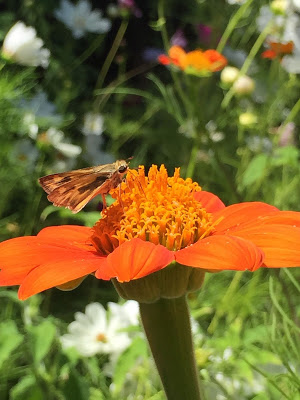
Some sort of skipper?

The ubiquitous cucumber beetle, everywhere you look
I had my fair share of sleepless times over the weekend, thinking of the bees. But I am determined NOT TO WORRY anymore, and just see what happens. I've done what I can. I will open the hive again in two days. There is nothing gained by worrying!!! (Right?)