Tomato Issues

As I've mentioned before,  I am harvesting tomatoes every day (at least 10 pounds of cherry tomatoes, and 15 pounds of slicing and paste, just today), but I didn't want the season to go by without recording the fact that we are having serious tomato issues, stuff I've never had before. I haven't been growing tomatoes long enough to know what the different diseases are, but the paste tomatoes starting looking funny as early as June, and now everything looks weird, and it's getting worse all the time. Our May was cooler than normal; our June was hotter than average, and July has been up and down, with temps as high as 108 (last week) and as low as mid-50s at night (last night). We also started with the drip system this spring, and I mulched with straw for the first time. Plus, we're in a terrible drought, and we don't really know how much to water and how often. So a lot of variables.

I know I have blossom end rot, which could be too much water or not enough water. Betting on the fact that we weren't getting enough, I upped our watering slightly, and the blossom end rot has gotten better - but now I have tomatoes that are splitting from the change in water - meaning their insides are growing faster than their outsides. On top of that, some of the tomatoes have random holes. I haven't found any bugs or worms.

Blossom End Rot

Splitting along the side

Splitting along the top

Random Hole
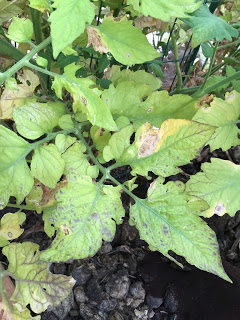
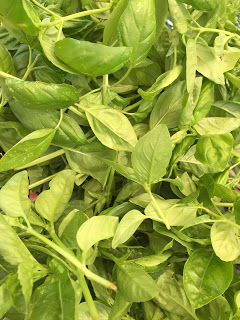
The fruit with blossom end rot goes to the chickens (and they've gotten a lot, sigh). The fruit with splits or holes still gets used; I just cut away anything bad, and they taste fine. But what really worries me, and has the whole season, is the leaves. In June the leaves on the paste tomatoes started forming a sort of wilt, like a shepherd's crook. That hasn't ever gone away, though we removed the straw mulch (thinking it might have been contaminated with herbicides). Lower leaves on all tomatoes started turning yellow, and now I have whole sections of dead leaves. I added Epsom Salts both in the soil and as a foliar spray, but it didn't seem to change anything. Some leaves have spots, some are curled. For a while I thought it was some sort of fungus, then I thought verticillium. I just don't know.


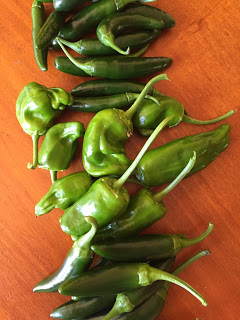
My working theory is still verticillium, because the squash and peppers have a similar wilt, though not nearly as bad.

delicata squash

'sunrise' sweet pepper
If any of you experienced gardeners would like to weigh in, I'd be happy to hear your thoughts on all of this.

Meanwhile I gave away quite a lot of cherry tomatoes today; we had too many to eat, and other than freezing, there's not a lot of ways to preserve them. The neighbors always seem happy to get some. I'll hang on to the larger fruit until Friday and make a few quarts of crushed tomatoes.


Hive Check

I thought you might like to know how my hive check went today.

Early this morning, I opened the lid of the hive. I didn't take out any bars. (This is exactly what I did yesterday, not wanting to bug them so soon after getting in there Saturday.) When I lifted the lid, the first thing I noticed was ants. Maybe 10-12 ants strolling around, robbing the hive. This pissed me off, big time.

I literally piled heaps of diatomaceous earth around the legs of the hive. This will do a couple things, I hope: Interrupt the ant's travel patterns, and desiccate the ones who go through it regardless. If nothing else, it will deter new ants from climbing in to the hive. A strong hive should be able to survive an attack of ants, but my hive is already reeling from the wax moth attempt, so I thought I'd better help out as much as possible.

This may have been overkill.
I immediately vowed to come back this afternoon and truly open the hive and take out all the bars. (Afternoon is the best time to open a hive, when it's warm, and most of the bees are out foraging.)

I've just come in from doing that, and I'm happy to say I saw absolutely no evidence of wax moths. Or ants. Hallelujah!!!! I am so incredibly relieved. The bees are working normally, there is brood, honey, nectar, and pollen, there is new comb being built. I did not see the queen, and I only saw one drone (it's getting close to drone overthrow time anyway, so this doesn't worry me).

One thing that I did notice, and it's not good or bad, just interesting, is that there are three fairly well-developed queen cups being maintained. Queen cups are larger cells built to raise a new queen. Sometimes the bees make these 'just in case.' Sometimes they make them because they are unhappy with the queen, and want to re-queen the colony. There is some debate about what the purpose is depending on where the cup is built on the comb. All three of the ones I saw today were in the middle of the comb, rather than the bottom. However! The comb is built a little funny because that's how this colony built it at first, in two swags rather than one, sort of attached in the middle.


Here you can see the two swags meeting in the middle, with the queen cup being built between them. Next to the queen cup is actually some drone larvae, you can tell because of the puffy tops (which kind of surprises me; it's a little late in the season to raise drones, I thought). But anyway, a lot of the comb in front of the hive was empty, not filled with eggs or larvae. So this could mean a couple of things. One, the queen has slowed down laying because we're getting towards the end of summer and therefore the end of resources. Two, the queen is injured or dead, and the hive is re-queening. Three, the hive is unhappy with the abilities of the current queen and is making a new one.

And I don't know which one. Time will tell.

Meanwhile, the hive is continuing to do it's work, and I see honeybees all over the flowers in the garden. Along with other critters, like these.

Some sort of native bee? I've got an email in to the Urban Bee Lab for ID.

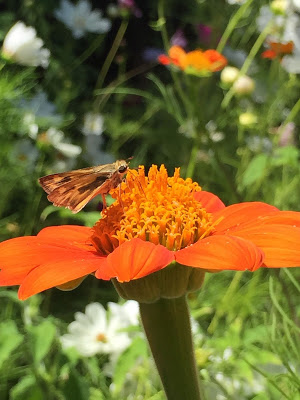
Some sort of skipper?

The ubiquitous cucumber beetle, everywhere you look
I had my fair share of sleepless times over the weekend, thinking of the bees. But I am determined NOT TO WORRY anymore, and just see what happens. I've done what I can. I will open the hive again in two days. There is nothing gained by worrying!!! (Right?)

Weekend Harvest and Preserving RoundUp

Let's drop in on our weekend harvest and have a peek at the kitchen projects going on as well. The kitchen is one busy room these days, and there is always either a bubbling pot of water on the stove, ready for canning, or the same pot cooling off in order to be reused in the garden.

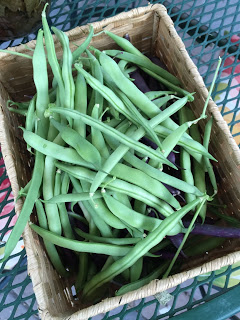
Every other night we have green beans with dinner, because every other day I harvest several pounds of these beauties.


I just learned this year that if you don't harvest the beans, the plant will stop producing new fruit. Interesting, yes?

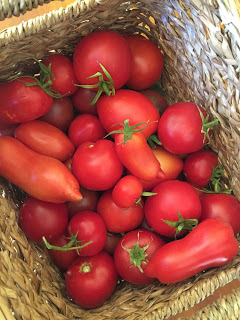
We harvest and eat cherry tomatoes every day - Tom's gotten in to the habit of going out each morning before he leaves and picking a bunch. Then he slices them, adds a few leaves of basil and some fresh mozzarella and a little olive oil, and takes it to share with everyone at work. What could make business meetings better than a little Caprese salad to nibble on? Speaking of nibble, that's how I usually get my daily dose of cherry tomatoes - I just eat them as I work around them.

The large slicing and paste tomatoes get picked once a week on Saturday mornings, and I usually get around 10 pounds. This weekend I turned them, once again, into canned tomato paste. We use paste for our homemade spaghetti sauce throughout the year, as well as a tablespoon here or there in other braises or sauces. Kate used to eat it out straight out of the can, but she doesn't do that anymore, darn it. This stuff would be terrific straight out of the jar.


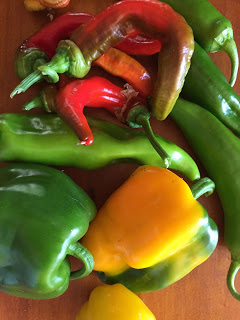
I pick the hot and sweet peppers once a week, unless I need them sooner for a recipe. This weekend, the sweet peppers were sautéed with shallots, garlic, and homemade chicken broth, then spooned over a grilled steak with sprinkles of gorgonzola on top. The hot peppers are still sitting on the counter. I've roasted and frozen dozens, and Tom has made enough hot sauce to keep everyone in our extended family happy for at least a year. I was debating what to do with them, when Adam came in to the kitchen. He tasted the pickles Tom made today, drank a little of my homemade apple juice ("tastes like liquid pie"), then saw the peppers. "Are those hot peppers, Mom?" "Yep." "Yesssssss. (fist pump)" Looks like he'll take care of those for me. This was after he toured the gardens and said, "Guess I'd better have a salad tomorrow, the lettuce is close to bolting." I love this kid.


Speaking of pickles, Tom picked a bunch of cucumbers and turned them into more pickles today. 


And I picked a huge amount of basil Saturday and made another six jars of pesto. We have enough pesto now to last us to next summer, I think.


I just checked the corn, and there are enough ears ready to have tomorrow night for dinner. The Delicata squash is nearly ready, just waiting for 'wiltage' on the stem, which is what I'm waiting for on the watermelons as well. The potato vines are starting to go brown, just need to let them die off further, and then I'll dig those up. As mentioned earlier, the romaine is starting to bolt, pumpkins are starting to take off, a second batch of collards is nearly ready for eating, and the butternut squash is coming along.

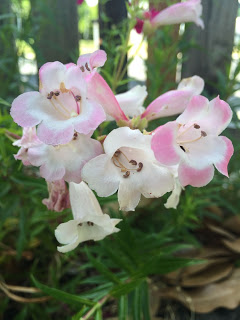
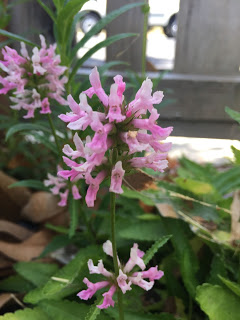
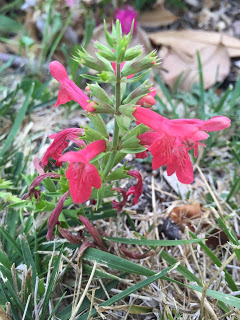
The flower garden is bursting with blooms. Here are some interesting ones I looked at today.

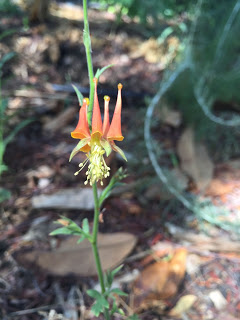
Columbine blooming in the woodland shade garden

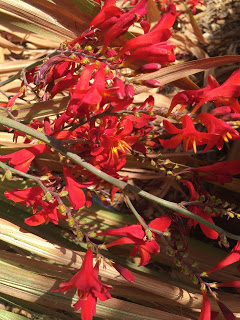
Crocosmia, drought stressed but blooming anyway

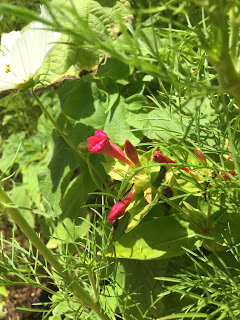
Scarlet Flax in the North Pollinator garden

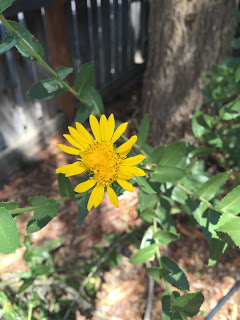
Native Gumplant in the woodland shade garden, there will be lots of this soon

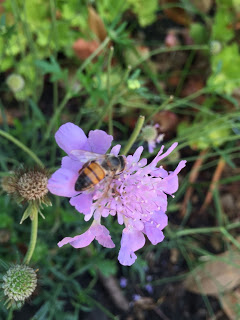
a honeybee visiting a Scabiosa

Nicotiana, shy during the day, glorious at dawn and dusk

Penstemon

Salvia

another Salvia
Opened the lid on the hive today, all looked well - will open it further tomorrow. Don't like to get in there and bug them so much, but need to stay on top of the wax moths.

Apple Projects

Our apples ripen in the late summer, rather than autumn, so about this time of year we have a lot of apples to eat. We can eat a good amount fresh, but we don't have a good place to store them long-term, and this time of year there is so much produce to eat! Often the apples end up in the compost. I've always hated this waste and determined this year to mitigate it.

So I've had several apple projects. Back when I summer-pruned the tree, I had a ton of windfall apples, and with those I made pectin, which then was used to thicken our strawberry and peach jams.

A last weekend, I picked a couple of bushels and made apple pie filling, which was a true canning adventure. I used the recipe from Growing a Greener World, and it was complicated! I felt proud of myself for tackling this project. We have five jars of filling for pies this winter.

With the remainder of the apples, I thought I'd make applesauce. Our daughter Kate has Aspergers, and is very picky about what she eats, but she does eat applesauce every day at lunch. Unfortunately she likes those squeeze pouches that are ubiquitous now. She also likes the apple/banana blend that we get at Whole Foods. I dislike the expense and the waste of those packets, so I had hoped to get her involved in making homemade applesauce and putting a 4 oz jar of that in her lunch every day, rather than a packet.  But Kate was pretty clear on the fact that she prefers the pouches, and since it's one of the only dependable fruit products she'll eat, I'm not going to die on that hill.

Plan B - apple juice. Neither of the kids are big juice drinkers, but both will drink apple juice if it's in the house. And I thought some homemade juice might be a good alternative to lemonade or milk in school lunches. After all, no added sugar or any other junk - and seriously fresh and rich with vitamins. So I got cracking.

I used the recipe from our favorite canning book, though the recipe is for grape juice originally, the author just says you can substitute apples or cranberries or any combination of the three. It was a long process, but fun, and smelled good! and I ended up with four and a half pints of gorgeous juice (four for the canning shelf, the half for immediate consumption).


Isn't it pretty? But a lot of work for a very little result. Not sure this is the best use of our apples, either - still searching for the ultimate apple recipe. However, the chickens loved the cooked, discarded pulp at the end of this project.

There are a few apples left on the tree, so I had Tom throw together a pie crust last night, and we'll have a fresh apple pie tonight, as a celebration of the end of all summer camps. Both kids are now home from all their camps and we have August to tool around town and have some day trips and adventures.

Wax Moths

I've been sitting here at the computer for half an hour trying to figure out how to start this post. We opened the hive today to check on things, see how the bees are getting along since we re-leveled the hive and took out so much comb a couple of weeks ago. And there is plenty of honey, nectar, pollen, brood. There are lots of bees and lots of activity. I think maybe there are less bees than before; it's possible there was a swarm and I missed it, but it's hard to know. The upshot is that things look pretty normal. If not for the fact that as soon as we took off the lid we noticed crumbly bits of stuff on a couple of the bars, and one sort of humped oval of crumbly bits. When I scraped it with the hive tool, out came a larvae. A  wax moth larvae.


Devastating. 

We burned that worm, burned all the crumbly stuff we could get off the bars, found one more larvae and a little web and burned that. We removed all the superfluous bars that the bees hadn't built on yet, and even a few that had a little bit of building going on - we want to reduce their amount of defensible space. And that's about all we can do. We have to be hopeful that the colony will be strong enough to fight off these guys and keep the hive. Right now the comb looks fine. We'll need to check the hive every day for a while and see if we see any more larvae, because wax moths can destroy a healthy hive in a week.

Wax moths are almost impossible to get rid of once they are in your hive. They thrive in places where there is little or no winter freeze; they can overwinter for up to a year in larvae form. Many people put their frames and bars in an electric freezer to kill off wax moths, and we'll need to do that if the hive cannot resist them and fails. The larvae like old, dark comb, which is naturally near the front of the hive, where the bees built first (and so it's the oldest comb). That's also where the brood is, and where the queen is as well. The wax moth larvae like to make holes in the comb, eat the pollen but also the brood, and make a webby mess of the hive. 

And I guess I'm just discouraged, honestly big-time discouraged. Beekeeping is kind of kicking my ass. So much can go wrong, and there is so little we can do to help. I really, really don't want to lose another colony, but I've got to gird myself for that possibility. Something that makes me really sad is that wax moths usually attack weaker hives. This colony seemed so strong, so vital, building so quickly, just a couple of weeks ago. It does seem as though there are less bees, but I'm just speculating about a swarm, I really have no idea. And if the colony was weak it was because we had to take out some of their badly-built comb and have them build again. Ugh ugh ugh. I just feel terrible. And if we lose this colony to wax moths, we won't even get the bittersweet blessing of a honey harvest, because it'll all be ruined by moth larvae.

Here's an interesting (and heartbreaking) video from a guy who lost one of his hives to wax moths. 

We'll keep you updated.