Hive news

Last Sunday when we opened the hive, we saw the queen! She is laying in a wonderful pattern, and we saw bees hatching out of their cells, so all is well. I've also started smelling the hive - it's a hard smell to describe, but the hive starts to emit a scent that is entirely unique, once there are babies, pollen, and nectar. It's very rich, not entirely pleasant, but not unpleasant, either. It's quite strong. I suppose it is also a mix of wood, wax, and propolis. Whatever the reason, the rich smell on the air, and seeing the queen and babies, makes me feel more secure around this group of bees.

I'm different around this colony, though, than my first. I am keeping my distance, emotionally. I suppose that's natural after losing a colony. You might wonder how one becomes emotionally attached to a bee colony. I can't explain it, but one begins to feel very protective over one's bees. I'm already going back and forth about whether to use miticides, come October (which was recommended to me very highly from the breeder).

My brother-in-law sent me a wonderful article from National Geographic. Here's a couple of sentences that stood out to me. The author, Charles Mann, is speaking with a beekeeper.

"Before varroa, he tells me, beekeeping was mostly a matter of bee-having -'they needed minimal attention, most of the time.' Since the mite arrived (in 1987), 'you really have to keep them.' Beekeeping, he says, should actually be called 'mite management.' Most farmers facing insect issues turn to chemicals... there are a dozen or more effective miticides. The chemicals are widely used, but not a single bee researcher, commercial beekeeper, or bee hobbyist I spoke to was happy about putting toxins into hives. In addition, many varroa are already resistant to commercial miticides."

Argh.

Maybe it's silly to be thinking about this already - after all, I have all summer to decide about this issue, as the mites usually show up late autumn/early winter. Tom and I are planning to attend (and re-up our membership with) the local beekeepers association meeting on Thursday night. I think I'll take aside some old-timers and ask what they think. My guess is, they'll say 'treat.' Meanwhile, the article stated, scientists are working on breeding a mite-resistant bee. I don't know if that will solve the problem; it seems to me that bees need to evolve a natural resistance to the mites.

Phil Chandler, the author of The Barefoot Beekeeper, seems to agree with me. More from the article: "'We cannot solve our difficulties by using the type of thinking that created them,' Chandler says. He's referring to the 'persistent delusion' that humans can control nature... many around him agree with his diagnosis. Sill, they look vexed when he says that the best thing to do for varroa would be... nothing. Keep bees healthy and well fed, but let evolution work. For ten years or more, beekeepers might lose most of their bees, he concedes. But natural selection would eventually lead to some kind of resistant bee. 'We have to think of these issues in terms of what is best for bees,' he says. 'Not what is best for us.'"

Our Queen

Beer making and garlic braiding

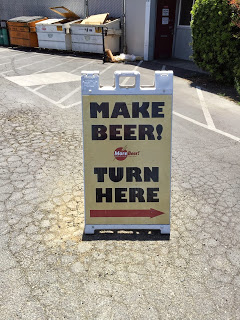
Tom and I are attending 'Beer School' through The Kitchn. Last week most of our assignments were preparing us for the actual brewing of beer, and yesterday our task was to go shopping for all the equipment we needed.


We visited our local brew store and had a fun time gathering up our list, which included strange-sounding things like 'hydrometer' and 'airlock.' We also got our grains. We are making an all-grain beer, which is apparently more flavorful but is a bit harder. It was fun to go into the 'grain room' and taste and smell all the grains. We also enjoyed milling the grains right there in the shop.

Employee Nolan helps us navigate milling
We have everything at home now, it set us back about $119 but we already had a significant amount of the kitchen items needed. If you had to start by getting that stuff too (stockpot, thermometer, etc) it would be quite a bit more costly.

I'm guessing that we may begin the brewing very soon. We're excited to get started making our first amber ale!

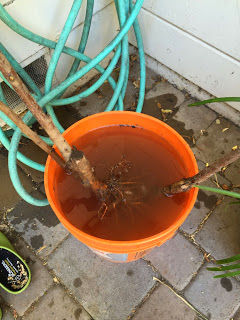
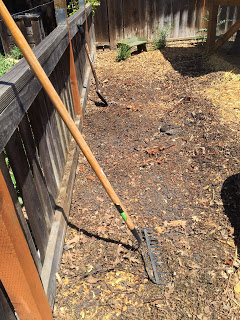
Today my fruit trees arrived from Stark Brothers, impeccably packed as usual. I soaked them in water for several hours while I prepared the beds. Last week I took out a huge ceonothus and many sunroses from along our North fence. The first thing I had to do today was borrow my father's ax and hack the stumps to pieces. I gotta tell you, nothing makes me more exhausted than using the ax. I always end up with numb hands and arms, literally dripping sweat. How did all the pioneers clear their land with just an ax? It blows my mind, every time I use this tool. Respect, pioneer dudes.

Next I needed to clear the land of mulch and dig some holes. Clay clay clay. Digging is the second-most exhausting thing in our hard-as-rock earth. I shall sleep well tonight.


Sunrose is gone, time for cherry trees...

...and here they are

only the ceonothus stump left....

...now a plum tree

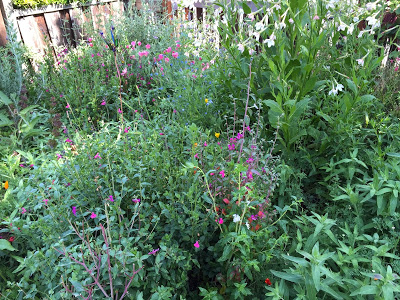
I put wheelbarrow after wheelbarrow of good compost in these areas, and mixed up a huge amount of flower and herb seeds, then broadcast them over the dirt. Tom hooked up drips, and in a few weeks, we'll see how these guys are doing. These trees probably won't fruit for at least two years. Planning for the future, yo. In the meantime, we'll hopefully get a nice pollinator garden going.

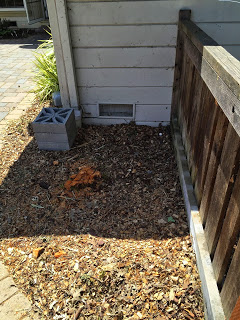
By the way, those cinder blocks you see in the plum tree picture are for the new rain barrel I ordered. Turns out, they don't make them the way they did five years ago when we got our old one; they no longer make them with removable lids. So you must use the spigot to fill your watering cans. (I guess it's a safety issue?) Therefore, they need to be up on blocks. Also in this picture is a small strip of bark for Joe. He likes to lie in this spot, and I keep taking away his favorite places. I couldn't bear to do it again.

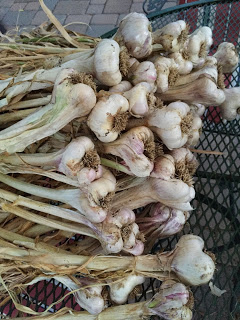
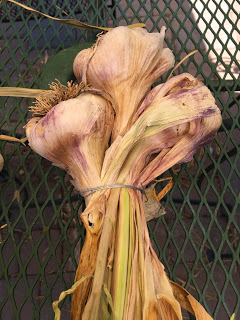
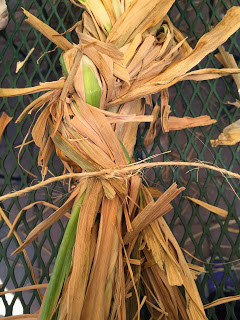
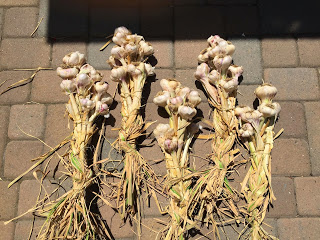
I also made my garlic braids. The garlic was harvested two weeks ago and placed to cure on top of our chicken coop. It had gotten quite dry in the curing period, so I decided to go ahead and braid it. You start out with three bulbs, wired together. Then you braid, adding another bulb to the middle each time. It's a little like French braiding hair (which I was never very good at). When you've reached the top, you secure with twine, making a knot at the front and then at the back, then making a loop with which to hang the braid.


Still a little green in the middle; that will dry with time


Dad has finished my canning shelf, which has knobs on which to hang these garlic braids, and I'll be installing that next weekend.

You may recall that I made Thieves Vinegar a few weeks ago. I decanted it in to a spray bottle and used it to clean the kitchen, the shower, and our wooden dining room table this weekend. I'm happy to report that it works excellently on all those surfaces. It smells good, too - very minty. And yes, vinegar-y too. But after using chemical cleaners most of my life, it was a nice change. I guess you just have to decide what you want to smell when you're done cleaning.

I put some in another spray bottle to take to work tomorrow - what with the kids' diagnosis', sensitivities, and allergies, we try to use natural cleaning products whenever possible. So we can use this to clean the lunch and station tables when we are done.

I can think of lots of other uses for this too - I'll try it as a clothes softener this week. Vinegar naturally softens clothes and it doesn't leave a vinegar smell on them, apparently. Much better for the environment than regular fabric softeners. Plus, if we go with a graywater system, we're going to need to use different detergents/softeners anyway.

I'm desperate to plant basil and get it started, but I'm loathe to pull out the kale until it's really and truly done. So I'm leaving the kale for now, and I planted some interim basil between and among the peppers. I ordered more seeds and will just plan on succession planting once the kale is finished. I also had to re-seed a few items. You see, we've attracted an intrepid scrub jay to our yard. He came for the chicken coop. He discovered that the chickens will sometimes, in their enthusiastic scratching and digging, pitch a treat out through the fencing of their coop. He sees them scratching and comes down, perches on the edge of a raised bed, and waits for any morsel that comes sailing out. Smart bird. Apparently he's also seen me seeding beds, because I've seen him steal the seeds once I've planted them. So I have to be stealthy. I have to make sure he's not around before I go out and bury and few furtive grains of corn or beans. I feel silly looking out for a BIRD, but there it is.

Finally, we tried to get to the fence gates. We've taken to parking our cars as close to our gates as possible (three gates, two cars - one gate is always unprotected) because the damn deer are hopping the fences to get in, now that they can't get over the fence. Beans - eaten! Strawberries - eaten! ARGH. And we just didn't get to the new fences this weekend. It's top of our list, next weekend.

And that's the news from Poppy Corners this second weekend of May. Have a good week, everyone!


Farm Dinner

This past January, I got a surprise text from Tom: "Happy Mother's Day! We're going to Full Belly Farm May 9!" Having dinner at the farm is something I've wanted to do for a long time, but they sell out very quickly. Tom happened to look at their website the day they posted the 2015 events, so he was able to secure our reservation early. I was very excited! We reserved a place for six of us so that Mom and Dad could go too, and we've all been looking forward to this for several months.

You might recall that we visited this farm once before, last Father's Day, on our hunt for local almonds. The farm wasn't giving tours the day we were there, but when I reached out to them, they welcomed us to look around on our own, and we did. It's a lovely place, but we only saw a very small part of it. We got to see much more last night!

We were told to arrive at the farm at 5:30. It was perfect weather; hotter in Guinda than in our part of the bay, sunny and about 84 degrees. We pulled up to the newly built event center, which was gorgeous.


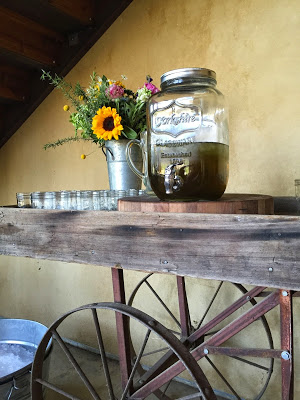
Friendly farm dog Milo ran up to greet us, and we made our way to the back patio, which had beautiful bouquets of flowers, pretty dining tables, and a side bar of Lemon Verbena iced tea. Delicious!


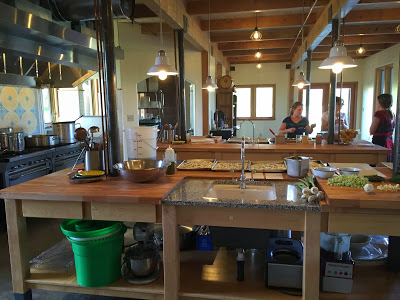
We enjoyed our beverages whilst chatting with the owner and chef, Amon (we met his wife Jenna a little later, as she was busy doing her own 'chef-ing' in the amazing kitchen). Dad and Amon talked a lot about the reclaimed wood used to build the center, and we enjoyed the view and being together.


I'd like to cook in this kitchen!
We then climbed aboard a touring wagon fitted to a tractor. We had a pretty cute driver.

Third generation farmer-in-the-making
Amon and his son took us around the property. Full Belly Farms has been certified organic since the early 80's, and it's a beautiful place, with birds flying everywhere amongst the fields filled with 70 different crops, cows and chickens and sheep in the background, five bee hives, and a thriving flower business. One of the best things about this farm is that they house and board their farmworkers each year, with a permanent crew of about 40 there full time. 


Amon was very proud of his family farm, and he should be, it is a very inspiring place.

Back to the event center, and time for dinner! We opened the wine we had brought with us (thanks to the families at my work and teacher appreciation week, we had a very nice bottle indeed!) and tucked in.

I didn't take any pictures of the meal, because I was too busy enjoying the food and the company (also I don't believe in phones at the table!), but it was all excellent, one of the best meals of my life, I think. We had wonderful house made cheese, salami, pickles, pasta, lamb - everything from the farm or close by. I think my favorite thing was the peach-leaf ice cream; it tasted rather almond-y and I can't wait to make it at home. It was a very 'spring' menu; it was a very 'California' menu; it was simply lovely.

I urge you to make your own visit to this magical place. There are many events happening this year; I think we'll try to make it back for the Hoes Down event in October. Many thanks to husband Tom, and hosts/chefs Amon and Jenna for a perfect evening!

Weekend Farmer

"Each day I go into the fields
to see what is growing
and what remains to be done.
It is always the same thing: nothing
is growing, everything needs to be done."

from The Farmer, by W.D. Ehrhart

As a weekend farmer, I get frustrated. I leave for work in the morning and see the weeds coming up in the mulch, and there's no time to stop and pull them. On my way to pick up the kids, I see a plant drooping, and I hurriedly bring over the hose and give it a quick spray, leaving the hose maddeningly tangled over the paths.  I see Tom quickly repairing a nail that's come loose after taking out the garbage in his work clothes at 7 a.m., rushing to get to the train on time. On my way to a meeting I notice a perfect strawberry ready to be picked - oh, there's another - can't get to that now. I arrive home in the dark and notice the package of seeds on the front porch; they'll have to go into the seed-box in the fridge, for now.

"I'll get it done this weekend." I must say it ten times a day. The list runs long by Wednesday, things begging to be accomplished. Between trips to school, work, and activities, between loads of laundry and dishes, between meals cooked and dogs walked, precious little gets done on the farm during the weekdays. Oh sure, a little extra corn for the chickens, a pea pod or a hundred picked for dinner, a quick glance at the bees to make sure pollen's coming in - that's about all there's time for. Even as I write this, I'm staring at the minutes of a community meeting that need typing up. I also just heard the washing machine beep. Or maybe that was my head popping off?

Some of this is just the season - spring is naturally a busy time in the garden. Some of it is pressure we've put on ourselves, trying to get the rest of the infrastructure done ASAP (and is that really necessary?). Some of it is the rush of the last term at school - extra projects and performances and testing. A lot of this will calm down once the middle of June hits, when everything that's going to be planted is planted, school is out for the summer, and all the building we're doing is finished. So I look forward to that time, when I know I'll be able to take a breath.

And I'm lucky, because after all, on a real farm, there would never be a breath, except maybe in the winter when the snow is deep. That's why this is a hobby farm. We get a lot of our sustenance from it, yes, but it's meant to be a respite for us rather than a stress. True joy is found with a shovel in our hands, or with aching muscles at the end of a good day's work, we've discovered. Satisfaction comes when we've provided a delicious and nutritious meal. The rewards are so many, as one astute friend recently reminded me (while asking me at the same time, "when do you SLEEP?").

So we plug on, weekdays for the world, weekends for the garden.

"Then can I walk beside you
I have come here to lose the smog
And I feel to be a cog in something turning
Well maybe it is just the time of year
Or maybe it's the time of man
I don't know who I am
But you know life is for learning

We are stardust
Billion year old carbon
We are golden
Caught in the devil's bargain
And we've got to get ourselves
Back to the garden"

from Woodstock, by Joni Mitchell

Raising the Fence

We worked all weekend on raising the fence. Tom did all the cutting and measuring of wood, I helped with the wire, and chopped down several old, woody bushes that were in the way. What we have now is, hopefully, a subtle but effective deer deterrent.


You can barely see the three-tiered wire going across these posts, which is just how I like it. Neighbors can see in, we can see out, and yet no one wants to jump it. The fence goes around our entire property, except for the driveway and garage, so this was a major undertaking. Tom bought six foot lengths of 4x4 posts and cut them into two foot sections. Then he bolted them on (using deck screws) to the existing posts using metal plates on two sides. The wire is heavy gauge and is threaded through staples pounded into the wood.


We have three gates, one of them double-sized. So Tom's next project is to make, essentially, four gates, each six feet tall. He'll make them similar to the chicken coop door, since we have some supplies leftover from that. They'll each be latched by some sort of string system that can be accessed by either side.

I cleared out a truck-sized load of old westringia, ceonothus, sunrose and buckeye. It was difficult, scratchy, and painful,  and I would have liked a nice huge bonfire afterward to celebrate, but that's not allowed here. So we borrowed Dad's truck and took it to the compost facility at our local waste center.


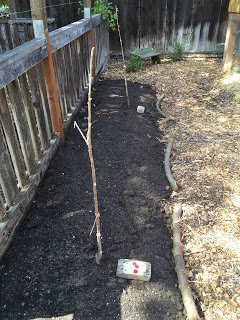
This project took up most of the weekend, but I managed to make some new bars for the beehive; paint a brick for the new blackberry vine I scored for free on Nextdoor; open the hive (all looked well); reseed some corn, beans, watermelon; add dirt to the potatoes; clean the coop and the house; do laundry; and weed and mulch and get everything looking nice - plus a half day of training for Girl Scout camp. We did cross everything off the list except I didn't get to the herb purees. That will be a job for the week to come!

I've ordered three new bare-root fruit trees to take the place of some of the bushes I took out. I chose two different sweet cherries and a Santa Rosa plum variety hybridized by Luther Burbank. Once I plant those, I'll spread a ton of flower seed around them, and hopefully have a pollinator garden in the North Garden as well as the South. 

Everything in the veg garden has sprouted and looks great. I have yet to harvest kale and plant basil in its place, and I have yet to harvest the shallots and plant cantaloupe in its place, but everything else is in.  It's all wonderful, but it's the flowers that are really knocking me out these days, so I'll leave you with pictures of those, plus a funky mushroom (I think it's a stinkhorn).

Clarkia, Mountain Garland

Blue Flax

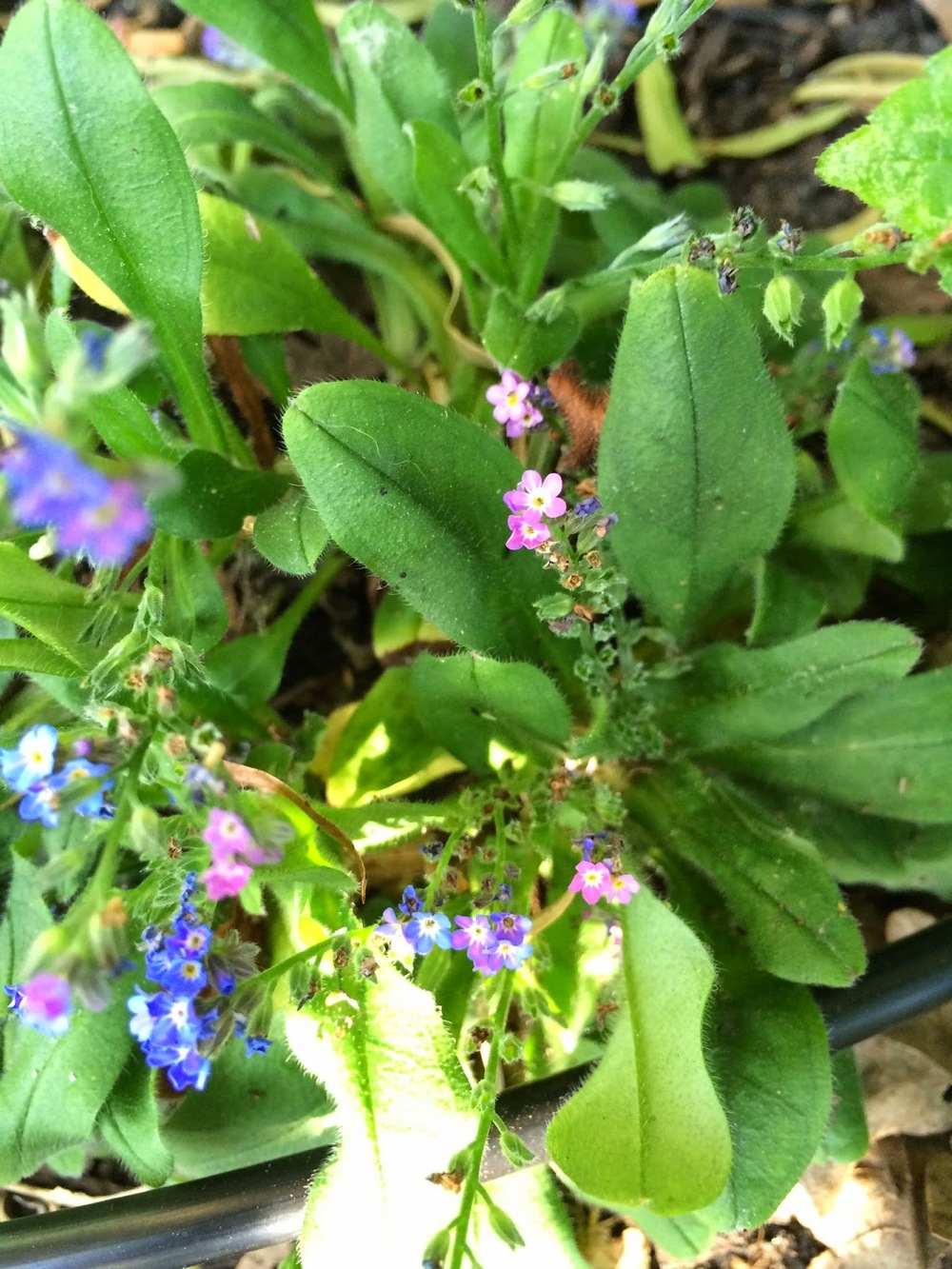
Forget-me-not

Pollinator section of the South Garden

Redbud seedpods

Tidy-tip and Phacelia 
Stinkhorn?
 Bonus picture -

Gopher snake Tom saw on a hike with Joe