More Spring Planting

What a great weekend, in the 80's temperature-wise, bright and sunny, and two perfect days of accomplishments in the garden!

Corn is in! This is one of my favorite crops each year, and I plan to succession plant this time around, so I get two crops. Nothing tastes as good to me as a fresh ear of corn, smothered with butter and salt. Or right off the stalk! Last year our yield was disappointing, so I'm hoping that having it in two different places will tell us what the corn prefers.

Collards are in! This is a wonderful summer crop; it is one of the few greens that can take summer heat. I have it in the South Garden, where it will get six hours of early sun, then afternoon shade. It did great there last year and I hope for the same this year. Young, tender leaves are delicious sautéed in olive oil and eaten just like spinach or kale.

Tom made four more trellises for me, learning a new method of joinery from my father.

In Dad's shop, sawing up the boards

The trellises before chicken wire is added
The trellises are for beans and winter squashes, which are both in! Two kinds of pole beans, green and purple, and two kinds of squash, Delicata and a climbing version of butternut. I'm waiting on pumpkin, as it will go underneath the pole beans, and I need to give the beans a head start before I plant pumpkin seeds. 

I yanked all the spinach, as it was starting to look peaked. I washed a bunch of still-nice leaves for our use, fed a bunch to the chickens, and composted the rest. Spinach was a great crop for us this winter and supplied us from January on.

I added a lot of nasturtiums, calendula, and marigolds to the vegetable beds, mainly for color and interest, but it can't hurt to draw the bees' attention to the crops, as well.

Speaking of bees: We opened the hive Saturday, and the bees are still building herky comb. So we had to remove some spurs, which made them mad, and made us sad. It takes a tremendous amount of calories and energy for the bees to build comb; I hope they don't get discouraged that we keep removing it. 

Here's a picture of some of the comb we removed. There's a lot of nectar stored in it, as well as different colors of pollen. The variety is pretty.
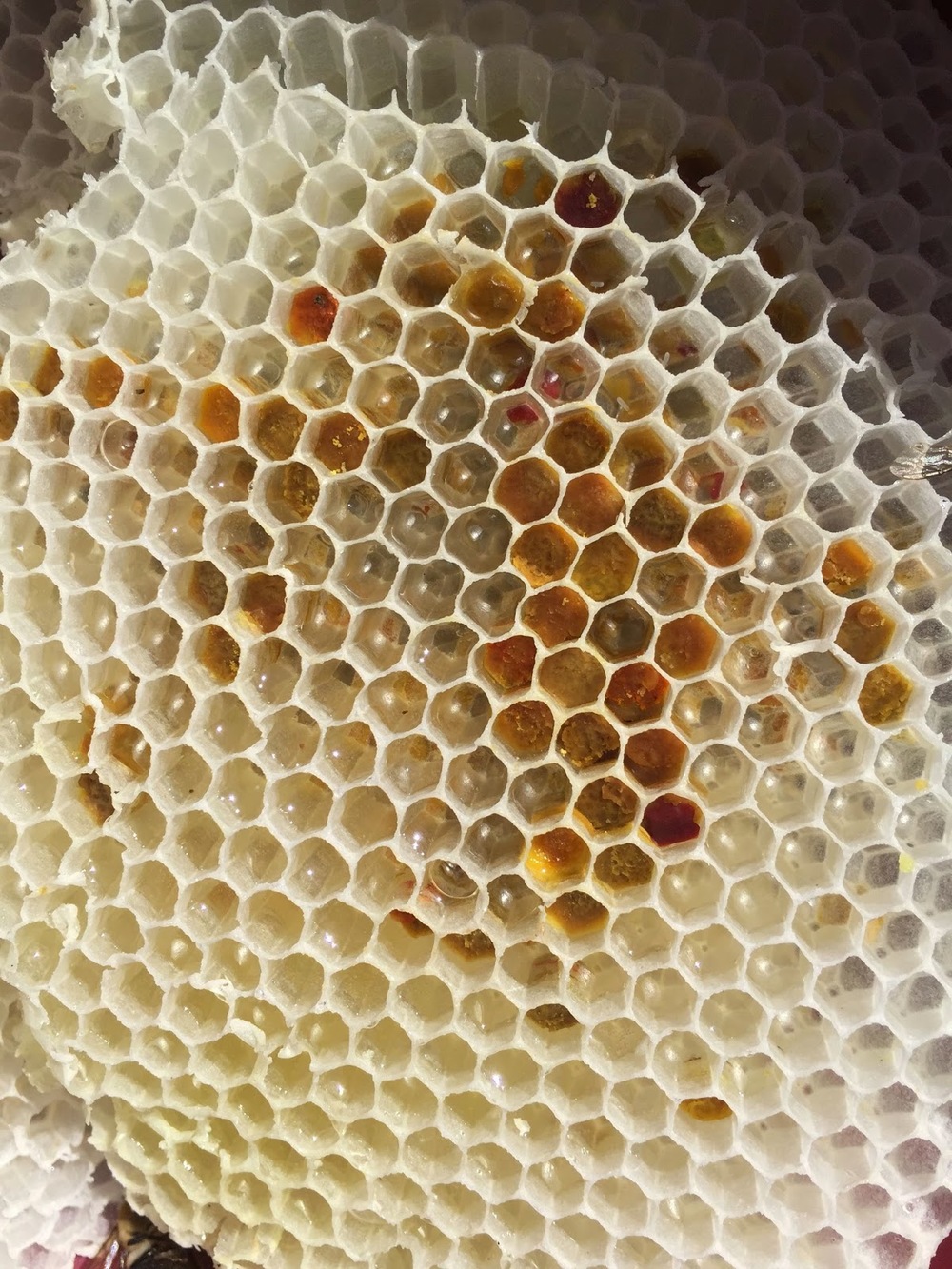


One good thing is that the bees have more comb than they did earlier in the week, so they are building quickly. I'm going to order more natural wax to glue on to the bars, so they have a better 'pattern' to emulate.

I took a look at Dad's hives this weekend, and promptly got stung. I haven't been stung in years! It hurts like the dickens until you take the stinger out, and then it's ok after that, except that the swelling can be uncomfortable. And, it'll be itchy in a couple of days.

Not just the stinger, but part of the bee's body, stuck in there.

Y'all know how to take a stinger out, right? Use a credit card and scrape it out. If you use tweezers, you squeeze the stinger and inject even more poison into the skin. After that, use cortisone cream or toothpaste (paste, not gel) to help with swelling and itching. Baking soda paste works too.

I harvested a bulb of garlic, to see if I need to go ahead and harvest the whole bed. The green stalks are starting to brown, which is supposed to be the indication of readiness; the bulbs are certainly huge! 


We've put it on the mesh above the chicken coop to cure; we'll take a look at it next week, and then decide what to do next. I'm not exactly sure how it's supposed to look, but I think I'll know when I see it. (That may be naive.)

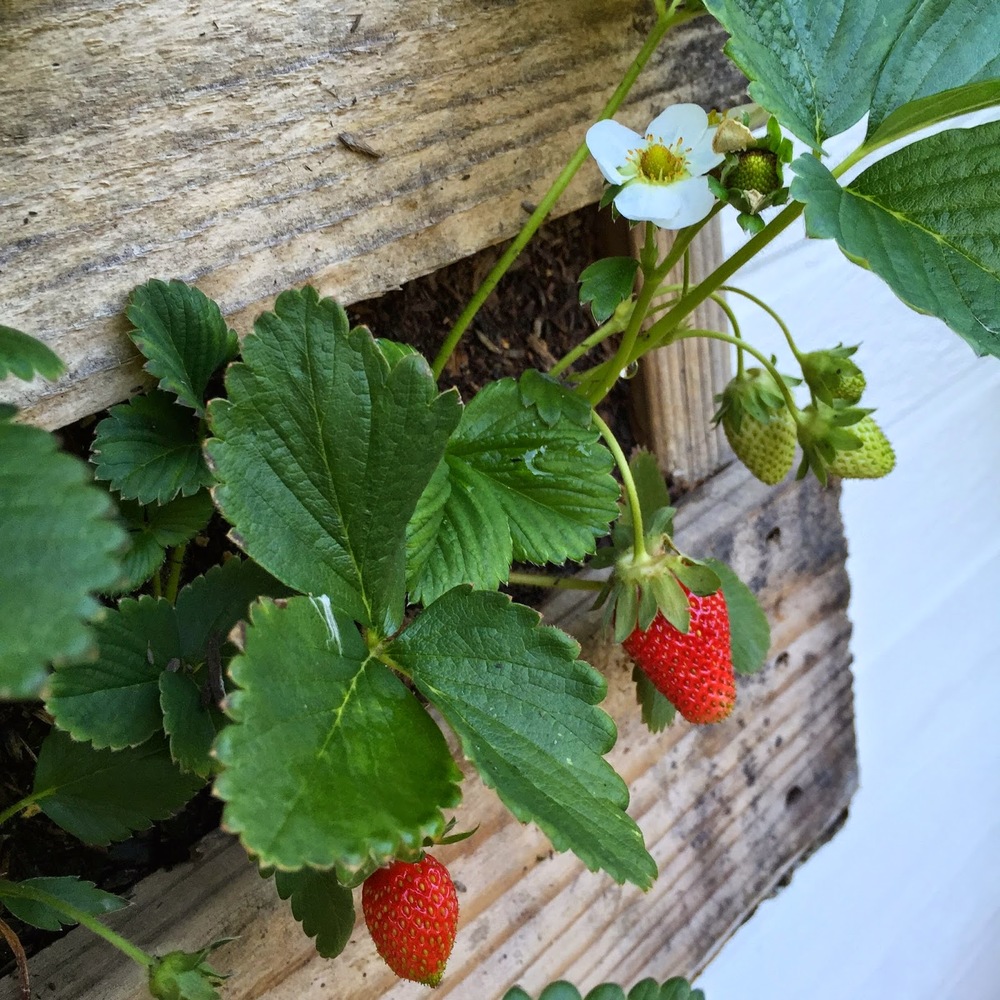
We're still harvesting kale every day, and peas every day - and, a new development - strawberries every day! Yahoo! They really are so much more tasty straight from the garden.


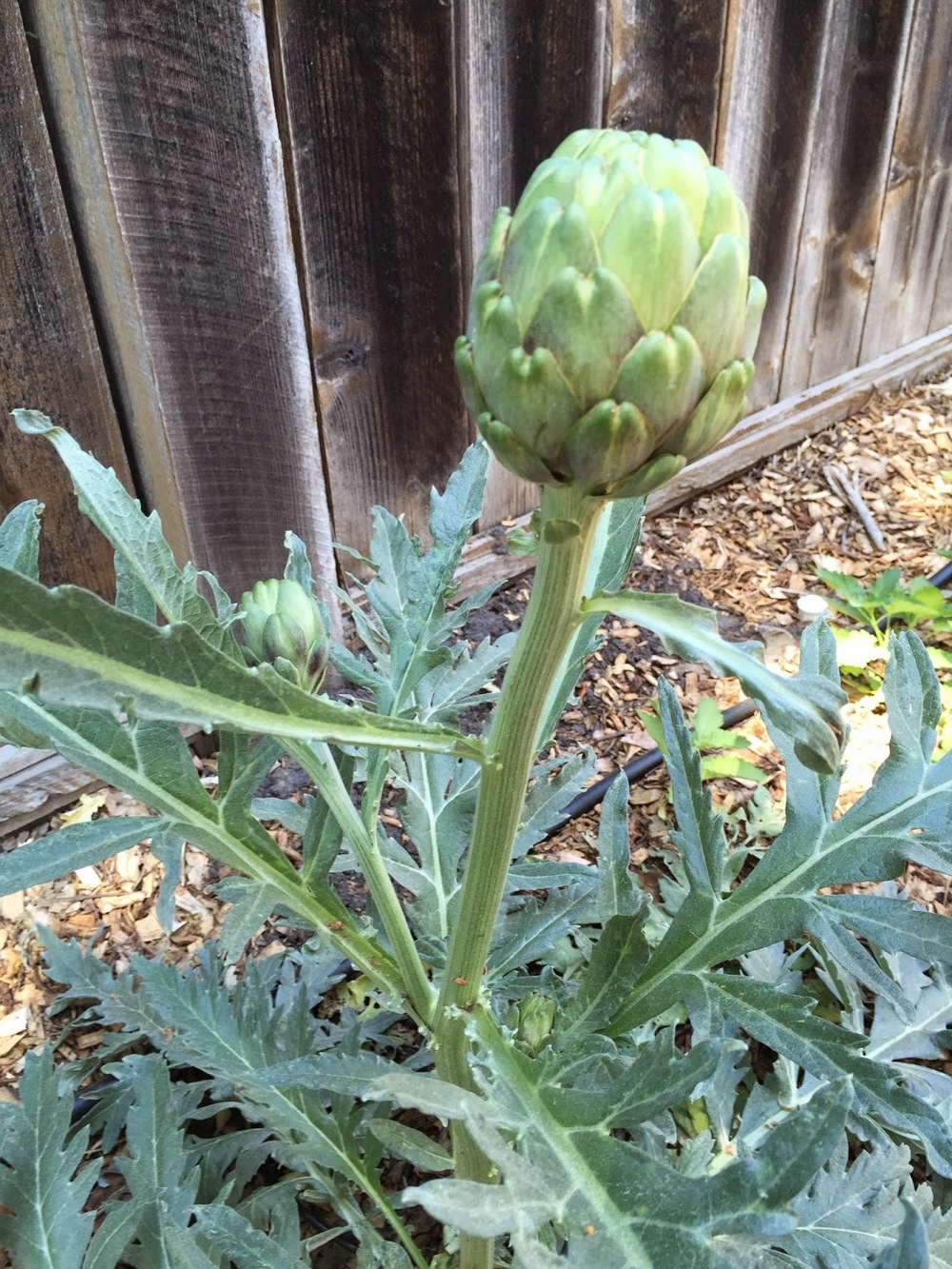
The artichokes are growing and I'm still not sure whether I want to harvest them, or leave them to flower this first year.


Cilantro is growing like crazy, and I need to figure out what to do with it all!


The herb spiral is growing wonderfully and producing plenty of produce for nearly daily use. I have rosemary in pots elsewhere, and basil will go in the beds as soon as it's warmer at night, and I've planted feverfew and chives in other spots as well; meanwhile this mound of herbs is so useful and one of the best things I've done in the garden. I just have to keep a sharp eye on the mint. It's a bully.


In the flower garden, phacelia bloomed this week. This plant is also called 'bee's friend,' as they love the blooms. I have two different kinds. Both are lovely.


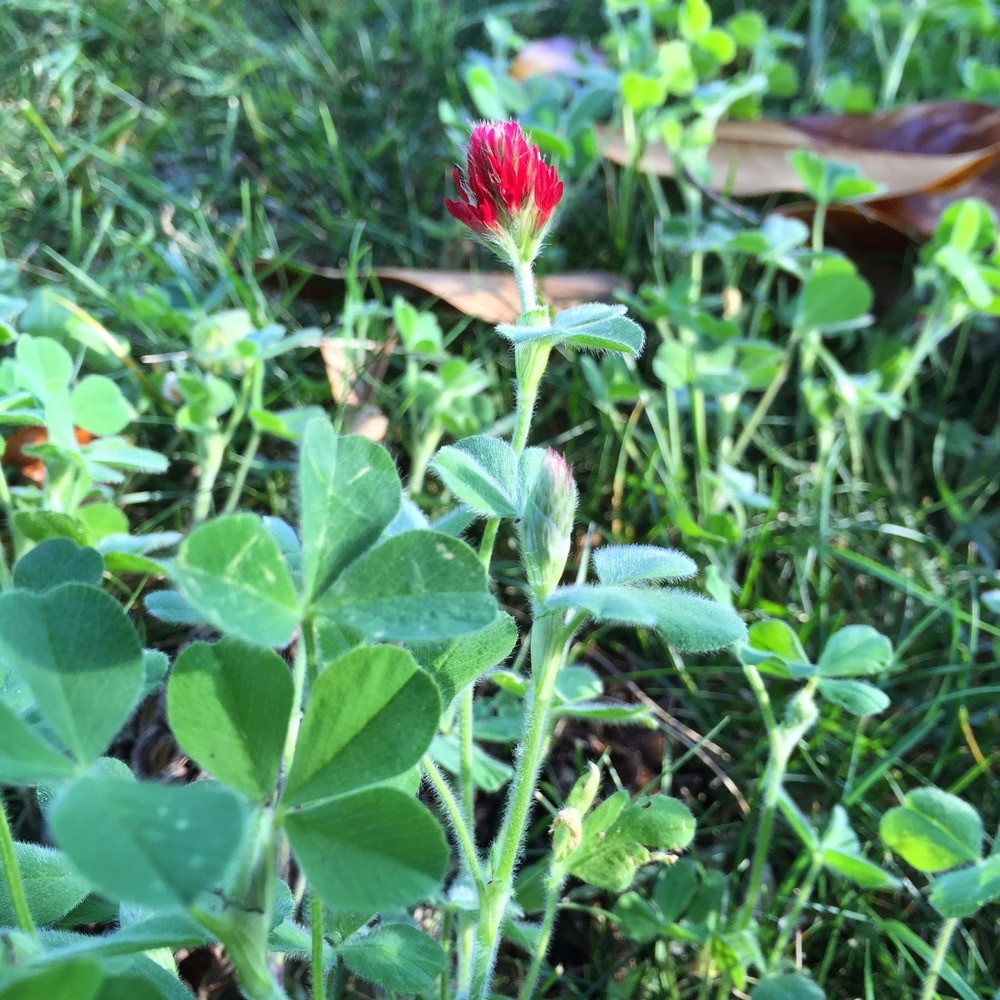
The red clover has now bloomed throughout the grassy area we have left in front; the bees love it, and it looks pretty. I just have to figure out how to cut the grass around it, or maybe I'll just mow it all down and watch it grow again!


We have plenty of white clover too, and I've recently seeded some more of that as well. It's just so much more useful than grass. Again, it's a small area, but I'm pretty down on grass right now (as you all know).

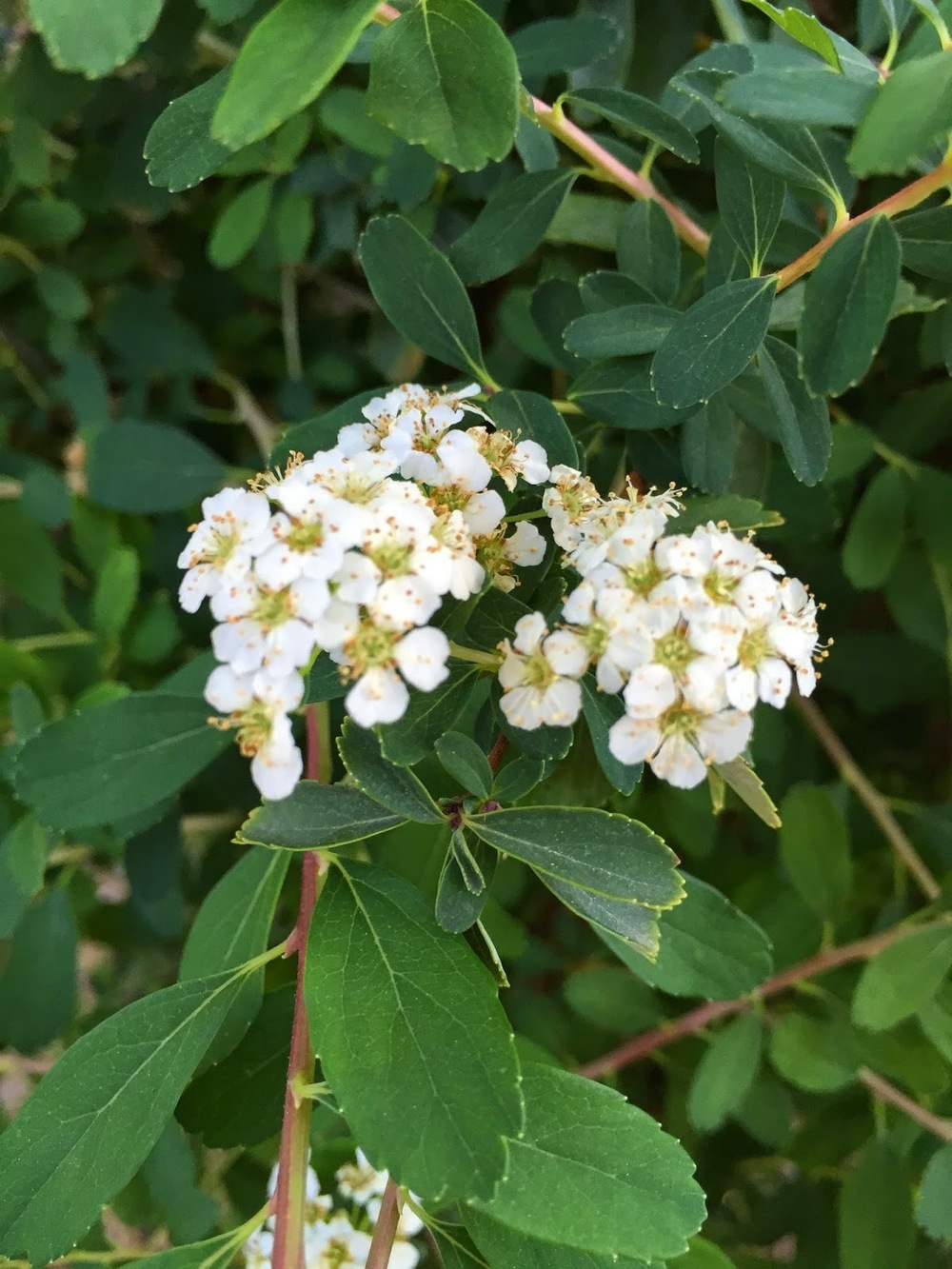
The pollinator garden is starting to burst with blooms, mostly poppies, but also hummingbird sage, salvias, and nicotiana. Borage is beginning, too. Plus the coral bells are still blooming. And spirea has begun to bloom.


I planted more flower seeds, plus some seeds for climbing up a trellis I have back by the water feature. These are an heirloom climbing bean that might even bear fruit. The seeds are quite beautiful.


After the we were finished planting and trellising the North Garden, Tom took a picture. It's really shaping up back here.

The rope is for the shade sail, which is over our patio.

So that's the North Garden. The South Garden is where the pollinator garden is, plus peas, kale, carrots, potatoes, romaine, and some leftover broccoli and beets. Soon I'll plant Bibb lettuce as well as basil, and when the peas are done, cucumbers, both slicing and pickling. That planting will probably happen in early May.

I'll leave you with two videos of some birds in our yard. The first are two blackbirds on our back fence; the male is doing a mating dance for the female. We've never seen this in our yard before, in fact we've never seen blackbirds here, though there are plenty in the open space. The second video is of a mother black-capped Chickadee, bringing food through a huge Ribes plant into a nesting box that Adam made a long time ago and nailed against his train shed. You can see the mother bird checking me out, then she flies in, then you can hear the babies peeping, then she flies out again. We love seeing bird activity in our yard!


Separate lives, but just for a few days

I went down to Southern California on personal business this week, while Tom manned the fort here at home. He has lots to tell you about his bee adventures:

On Tuesday I opened the hive, mostly to check on the status of the queen. When we put the bees in the hive on Saturday, the queen was in a cage, separated from the rest of the bees by a candy plug. This gives everyone a chance to meet & mingle before they can really get together. The bees had been going through a fair amount of sugar water, and I was anxious to see how things were progressing inside.

When I opened up the hive on Tuesday, I noticed with some dismay that the bees were building some comb aligned with the top bars, but then other comb was at an angle offset from the bars of the hive. This isn't good for our beekeeping needs, since we need to be able to lift up individual bars and inspect the comb.

It's a little hard to see, but this comb is aligned with
the length of the bar, which is tilted up from the hive.

After a quick consult with Elizabeth on Tuesday afternoon, we decided that the offset comb needed to go. Armed with our new smoker, a hood, gloves, and a long-sleeved shirt, I set to work on Wednesday afternoon. First things first – an inspection of the queen cage showed that she had been released -- yay! Then I had quite an adventure – I had to lift out bars, set them aside, scrape off the bad bee-covered comb into a bowl, and rearrange bars.

You can see two separate lobes of comb,
offset from the axis of the bar.
There was some comb that had fallen to the bottom of the hive, so I needed to temporarily remove a lot of bars so that I could get my hand in there and remove it.

Sometimes, you've just gotta stick your hand in a big patch of bees.
Each of the bars that had offset comb were bars that we had reused from last year. I replaced them with some unused bars from last year, where we had attached a starter strip of wax. The starter strip goes along the length of the bar, and we had good luck last year with the bees developing comb in the appropriate direction.

This is actually a picture of the queen cage from last year's batch of bees,
but you can see the strip of starter comb.
After about 30 minutes of work, I sealed up the hive again, and left the bowl with cut-off, still bee-covered comb to rest on the ground near the entrance of the hive. I had to hope that the now-released queen somehow remained un-squished by me, and inside the hive. The bees buzzed around quite a bit, much like the first day when we installed them, but by evening they'd settled down again, and today they looked like they were resuming work. It's unfortunate that we had to cut away so much comb that they'd built in the last few days. We'll be back in to inspect on Saturday to make sure that all of the new comb is growing in the right direction.

In other animal husbandry news, the chickens are really looking more like chickens now.


Okay, back to Elizabeth:

While Tom was dealing with sideways comb and two kids, a dog, a cat, and six chickens (plus work and cooking and making lunches!), my week was easier, logistically. I spent some time with good friends and family in both Huntington Beach and North Hollywood, and enjoyed the drive down on I-5, as much as possible. It's awfully dry.

That ribbon of blue in the middle is the canal, which carries water
from our neck of the woods down through the agricultural valley of CA,
all the way to LA. Looking at this landscape, do YOU think it should be farmed?
Do you know how much of your food comes from central CA?
Once in SoCal, the scenery looked more like this:

And then my head popped off.
But in spite of traffic, I had some time to do this:

Tour the Queen Mary

And this:

Touring the Russian Submarine with my pal O.

And this:

Sit on this cool bench, handmade by my friends, and
enjoy the hummingbirds as they visited the succulents

And this:

Watch my friends record a track in their studio

And this:

Plant a container garden for each of my 'god' children
(they aren't really my godchildren, but that's how I think of them)

By the way, in Southern California, it's like the drought is nonexistent. No one is talking about it (at least not casually), there are no huge billboards like there are at home warning us to use less water, and I saw sprinklers going everywhere. When I asked my friends if they were concerned, they actually said "we don't know much about it." In Northern California, it's the main topic. EVERYONE is talking and worrying about it. Considering how much of our water moves down south, shouldn't the people living there be even MORE worried about it than we are? And even more careful than we are? Sheesh.

On to happier subjects, ones that don't raise my blood pressure! As soon as I came home today, Adam and I had to work on the visual component of his extracurricular project about changing the school lunch program. He decided he wanted to cook a lunch that he would like to eat at school, and that would be do-able for school. He made a very delicious whole wheat pasta primavera with vegetables from the garden and grilled chicken, a spinach salad from the garden with a yogurt Caesar dressing, and a rhubarb and strawberry crumble.

Isn't the boxed milk a nice touch?

He presented his findings and ideas to a member of the school board and the head of the education association, who enjoyed eating all the delicious food he made. In fact, the school board member said to him that she thought they might be able to pilot a program based on Adam's research! This was very exciting, and I'm very proud of him.

Now, I'm looking forward to the weekend, where I can look inside the hive myself, and hang out with the chickens, and get the rest of the summer veg planted. Sounds like heaven!


Weekend Wrap-Up

Well, the bees are settling in to their new home. Most of the forager bees took flights today to orient their internal GPS - figuring out which way is East, laying scent paths to guide them back home, exploring some of the flowers in the yard. Even the drones flew today, drunkenly weaving their way back to the landing board. The mason jar of simple syrup that I put out yesterday at 5 was already empty at 5 again today and had to be refilled, so they're eating! I very much enjoy perching in front of the hive and watching all the activity. It just feels right that there's bees back in the garden. Or, as Tom put it, "The band's back together!"

Tom finally figured out the very last piece of the drip system (yes, little bits still needed working on, I told you this project was tricky!) and now all the veg is being watered, which is a great relief. Not only is everything getting regular water direct to the roots, the drip system also means I can mulch around plants heavily, preventing evaporation. (And helping to dissuade weeds, and keeping the soil from blowing away, etc - you've heard all this before.) I'm using straw for mulch, since I always seem to have a bale on hand lately, and it's easy to move around if necessary.

The chickens are getting quite large, and a friend lent me two fake eggs to place in the nesting boxes, to convince the ladies that it's the best place to lay. I don't expect them to lay for another two months, but it can't hurt to get them thinking straight early.

I planted some romaine and we got the other potato cage made and planted with the second batch of seed potatoes. We also built a bamboo trellis for the raspberry vines (though the deer have found the leaves, which is sad). But that's about all we got done this weekend in the garden. It was Kate's birthday, so we spent our time in other ways.

I'll leave you with a couple things that made me glad today (besides bees and birthdays):

The red clover I seeded in the grass (or what's left of it) has finally begun to bloom! Ain't it pretty?
Can't wait for a carpet of red!

The first strawberries ripened in the pallet wall! These were eaten immediately after I took this photo.

My shy Wood Sorrel bloomed. It's so sweet in the shade of the front porch!
Hope you all have a wonderful week. Happy Gardening!

New Honeybee Colony

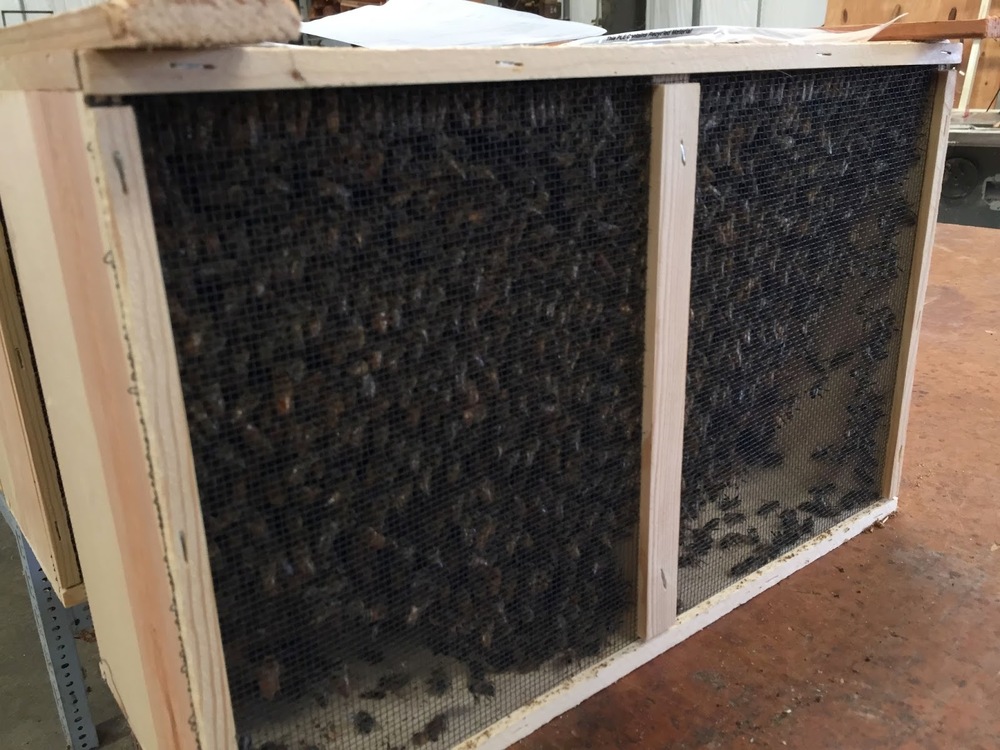
After I lost last year's colony of bees due to Varroa Mites, I immediately started researching where to buy a new colony. It's harder than you think! Last Spring, I obtained them from my local beekeeping association, which was fine, but I thought getting them directly from the source might allow me to learn a bit about their practices and provide an interesting field trip. I ended up ordering four pounds of Italians from Taber Honeybee Genetics in Vacaville (I also ordered four pounds for Dad, as he wanted to start another hive). I would have much preferred finding a swarm - I am starting to believe that swarms are generally healthier and stronger, having proved themselves genetically over time. However in all my hikes and walks with Joe, I never found one. So I went with my original plan, and today Dad and I went to pick them up.

Vacaville is about halfway between my home in Walnut Creek and Sacramento. Its history is in farming; and indeed we passed many almond orchards along the way. Once you travel back past the strip malls and restaurant chains, it's farm country.


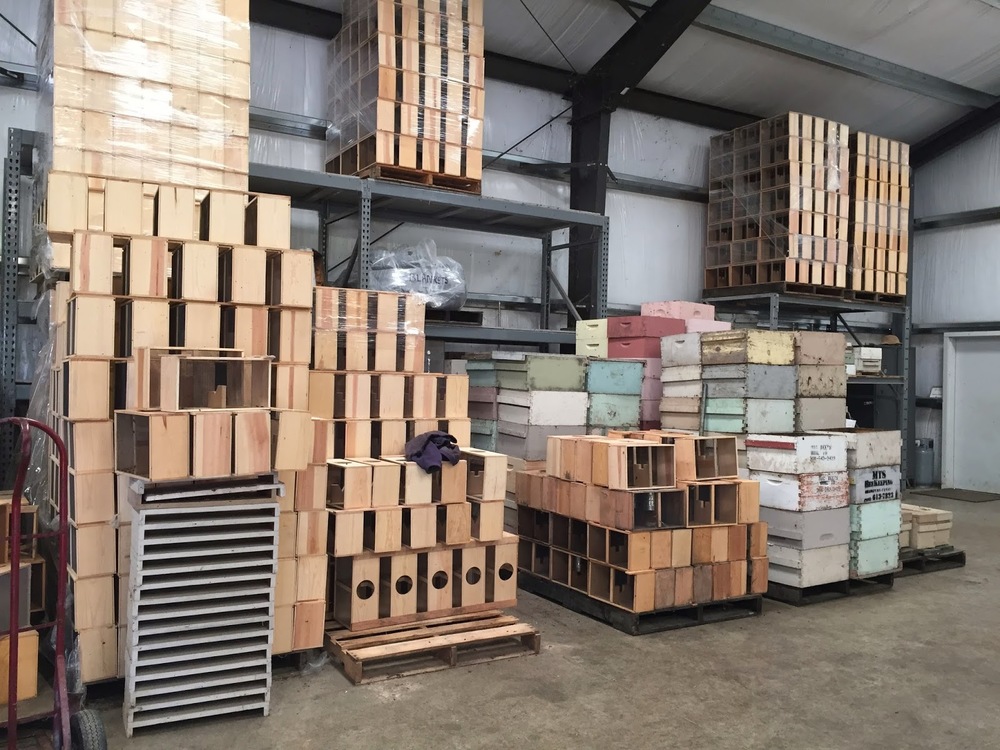
The bee warehouse was unmarked, and surrounded by fields of wild radish in bloom. We weren't the only ones picking up our packages; there were several other families there as well. Inside the warehouse were the packaged colonies waiting for pickup, and walls full of wood, nucs, and supers.


We were lucky enough to talk to both the guy in charge, and the guy in charge of bees (two different people). The guy in charge generally warned us about Varroa and Nosema (an intestinal infection) and gave us instructions on how to treat those problems, which gave both me and my dad lots to think about, as neither of us have ever treated our honeybees (and we've both lost hives). Let's just say, for now, that the treatment didn't seem as horrible as I thought it would be. And the guy was adamant that we treat even if we see no sign of disease, as it's hard to see until it's too late. More on this in the Autumn, which is when we'll need to think about it again.

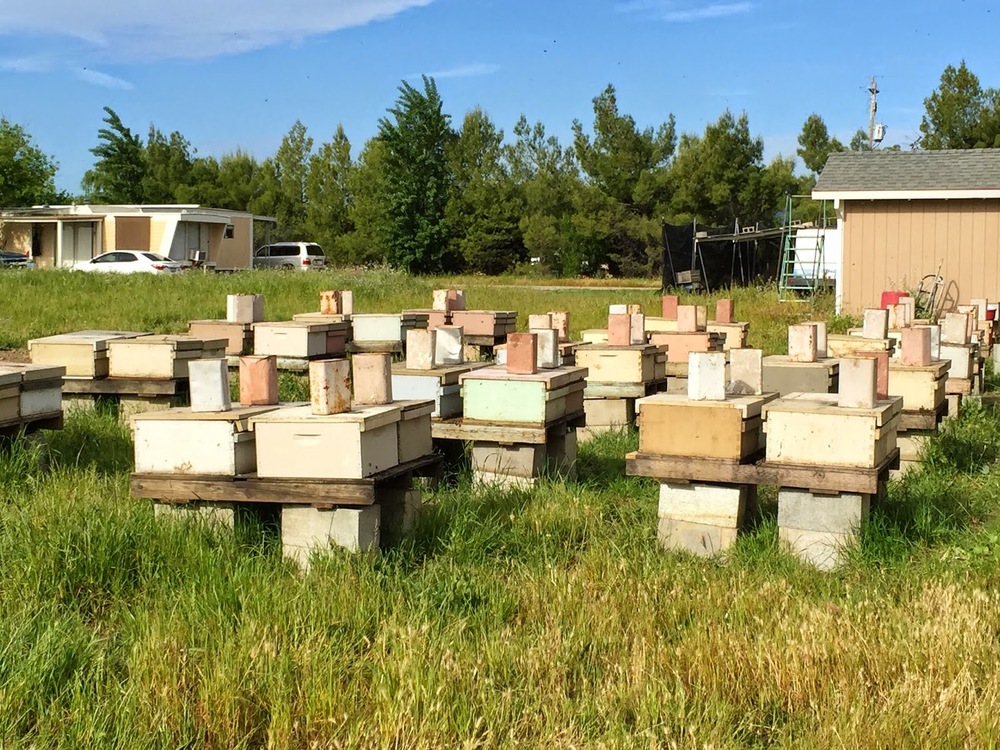
Then we got to talk to the guy in charge of bees, a quiet gentle man who spent a lot of time answering our questions about how the operation works. The company rents out 4500 hives of bees each year, first to the almond orchards, then to the sunflower fields when they bloom. In between they feed on wildflowers. That's the first 'tier' of their business.

The second tier of the business is raising queens. Behind the warehouse, there were about six 'breeding' colonies, as he put it, which provide the larvae.


Every two weeks, the beekeepers remove three-day-old capped larvae from these hives and insert them into special frames, 45 to a frame, which are then inserted into about 20-30 queen-less hives in another area.


Any larvae can become a queen, of course - it just needs to be fed royal jelly for the entire larval development period. And that's what these queen-less colonies do, of course - they get excited that there is a potential queen, and they feed the larvae solely on royal jelly. (Royal Jelly is a combination of digested pollen and nectar mixed with a chemical secreted from a gland in the nursing bee's head.)

After ten days, the beekeepers remove the frames of queen larvae and put them in an incubator. They do this because the queens will kill each other if they hatch in the hive (there can only be one queen, after all). After the queens hatch, they sell them to folks who need to re-queen a colony, or add them into the packaged colonies which we purchase, or queen a hive that needs one in their own yards. 

And, just so you don't feel sorry for the queen-less hives, after a couple of cycles, they provide them with a queen that they can keep, and they use a different colony for the purpose of raising queens. It's all so fascinating!

Dad and I seemed to be the only people asking these questions, and we were the only ones to prowl around the warehouse checking out the bees. If I could urge everyone to do one thing in their lives, it would be to be more curious, about anything and everything! I learn so much from asking questions no one else asks. I often get to go behind the scenes, because everyone likes to talk about their job, if they're proud of it. Rangers are a perfect example. The next time you're at a park, talk to the ranger! Ask questions! You'll learn more in 15 minutes than you ever thought you could.

Anyway, we brought the bees home (buzzing all the way! So good to hear that sound again), and then they had to sit in a cool, shady place for the rest of the day, chilling. It's always advised to put your new colony in the hive in the late afternoon, so the bees can get used to their new digs before exploring the terrain. 

Finally it was time to release them. I set out all the tools I'd need, made sure I had the sugar syrup all ready to go, got rid of a few stray spiders in the hive, and then Tom and I made a plan. Tom was dressed in long sleeves and a hood; I chose to not prepare in any way except wearing gloves, thinking that I'd be fine. We lifted out the can of sugar syrup that is included in the colony, and bees came swarming out. 

The first job was to wire the queen cage to one of the bars in the hive, and uncap the candy plug that is at one end of her cage. The worker bees will chew through the candy to release the queen, and that is how they all get to know her before she starts laying eggs. The queen cage was simply covered in bees, and it was hard to get a wire on with gloves and uncap the candy. Finally I just took of my gloves and did it. Once the queen was in place, we could shake the rest of the bees from the nuc into the hive. Tom shook and shook and shook, and still there were some clinging and refusing to go into the hive. I left the nuc out by the hive so the stray bees can find their way up and inside. Four pounds of bees is a LOT of bees (about 3,000 per pound!), and they were crazy. I guess I'm just used to bees being very calm and not too disturbed by what we do - I don't remember it being so nuts last time! But it was nuts. We couldn't get the bars in, because everything was covered with bees. A bee flew up Tom's shirt; he had to go take care of that. We needed smoke, and hadn't even lighted the smoker, so Tom had to go get that and get it started. Of course then it went out and we needed to do it again! A bee got tangled in my hair; I had to walk away quickly and go get my hood. I cannot describe how many bees there were EVERYWHERE. Thankfully the kids were in the house, the dog was in the house, the cat was either in the house or hiding, so we only had to worry about ourselves. It took forever, but we patiently smoked the bees off or brushed them off with our bee brush until we could get the bars in. Then there were a lot of bees back behind the divider - we use that to keep the hive a manageable size for the bees until the colony grows - and we had to get all the bees out from the back of the hive. More spiders, really gross spiders, crawled out. It was bug Armageddon. 

Somehow I managed to take pictures during all this. And somehow - I do not know how - neither one of us got stung. That's pretty amazing. 


And here's a 10 second video of the chaos.


We walked away and left the bees to get acquainted with their new home. About an hour later, they were settling down and figuring out the whole system. I hope they like it here. I hope they decide to stay. I hope the queen is viable. I hope a lot of things, but we can only wait and see how things go. I'll open the hive next weekend and check to see that everything is ok with the queen; it will be hard to wait. Meanwhile you'll find me out in the garden, just watching.

Worms and Lacewings (and a fat Tom Turkey)

Every year I order worms for the compost bin.

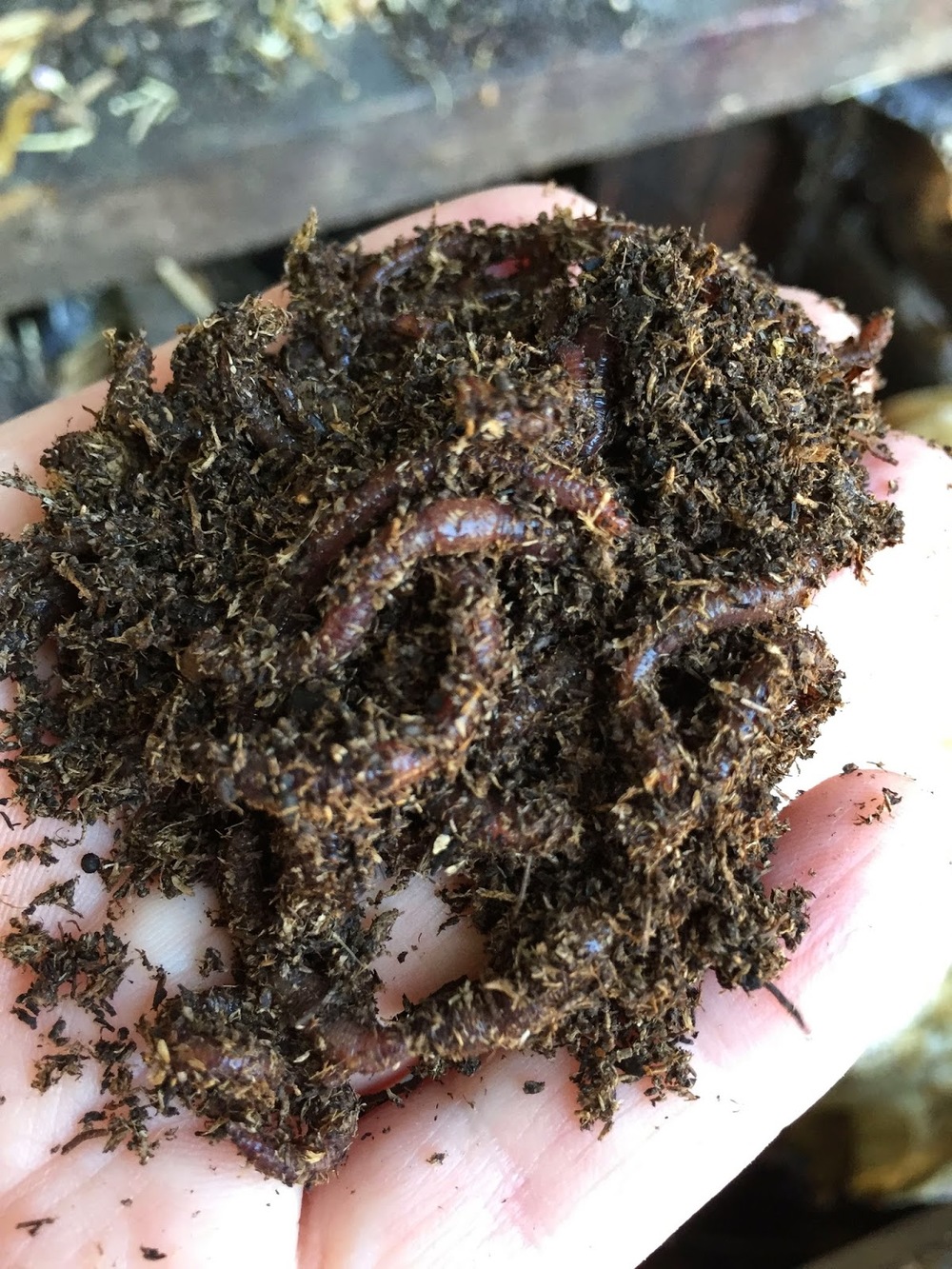
My original compost bin is rather small (we now have three total, two of which are quite large). Because it doesn't generate enough heat by its size and volume of material, I need to add worms to help with the decomposing process. I generally get a pound every year or so. This year, I ordered from a new place, The Worm Farm. They are fairly local, up north, and the worms arrived today.

What do you suppose the letter carrier thinks of this?
Within the box, the worms are usually packed in a muslin bag, with dirt and shredded paper. A pound of worms is about 1,000 - so the bag is pretty packed and squirmy.


Upon opening the bag, I was pleased to see a lot of dirt and not a lot of shredded paper. Better for the worms.
Then you release them into your compost. The worms tend to burrow down in the contents of your bin pretty quickly; they like to be at the lower levels, it seems to me.


You don't want to buy just any worms - you want Red Wigglers - or Eisenia Fetida. These are different from earthworms. Earthworms are great! But Red Wigglers are master composters. 

I've also already noticed aphids in the garden. Only on the roses that are left (only three now - I've taken out dozens that were here when we moved in), but they could spread and often do. I've released ladybugs before, but they just tend to fly away - it's larvae you really want anyway. So I bought Green Lacewing Larvae from Arbico Organics, 5,000 eggs. They also arrived today.

The postman is really freaking out now.
They were packed nicely, in a heat-shielding bag, in a tiny container.


They were packed in bran. I scattered them in three places - on the roses where I've seen aphids, and in both the North and South veg gardens.


The instructions said I probably won't see them hatch. But I sure hope to see them flying around the garden, eating up all the baddies.

I also use a garlic spray for aphids. I chop up a clove a garlic, add it to the sprayer along with some dish soap and water, and then I spray it directly on the affected area. It works a treat. But I don't like to use the spray on veg, so that's why I was proactive about the lacewings.

Of course, turkeys are a regular part of living here in the foothills of Mt Diablo, but heading up to the open space to walk Joe today, I came upon a whole passel of males, displaying. It was spectacular. I got a shot of the largest one.

I don't know if the female turkeys are impressed, but I sure was!

His wings made a funny sound, dragging on the pavement. He wasn't concerned about me at all, just as proud as proud could be. 

It's raining creatures around here. Tomorrow I go pick up the new honeybee colony!