• About
  • Blog
  • Contact
  • Favorites
  • Archive
Menu

Poppy Corners Farm

Street Address
Walnut Creek, California
Phone Number
Walnut Creek, California

Your Custom Text Here

Poppy Corners Farm

  • About
  • Blog
  • Contact
  • Favorites
  • Archive

Climate Zones

August 7, 2023 Elizabeth Boegel

Poppy Corners in August (the South Side) - Walnut Creek

Environmental Center in August - Oakland

It’s a great privilege to work and farm two gardens; my own garden on my own home property, Poppy Corners, in Walnut Creek, and my school garden, behind the Environmental Center at Merritt College, in Oakland.

In some ways, these two gardens are very much the same. They were both conceived and begun by the same gardener - me. I have a certain gardening aesthetic, which you’ll find reflected in both spaces; I have a certain way of doing things that works well for me, and I use those methods in both gardens.

However, there are a lot of differences, too. I’ve been working in my home garden for nearly 19 years, while the school garden was started in January 2022. My home garden’s design, planting, and maintenance are largely done by me, with a little assist from Tom once in awhile, while the school garden is designed, planted, and maintained by a whole host of folks, mainly students, a new group of which arrives each semester. Each garden has been built using what materials could be found or purchased at the time, and the landscapes reflect that. The soils are different: In Walnut Creek, we have 100% clay, because this land was under water a long time ago; the school garden is on top of a hill which is uplifted volcanic matter that has greatly eroded, which gives it a rocky, sandy texture. (*Note - in both gardens I grow annual vegetables in soil that is brought in, because neither original soil is great for growing veg.) The goals for my home garden are to provide food for my family, habitat for wildlife, and beauty for the neighborhood. The goals for the school garden are to provide a safe learning space and a lovely place for students to gather; this forms community, which our program is determined to provide.

But another main difference between the two spaces is climate.

Walnut Creek is about 20 miles inland from San Francisco and its bay. It has mountains surrounding it to the east and west, while to the north and south are long valleys. Oakland is directly on the bay, about 10 miles east of San Francisco. Oakland runs from the flats in the west, up into the hills to the east; this divides the city in many negative ways, while also dividing it climatically. My school, as I mentioned, is in the hills.

Why does this matter, you might ask? We all have climate differences depending on where we live, but here in the Bay Area, we have far more differences than most, thanks to the influence of the San Francisco Bay and the Pacific Ocean. We call these ‘microclimates.’ I’ll get to those in a minute.

But first, this is the USDA Plant Hardiness Map. This map was developed primarily as a tool for farmers, but gardeners use it frequently as well. These zones are divided by the lowest temperatures rather than the highest; for instance you can see that the central northern part of our country gets quite cold in winter, while the southern part of the country stays warm (or at least temperate) in winter. If you look at this map, and the close-up below, it looks like the Bay Area (about a third of the way down the state from Oregon) is generally homogenous. That is, that the coldest temperatures in San Francisco are about the same as the coldest temperatures in Antioch. There are some slight differences, but it’s not markedly different. According to the USDA, Poppy Corners is in Zone 9b, which gets down to a low of 25 degrees, while the Environmental Center is in Zone 10a, which can get down to 30 degrees.

Not a lot of difference, according to the lowest temps.

Those lows are extreme examples, of course - they are what ‘might’ happen, while the lows over time are not nearly that low. I have found that wintertime in Walnut Creek includes a few nights under 30, while most of the time we are in the upper 30s to low 40s. In Oakland, the low rarely gets below 50, as is more usually around 55 at night.

The USDA doesn’t take in to account the high temperatures during the day, which are also quite different. For instance, summers at Poppy Corners generally involve regular daytime temps in the 90s, with many days over 100. Summers at the Environmental Center are much more temperate, and generally stay in the high 60s to the mid 70s.

Here’s another difference: The humidity in each place varies greatly. Walnut Creek rarely gets summer fog from the bay - we’re just too far inland and the fog has to make its way over the Berkeley hills to get to us. But we do tend to get ‘tule’ fog in winter, which is moisture creeping in from the Sacramento/San Joaquin river delta to our east. However, Oakland regularly gets fog in the summer, as it’s much closer to the bay. In fact there are many mornings when I arrive at work in the summer to find the path soaked by fog drip. And in winter, Oakland does not get the tule fog. All of these things determine what and how you grow plants, and the differences can get a little frustrating.

Long ago, it became clear that Bay Area gardeners needed some guidance; growing things in San Francisco was obviously not the same as growing them in San Jose, or Mill Valley, or Richmond, or Vacaville. Gardeners clamored for more specific zones, and in 1954, a local magazine called Sunset published a book called The Western Garden Book, which redefined the climate zones and in turn, local horticulture. The Western Garden Book was, and still is, considered the bible of western gardening. Many gardeners use solely the Sunset zones (17 of them across the west) to plan and plant their gardens.
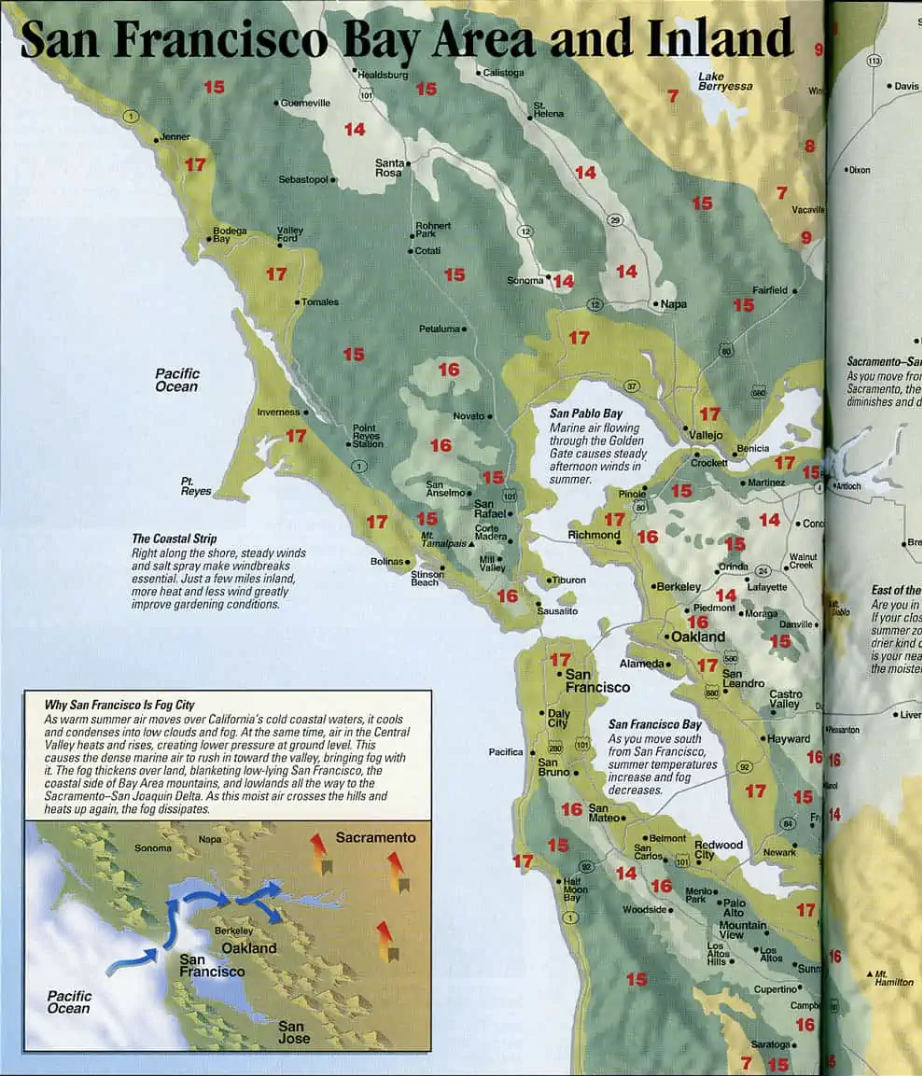
The Sunset climate zones take in to account all of the things I mentioned above: Not just the wintertime low temps, but also the summertime highs, and the humidity, and even the elevation. On this map, you can see that my garden in Oakland is in zone 16, while my garden in Walnut Creek is in zone 14. The descriptions Sunset gives for each zone is great, but here’s what I think is the most salient point: The coastal climate of Oakland is dominated by the ocean weather about 85% of the time, and by inland weather about 15% of the time, while the inland valleys in Walnut Creek are the opposite.

On top of that, as an observant person, I have discovered that there are micro-climates within microclimates. Poppy Corners, being in the deep valley on the west side of Mount Diablo, tends to get even more extreme temperatures, because the air is trapped by the mountain. Our winter temps are lower, and our summer temps are higher, than other cities in zone 14. We know this because we have recorded it for several years on our weather station. Here’s another interesting and salient fact: In the Bay Area, it cools down at night. It very rarely stays warm, no matter how high the temperature gets during the day.

“Ok,” you might be asking, “so what does all this have to do with actual growing in each garden? What’s your point, Elizabeth?” Why am I obsessively pondering this climate-zone stuff?

Here’s why: Everything in the school garden grows better.

Now, the school garden is not as mature; the perennials haven’t been there as long, and haven’t had as much time to grow. The space is changing all the time, as we determine what the needs of our classes/desires of all the instructors are. These things are reflected in the appearance of the garden. But even still - I look at the vegetables and flowers and herbs and natives and fruit trees and I think, damn. Oakland’s got it going on.

This is counter-intuitive. You’d think that the higher heat of my inland garden would be better for summer veg, at least. Tomatoes and peppers like it hot, right? And you’d think that the inland winter chill would be better for fruit, right? And at one time, maybe that was true - maybe the differences wouldn’t have been so marked, 50 years ago. Just little things, little tweaks here and there, would help the gardeners in different zones to make subtle changes that gave them success.

But in our changing climate, we already know that the extremes are getting more extreme. In my Walnut Creek garden in the summer, I either have full sun which bakes everything to an absolute crisp, or I have partially shady conditions that sure, don’t burn the plants, but also don’t allow for maximum production. In the Oakland garden in the summer, there is full sun nearly all day - but the plants don’t burn, and the fruit and veg ripens spectacularly. Take this example of the tomatoes in each garden:

Poppy Corners - spindly and not a lot of fruits

Environmental Center - chubby and huge, and full of large as-of-yet-unripe fruits

Why is this? Here’s my theory: It’s all about the range of temperatures. In Walnut Creek, in the course of a year, we range from 25 degrees to 115. That’s not too different than many places in the United States. But, over the course of a summer day, we often range from 50 degrees to 100. A difference of 50 degrees is not unusual here. That’s a HUGE daily change. In Oakland? Over the course of a year, it ranges from about 40-80 degrees. Much less of a range than most places in the United States. And over the course of a summer day? Mainly about 65-75 degrees. Not a very large daily change.

And this, my friends, is the big difference in my two gardens. In a study on Elsevier called “Ambient Temperature Signalling in Plants,” the introduction states, “Plants are exposed to daily and seasonal fluctuations in temperature. Within the ‘ambient’ temperature range… temperature differences have large effects on plant growth and development, disease resistance pathways and the circadian clock without activating temperature stress pathways.”

Plants are adapted to yearly, monthly, daily, and hourly temperature ranges. What they are NOT adapted to is increased temperature stress. And it is extremely clear to me that we are experiencing increased temperature stress at Poppy Corners. What I could grow easily 15 years ago, or even 10 years ago, I cannot grow now. And for now, at least, Oakland’s extremes are mostly mitigated by the beautiful San Francisco Bay. THAT is why everything grows better at the Environmental Center. And it’s why we, as gardeners, have to be aware of what’s happening in our own plots in our own cities, and why we have to learn to adapt to how conditions are now, not how they were when we started.

Tags climate
2 Comments

My Favorite Flower*

July 13, 2023 Elizabeth Boegel

*At least, at the moment.

People ask me what my favorite flower is all the time, and my answer tends to change depending on the season or month. November is for saffron crocus, for example, while December is for narcissus, January for manzanita, and February for ceanothus. It gets harder to just pick one in the months of March through October. When California poppies are blooming, they’re all I want to look at. When sunflowers are tall and broad and proudly enormous, I’m smitten. It’s like this with every flower; it’s hard to choose just one.

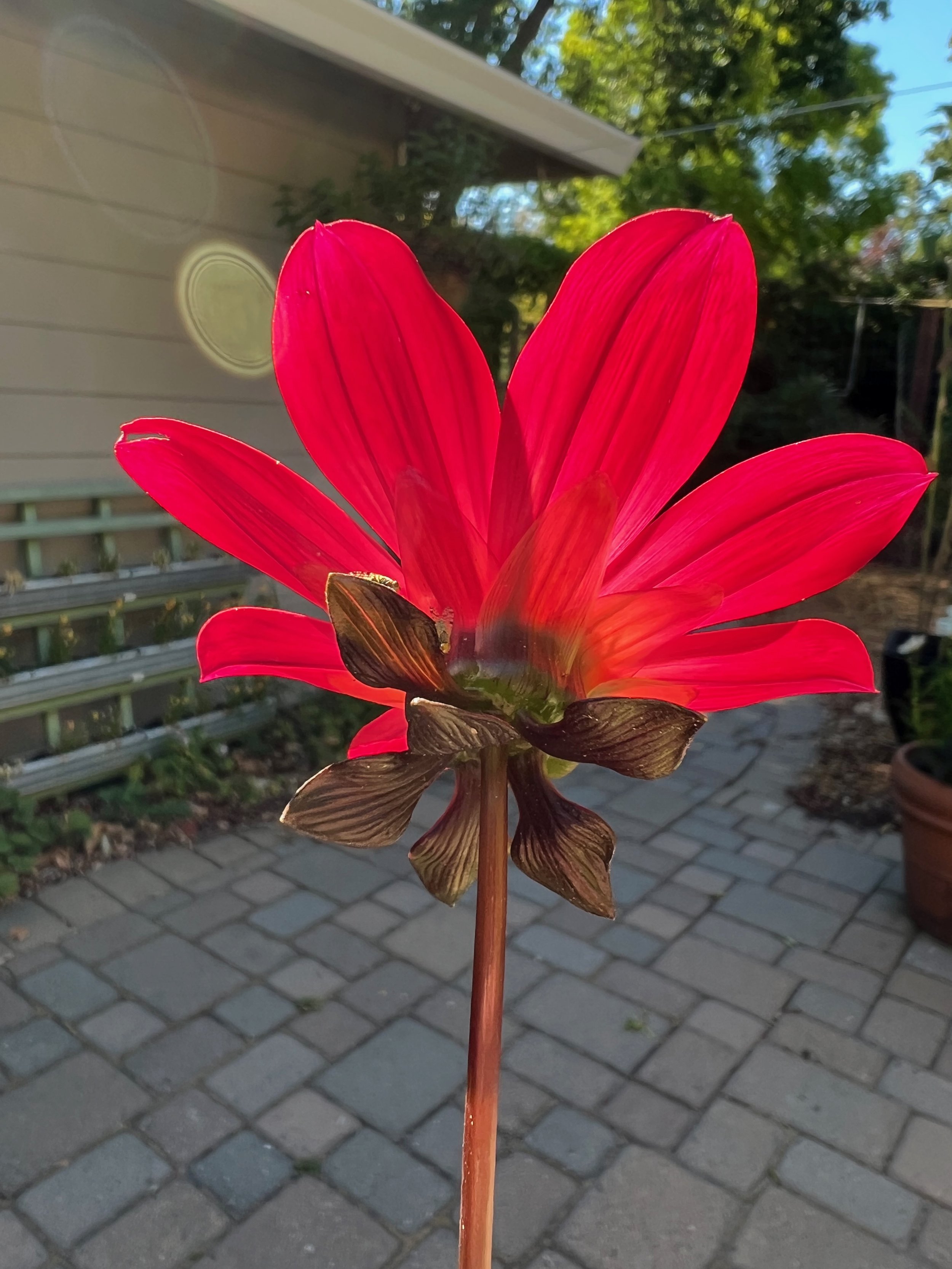
But right now - oh, right now - my favorite has to be the dahlia.

Particularly the dark-foliaged dahlias. There’s been an explosion of new dark-leaved varieties in the past few years, and I just think they are so striking. There’s the Happy Single series, and the Mystic series, as well as some old-fashioned varieties that have dark foliage. Frankly, I want to plant every single one.

But only the single-flowered ones, please. The single flowered varieties are best for pollinators. All those double blooms, and cactus blooms, and pom-pom dahlias - those have all sacrificed, in the hybridization process, nectar and pollen for extra petals. I don’t want extra petals; I want the insects to be able to use the flowers. Frankly I don’t want any flowers in my garden that can’t be used as food for something.

Dahlias are tubers, and here in coastal (ish) California, we can leave them in the ground all winter; in colder climes, the tubers need to be dug up each winter and stored in a cool dry place, and replanted in spring. They hail from Mexico and Central America originally, and that tells you something about the growing conditions they prefer: Dahlias like full sun, and a good amount of water. I find I sometimes have to give them supplemental water when it’s over 100 degrees. In that respect, they are not a terribly good choice for arid California, so lately I’ve been growing them more in pots, where I can baby them a little.

These flowers give me so much pleasure, I can’t imagine summer without them.

Tags flower garden
2 Comments

Orchard Update

July 10, 2023 Elizabeth Boegel

I thought you’d like to see what the orchard is looking like these days. We planted these bare-root trees on February 20th, and this area was looking quite bleak, with just (what looked like) sticks in the ground. Thanks to all the rain this winter, and the good rich soil we have provided, the trees are positively bursting with leaves and vitality. I don’t expect to get any fruit this year at all, but that’s ok - we actually want the roots to establish well this first year, and then next year, hopefully we’ll start seeing some harvests.

Tom and I both consider this project a great success. We can already see how, as these trees grow, they will provide a nice shade cover on this side of the garden, which is very hot in the summer. It’s going to be a lovely place to sit and enjoy. I am not doing any pruning at all until winter, and even then it will probably be fairly light. I will do a larger pruning next summer to control for size.

Tags fruit garden
6 Comments

Welcome to the Jungle

July 8, 2023 Elizabeth Boegel

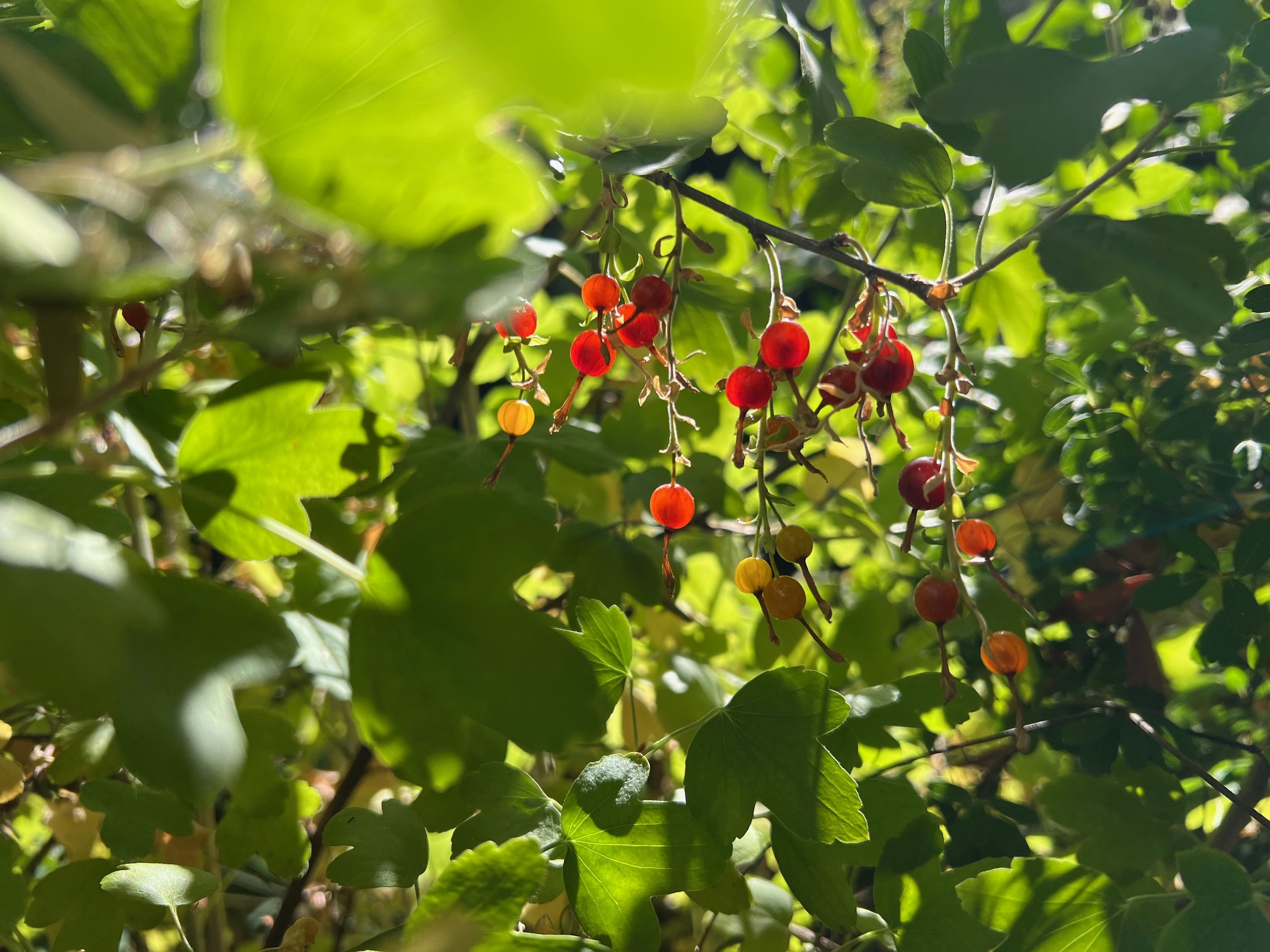
Ribes sanguineum - our native flowering currant. Technically all the berries in the genus are edible, but these are more delicious for birds than humans. Their beauty is unmatched, though.

What kind of person are you? Do you tend towards ‘type A,’ fully in control at all times, planning and organizing and keeping everything running correctly? Or are you rather laissez-faire, letting it all slide, ok with chaos, cool as a cucumber while the world spins around you? Maybe you’re somewhere in between, like I imagine most of us are.

Now, what kind of gardener are you? Do you like a perfect lawn, clipped hedges, formal plantings? Or are you more a meadow sort of person, with tall grasses and native annuals waving in the breeze? Do you like plantings where each plant is individual and spaced far from others, or do you prefer everything crowded together higgledy-piggledy?

Eryngium or Sea Holly, much loved by pollinators of all kinds

I think you already know what kind of gardener I am. I often say I’m a ‘messy’ gardener, and that’s true, but it’s not because I’m lazy (well, most of the time anyway), it’s because there are real scientific benefits to planting this way. It’s a conscious choice on my part; I do it to increase the resilience of my personal home ecosystem. And I do this even more deliberately because I live in an urban area; we are three-quarters of a mile from a major freeway that is often bumper-to-bumper traffic, and one and a half miles from a crowded suburban city center. Our neighborhood has homes on nice-sized lots, about 7000 square feet or so, but most of the homes here have been expanded from the 1940’s cottages they were planned to be and every family seems to have a car for each driver. Our street is jam-packed with cars, power lines, and concrete. I assume most of us live in the same kind of neighborhood.

Not everyone nearby appreciates my style of gardening, because it can look unplanned and chaotic. I often watch the reactions of passers-by, and they seem to be in two camps: One group looks confused, and tends to pass quickly, while the other group often stops short, looks around, then really looks, then finds something hidden or discreet, a secret bloom or bee, and ends up standing there transfixed for several minutes. Then they move about a foot along and repeat the whole process. Those are my people.

So why am I deliberately choosing to plant this way? What are the scientifically proven benefits of a messy garden?

First, and perhaps most obvious, is that layers of diverse plants, both vegetative and flowering, provide habitat for wildlife. I’m sure you’ve read about the decline in insects in our modern age; this is quite serious, because insects are near the bottom of the trophic pyramid. They provide food, directly or indirectly, for almost every species above them in that pyramid. If insects crash, everything crashes - insects are integral to every terrestrial food web (Goulson, 2019). But insects are not the only things declining; terrestrial vertebrate populations have decreased by one third, half of all amphibians are imperiled, and bird numbers across North America have fallen by almost 3 billion since 1970 (Wagner, et al., 2021). We can make a difference by increasing habitat for insects in our gardens, by planting a great variety of flowering plants and green leafy things, by planting in layers from the tallest oak to the tiniest groundcover, by crowding the space so that there is protection and safety.

As these flowers senesce and become seed, they provide food for the birds. As the leaves fall and collect on the ground, they become food for the soil organisms, who turn it into nutrients for our plants. Leaf litter is also biologically rich, providing pockets for the smallest creatures in which to hide and live. And this deep mulch layer conserves water, keeping it in the ground where we need it most, especially in California.

This multi-layered planting also shades the ground beneath, creating microclimates of humidity and coolness, which in turn allow the plants to thrive, particularly in dry climates where humidity is hard to come by. And if you have enough tall layers, this provides shade for the humans who also like to be in the garden. If a garden is planned well, deciduous trees can provide shade in hot months and allow sun to come through in the cold months. This can help us with our home energy bills, too, allowing us to use less AC in the summer and less heat in the winter.

And all of the concrete around us - the roads, the driveways, the sidewalks - absorb heat during the day and create an urban heat island, and compound rising temperatures due to climate change. A densely planted green space can help reduce the effect of urban heat islands, especially if everyone in the neighborhood participates in this kind of gardening. No one wants to go outside and walk, or play, in an exposed location, subject to the glaring heat of the sun. Let’s shade the sidewalks for our neighbors.

Another exciting benefit of dense planting is that plants can filter 27% of pollution drifting in from nearby roads and freeways (Arenschield, 2019). Here at Poppy Corners, our prevailing wind comes from the west and the Bay, over the Berkeley hills and sweeping up the valley to us in Walnut Creek, passing over two major freeways. All of that pollution blows towards us and gets stuck in the valley under Mount Diablo, where our home is. Knowing that our dense planting can help mitigate that drift is very satisfying.

Studies also show that when vegetation intensity is increased from mild to moderate, city noise can be reduced by up to 50% (Ow & Ghosh, 2017).

And finally, consider how you want your garden to feel when you’re out in it, lounging and relaxing. What feels good? Nothing delights me more than lying in the hammock under the tall Chinese pistache trees, watching the finely-cut leaves dance in the wind, creating dappled sunlight on my face, allowing me to feel warm and protected at the same time. I hear the fountain gurgling, I hear the birds bathing and chattering, I hear the bees in the nearby blooms. I feel like I’m in a private, secluded space, even though the street is only 12 yards away and our next-door neighbor’s back door a mere 6 feet away. It’s like my own secret jungle.

So I encourage you to think about how densely your garden is planted. I know we’ve heard a whole bunch of hooey, our whole lives, about how plants compete and they shouldn’t be grown closely together. But that’s just not the case. Plants like to share resources, connected by vast underground fungal threads. They like being messy and chaotic. They like being left to their own devices. Allow yourself to disconnect from the idea of a tidy garden, and allow the jungle to thrive.

Tags resilience
1 Comment

Catching Up

June 13, 2023 Elizabeth Boegel

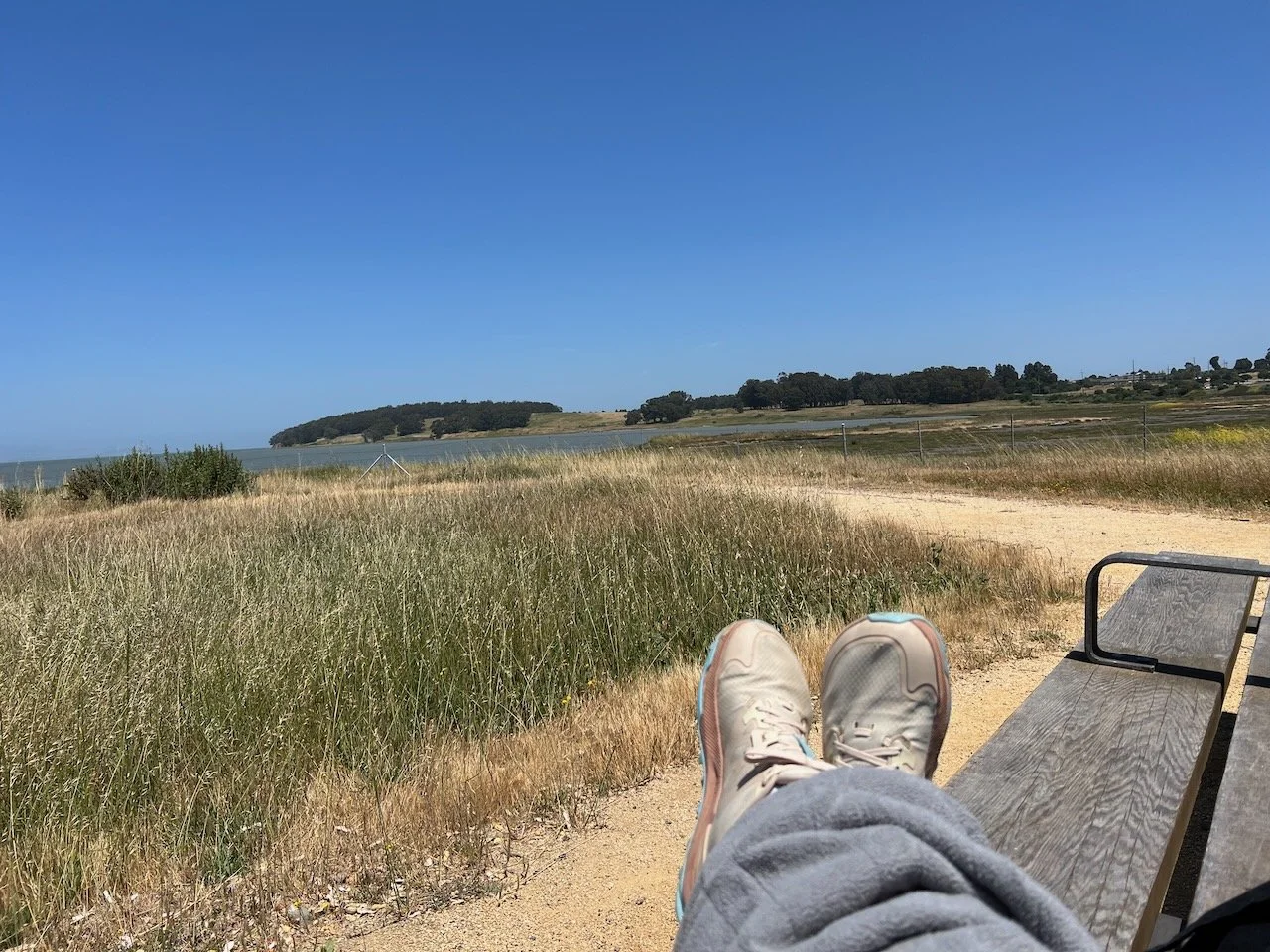
I’ve been laid up. I had knee replacement surgery on May 19th, and was ordered to keep my foot 18” above my heart as much as possible. Other than Tom taking me out for ‘airings’ (that’s me, well-wrapped up and happy watching the shorebirds at Pt. Pinole while Tom had a long walk), completing my daily range-of-motion exercises, and doing some rudimentary gardening, I’ve been following doctor’s orders. I’m starting to feel better, and am hoping that I will be cleared for some walking at my next PT appointment.

I don’t know if it was entirely allowed (don’t tell my PT), but I did harvest the garlic and shallots at the beginning of the month. Tom hung the garlic in the garage (our usual method), and spread the shallots on the front porch bench to dry. It’s imperative, if you want alliums to last a long time, to get them as dry as possible (“cured”) before hanging them inside the house. I expect they’ll be ready for braiding by the end of this month.

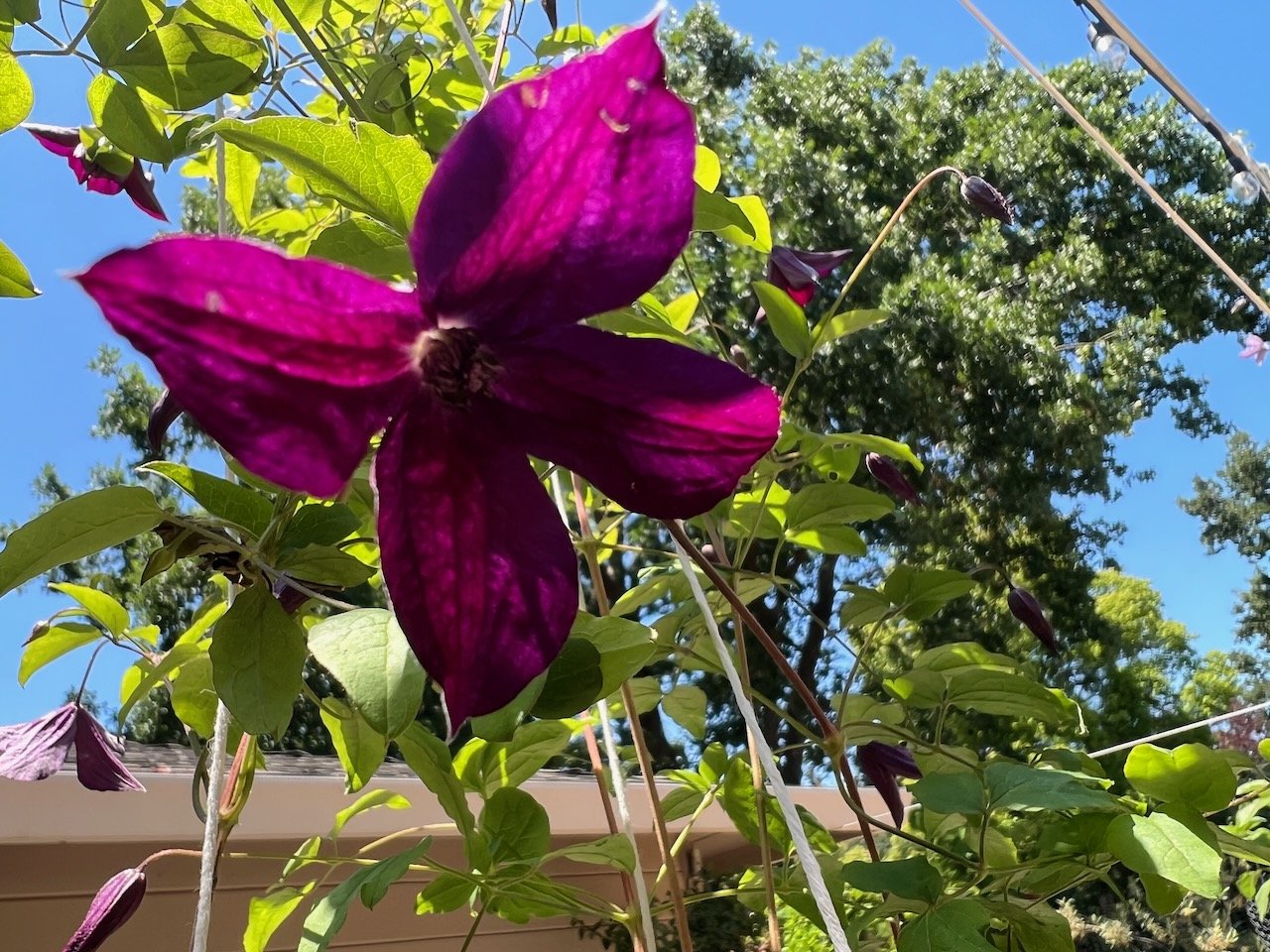
This past winter, we dug up the hops that we used to grow every year in large containers on our back patio, and donated them to my school garden, where they are happily growing up the side of a shipping container. To replace those, I ordered four new clematis vines from Brushwood Nursery, which Tom planted while I was in Georgia. They’ve begun blooming, and every day I spend a few minutes just admiring them. One is yet to open (‘Emilia Plater’), but the other three are so lovely.

‘Arabella’

‘Blue Angel’

‘Black Prince’

We have a family of Cooper’s Hawks in the neighborhood, which are keeping me entertained while I’m resting on the back patio. I’ve also delighted in watching the lizards hunting honeybees below the hive, and swallowtail butterflies foraging in the pollinator gardens. It’s been quite nice to have some time to just sit still and watch, even though my knee aches while I sit there.

All the orchard trees have survived and are thriving. Recently, the persimmon bloomed. We’ve had some windy days and some of the blossoms have blown off. I collected them and arranged them on a table, because they are so beautifully wing-shaped (photo above). I’m not sure I’ve ever seen a persimmon blooming before.

Rin drove me to the garden center (Rin is walking and driving again!) so I could get some bedding plants to refresh some containers. I keep trying different things in the pallet planter, which is in a very hot and dry spot. Nothing ever lasts long. I’ve decided to try portulaca (moss rose) this summer and I hope it survives. I’ve made some pretty groupings of pots in different parts of the yard, and I must say they look really nice. These are the sorts of things I haven’t had time for, since I’ve been teaching. It feels good to spend time in the garden and spread some love. The blueberries and raspberries are coming in, and soon we’ll have tomatoes and peppers and beans and cucumbers!

Tags flower garden, vegetable garden, fruit garden
4 Comments
← Newer Posts Older Posts →

Subscribe

Sign up to get email when new blog entries are made.

We respect your privacy. We're only going to use this for blog updates.

Thank you! Please check your email for a confirmation notice to complete the subscription process.

Powered by Squarespace