• About
  • Blog
  • Contact
  • Favorites
  • Archive
Menu

Poppy Corners Farm

Street Address
Walnut Creek, California
Phone Number
Walnut Creek, California

Your Custom Text Here

Poppy Corners Farm

  • About
  • Blog
  • Contact
  • Favorites
  • Archive

Time to Order!

February 22, 2022 Elizabeth Boegel

It’s time to start thinking about ordering onions, shallots, garlic, potatoes, sweet potato slips, and asparagus crowns. My favorite place to get these items is from Filaree Farms in Washington State. They are an organic operation, and family owned. Everything I’ve gotten from them has been first-rate.
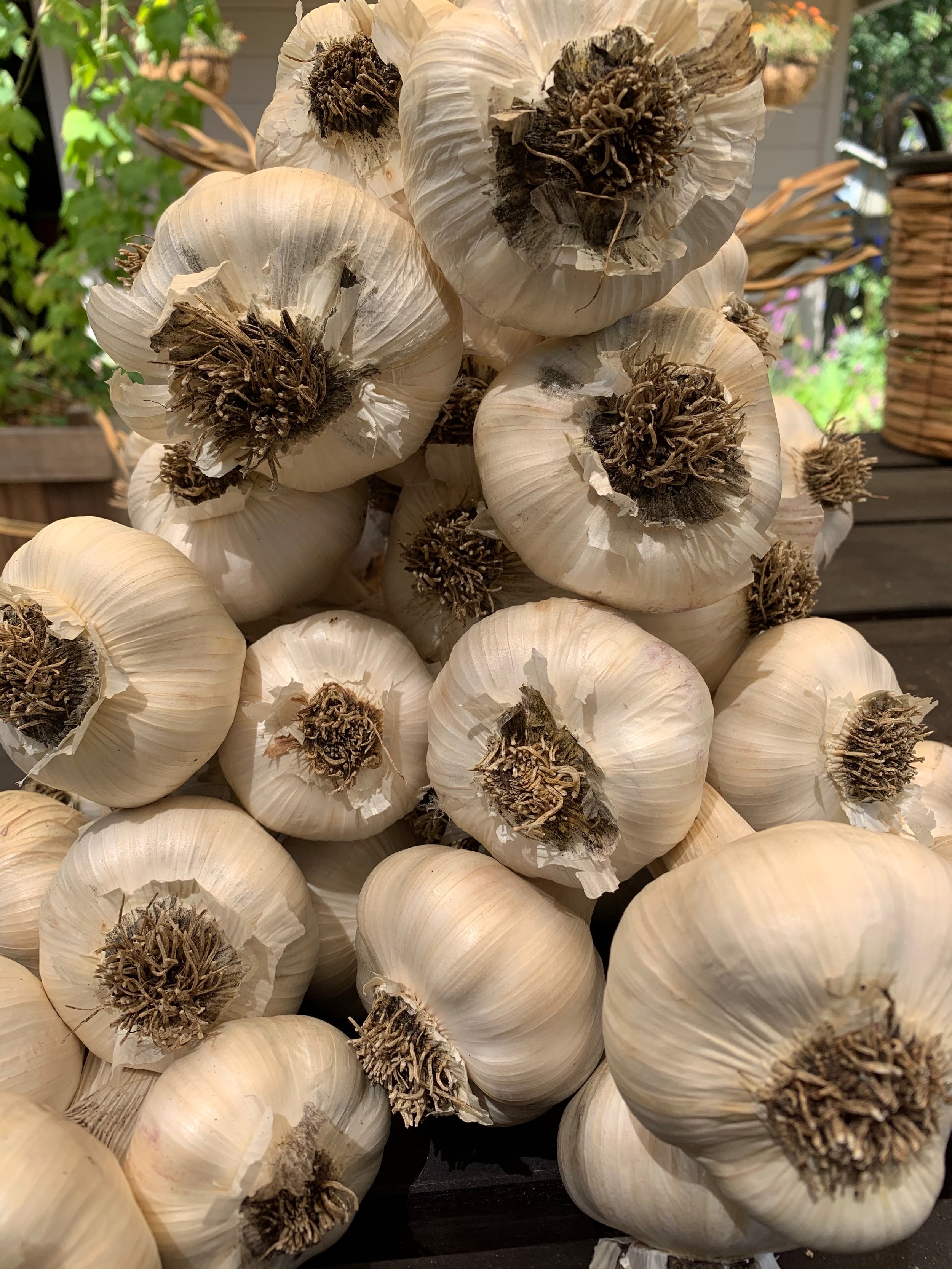
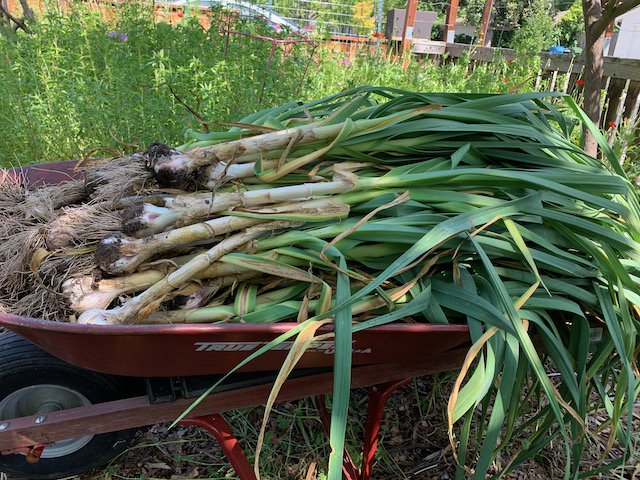
For garlic, my favorite variety is a softneck called ‘Inchelium Red.’ I’ve grown it for the past five years and we love it. It has a strong flavor and a beautiful purple cast to it, and it dries and braids well. It’s also a fairly good keeper, even in our warm dry climate.

I do not grow onions, but I do grow shallots, and like both ‘Dutch Red‘ and ‘French Grey.’ We have had allium aphids quite badly with ‘Dutch Red,’ so I’m going to try ‘French Grey’ again this year and see if we have better odds.
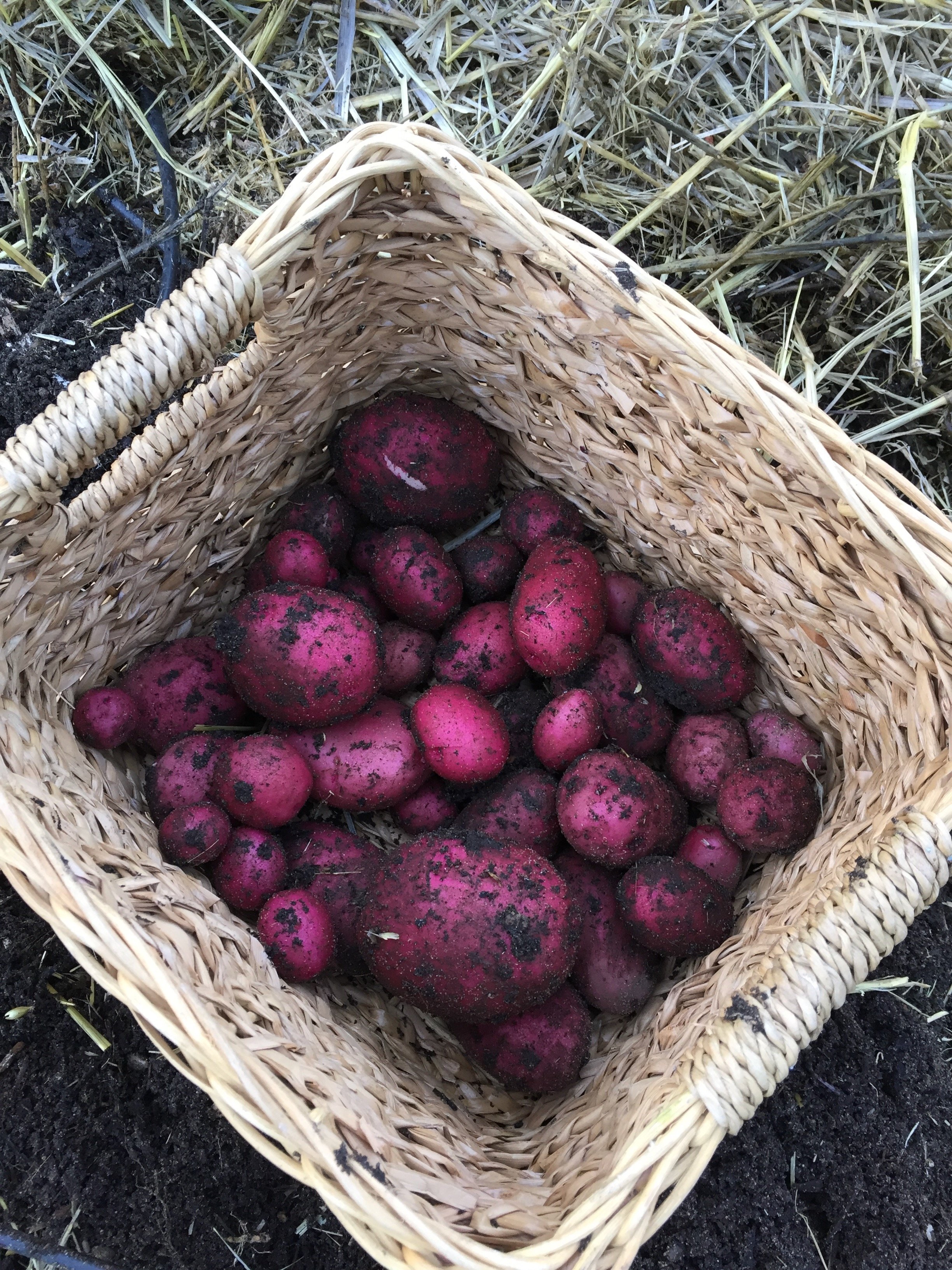
Potatoes come in three different ‘time’ categories, if you will - early season, mid season, and late season. Early season include varieties such as ‘Yukon Gold’ (my favorite). Mid Season include varieties such as ‘Red Chieftain.’ Late varieties include all the fingerlings, and russets. It’s fun to plant 1-2 of each kind, so you have potatoes all the way through summer. Home-grown potatoes really do taste different than store-bought, so it’s worth giving it a try.

Asparagus is a vegetable that takes some patience, as well as a permanent place in your garden. You’ll plant the crowns, which look like little octopi, and then you’ll wait three long years, watching the shoots grow and flower and leaf, before you can start to harvest them. But once they establish, they’ll be in your garden for 15-20 years, which is a very good return on your investment.

Ordering now is recommended, as most growers run out of supply quite early. You might be able to find a local supply, but why not do it now, while you’re thinking about it?
Tags garlic, asparagus, potatoes
2 Comments

Nature's First Green is Gold

February 16, 2022 Elizabeth Boegel

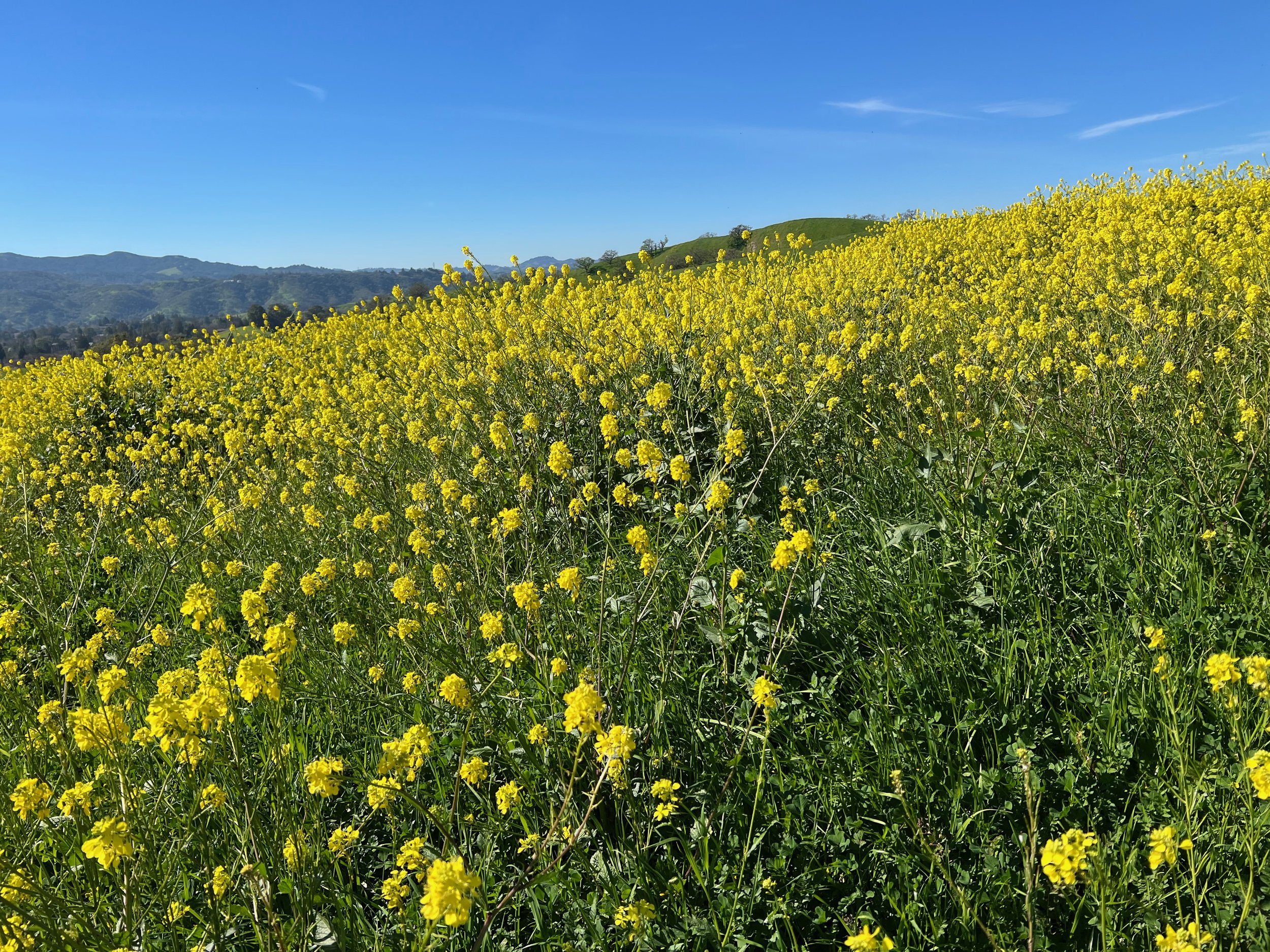
Wild Mustard

If the poet Robert Frost is to be believed, anyway! I am not sure I agree, however, that gold is “her hardest hue to hold.” Certainly, gold flowers are abundant in early spring, and I can’t help but wonder… why?

Narrow-leaved Mule’s Ears

My instincts tell me that it is something to do with the pollinators that are emerging from hibernation at the same time. As soon as daytime temps start to reach 50 degrees (F), native bee queens will start to come out from their cozy winter dens.

California Buttercup

Right now, our hikes are simply overflowing with yellow flowers, no matter where we choose to walk. And this past weekend, Tom and I were lucky enough to witness a miracle of nature on the Burma Road Trail on Mount Diablo, not far from Castle Rock.

Fiddlenecks

There are 1600 native bee species in California, and I have no idea which one this was. They were emerging from holes in a section of the trail that was made of clay and sandstone, quite hard-packed and dry. There were hundreds of bees flying just above the surface of the path, in a frantic circular pattern. We stopped to watch, and then Tom saw a head emerging from a tiny hole in the path. We watched as a female bee dug out the rest of the mud from the entrance, then crawled out. Immediately a male bee pounced on her and mated with her for several seconds. This pattern repeated itself over and over as we watched, and we realized that the males had emerged first, and had been flying over the path just waiting for the females to show themselves.

California Golden Violet

As you can imagine, we were entranced and delighted. Our online searching has not turned up the name of this bee species, but we are hoping one of our readers might know and will share in the comments. Meanwhile, I wondered: Have certain types of native bees evolved to exit hibernation at the same time as the native plants with yellow flowers bloom?

California Poppy

I’ve looked at several studies now, and while it is true that color is what makes flowers stand out to pollinators from a distance (something is needed for the flower to stand out from the field of green), it’s the un-seeable-by-human-eyes UV patterns in the centers of each flower that attract the bee in to the pollen (and nectar). Yellow flowers do attract pollinators, but so do white flowers, and blue flowers. And pollinators are opportunists; they’ll eat whatever they can find, especially in a Mediterranean-dry climate where winter rains promote flower blooming.

Sticky Monkey Flower

In other words… no one really knows.

Western Wallflower

It’s good to have some mystery in life. It’s good to ask questions for which we do not know the answer. It’s good to ponder these mysteries and let them delight us.

Glue-seed

And it’s especially good to get out into the lovely late-winter sunshine and see what’s blooming… and what’s buzzing.

Tags pollinators, natives
Comment

A Tale of Two Garlics

February 1, 2022 Elizabeth Boegel

Or rather, a Tale of Two Garlic BEDS.

This year, I didn’t plant as much garlic as I have in years past. The kids are both at college, and while Tom and I are very fond of garlic and cook with it nearly every night, making two portions rather than four has changed my planting schemes considerably (for every crop, not just garlic). I decided to put the garlic in our two fire-ring beds this winter and see how it worked out.

Last summer, one of these beds held basil (a riotous overflowing abundant crop of basil!), and the other held cilantro - which grew, then quickly flowered, and set seed, as cilantro tends to do. Last winter, both of these beds held sweet pea flowers.

I planted the garlic cloves in both beds at the same time this past October. Both get the same amount of drip irrigation. Both have very similar conditions regarding sun exposure, particularly in winter when our chitalpa tree loses its leaves. But the garlic crop in one bed is much greener, and much further along, than the other.

The top bed held the basil, which I either harvested before it had a chance to set seed, or did set seed but hasn’t germinated, because it simply can’t in cold temperatures. The bottom bed has its third or fourth crop of cilantro at this point, because it definitely set seed, and it can germinate well in cooler temps.

The cilantro bed not only looks prettier, full and abundant and rich, the garlic is also further along, taller and greener than the basil bed. The soil in this bed is also darker and richer than the soil in the basil bed.

What’s going on here? It’s all down to the wonderful synergy that happens when two or more crops grow together. One might think that the garlic growing alone would do better - after all, it has no competition for nutrients, light, or water - but that’s obviously not the case.

The bed with both garlic and cilantro is doing so well because the two species are sharing resources. Mycelium (strands of fungi) are connecting between the roots of the plants, and are shuttling resources between the two. Even more importantly, the garlic and cilantro are feeding two different colonies of microbiota in the soil. Each is photosynthesizing and pumping sugars down through their root systems to feed all the microscopic critters, and that means double the food. It’s also likely that specific species show up to eat from the roots of each kind of plant. It’s a beautiful symbiosis that results in TWO great crops, rather than just one.

My guess is that I’m going to be able to harvest the garlic that is growing with the cilantro earlier than the one in the old basil bed. It will be interesting to see if my hypothesis is correct.

Tags garlic, vegetable garden, cover crops
1 Comment

Hope in Ordinary Time

December 30, 2021 Elizabeth Boegel

I’ve been doing a lot of thinking about the coming year. I don’t make resolutions, but I do frequently make goals. And I always try to have an overarching theme that guides our year, both in and out of the garden. Last year, our theme was ‘resilience.’

The week between Christmas and New Year’s Day, Tom is home from work, and we have been able to go on long walks together (often in the rain, which we stoically bear without complaint since it is so needed - and as a bonus, it makes us walk faster). Our conversations during these walks have been interesting; as often happens, our goals and ideas for the approaching year complement each other and converge nicely.

As the world and its circumstances seem determined to break our spirits, I like the idea going in the complete opposite direction and cultivating a robust attitude of hope. It’s a tall order. How do we hope - and I mean actively hope - in the face of all that’s wrong around us? What does this kind of active hope look like? What form does it take? How does it express itself?

Similarly, as the world and its circumstances seem determined to whirl ever faster, threatening to throw us into a tailspin, Tom has decided to concentrate on slowing time down. He’s wondering how to count each day, and each moment. How to be truly aware and truly living, dwelling, not just somehow glossing over time, quickly on the way to the next thing.

These ideas reminded us both of the liturgical season called ‘Ordinary Time.’ In the church, part of the year is made up of the major seasons of Advent, Christmas, Lent, and Easter. During these times, life is full of flashy events and excitement! But then there is the time of year when none of this taking place. It’s ordered time, ordinal time, ‘ordinary’ time. Some say that Ordinary Time is the perfect season for conversation, growth, and maturation. It can also be a time where we allow the mystery of life to deeply penetrate our consciousness.

Ordinary Time does not have to mean tedious, or repetitive, or dull. Certainly it can be these things too, but the idea is to make all time matter in some higher way, even if it’s not exciting. What is the gift in an ordinary life? What can simplicity teach us? When the theatrics are over (and let’s face it, we’ve all been living in a heightened state for quite some time now), what are we left with?

Could it be… hope?

So that’s our goal for 2022. Cultivating hope while learning to live consciously in the present, in ordinary time.

We look forward to more of these kinds of conversations in the coming year, whether they concern the garden or just our lives. Thanks for spending time with us. We wish you all a very peaceful and happy New Year!

Tags goals
10 Comments

Summer in December

December 1, 2021 Elizabeth Boegel

Here’s a happy honeybee aiming towards a fully-opened sunflower on the first day of December in my garden. It’s been chilly at night, but the daytime has been beautiful and warm and in the 70s. Yes, this is unusual. Yes, this concerns me. But I must confess it also delights me. I am enjoying the summer blooms in my garden, and the warm afternoon temperatures which are perfect for walking. I think it’s important that we remember to be present, whatever the moment gives us. I can be worried about our place on this planet and happy to bask in the afternoon’s slanted glow. Environmental work can be draining, so let’s take the joy where we can.

The cover crops in my garden also include, at the moment, cosmos. And borage, cilantro, buckwheat. I used our homemade compost to top off these beds, and the seeds that didn’t die in that pile have germinated and are flowering freely. It’s all good. A cover crop can be any crop, and it’s all improving the soil.

A side benefit to these sunflowers growing this time of year is that the goldfinches leave them alone. In summer, my sunflowers are always decimated, the leaves eaten down to the veins. This means the plant can’t photosynthesize and can’t bloom properly. Why don’t the goldfinches do this in winter? It could be that they don’t need greens this time of year, requiring only protein and fat to prepare their bodies for laying eggs. It could also be that most have migrated for the season, and the ones I see around the bird feeder are too few to do much damage.

Hey, maybe I’ll only grow sunflowers in the autumn and winter from now on.

Happy December, everyone.

Tags climate, flower garden, birds, cover crops
4 Comments
← Newer Posts Older Posts →

Subscribe

Sign up to get email when new blog entries are made.

We respect your privacy. We're only going to use this for blog updates.

Thank you! Please check your email for a confirmation notice to complete the subscription process.

Powered by Squarespace