• About
  • Blog
  • Contact
  • Favorites
  • Archive
Menu

Poppy Corners Farm

Street Address
Walnut Creek, California
Phone Number
Walnut Creek, California

Your Custom Text Here

Poppy Corners Farm

  • About
  • Blog
  • Contact
  • Favorites
  • Archive

Consistency

July 15, 2021 Elizabeth Boegel
The North Garden, which counterintuitively gets the most intense, direct afternoon sun. Note the new shade cloth above.

The North Garden, which counterintuitively gets the most intense, direct afternoon sun. Note the new shade cloth above.

The South Garden, which (also counterintuitively) gets mostly morning sun, due to middle-day shading from large trees.

The South Garden, which (also counterintuitively) gets mostly morning sun, due to middle-day shading from large trees.

According to the Oxford Dictionary, consistency is “conformity in the application of something, typically that which is necessary for the sake of logic, accuracy, or fairness.”

Consistency is something with which we struggle in our garden, even in normal years.

But what is a normal year? We haven’t had one of those for a long time now. We in the outer SF East Bay have experienced wide temperature swings. For example, last Saturday, according to our weather station, the high was 112.8 degrees (F) in our North Garden at 2:45 pm; by Wednesday morning at 6:15 am it was 53.8. it’s normal to get cool here at night due to the influence of the Pacific Ocean, but a 59 degree difference is extreme even by our standards.

And rain? Well, I’m sure you’ve heard about the lack of it; here in Walnut Creek, our local city weather station has recorded 5.98 inches this year. For comparison’s sake, let’s look at Springfield, Missouri, a city a friend of mine lives in. He’s been dismayed by the amount of rain they’ve had this year, but in actuality, it’s five inches less than in “normal years” - 2021 has recorded a total of 31.8 inches since January 1. We won’t get rain again until November, if we are lucky. Springfield will have regular rain through the rest of the year.

Living in a Mediterranean climate, we expect less rain. But we do expect about 3-4 times the amount we’ve had this year.

The combination of these heat and precipitation inconsistencies has resulted in a pretty terrible die-off in our food garden.

Dead pepper

Dead pepper

Dead tomato

Dead tomato

Blossom end rot. It’s on every single one of my tomatoes, regardless of variety. This is because when it’s over 100 degrees, I water them twice a day instead of just once, and tomatoes like consistent water. But otherwise they would have all died, and I just couldn’t let that happen.

Blossom end rot. It’s on every single one of my tomatoes, regardless of variety. This is because when it’s over 100 degrees, I water them twice a day instead of just once, and tomatoes like consistent water. But otherwise they would have all died, and I just couldn’t let that happen.

Crispy hop bines

Crispy hop bines

Crispy blueberry bushes

Crispy blueberry bushes

Screen Shot 2021-07-15 at 10.46.36 AM.png

This last image is from drought.gov which is updated every Thursday. In the Bay Area, we are now in Exceptional Drought conditions. Our governor has asked for a 15% voluntary water reduction from all residents (I’m not sure what companies have been asked to do). As a family, we had to have a discussion: Which water will we give up? We’re pretty good about our consumption in the house - we have only one toilet, and it’s low-flow; we have one shower, and we’re good about keeping our time in there short; we have a dishwasher and it’s energy-and-water-efficient (which saves a ton of water over hand-washing); and our laundry washer is a tiny front-loader, which uses a lot less water. Our one big water ‘expense’ is the garden.

Unable or unwilling to let the garden die after investing work and expense to establish it, we decided that our first plan of attack would be toilet flushing. If we “let the yellow mellow” and “flush only the brown down,” we can save the 15% that has been asked of us. It’s an easy fix…. for NOW. Soon, we are going to be asked to reduce even more, and then, well, I’m going to have to make some hard decisions.

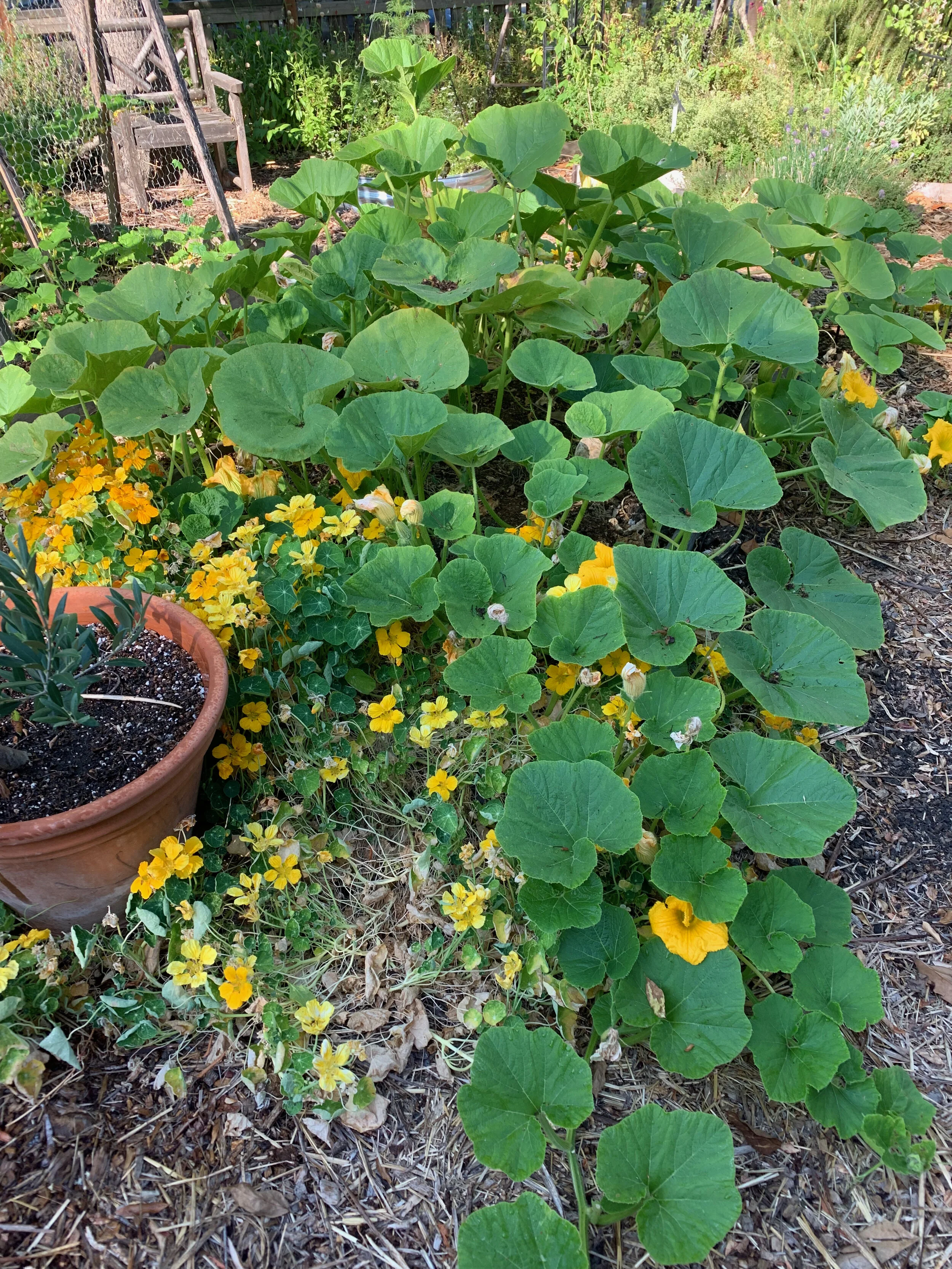
I have noticed that many things in the garden are doing well, despite the inconsistencies, and it’s no surprise which ones.

Basil, and other Mediterranean herbs
Basil, and other Mediterranean herbs

Pumpkins

Pumpkins

Winter squashes

Winter squashes

Native plants, like Toyon…

Native plants, like Toyon…

… and manzanita

… and manzanita

Despite the fact that I believe I’m saving the state water by growing my own food rather than buying it at the store (consider the amount of water farms use, the amount of energy used to get the food to the store, the amount of energy I use to get myself to the store), I am now convicted that I cannot continue to grow in the way I always have. The climate is changing and even if we stop worldwide global emissions today, the effects from it are going to last for hundreds of years. This means I need to figure out how to garden for the future, not the past.

Let’s go back to that definition of consistency, which included “that which is necessary for the sake of logic.” Logically we know that the weather is only going to get more extreme as a result of climate change, so therefore it doesn’t make sense to continue doing the same things and expecting to get the results we used to get. It’s time to rethink how and which things to grow in our gardens. What does that look like? It means a slow transition (because it’s going to take both effort and money to make this change) in our yards and in our diets. We may have to choose perennial veg and fruit over annuals. We’ll have to be religious about mulching or growing plants more closely together to shade the soil. We might have to grow more at certain times of year, like spring and fall. rather than summer and winter. We’ll have to get even better at preserving what we grow for the lean months. We might even have to eat things we don’t particularly like, which might be the biggest shift of all.

Over the next year, I’m going to get serious at looking at my property in a new way, with a focus on what the next five years might look like, and make changes accordingly. I suggest you come along with me for the ride. Let’s do our part to usher in an even more conscious type of gardening, one that looks to improve our future.

Tags environment, west coast, water
6 Comments

Solar Power

July 5, 2021 Elizabeth Boegel
IMG_7207.jpeg

This post will be a bit unusual, as both of us will chime in.

From Elizabeth:

In May, we were finally able to have solar power installed on our house. We used a local electrical company called Got Watts? and we were beyond satisfied with their services. The initial paperwork took a couple of weeks, the actual installation took two days, and PG&E (our local power company) took over a month to finally give us permission to operate. It’s been operating now for a couple of weeks, and we have an app on our phones that shows us how much power we are producing, consuming, importing, and exporting; the data is starting to stack up and that shows us further ways we can increase our energy independence.

I want to be totally transparent about our process and our feelings about it, so that you can determine if this is the right way for you to move forward. I believe that solar is something we will all eventually have to embrace and install on our homes, so the more we know, the better. First, the money side of things: The cost is still prohibitive, and though in California there is a tax break that will fund about 20% of it, it is still an absurd out-of-pocket expense. We paid over $20,000 for this system, which included a new electrical box (ours was from 1949 and did not have the capacity to handle the new 7680 watt PV system). This also included all permitting, and a discount because we paid in full by check. We used an inheritance from Tom’s parents to pay for the bulk of this. If we had not had that money, we would have been saving for a much longer time. To me it is clear that solar needs to be subsidized by the government so that it is viable for everyone. I am aware that this would be an enormous amount of money for the government to provide. We can argue about the true cost of climate change another time.

As for my philosophy, I do not think that solar alone is going to meet the world’s electricity needs, especially as global temperatures increase and those in the hottest, most humid environments begin to feel the health effects of it. We will need everything at our disposal to provide power - that is, everything EXCEPT fossil fuels. If we cut out oil and gas, what’s left? Wind, solar, existing hydro (although with the water crisis in the west, that is becoming a fragile technology), and nuclear power. We will also need a way to store power when it is not being produced, in the form of bigger, more efficient batteries. Our home system does not have a battery for back-up power, because it would have doubled our price and we simply could not afford it. Plus, it wouldn’t have been able to store much more power than what it would take to run our refrigerator for a day. When the technology improves and the price drops, we will consider adding a battery for back-up.

The solar industry also has its share of problems. The process of making solar panels is a dangerous one; it uses many chemicals which are hazardous to both the people working on them and the environment when they are discarded. We currently do not have good battery recycling in place, and that is an urgent need. However, as I’ve often said, we have to begin now to make better choices. They may not be perfect choices, and there are trade-offs to everything, but we will continue to make even better choices as they become available.

With all of this in mind, here is some data for you to consider. Below is a typical day for us, one in which we are not charging one of our electric vehicles.

IMG_7811.jpeg

You can see that the bulk of the power is generated in the middle of the day, just as you’d expect. However, we are consuming small amounts of power over the course of the day, leaving quite a bit of the midday-generated power to go to the grid; alternatively, this means that we are buying power from the grid at the times we are not generating it. This particular day, though warm, was not hot enough for us to use air conditioning. On this kind of day, I figure it’s all a wash - the good we are doing for the grid at large, evens out our usage at times when we are not producing.

But - what happens when we plug in our electric cars to charge overnight? We have always charged our cars at night because it costs us less money to buy electricity at that time (and, we’re not using them at that time). Here is an example of that sort of day.

IMG_7812.jpeg

You can see that we are needing to pay to import energy from the grid overnight. This is one of the big challenges with solar, or many other kinds of renewable sources of energy – absent some kind of storage solution, you need to align power generation with power consumption every minute of the day.

From Tom:

One of the questions we’ve wondered is whether it would make sense for us to shift our car charging pattern to more closely align with the solar generation pattern (assuming that having a car plugged to charge in the middle of the day is logistically feasible). Like many questions, the answer is complicated, and depends on your frame of reference.

To look at it from an economic standpoint, we needed to look at the way PG&E is charging us for power and crediting us for power that the solar system is generating above what we’re consuming. After downloading our usage data and working through some spreadsheets, we’ve come to the conclusion that aligning our car charging with the solar generation (vs. overnight) probably doesn’t make much of a difference, and we might actually make out a little bit by charging it overnight.

Our usage data shows that our cost per kWh from PG&E is the same as the credit per kWh that we get when our panels are producing more than what we’re using. Those rates vary by time of day — right now, about $0.18 per kWh between midnight and 3PM; about $0.36 per kWh from 3-4PM and 9PM-midnight, and $0.46 per kWh from 4-9PM. Since most of our solar power is getting generated between 8AM and 4PM, we’re getting credited at about the same rate as we’d get charged if set the cars to charge between midnight and 7AM. We might make out a little bit charging in the early morning, and then selling back to PG&E at that higher 3-4PM rate, but that’s not a big difference.

Even though the time of day we choose to charge our cars is probably an economic wash, there is something that feels odd about charging the car when our panels are not generating power. Is there an environmental impact? Charging our car overnight means that we’re pulling power from the grid, with whatever sources of electricity the grid is using at that time. While we talk about getting our power from PG&E, technically we’re getting our power from MCE Green Energy, which means that 60% of the electricity is getting generated by renewable sources (solar, wind, hydro), but with our overnight charging pattern, it’s likely that the electricity we’re using is getting generated by hydro and some set of non-renewable sources. If we were to charge our car midday, we’d know that a bulk of the electricity to charge it comes from our solar, as opposed to those other sources.

All told, at this point we’re going to keep our overnight car charging pattern. This research has led us to a slight adjustment (starting charging at midnight instead of 10PM), so that we can avoid the higher 9PM - midnight rates. There’s also the convenience of charging the car when nobody is looking to drive it.

Of course, we’re also only about a month into this. It’ll be interesting to see how our electricity generation and usage varies over the course of the year.

From Elizabeth:

What I’ve realized, and may seem obvious to many of you, but it certainly wasn’t to me, is that the power we are generating from our solar panels isn’t coming directly in to our house. It goes into the grid. If we were on a homestead somewhere, and we were not connected to any municipal power company, then we’d have our appliances connected directly to the solar panels. At night, lacking a battery stack, we’d have to use candles or oil for light, and a wood fire for heat (also not terribly sustainable). Because our house was built to be connected to the grid, the power we generate goes into the grid. We are still buying all the power we need; however, we are earning back the same rate for the power we generate.

This feels a little disappointing. We are not energy independent. If PG&E decides to cut the power in order to curtail the chance of a fire on a very hot, dry, windy day, then our power will be cut, too. If a terrorist attacks our power grid, we’re going to be out of power just like everyone else.

However, the good news is that we are contributing. The amount of power we generate using the sun replaces power that is being generated by other sources. Here in California, a lot of our power is provided by solar, wind, and hydro plants, but we do also use a lot of natural gas and nuclear for electricity generation. Here is recent data from EIA (US Energy Information Administration):

Screen Shot 2021-07-05 at 8.22.50 PM.png

For information about your own state, you can visit EIA to determine how your electricity generated. HERE is the link.

This whole process has been an interesting one. We have learned a lot, and still have more to learn, but I hope our experience will help you make a more informed decision when it comes time for you to consider your own energy footprint.

Edit 7/13/21: Got a summary from Enlighten for the second half of June, and thought this was interesting:

Screen Shot 2021-07-13 at 5.28.23 PM.png


Tags environment
4 Comments

Sometimes We Make Mistakes

June 14, 2021 Elizabeth Boegel
IMG_7637.jpeg

Yesterday, I went out at 6 am to release the chickens, as I do every morning, when I realized that there was something wrong. A juvenile opossum had become caught in one of our rat traps. Her right front paw was held fast by the trap, and it seemed clear that she had been there for several hours.

I went inside and woke up Tom, and after donning heavy leather gloves, we managed to free her and house her temporarily in a cardboard box. I called our local wildlife rescue (Lindsay Wildlife Experience), and while they are usually open every day for this sort of emergency, they were actually closed. I left a message, not knowing what else to do. Within an hour, one of their volunteers had called me back to tell me where to take the opossum (a local animal hospital was taking Lindsay’s patients that day). Tom and I were able to drop the opossum off and I hope they can fix her mangled right paw and eventually release her into the wild again.

IMG_7654.jpeg

As you can imagine, we felt simply terrible about all of this. We thought we had found a sustainable way of reducing the populations of non-native rats in our garden and had designed the traps so that only rats could get in. We did not even think that an opossum would be interested in bird seed (they usually eat dead or rotten things), and certainly didn’t think about a baby opossum being able to access the trap. We thought we might eventually get a squirrel by accident (it seems they can get in any space no matter how well protected) but we weren’t too concerned about that, since non-native squirrels are quite prolific here and thinning them out might not be a bad thing. But we never considered anything else getting in.

The truth is that sometimes we make mistakes. We can have the best intentions in the world and still mess up.

I get a lot of questions from clients and readers of this blog who are agonizing over choices in the garden, such as how much to water, or what to plant, or whether to use fertilizer, or any of a hundred other things. I can give you advice, but honestly my advice isn’t worth very much. What is worth so much more is your own lived experience. This is all experimental. What works in my garden may not work in yours. Your soil may be different, or your exposure, or the way you plant a certain thing, or the seeds you use - there are a million different variables. The only thing we can do is try, and hope nothing gets hurt. And still, sometimes, as in our case with the opossum, something does get hurt. That doesn’t mean that we shouldn’t always try to do better, or to try at all. The trying is so important. And as we learn, we try different things, and then we learn some more.

I want to say the same thing about climate change and our reaction to it. Gosh yes it’s getting dire, and something on a large scale must be done, but there are a million personal choices we make every day that either affects the environment in a positive way or a negative one. Then there are a million more that might be only slightly positive, or the positive bits only slightly outweigh the negative. Does that mean we stop trying? Absolutely not. We must keep trying. Every day. To make the right choices and to tip the scale in the right direction.

We’ve removed all the rat traps. It’s just not worth harming an innocent creature. I will continue to do what I can to dissuade the rats from hanging out in our yard - things like removing the chicken food from the coop at night, and netting our vegetables. I will hope that the predators expand their numbers and realize that there is good food running around in our garden. I will hope that nature balances things out, without any ‘help’ from me, which is the way it really should be. And I’m going to keep experimenting, and keep learning.

Tags mistakes, wildlife
Comment

New Things

June 7, 2021 Elizabeth Boegel
IMG_7368.jpeg

There’s some new things going on here at Poppy Corners, and I think an update is warranted.

First up, my summer class has begun. I’m taking “The History of Environmentalism in the US and California,” and so far, it’s quite interesting, although I’m only in the second week.

Secondly, I have accepted an internship with a non-profit organization in Oakland called Friends of Sausal Creek. My job title is ‘Communications and Community Education Intern,’ and I’ll be working on things as varied as the monthly newsletter, restoration projects, updating the website, and leading school field trips (when they resume). Friends of Sausal Creek works to restore, maintain, and protect a watershed which runs from the hills of Oakland all the way down to the San Francisco Bay. For more information about this excellent organization, visit their website here. The picture above accompanied my introduction in the newsletter.

IMG_7378.jpeg

The summer garden has really taken off in June, with the arrival of some hot weather and warm nights. We’ve even eaten our first hot peppers of the season! I’ve done some succession planting with annual herbs and cucumbers, and will do so with beans, as well, this week. The tomatoes have lots of blossoms, so I’m looking forward to that first end-of-June cherry tomato.

IMG_7384.jpeg

And it’s soft fruit season, with berries coming on every day. It’s delightful to have an assortment with our dinners each night. My raspberries in particular have taken off this year, and have put out runners all over that side of the garden. I’m going to have to figure out how I want to manage them in the future. A thicket, while in theory sounds great, will be hard to maintain easily as raspberries are thorny.

IMG_7400.jpeg

Rin has graduated from high school, and I loved this bit they contributed to the last issue of the school newspaper. It echoes my own feelings about being a student, and the ways in which I best learn. Perhaps you can identify with this as well.

We are very excited for Rin’s matriculation at Savannah College of Art and Design in the fall. It seems the perfect fit for them! We are so proud we could burst.

IMG_7370.jpeg

Adam is home from Cal Poly (for now); he’ll be going back and forth to San Luis Obispo this summer, as he is renting a house with two other students, and they have planted a new garden in the backyard. It’s pretty fun to be sharing gardening knowledge with him. I expect he will soon surpass me, just as he has done with cooking and music.

Tags vegetable garden, fruit garden
8 Comments

Who's Eating the Eggs?

May 25, 2021 Elizabeth Boegel
IMG_7294.jpeg

Almost every day these past two weeks, when I go out to put the chickens up for the night, there is an egg that’s been eaten. Nothing left but some slime, maybe a bit of shell. The other eggs are untouched - beautiful and perfect (if sometimes a little dirty).

If I make an effort to go out and collect them during the day, nothing has been eaten - so this event seems to happen at dusk. We wondered: Was one of the chickens getting into the habit of eating the eggs? And if so, why was the shell also gone? Would they eat the entire thing?

I had definitely been noticing some rat activity in the coop, especially around dusk. I no longer keep the chicken food in the coop - I keep it out in the run, so that if a rat wants it, they’ll have to brave being out in the open to get it (owls and hawks, where ARE you???). At night, I bring it inside. I keep the water outside in the run at night, too, though it’s in the shady part of the coop during the day. I decided that it was rats eating the eggs. They were crawling up the ladder (a flat piece of wood, basically) into the coop and gobbling it up, right before the chickens started making their way up to go to bed. The chickens don’t really use the ladder - they fly in and out of the coop instead - so I removed the ladder entirely. This seemed to stop the egg problem and I was patting myself on the back.

Then one night I waited until later than usual to go get the eggs and shut in the chickens, and darn it! An egg eaten. My working hypothesis was, and still is, that rats had figured how to get up into the roost without the aid of the ladder. They are canny little buggers.

However….

IMG_7283.jpeg

I found this in the coop this morning. Not up in the roost, but down on the ground, dead. Stretched out to its full length, it was probably about a foot. So a small snake, then, and it had clearly eaten something before expiring.

You may recall that we found a sharp-tailed snake under a brick in our garden last year. I believe this dead snake is the same kind. To be sure, I wrote to Gary at California Herps and asked for verification. He’s always so responsive and helpful when I have a lizard or snake question. Here’s a copy of our conversation:

Me: Hi Gary, I found this snake dead in our chicken coop. If stretched out, would be about a foot long. The only snakes I have ever seen in our garden are sharp-tailed. Do you think this is also a sharp-tailed?

Gary: Hi Elizabeth. From the size, the scales, the tail, what look like dark bars on the underside, and your past history, it could be a sharp-tailed snake. There are three other species of similar-looking small snakes in your area, but they don't have the blunt tail with a sharp tip that this one appears to have. All of them eat small invertebrates and small mammals but I don't think any of them would pose a threat to your chickens. The larger snakes in your area - gophersnakes, rattlesnakes, whipsnakes, racers, and kingsnakes - might try to eat chicks and maybe eggs, but I don't think they would try to eat adult chickens.

Me: Thanks Gary! I really appreciate your expertise. I’m not worried about the chickens, but we have had something predating on the eggs.... I can’t imagine this little guy could have managed that though. I assumed he was eating slugs. We also have some huge rats, so I would very much like some bigger snakes in our garden! I’ve been trying to attract them for years, so it’s exciting to see some activity finally.

Gary: The subject of the possibility of snakes in California preying on chicken eggs came up recently when I read an article about a rat snake in the east that ate a golf ball that was put in a chicken coop to encourage egg laying. There are no rat snakes in California, but gopher snakes and California king snakes have been known to eat birds eggs and chicks, and could probably prey on chicken eggs.

IMG_7285 (1).jpeg

Well, as you can imagine, I found that exchange fascinating. I still don’t think this little guy is eating the eggs, but WHY was it in the coop? And what WAS it eating (could it handle baby rats???)? How did it die? And are there other snakes in our garden that I’ve just not seen? As usual, the answer to a question begets more questions.

Time to set up the wildlife camera in the coop, to record both day and night. We can answer a few questions that way, one of them being, who is eating the eggs? I love a good mystery.

Tags wildlife, chickens
4 Comments
← Newer Posts Older Posts →

Subscribe

Sign up to get email when new blog entries are made.

We respect your privacy. We're only going to use this for blog updates.

Thank you! Please check your email for a confirmation notice to complete the subscription process.

Powered by Squarespace