• About
  • Blog
  • Contact
  • Favorites
  • Archive
Menu

Poppy Corners Farm

Street Address
Walnut Creek, California
Phone Number
Walnut Creek, California

Your Custom Text Here

Poppy Corners Farm

  • About
  • Blog
  • Contact
  • Favorites
  • Archive

Homemade Garlic Powder

February 15, 2021 Elizabeth Boegel
IMG_6288.jpeg

2020 had one thing going for it: We had an absolutely perfect garlic crop. I had finally perfected our method of growing garlic and it yielded beautiful, plump garlic bulbs, with juicy, succulent cloves. We’ve enjoyed it fresh ever since we harvested it. But then it did what garlic naturally does after a certain amount of time - it began to bolt and grow. We don’t have a root cellar, so storing garlic in ideal temperatures/humidity is just not possible for us; eventually it’s just going to turn, and there’s nothing to be done about that.

Garlic that has bolted (started sending up new growth) is still safe to eat, as long as the cloves are still firm. However, you need to cut out the growing shoot before using it, as that part will be bitter. Also, inevitably, the shoot will use up all the sugars in the clove, leaving it mushy and tasteless. So it’s a careful dance, knowing when to stop using your garlic harvest.

We knew that we wanted to get ahead of the mushy-clove stage, so this past weekend, we made garlic powder with the remaining bulbs. I cut down all five of the strings of garlic still hanging over the piano. I kept two big bulbs to try another experiment; planting them now, in pots, to see if I can get a fall crop of garlic on top of our already-growing spring crop (planted last October). I’ll let you know how that goes. I also removed the firmest two heads and popped them in the fridge, hoping to halt their growth and allow them to be used in cooking a bit longer. The rest of them were separated into cloves, shaken together in two identically-sized cake tins to remove their skins, and then sliced in half to remove the growing shoots.

IMG_6296.jpeg

Then, the cleaned cloves were put into the food processor in batches and chopped up. We spread the mixture on dehydrator sheets and dried it for about 20 hours. I wish you could have smelled our house while that was happening. Truly, I felt like we were in the middle of some kind of spice factory. At first, it was so strong, it made our eyes water; after a few hours, the scent changed to something sweeter and mellower, but still plenty strong. It’s a really good thing we had already planned on Italian for dinner, as this smell fitted right in!

before drying

before drying

after drying for 20 hours

after drying for 20 hours

After that, it was just a matter of peeling the dried puree off the sheets and popping it into our dedicated spice grinder. It ground up beautifully into a soft, creamy powder, and yielded an entire pint! That’s enough powdered garlic to see us through a year, at least.

IMG_6304.jpeg
IMG_6305.jpeg
IMG_6307.jpeg

This project took a lot of time, but we are so glad we were able to use up the rest of our beautiful garlic harvest in a sustainable way. It feels right, and honors the time, money, and effort it took to grow the crop in the first place. Nothing is as rewarding to grow as a staple like garlic, which is used so often in our cooking.

Have you ever dried your garlic crop? Have you ever planting sprouting cloves in the spring for a fall crop? If so, I’d like to know how your efforts turned out!

Tags garlic, projects, preserving, vegetable garden, herb garden
2 Comments

I've become THAT lady

February 7, 2021 Elizabeth Boegel
IMG_6251.jpeg

Yep, I’ve become the person on the block who sets up a hidden fairy garden, hoping to amuse the kids that are passing by on their daily walks.

Tom and I were touched by a story we watched on CBS’ Sunday Morning, a few months back now. It chronicled a 20-something woman and her relationship with a child on her street. Wait, here it is - you can watch it for yourself.

Awesome, right? It made me think more about the space below our Little Free Library, which is already a popular item in the neighborhood. The space below was covered by plants, yes, but those were easily trimmed back, and a lovely little glen cleared. And then I made a fairy garden.

I have no idea if anyone has even found it yet, or if it will be well-received. But I do know that our street has been filled with small children, zipping back and forth on their bikes, or being pushed in their strollers, or just running ahead of their parents. The pandemic (and our long shelter-in-place mandates) have made our local streets even more precious, a place to get some exercise and say hello to neighbors, while giving us something new for our eyes to focus on. Our next door neighbors have their two Silkie chickens right next to the sidewalk, which also provides great entertainment for anyone who walks by. And now that we’ve had some rain, and some early spring sun, the garden is starting to pop - delightful flowers are starting to appear as if by magic. Bulbs, like narcissus, anenomes, and daffodils, and early spring bloomers like flowering currants and the charming blue of forget-me-nots, and curious vegetables like fava beans and shell peas. The bumblebee queens have left their dens and are foraging in the native manzanitas. There’s plenty of magic all around, if only one looks for it.

Tags flower garden
6 Comments

Wind

January 19, 2021 Elizabeth Boegel
IMG_6178.jpeg

Tom built our tomato trellises to last. They were heavy, balanced, braced. But they were no match for our current wind event.

Screen Shot 2021-01-19 at 12.49.48 PM.png

We usually have these wind events in late summer and early fall. I’m not sure we’ve ever had anything like this in January before.

Screen Shot 2021-01-19 at 12.51.55 PM.png

The National Weather Service warned us that it was coming, but we never even imagined it would take down our trellises. Many folks are out of power. Mt. Diablo, just a few miles to our east, saw wind gusts of 82 mph last night. Dozens of fires have begun and been put out. Some have developed into larger fires. We’ve had basically no rain, and the humidity is in the basement, leaving us with extremely dry conditions.

Screen Shot 2021-01-19 at 12.52.42 PM.png

This is from Fire.gov right now.

The wind should abate by tonight. As soon as it does, we’ll have some cleanup and rebuilding to do.

IMG_6179.jpeg
Tags climate
2 Comments

It's Time to Start Pepper Seeds (at least here in California)

January 17, 2021 Elizabeth Boegel
Seeding Tray notes

Seeding Tray notes

I learned just in the last couple of years that it’s best to start pepper seeds long before starting tomato seeds. Tomatoes germinate and grow quickly, so if you sow them in March, they’ll be ready to plant out late April to early May. Peppers take a much longer time to germinate, especially, and their growth is also quite a bit slower. Last winter was the first time I started peppers in January, and we were eating our first ripe red ones by the end of June, early July. Which, in my opinion, is excellent.

IMG_6158.jpeg

My seeding trays fit 50 2x2 inch soil blocks, and I sow two seeds per block, to insure that I’ll get at least one viable seedling of each variety. In about a month, these will probably need to be potted up to 4” containers, and then in March it will be warm enough to take them outside to the greenhouse. That will leave my seeding table empty and available for tomatoes.

*** By the way, I have a ton of seeds left over, some from each year since 2018. If you’d like to grow your own peppers this year, please let me know and I’m happy to give you some seeds. The Johnny’s hybrid seeds, in particular, are a bit pricey, and I would rather have them be used than go to waste.

IMG_6161.jpeg

My seeding setup is quite simple: A table, a towel, a heat mat (for under the tray, to keep things warm for the germination process), and a light - that’s it. The seeds don’t need light until they germinate, but they need heat the entire time. Usually I set this up in our bedroom, but that’s where Tom’s “office” is this year, so I guess the living room will have to do.

We’ve had temperatures a full 20 degrees higher than normal this time of year, and there have already been wildfire starts in southern California, so it’s going to be a doozy of a year. No rain in sight, either. This weather does make us want to be outdoors all the time, so we’ve indulged that craving - getting compost dug and plants side dressed, brewing beer, pruning trees, and of course the ever-present chore of weeding. I used organic rice straw to mulch everything last year, and that was a mistake - I have rice germinating all over the place. However, I also have winter garden seeds germinating too! So that’s a nice side effect of this weather.

Tags vegetable garden, seed starting, peppers
1 Comment

Refreshing a Pollinator Garden

January 12, 2021 Elizabeth Boegel
IMG_0560.jpeg

I spent a happy Monday shopping for, and then installing, about 42 plants in the South Pollinator Garden, in a complete redo of the area.

Originally, this was an area where I planted a few perennials, but mostly annuals. Twice a year, I would clear out the garden and re-seed depending on the season. You can see a late summer example, above, with perennial aster and fennel, and annual zinnas. Not only was this expensive in terms of money (two large orders of seed, twice a year), it was expensive in other ways too; it always took several days of labor, plus a lot of water to germinate the seed - and it caused a lot of soil disturbance, too. On the other hand, it provided a huge amount of biomass for the compost pile, and a ton of nectar and pollen for foraging insects.

But considering the future regarding climate, I am rethinking the way I garden. I feel strongly that the word ‘resilience’ is not just important for me as a person, but also for the ecosystem in our yard. Pollen and nectar, habitat and shelter, are all crucial. But so is a reduction of inputs. And if I am constantly tearing out and replacing, that doesn’t help me or the ecosystem.

image credit: Flower Magazine

image credit: Flower Magazine

Last spring, I became obsessed with the gardens of Piet Oudolf, who designed Manhattan’s High Line, as well as Chicago’s Lurie garden. His gardens are like paintings. He uses a lot of grass and non-flowering plants which provide the effect of a gently undulating sea. Within that sea are bursts of color, which in the autumn turn to seedpods and add a different focus. Every winter, he cuts it all down, and everything regenerates in the early spring.

Of course here in California, this can be recreated; however, our dormant season is in summer rather than winter, and the planting needs to be recalibrated to fit those circumstances. Aso for our climate, which is mainly hot and dry! Using some native plants and grasses would help to ground this painterly garden style in our California reality.

Adding to the complexity of this particular garden space were the current perennials that I wanted to keep. These include a lot of spring-flowering bulbs, some vines, and some Mediterranean plants. Also, there is a small deciduous tree (a Western redbud) which provides shade over a third of the garden in summer. This space is small, about 10x10 feet, and south facing. It is bordered on one side by a sidewalk and the street, which reflects heat and makes the edges of this bed even hotter and drier.

IMG_6106.jpeg

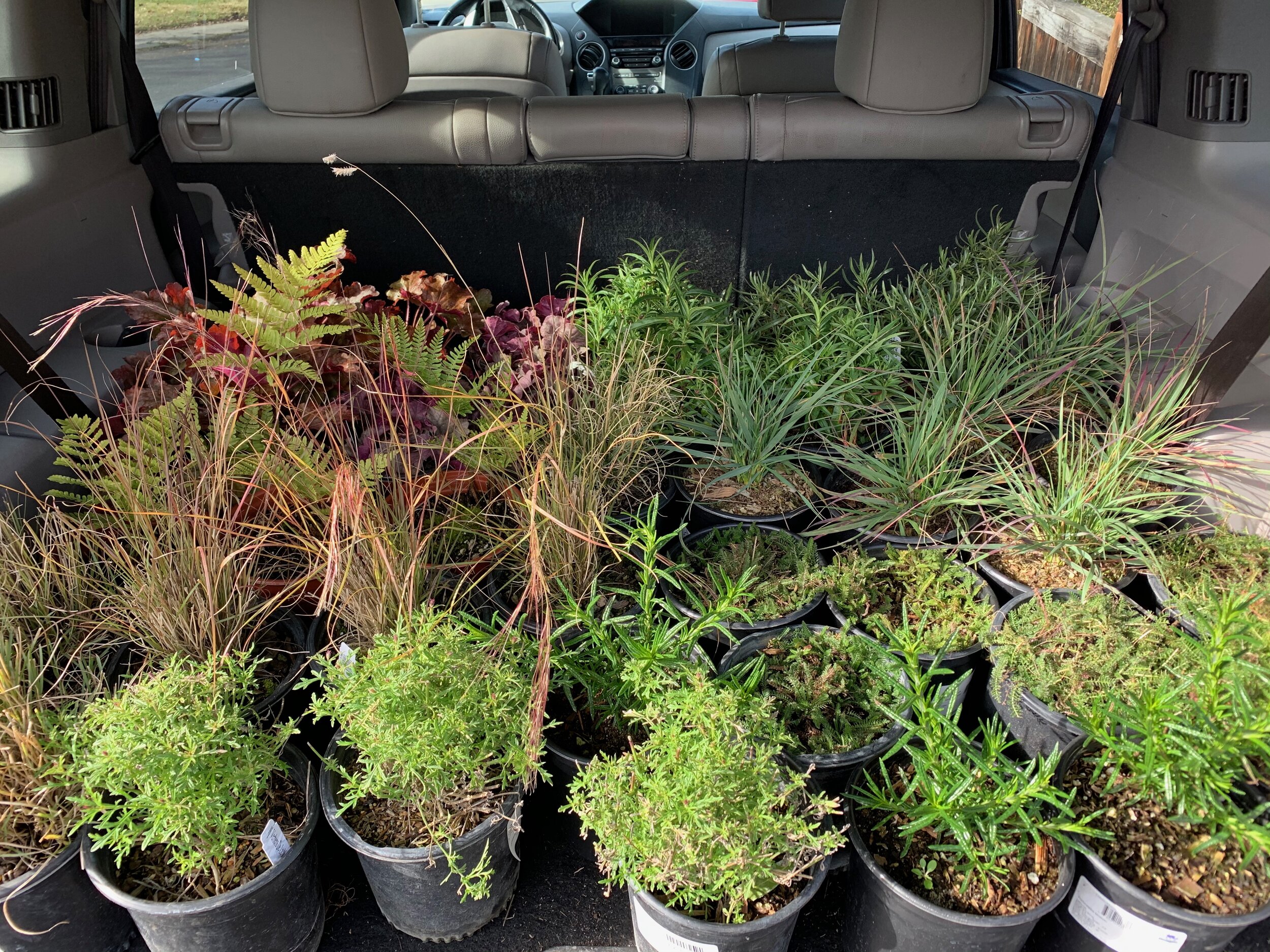
With all that in mind, and with a list of possibilities in hand, I took a trip to a local nursery and came home with a bunch of interesting plants. Not everything I wanted was available in January (natch) but I found some good substitutions, and I will also likely add plants as the space fills in. I got three gallon-sized pots of each variety, mostly. Planting in threes works quite well in any space. If you click on the names of each of the plants below, you will be shown a picture of the plant and how it looks full-sized.

For the shady areas, I chose a fern, Dryopteris erythrosora, as well as two varieties of Heuchera (Coral Bells); Heuchera ‘Stainless Steel’ and Heuchera ‘Peach Flambe.’

In the transition area between shade and sun, I chose native Trichostema lanatum (Wooly Blue Curls).

For the sunny areas, I chose three kinds of grasses, all native: Calamagrostis foliosa (I actually got six gallons of this one), Bouteloua gracilis ‘Blonde Ambition’, and Aristida purpurea (Purple Three Awn).

I chose five different flowers for the sunny areas, with the caveat that I will likely add a few more kinds as they become available. I really wanted some Echinacea (coneflower), Echinops, and Eryngium, but those will be a summer addition. Meanwhile, I have planted Penstemon heterophyllus ‘Margarita BOP,’ Penstemon ‘Midnight,’ Achillea m. ‘Summer Pastels,’ Achillea m. ‘Summer Wine,’ and Verbena lilacina ‘De La Mina.’

IMG_6107.jpeg

Ever since I cleaned up this area after first frost, it has looked rather bereft. Normally I would have seeded poppies and phacelia here right after clearing, but this time I left it empty for the redo. You can see the passion vine, and the redbud tree, and various narcissus, and some forget-me-nots beginning to put out foliage, but what you can’t see are all the salvias and monardellas and hollyhocks and summer bulbs etc that will begin to fill in the space in spring. Still, there are plenty of bare areas to be planted up.

IMG_6109.jpeg

Here is that same area with the 42 gallons of plants in their final locations. I rearranged these several times, but finally decided I was happy and planted them all in. I added grit to the clay soil here, and today I will go in and add some compost as a mulch. Hopefully, everything will ‘take,’ and soon I will have a much fuller and vibrant garden here, which will also be more sustainable. I shall be sure to take pictures and report back!

Tags flower garden, wildlife, pollinators, projects
2 Comments
← Newer Posts Older Posts →

Subscribe

Sign up to get email when new blog entries are made.

We respect your privacy. We're only going to use this for blog updates.

Thank you! Please check your email for a confirmation notice to complete the subscription process.

Powered by Squarespace