• About
  • Blog
  • Contact
  • Favorites
  • Archive
Menu

Poppy Corners Farm

Street Address
Walnut Creek, California
Phone Number
Walnut Creek, California

Your Custom Text Here

Poppy Corners Farm

  • About
  • Blog
  • Contact
  • Favorites
  • Archive

It's Time to Start Pepper Seeds (at least here in California)

January 17, 2021 Elizabeth Boegel
Seeding Tray notes

Seeding Tray notes

I learned just in the last couple of years that it’s best to start pepper seeds long before starting tomato seeds. Tomatoes germinate and grow quickly, so if you sow them in March, they’ll be ready to plant out late April to early May. Peppers take a much longer time to germinate, especially, and their growth is also quite a bit slower. Last winter was the first time I started peppers in January, and we were eating our first ripe red ones by the end of June, early July. Which, in my opinion, is excellent.

IMG_6158.jpeg

My seeding trays fit 50 2x2 inch soil blocks, and I sow two seeds per block, to insure that I’ll get at least one viable seedling of each variety. In about a month, these will probably need to be potted up to 4” containers, and then in March it will be warm enough to take them outside to the greenhouse. That will leave my seeding table empty and available for tomatoes.

*** By the way, I have a ton of seeds left over, some from each year since 2018. If you’d like to grow your own peppers this year, please let me know and I’m happy to give you some seeds. The Johnny’s hybrid seeds, in particular, are a bit pricey, and I would rather have them be used than go to waste.

IMG_6161.jpeg

My seeding setup is quite simple: A table, a towel, a heat mat (for under the tray, to keep things warm for the germination process), and a light - that’s it. The seeds don’t need light until they germinate, but they need heat the entire time. Usually I set this up in our bedroom, but that’s where Tom’s “office” is this year, so I guess the living room will have to do.

We’ve had temperatures a full 20 degrees higher than normal this time of year, and there have already been wildfire starts in southern California, so it’s going to be a doozy of a year. No rain in sight, either. This weather does make us want to be outdoors all the time, so we’ve indulged that craving - getting compost dug and plants side dressed, brewing beer, pruning trees, and of course the ever-present chore of weeding. I used organic rice straw to mulch everything last year, and that was a mistake - I have rice germinating all over the place. However, I also have winter garden seeds germinating too! So that’s a nice side effect of this weather.

Tags vegetable garden, seed starting, peppers
1 Comment

Refreshing a Pollinator Garden

January 12, 2021 Elizabeth Boegel
IMG_0560.jpeg

I spent a happy Monday shopping for, and then installing, about 42 plants in the South Pollinator Garden, in a complete redo of the area.

Originally, this was an area where I planted a few perennials, but mostly annuals. Twice a year, I would clear out the garden and re-seed depending on the season. You can see a late summer example, above, with perennial aster and fennel, and annual zinnas. Not only was this expensive in terms of money (two large orders of seed, twice a year), it was expensive in other ways too; it always took several days of labor, plus a lot of water to germinate the seed - and it caused a lot of soil disturbance, too. On the other hand, it provided a huge amount of biomass for the compost pile, and a ton of nectar and pollen for foraging insects.

But considering the future regarding climate, I am rethinking the way I garden. I feel strongly that the word ‘resilience’ is not just important for me as a person, but also for the ecosystem in our yard. Pollen and nectar, habitat and shelter, are all crucial. But so is a reduction of inputs. And if I am constantly tearing out and replacing, that doesn’t help me or the ecosystem.

image credit: Flower Magazine

image credit: Flower Magazine

Last spring, I became obsessed with the gardens of Piet Oudolf, who designed Manhattan’s High Line, as well as Chicago’s Lurie garden. His gardens are like paintings. He uses a lot of grass and non-flowering plants which provide the effect of a gently undulating sea. Within that sea are bursts of color, which in the autumn turn to seedpods and add a different focus. Every winter, he cuts it all down, and everything regenerates in the early spring.

Of course here in California, this can be recreated; however, our dormant season is in summer rather than winter, and the planting needs to be recalibrated to fit those circumstances. Aso for our climate, which is mainly hot and dry! Using some native plants and grasses would help to ground this painterly garden style in our California reality.

Adding to the complexity of this particular garden space were the current perennials that I wanted to keep. These include a lot of spring-flowering bulbs, some vines, and some Mediterranean plants. Also, there is a small deciduous tree (a Western redbud) which provides shade over a third of the garden in summer. This space is small, about 10x10 feet, and south facing. It is bordered on one side by a sidewalk and the street, which reflects heat and makes the edges of this bed even hotter and drier.

IMG_6106.jpeg

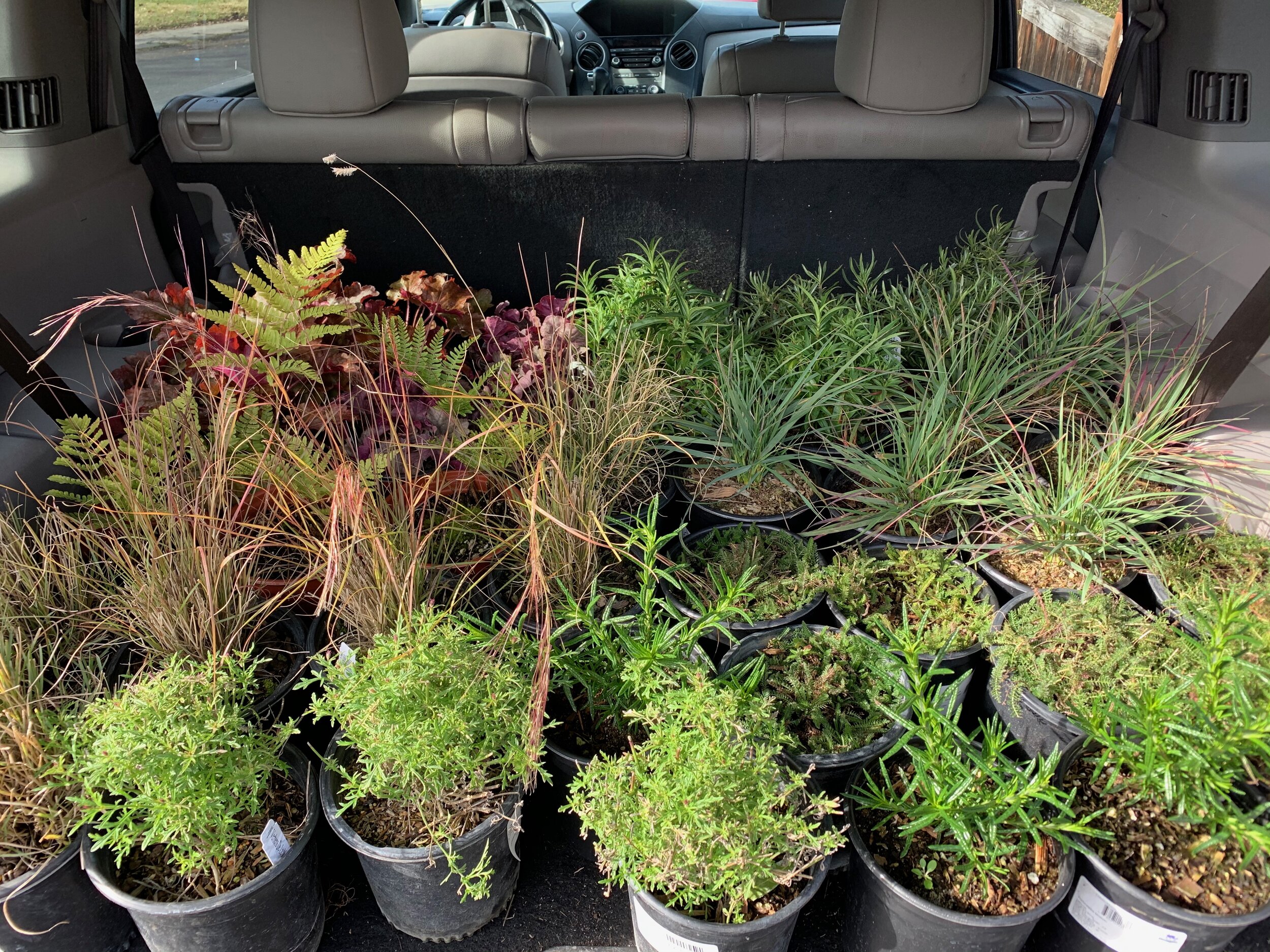
With all that in mind, and with a list of possibilities in hand, I took a trip to a local nursery and came home with a bunch of interesting plants. Not everything I wanted was available in January (natch) but I found some good substitutions, and I will also likely add plants as the space fills in. I got three gallon-sized pots of each variety, mostly. Planting in threes works quite well in any space. If you click on the names of each of the plants below, you will be shown a picture of the plant and how it looks full-sized.

For the shady areas, I chose a fern, Dryopteris erythrosora, as well as two varieties of Heuchera (Coral Bells); Heuchera ‘Stainless Steel’ and Heuchera ‘Peach Flambe.’

In the transition area between shade and sun, I chose native Trichostema lanatum (Wooly Blue Curls).

For the sunny areas, I chose three kinds of grasses, all native: Calamagrostis foliosa (I actually got six gallons of this one), Bouteloua gracilis ‘Blonde Ambition’, and Aristida purpurea (Purple Three Awn).

I chose five different flowers for the sunny areas, with the caveat that I will likely add a few more kinds as they become available. I really wanted some Echinacea (coneflower), Echinops, and Eryngium, but those will be a summer addition. Meanwhile, I have planted Penstemon heterophyllus ‘Margarita BOP,’ Penstemon ‘Midnight,’ Achillea m. ‘Summer Pastels,’ Achillea m. ‘Summer Wine,’ and Verbena lilacina ‘De La Mina.’

IMG_6107.jpeg

Ever since I cleaned up this area after first frost, it has looked rather bereft. Normally I would have seeded poppies and phacelia here right after clearing, but this time I left it empty for the redo. You can see the passion vine, and the redbud tree, and various narcissus, and some forget-me-nots beginning to put out foliage, but what you can’t see are all the salvias and monardellas and hollyhocks and summer bulbs etc that will begin to fill in the space in spring. Still, there are plenty of bare areas to be planted up.

IMG_6109.jpeg

Here is that same area with the 42 gallons of plants in their final locations. I rearranged these several times, but finally decided I was happy and planted them all in. I added grit to the clay soil here, and today I will go in and add some compost as a mulch. Hopefully, everything will ‘take,’ and soon I will have a much fuller and vibrant garden here, which will also be more sustainable. I shall be sure to take pictures and report back!

Tags flower garden, wildlife, pollinators, projects
2 Comments

Refreshing Your Container Plantings

January 7, 2021 Elizabeth Boegel
Freshly seeded pots

Freshly seeded pots

I don’t start school until the 19th, so I allotted this week and the next for specific garden projects. In retrospect, I could not have planned this better - it’s a great way to keep myself from perseverating over the news. We’ve had a slight amount of rain, which allowed the weather to warm up a bit, and being in the garden is exceedingly pleasant as long as I’m wearing a sweatshirt.

IMG_6072.jpeg

My first big job was cleaning up - removing dead plants, clearing out heavy layers of leaves, etc. This is all necessary and important, if not particularly fun. But the last two days I’ve spent refreshing some containers that really needed it.

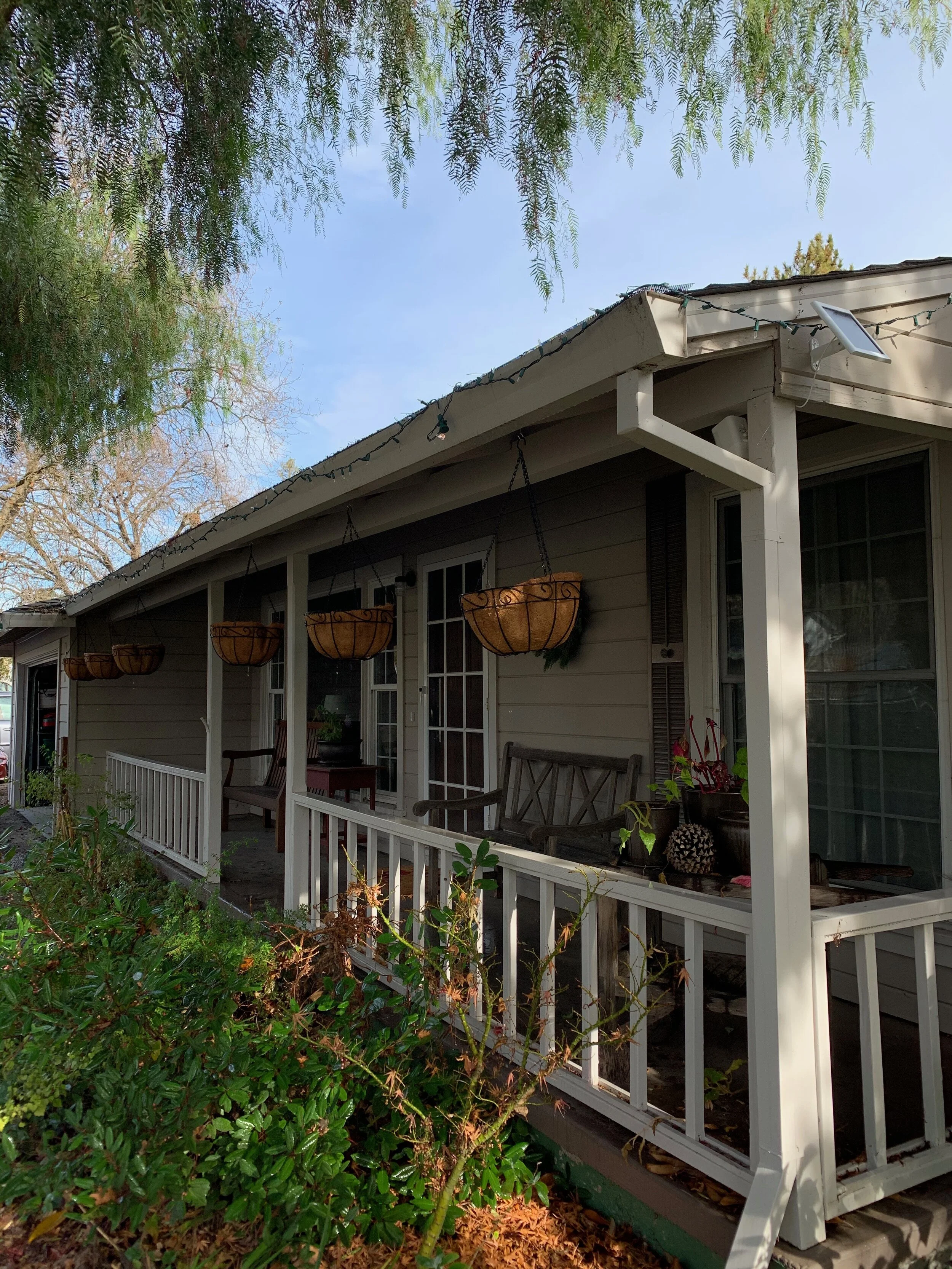
After a year (or more likely, two), hanging baskets tend to look like the one above. The birds have pulled out a bunch of the coir to use in their nests; the plant is clearly senescing and not happy. I have eight of these around the property, so I took out all the old plants, cut them back, and replanted them in the ground elsewhere. They may not make it, but if they do, hey - it’s a free plant in a place I need one! Then I bought new coir liners, filled them with fresh potting soil amended with vermiculite for drainage, and added a little bit of organic fertilizer. All of the pots received a sowing of sweet peas (this is a great time to sow them if you live in a mild climate).

IMG_6074.jpeg

It was also time to refresh our pallet wall planter. This hangs on Adam’s train shed, which is painted white and reflects a lot of heat. It’s south facing and gets full sun all day. Keeping it wet is a challenge, even though we have run a drip line up to the top of it. When we originally planted it, we didn’t make ‘shelves’ under each crosspiece; we just laid it down horizontally to pack it with dirt and plant it, and then hung the thing vertically. Can you guess what happened? Over time, as the soil compressed, it moved down to the bottom where Tom had made one shelf to keep the dirt from falling out. Packing more dirt in was impossible without it falling down, and then out the front. Many, many plants died.

IMG_6080.jpeg

Tom and I took all the old plants out (most of them beyond saving) and all of the old dirt out. Then he made me shelves for each level, so that each level acts like it’s own separate container. He made the shelves out of redwood and drilled drainage holes in them. I poured over my plant books and catalogs, trying to figure out what might work in a very dry, very hot place. Today I went shopping and then planted the pallet with Anthemis sancti-johannis “St. John’s Chamomile” and one of our native Californian Phacelias, Phacelia campanularia “Desert Canterbury Bells,” as well as some succulents that made the cut. The plants at the top are transplants, two of which are Felicia aethiopica “Tight and Tidy” and the others something with silvery foliage and yellow flowers that I can’t remember the name of. Everything looks a bit droopy because I forced them into a narrow, sideways space, and watered them half to death. But I expect they’ll perk up and start to look good in about a month or so. I will definitely keep you posted.

These mild days of winter, here in California, are a perfect time to do small, easily-accomplished projects around the yard, while we aren’t smothered with the spring ‘to-do’s.’ Remember that anything you grow in the ground can be grown in a container, with very few exceptions. All containers need a mix of good potting soil (the best you can afford) mixed with a little homemade compost if you’ve got it, and either grit or vermiculite for drainage. All containers need to be fed regularly, especially in late winter, with the days lengthening and plants starting to put on new growth. If you have container plants that are doing well, it’s still a good time to add compost, sheer back dead or browning leaves, and generally make things tidy before spring arrives.

I shall be sharing some of my other winter projects with you as I accomplish them. I’d love to hear about your list, too!

Tags containers
4 Comments

Word of the Year: Resilience

December 31, 2020 Elizabeth Boegel
Our garden was incredibly productive, up until September. Having more time at home in the spring allowed us to increase our abundance in a big way - more flowers, more fruit, more veg. It also allowed me to do more preserving, earlier in the year. I…

Our garden was incredibly productive, up until September. Having more time at home in the spring allowed us to increase our abundance in a big way - more flowers, more fruit, more veg. It also allowed me to do more preserving, earlier in the year. It looked like a banner garden year for us, and then the extreme heat, massive fires, and thick smoke arrived, virtually killing everything and putting a huge damper on fall and winter gardening. The garden still hasn’t recovered, despite my replanting it no less than five times. I won’t stop trying!

I don’t make New Year’s resolutions - I just don’t really believe that fresh starts have to happen only on some arbitrary day. However, I frequently set goals for myself. Sometimes they take the form of a weekly or daily list, and sometimes they are more substantial, encompassing an entire season or an entire year. If you had asked me what my goals were for 2020, I might have said something along the lines of, “well, I want to have a productive garden, continue my education both formally and informally, support my kids as they move into their college years,” etc etc etc… something fairly vague. All good stuff, but not exactly measurable, with a finite end. Maybe it’s a good thing that I didn’t have goals with closed parameters in 2020 as we were all completely steamrolled by the year. I look back at early March and am amazed by our former naiveté. This thing we felt would be just a little hiccup turned out to absolutely rule our lives for the best part of a year. Despite the swell of encouragement we felt with the arrival of vaccines, it doesn’t look like the hiccup is going to stop any time soon.

For the first couple of months of shelter-in-place, we Boegels were merely existing, trying to come to terms with our new home-based life. I imagine the entire world went through this adjustment, a sort of ‘pause,’ a sort of grieving of things missed, an increase in anxiety, and an uncomfortable dance with the unknown. It was a kind of limbo. At the beginning of June, though, something began to change for our family. I don’t know if it was because we settled in to the situation, or became more accepting of it, or if something bigger happened, but an enormous shift occurred in a very defining way. At the time, I don’t think we even realized it, but looking back on the year, I know that’s when things began to clarify for us. By September, we knew what it was, and we had named it: it was Resilience.

Looking down from a big hill into the Pine Valley canyon in Mt. Diablo State Park. Tom and I have really ramped up our outdoor activity this year, enjoying all the open space that exists within a 10 mile radius of our house.

Looking down from a big hill into the Pine Valley canyon in Mt. Diablo State Park. Tom and I have really ramped up our outdoor activity this year, enjoying all the open space that exists within a 10 mile radius of our house.

This word, resilience, has become a north star for us. The events of this year - the pandemic, of course, but also the Black Lives Matter movement, the unprecedented wildfire and continuing drought in California, and the urgent threat of climate change - crystallized our focus in a new way. I have a feeling we are not alone in this. As Adam said recently, “this year changed everyone, whether they know it or not; for some, it’s a positive change and for others it’s a negative change, but we’ve all changed.” I feel confident that for us, this year has brought us some very positive changes.

It’s hard to talk about positive changes in a year that has been so desperately sad in so many ways. Loss is a constant partner. So much has been lost to us collectively this year - most devastatingly, loved ones, but other things too like personal freedoms, confidence in our government, and defining events such as weddings and graduations. The terrible differences in equity and justice became (rightly) another constant partner, as we opened our eyes and allowed ourselves to really see and understand privilege.

Our family is one of the lucky ones. We have not been sick, we have not had to say goodbye to someone over a computer, Tom’s job has been safe, we are able to pay our bills, we have lived with privilege. Because of those things, we are able to concentrate on the silver linings. We can concentrate on the future. We can think about the way we want our lives to look. We can look ahead to the new year and make some goals.

Rin became very involved in protesting and marching, and learned a lot about civil justice and the power of citizens to make positive change. Through her, Tom and I have also learned a lot about our own attitudes and learned responses and how we can…

Rin became very involved in protesting and marching, and learned a lot about civil justice and the power of citizens to make positive change. Through her, Tom and I have also learned a lot about our own attitudes and learned responses and how we can be better in the future. It’s not often that you get a chance to be confronted by your own belief systems and it is sometimes hard to open your mind and see things differently. Luckily, we were given the opportunity to do that, with our daughter’s help. I think before the events of this summer, Tom and I would have said that we were very aware of civil rights issues and great supporters of the cause. With Rin’s involvement and passion, we saw that we really weren’t, and we have tried hard to listen and learn and improve our awareness and knowledge. This will be an ongoing education.

What does resilience look like, not as a cerebral thing, but practically? I can’t speak to what it might look like for you, but for us, it’s cemented around two specific concepts - health and flexibility.

As far as health is concerned, it has become glaringly clear to us that we need to be as healthy as possible to have the best chance of avoiding (or beating) Covid-19. We also want to age gracefully and well, to have the strength to accomplish anything we want in the garden (or in life!), and to have the stamina to outrun anything the (uncertain) future could throw at us.

We also need to to be flexible - ready to switch gears at a moment’s notice, ready to fend for ourselves if supply chains break down, and ready to move quickly if the situation calls for that. We want to ‘stay frosty,’ as a soldier might say - ready for anything, and strong enough to make the necessary shifts. Flexibility requires fluidity, an ability to stay unstuck - this means we need to be agile not just in the body, but in the mind and emotions as well. We have to be able to process things quickly and decide a course of action without letting fear or worry bog us down.

Conceptually, this is a work in progress and has been for a couple of months now. Our behavior changed before we even had the ability to process it or put it in words. The actions came before the definition, I guess, and the actions began in June, when I started a new, life-changing way of eating. I’ve always been a healthy eater; I like a wide variety of foods, and we cook most of our meals with what we grow in the garden. Despite this, I’ve always struggled with being overweight and never really understood why. I started to hear great things about intermittent fasting, which changes the time you eat rather than what you eat, therefore giving you some control over the hormonal influence of insulin for storing fat. I decided to give it a try. Very quickly it was obvious that it was game-changing. By July, it was so clear that my mood and body were both improving and lightening that Adam decided to try it. By August, Tom was on board. Since then, I’ve lost over 50 pounds, Adam 40, and Tom 25 (Rin is happy with her current health, so during the day she is on her own for meals; this means she is learning to be more independent, which is probably good since college is coming up for her! We still all eat dinner together each night, so that hasn’t changed). We all feel so much better, in body, mind, and spirit. We no longer have the blood sugar swings we used to, which means we are much more even tempered and less irritable. Our brains are sharper, and we get more done. Our bodies have been able to handle increased activity and we are enjoying it tremendously. I even had a yearly physical in which every marker of health was excellent, which I’m not sure has ever happened before!

On the trail

On the trail

Health will be an ongoing, crucial part of our continuing goal to be resilient - it doesn’t stop here. I can’t speak for my kids, but Tom and I both have some concrete, measurable goals in this department, one of which is to never have to start from scratch again. This is a lifestyle change, which means it is a system change. It doesn’t so much limit us as expand us. In fact, we don’t feel limited at all. We still eat all our favorite things, in sometimes very large amounts, just at a specific time of day. Tom still brews and drinks beer. I still make desserts every week (I love dessert). We are still determined to continue to grow, eat, and preserve as much of our own food as we can.

We’ve had some spectacular meals this year, with lots of homegrown produce, preserves, and delicious baked goods. Dinner has become even more important to us as a family. We found that being under shelter-in-place orders gave us the gift of time tog…

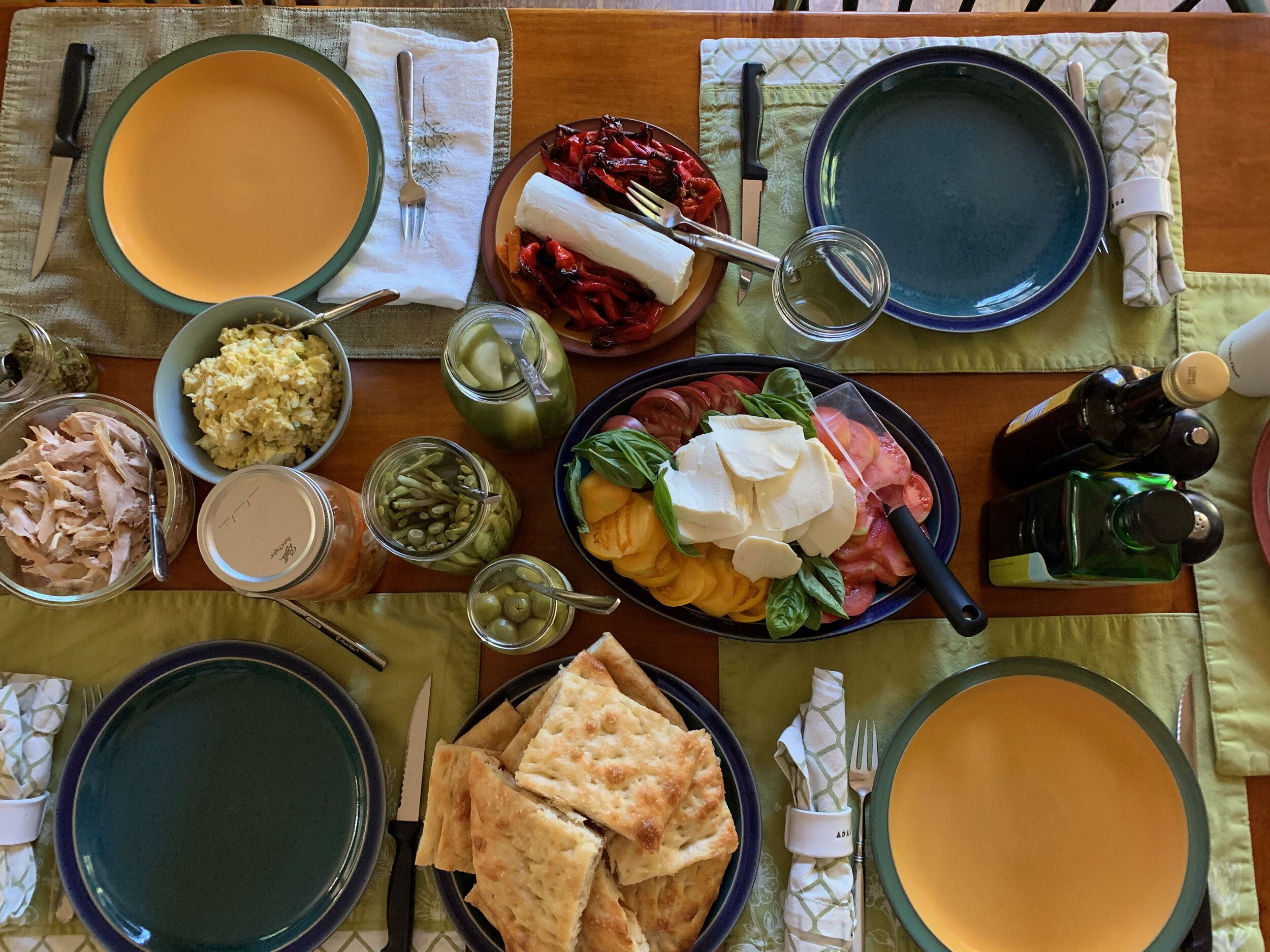
We’ve had some spectacular meals this year, with lots of homegrown produce, preserves, and delicious baked goods. Dinner has become even more important to us as a family. We found that being under shelter-in-place orders gave us the gift of time together. As those of you with older children can attest, this is usually difficult to come by; but this year, we got to spend enormous amounts of time with our young adult children, which allowed us to know them in a deeper way.

Speaking of growing food, that item comes under the other part of resilience, which is flexibility. What a strange gardening year this has been. It started out iffy, as we didn’t receive the amount of rain we usually do in California (‘usual’ being an increasingly irrelevant term). We were dry, dry, dry. But when Covid hit, we suddenly had more time at home to garden, and as a result, things looked fantastic. I improved many ornamental areas with new perennials and planted tons of veg, while Tom made new trellises for me. We had a bumper summer crop, and because we weren’t able to do our usual summer traveling, we were home to eat and preserve all of it. The bounty didn’t last, however, as extreme temperatures took over, and the garden began to shrivel. Then the wildfires started; we had months of choking smoke and ash-filled air along with the now-famous orange skies of late summer and early fall. The garden tanked. Since then, I’ve planted the winter garden five times, with very little luck, even though I’ve applied a record amount of homemade compost. We’re still dry, very behind in our precipitation amounts, and we still have our rat problem (though it’s getting better) as well as hungry birds who eat everything I plant. I’ve resorted to bird netting over every bed, though I hate it, and one of two things is going to happen once the garden warms up: Either I’ll end up with nothing, or the millions of seeds I’ve planted over the past five months will explode in a riot of food. The latter would be awesome. I suppose I could chalk all this up to an exercise intended to increase my flexibility, and I guess it is that, but in a way that’s maybe not so satisfying.

IMG_5298.jpeg

Buying five complete sets of seeds doesn’t seem resilient to me. Going all winter without home grown food is definitely not resilient. What’s my plan B, if this happens again? Do I have a local farmer with a CSA in my back pocket, ready to provide so I don’t have to rely on the stores? Home-delivered pastured, grassfed meat seems important. For that matter, so does local, home-delivered coffee, not to mention bamboo toilet paper on subscription.

Looking around our property with new eyes, there are all kinds of practices that don’t allow for flexibility or resiliency. Watering when the skies don’t provide? Maybe a compromise: Water the food, but don’t water the flowers, or at least not so frequently. It’s time to change our ornamental planting scheme. Relying on PG&E when the winds pick up? Foolish, as power shut-offs are now de rigueur. It’s time to figure out solar power and battery backup, ASAP.

Maybe it’s a stretch, but this sort of thinking is needed for our emotional lives, too. What keeps us emotionally and mentally resilient, even in hard times? How did people do it during years of war? We figure that by focusing on our priorities, hunkering down with family, cultivating close friendships, showing compassion to those who have less, and remaining grateful and mindful, we can stay strong. This was a hard, depressing year, and I believe all of us are experiencing a sort of low-grade, chronic anxiety, which can interrupt sleep, cause us to reach for comfort foods (usually with high sugar content), and generally rely on crutches of all kinds. Stress-reducing activities have helped us all so much. Gardening is definitely one of those, as well as outdoor exercise and getting as much sun (even if it’s cold winter sun) and fresh air as possible. Nutrient-dense foods have been crucial. We’ve downloaded the “Calm” app and are listening to sleep stories every night as we relax and fall asleep, and we’ve begun using our Apple Fitness to guide us in everything from yoga to weight lifting. I’m sure we’ll find more ways to help us manage worry and anxiety, and if you have some ideas, we’d love to hear them.

We are lucky to live in a place where there is a generous regional park system, which constantly gives us new walks with fresh views.

We are lucky to live in a place where there is a generous regional park system, which constantly gives us new walks with fresh views.

So for us, resilience was the focus for 2020, and it is our continuing goal (not resolution!) for 2021. It’s possible that 2021 will surprise us even more than this year did, but I imagine our goal will stay the same even so. I am reminded of a Ha Jin poem, which says “You must hold your distant center./Don’t move even if earth and heaven quake.” Hold the center, friends. And I wish you the happiest of Happy New Years.

7 Comments

Happy Holidays!

December 23, 2020 Elizabeth Boegel

Hello friends,

I have not written for several months now, not for lack of desire or interest, but just because I got so busy; my workload at school increased quite a bit! I did not want to let this holiday pass by without sending you our very warmest wishes. Tom and I are so grateful for you, and for your attention to our little garden, and to our adventures here. We feel as though you are family. We hope you are all safe, healthy, with plenty of good food to eat, and with some family or friends close by in your ‘bubble.’ Have a very merry yuletide! Here’s to a new year with more garden and nature discoveries!

Cheers, Elizabeth

IMG_4487.jpeg


4 Comments
← Newer Posts Older Posts →

Subscribe

Sign up to get email when new blog entries are made.

We respect your privacy. We're only going to use this for blog updates.

Thank you! Please check your email for a confirmation notice to complete the subscription process.

Powered by Squarespace